
STEADI: Intervene
How to Stay Safe and Connected at Community Events
Fear of falling shouldn't keep an older adult from community events. A short before–during–after routine — from footwear and medication timing to crowds and curb cuts — makes outings manageable, and staying socially connected is itself a documented fall-prevention strategy.
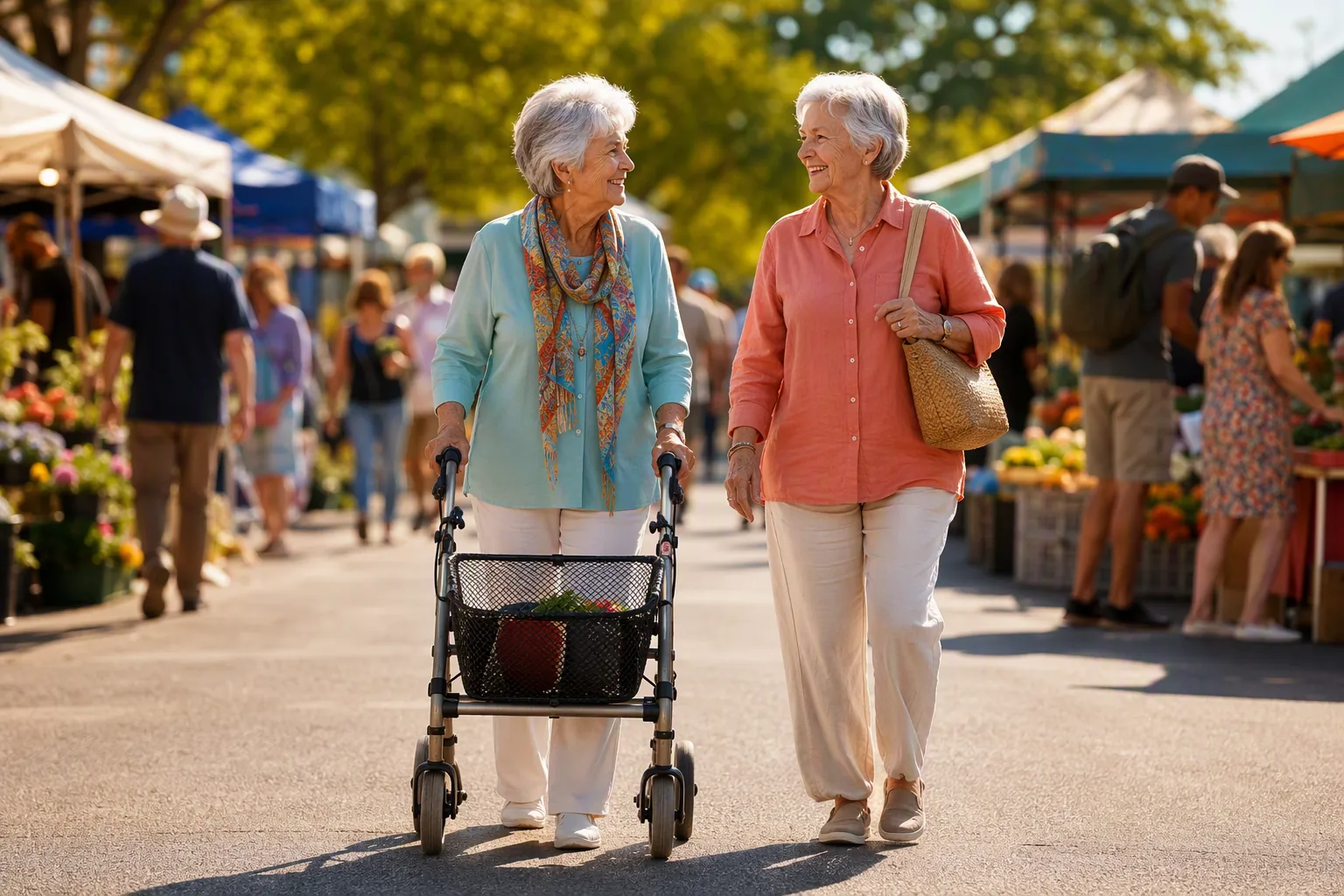
The event flyer is on the refrigerator: farmers market, church supper, summer concert, senior-center lunch, neighborhood festival. The question is not only “Do I want to go?” It is also “Will the parking be a mess? Will I have to stand too long? Is the pavement uneven? What if I get lightheaded in the crowd?”
Those are sensible questions. More than 1 in 4 older adults falls each year, and falls lead to about 3 million emergency department visits for fall injuries and about 41,000 deaths each year in the United States.[1] Planning is not fussing. It is how older adults can stay safe and connected at community events without turning every outing into a medical project.
Staying home every time an outing feels uncertain may look safer for a day, but withdrawal has its own cost. The National Council on Aging describes social activity as part of fall prevention because connection helps support movement, balance, mobility, and spatial awareness, while reduced activity can weaken muscles and increase fall risk over time.[2] One event does not cancel out medication side effects, poor lighting, loose shoes, or a slick curb. But a repeatable outing routine can keep community life from shrinking unnecessarily.
This article is for prevention and planning. It is educational, not medical advice. If you have had repeated falls, fainting, new dizziness, a recent medication change, or a condition that affects walking or balance, use this routine alongside guidance from your clinician.
A community event has different fall risks than a living room
Home hazards get a lot of attention: rugs, bathroom floors, dark hallways. But active older adults do not live only inside. A CDC/NEISS analysis of fall-related emergency department visits found that, among visits with a known fall location, 28.4% happened outdoors. The share was higher among adults ages 65 to 74, at 41.2%.[3] That does not mean every outdoor event is dangerous. It means the sidewalk, parking lot, curb, portable restroom path, grass edge, folding-chair row, and crowd movement deserve a plan.
The useful plan is short enough to repeat: check yourself before leaving, choose the easiest route on purpose, move through the event without rushing, and notice afterward what needs to change next time.
| When | What to decide |
|---|---|
| Before leaving | Medication timing, shoes, vision needs, weather, phone, emergency information, mobility aid, and whether to bring a walking partner. |
| Getting there | Where to park or be dropped off, which entrance has the fewest curbs or stairs, and where you can sit before you are tired. |
| At the event | How to move through crowds, where to find shade or shelter, which surfaces to avoid, and when to take a break. |
| Afterward | Whether there was a stumble, dizziness, new pain, or a confidence problem worth discussing before the next outing. |
Before you go: make the outing easier before the first curb
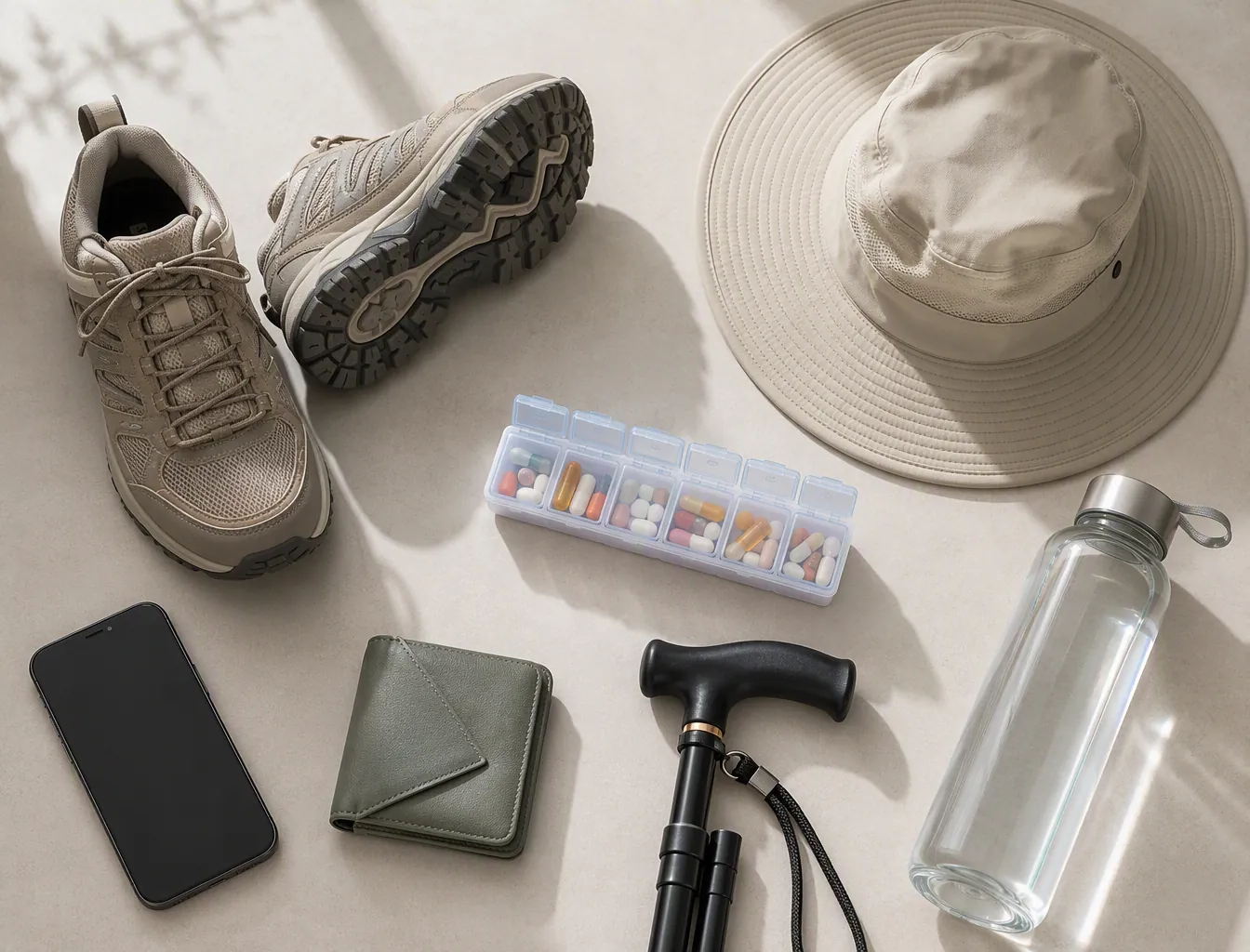
Most event safety is decided before the car door closes. Not by worrying harder, but by removing the predictable annoyances: the shoes that slide, the pill that makes standing in line a bad idea, the phone with 12% battery, the cane tip that has worn smooth, the glasses left on the kitchen counter.
Check medication timing, not just the medication list
A medication can be perfectly appropriate and still make an outing harder at a particular hour. Mayo Clinic notes that several medicine groups can increase fall risk in older adults by causing dizziness, sedation, or blood-pressure drops, including sedatives, antidepressants, antipsychotics, antiepileptics, muscle relaxants, NSAIDs, and opioids.[4]
Before a long event, ask a practical question: “Is this the time of day when I usually feel lightheaded, sleepy, unsteady, or rushed to the restroom?” If the answer is yes, that does not automatically cancel the outing. It may change the plan: arrive later, sit during the opening music, choose a shorter visit, eat before taking a dose if your clinician has told you to do so, or ask your clinician whether the timing of a recurring side effect should be reviewed.
Do not skip or rearrange prescribed medications just to attend an event unless your clinician has instructed you to. The safer habit is to recognize when a dose and a crowded, hot, standing-room-only setting do not pair well.
Wear the shoes that behave, not the shoes that match
Outdoor events punish small compromises. Thin soles feel every pebble. Loose slip-ons catch at the heel. Dress shoes that are fine for a restaurant floor can be wrong for grass, gravel, wet pavement, or a sloped parking lot.
NCOA’s neighborhood fall-prevention guidance recommends flat shoes with firm rubber soles for outdoor walking.[5] That is a plain standard and a good one. If the event involves weather, check the soles again. For cold-weather gatherings, review cane tips, boot tread, and ice plans in our winter safety guide for seniors living alone. For wet events, use the same thinking in our guide to preventing falls in heavy rain.
Treat vision as part of the route
A farmers market is full of visual clutter: tent legs, cords, baskets, curb edges, chalk signs, children moving fast, dogs on leashes. NCOA recommends yearly eye checks and notes that vision problems can double fall risk.[5] If you use distance glasses, sunglasses, or a brimmed hat to manage glare, put them with your keys rather than trusting yourself to remember at the door.
If you have started missing curb edges, bumping into low objects, hesitating in dim rooms, or struggling with glare, review the signs of vision loss in older adults before assuming the problem is simply “getting older.”
Pack the small safety kit
The kit does not need to be dramatic. It needs to be present:
- A charged phone.
- Emergency contact information.
- Current medication list or medical ID information.
- Glasses, hearing aids, or other everyday supports.
- Water, especially for warm outdoor events.
- A light layer, hat, or rain protection when the forecast is uncertain.
If you use an iPhone, set up Emergency SOS and Medical ID before you need them; our guide to iPhone safety features for seniors walks through that setup. For people who live alone or depend on a support network, the same “leave prepared” habit appears in our severe weather preparedness checklist for older adults.
Decide on the walking partner or mobility aid before pride gets a vote
Some people are comfortable using a cane, rollator, or walking partner on ordinary days and suddenly resist at a public event. That embarrassment is real. It is also worth naming ahead of time, because the middle of a crowd is a poor place to negotiate with yourself.
Harvard Health recommends using a rollator or a companion’s arm in crowds, noting that a rollator can provide stability and also signal to others to give space.[6] That second part matters. In a crowd, a visible support can do what quiet politeness often cannot: create a small buffer before someone backs into you or cuts across your path.
If you bring a cane, walker, rollator, or wheelchair, give it a quick inspection: tips, brakes, wheels, seat, handles, and anything that folds or locks. Our wheelchair safety checklist is written for wheelchairs, but the habit carries over: a mobility aid should not add a new problem on the way to solving the old one.
Getting there: choose the boring route
The best route to an event is often not the shortest. It is the one with the fewest decisions under pressure.
Park close when you can, use a drop-off area if that is safer, and avoid squeezing between parked cars. Harvard Health specifically recommends parking close, avoiding tight spaces between cars, and using elevators instead of stairs when available.[6] None of that is special treatment. It is route design.
Before you step away from the car or drop-off spot, pause and scan. NCOA recommends looking ahead for cracks, holes, and uneven areas, and using curb cuts and handrails.[5] At an event, that scan should include temporary hazards too: cable covers, tent stakes, grass-to-pavement transitions, wet leaves, mulch, loose mats, stroller traffic, and folding chairs that have migrated into walkways.
A walkable downtown or town square can make this easier when crossings, sidewalks, benches, curb cuts, and visible destinations are designed well. If you are choosing between two community outings, our article on what seniors gain from a walkable downtown offers a useful way to think about sidewalks, crossings, and rest stops before you commit.
At the event: move like you have a right to take up space
Crowds make people drift. The safest person in the crowd is often the one who does not drift with it. Pick the edge of the flow, the smoother side of the path, the route with the handrail, the curb cut instead of the curb, the elevator instead of the stairs, the open aisle instead of the shortcut between chairs.
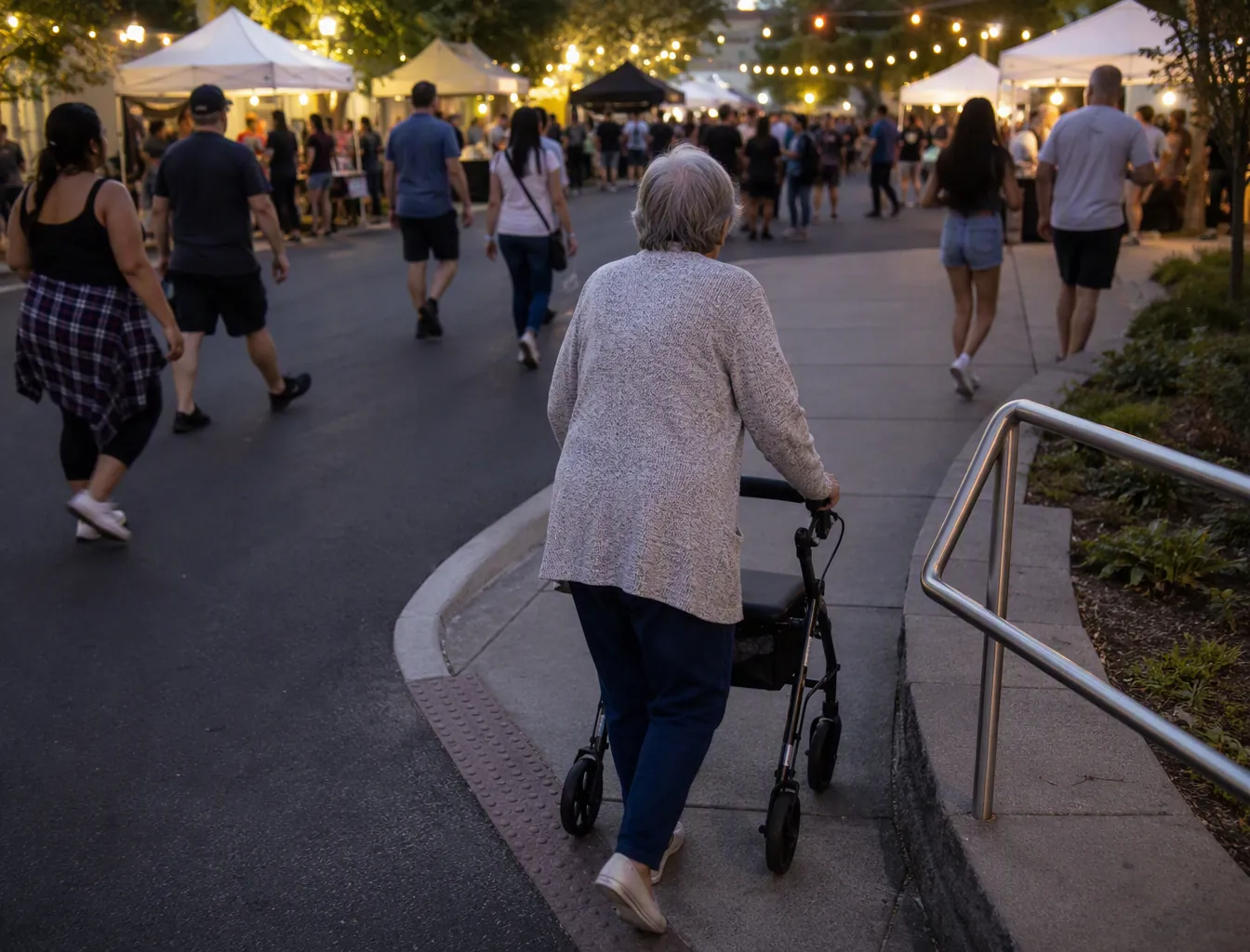
If you use a rollator, do not apologize for the space it takes. If you walk with a friend, agree on the arrangement before entering the thickest part of the crowd: arm-in-arm, side-by-side, or one person slightly ahead to spot obstacles. The helper’s job is not to tow or steer like a cart. It is to help choose a stable path and slow the pace before fatigue turns into wobbliness.
Look for accessible-event basics
Temporary events are not excused from common-sense access just because they are temporary. ADATA’s planning guide for accessible temporary events describes features such as accessible routes at least 36 inches wide, ramps with a 1:12 slope, at least 5% of portable toilets accessible when portable toilets are provided, and shelter when temperatures are above 80°F or below 50°F.[7]
As an attendee, you should not have to memorize specifications. But you can look for the practical signs: Is there a wide route that does not force people through mud or gravel? Is the ramp usable without a steep shove? Is there an accessible restroom near the event area? Is there shade, cooling, warming, or indoor shelter when the weather calls for it? If an event map or volunteer cannot answer those questions, that tells you something about how carefully the outing needs to be planned.
Sit before you have to
A seat is not a surrender. It is a reset. At an outdoor concert, sit through the opening remarks instead of standing because everyone else is standing. At a senior-center meal, choose a chair with a clear route to the restroom rather than the chair that traps you behind a table leg and three purses. At a market, use a bench before the return walk, not after your legs are already shaking.
Heat and dehydration can turn a manageable walk into a lightheaded one. For summer events, pair the outing plan with a senior heat safety checklist or our guide to elderly heat wave safety. The decision may be as simple as attending in the morning, sitting in shade, bringing water, or leaving before the hottest part of the program.
Let the crowd pass
The riskiest moments often happen when everyone moves at once: after the prayer, after the raffle number is called, when the music ends, when food is served, when rain starts. You do not need to beat the crowd. Wait thirty seconds. Let the line thin. Step to the side where you can see the ground. Then move.
If a route has become crowded, wet, dark, or blocked, change routes instead of trying to prove the original plan was fine. Independence is not measured by taking the difficult path. It is measured by getting yourself where you meant to go with enough steadiness left to enjoy being there.
If there is a stumble, do not hide it
Many older adults do not tell a clinician when they fall. NCOA reports that fewer than half tell their doctor.[8] That silence is understandable, especially when the fall feels embarrassing or when someone worries it will trigger restrictions. It is also unhelpful. A stumble may point to a medication problem, vision change, blood-pressure issue, footwear problem, balance change, or event hazard that can be corrected.
Do not try to sort out warning signs from memory at the event. If there is a fall with a head hit, new pain, dizziness, weakness, confusion, unusual symptoms, or any concern in the next 24 to 72 hours, use our crisis-path guidance on the 24–72-hour watch window after a fall and contact medical help as appropriate.
After you get home: keep the lesson, not the fear
The last step is small and easy to skip. Before the day turns into memory, name what worked and what did not.
- Was the parking or drop-off point close enough?
- Did the shoes grip on the actual surfaces?
- Was there a time of day when medication side effects, fatigue, heat, or hunger made balance worse?
- Was the rollator, cane, wheelchair, or walking partner useful in the crowd?
- Did you know where to sit, use the restroom, and leave without rushing?
- Did the outing make you more confident, or did it reveal a risk to discuss with a clinician?
Write down one change for next time: different shoes, earlier arrival, a closer entrance, a walking partner, a rollator instead of a cane, a shorter stay, a shaded seat, a call to the organizer, or a medication review. The purpose is not to make community events risk-free. The purpose is to make the predictable risks visible and small enough that connection stays part of fall prevention.
References
- “Facts About Falls.” Centers for Disease Control and Prevention.
- “How Do Social Activities Prevent Falls in Older Adults?” National Council on Aging.
- “A Descriptive Analysis of Location of Older Adult Falls That Resulted in Emergency Department Visits in the United States, 2015.” PMC.
- “Medicines that increase fall risk in older adults.” Mayo Clinic.
- “5 Steps to Avoid Falls in Your Neighborhood.” National Council on Aging.
- “Protect yourself from falls outside the home.” Harvard Health.
- “A Planning Guide for Making Temporary Events Accessible to People with Disabilities.” ADA National Network.
- “Get the Facts on Falls Prevention.” National Council on Aging.
Related reading
Noticed something outdated or inaccurate on this page? Flag a correction. We review every report against CDC, NIA, and AARP HomeFit guidance before updating a page.
Part of the Fall Prevention section.