
STEADI: Assess
Parkinson's Fall Warning Signs and When to Act
Advancing Parkinson's sends warning signals a caregiver can see at home — freezing at doorways, shuffling or festinating steps, dizziness on standing, and the first actual fall. Learn what each sign means for fall risk, when to raise it with a clinician, and what to do in the first minutes after a fall.
This guide is for caregiver education and home-safety planning. It is not medical advice, and it cannot tell you whether Parkinson's has advanced, whether a medication should change, or whether a symptom has one cause. Use it to decide what to observe, what to change at home, and what to bring to the clinician.
When you're caring for an older parent with Parkinson's, the useful starting point is often not a disease stage. It is the moment your parent pauses at the doorway, takes several tiny steps before turning, grabs the dresser on the way to the bathroom, or sits down abruptly after standing. Those details matter because falls are common and consequential in Parkinson's: the Parkinson's Foundation says about 60% of people with Parkinson's fall each year, and two-thirds of those who fall do so more than once in that year.[1]
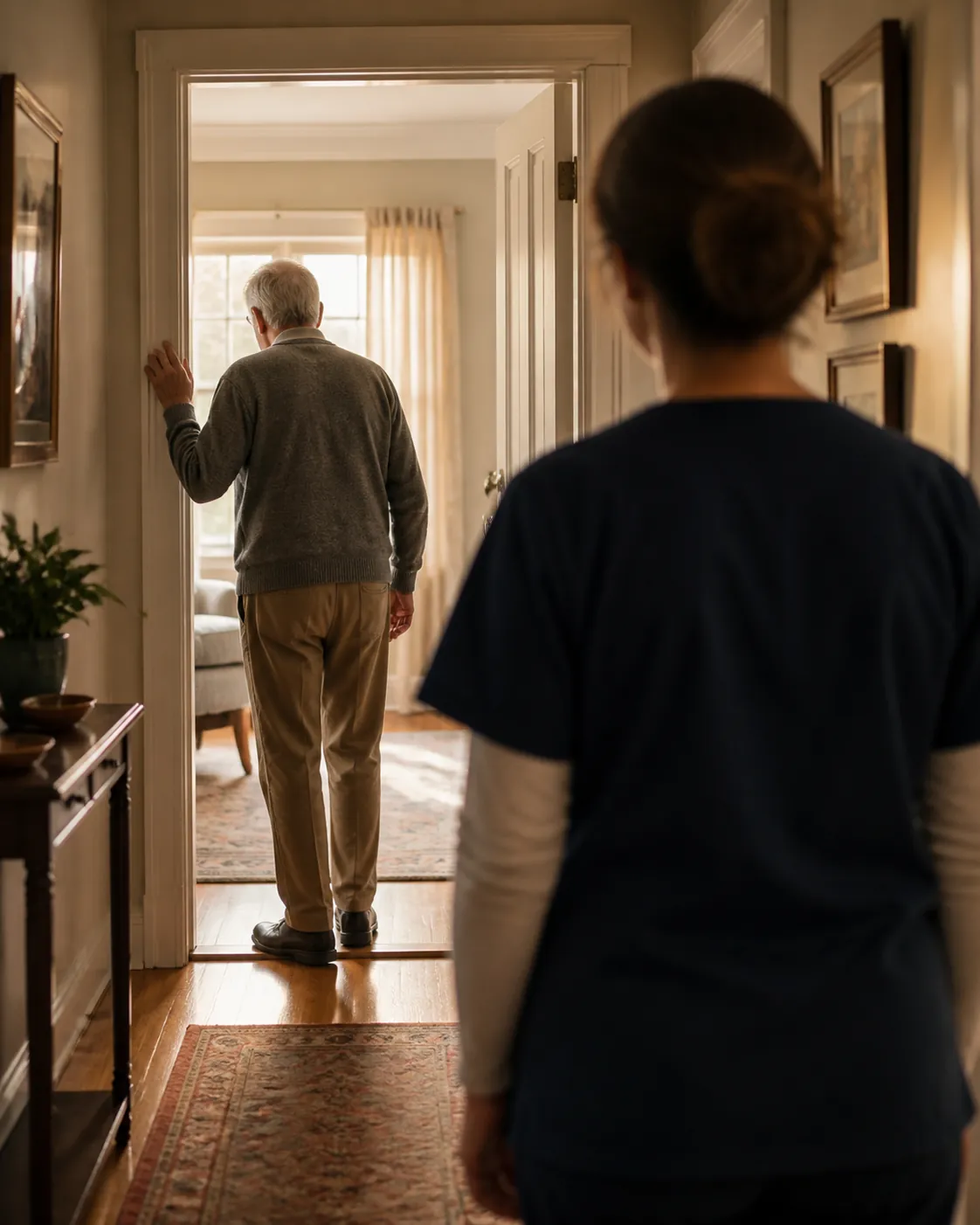
The goal is not to predict every fall or turn one bad day into proof of decline. The goal is to make the next appointment more useful and the next walk across the room less risky. A caregiver can do that by naming the behavior, writing down where and when it happens, making the immediate home adjustment that fits the situation, and knowing when the event belongs with the care team or with emergency services.
Start with the changed task, not the label
A useful observation sounds ordinary: “Dad froze at the bathroom doorway twice this week,” “Mom speeds up in tiny steps when she turns toward the recliner,” or “He gets lightheaded after standing from the kitchen chair.” That is more actionable than “he seems worse,” because it gives the family and clinician a place to look.
| What you see | What to write down | What to change now | What to raise with the care team |
|---|---|---|---|
| Freezing at a doorway, turn, narrow space, or chair approach | Location, time of day, whether it happened before the next medication dose, and whether there was a near-fall | Clear the route, improve lighting, remove threshold clutter, and avoid rushing the turn or transfer | Ask whether the freezing pattern, medication timing, gait support, or therapy plan should be reviewed |
| Shuffling or festinating steps | Where the steps start, whether the person speeds up, and whether they can stop safely | Shorten risky walking routes and remove loose rugs, cords, and obstacles | Ask whether gait, assistive equipment, or physical therapy should be reassessed |
| Balance loss during turns, standing up, bending, or transfers | Which movement caused the loss of balance and what the person reached for | Check chair height, bathroom transfers, lighting, and grab-bar needs | Ask whether transfer technique, strength, vision, or equipment fit needs evaluation |
| Dizziness or faintness after standing | Position before symptoms, timing, fluids or meals if known, and whether there was a fall or near-fall | Have the person sit back down safely and avoid walking while lightheaded | Raise it promptly; medication and blood-pressure review may be needed |
| Unsafe attempts caused by confusion, poor judgment, or rushing | What the person tried to do and what cue or situation triggered it | Reduce the chance of unsupervised risky transfers where possible | Discuss cognitive, judgment, sleep, and safety changes with the clinician |
1. Freezing of gait: the pause that changes the whole route
Freezing of gait is one of the clearest fall-warning signs a caregiver can see at home. It may look as if the person's feet are briefly stuck to the floor while the upper body is ready to move. The Parkinson's Foundation describes freezing episodes as typically lasting 1 to 30 seconds and clustering around turns, doorways, narrow or congested paths, and the approach to a chair.[2]
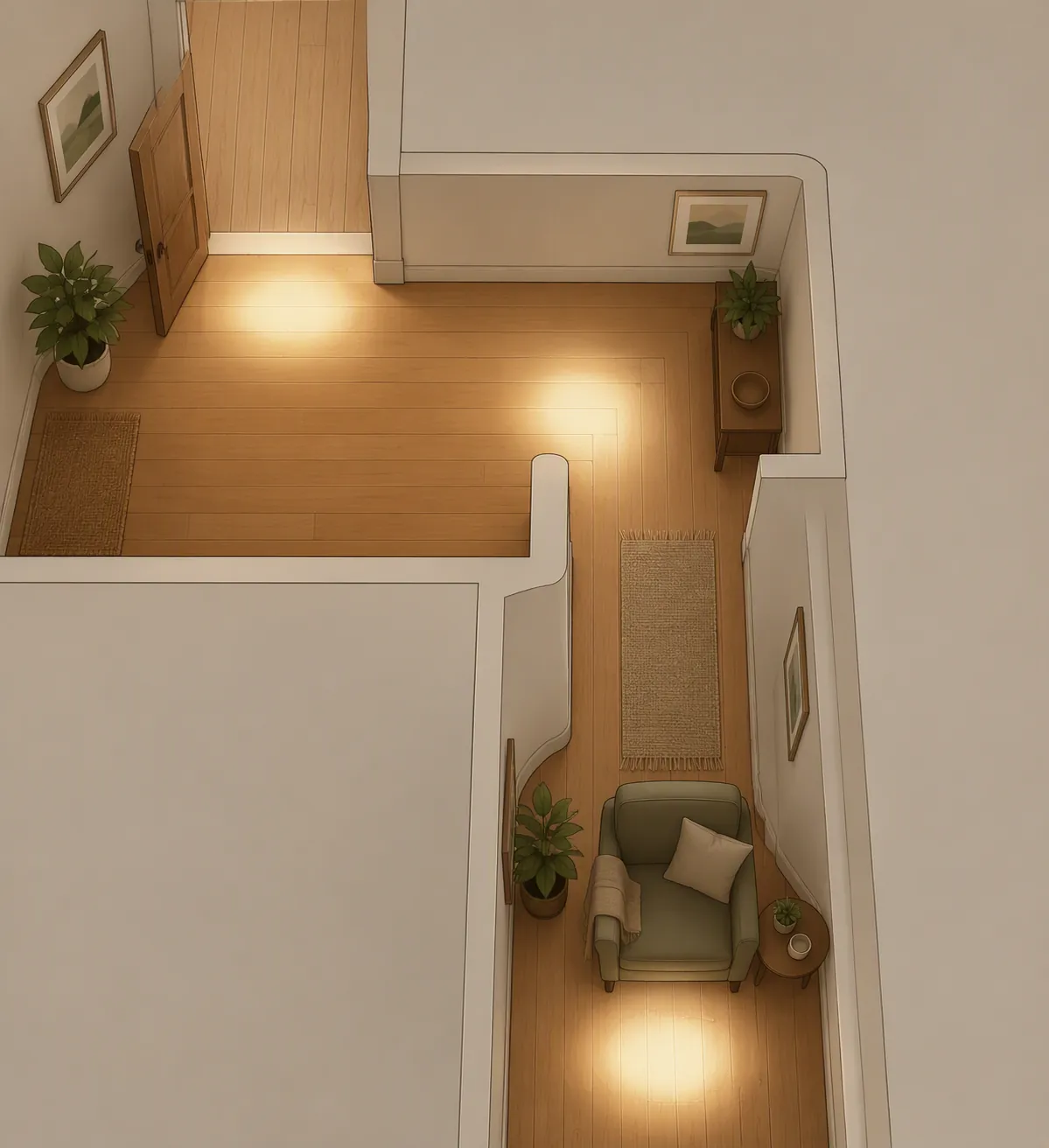
Those locations are not random. Doorways create a threshold. Turns require the body to rotate and step at the same time. Narrow spaces leave little room to recover. A chair approach adds a second task: walking must become turning, backing up, reaching, and sitting. If freezing appears mostly in one of those places, the first home response is to make that place easier to pass through.
- At a doorway: remove shoes, baskets, loose mats, and cords from both sides of the threshold; check that lighting does not create a shadowed strip across the floor.
- At a turn: widen the path if furniture forces a tight pivot; keep the route consistent so the person is not surprised by moved objects.
- Near a chair: leave enough open floor in front of the chair for a slow approach and a controlled turn; avoid placing side tables, ottomans, or oxygen tubing where feet must step.
- In the bathroom: treat freezing near the toilet, shower, or sink as a transfer warning, not just a walking issue.
For a broader home-route check, use the same practical mindset as a home modification review: clear the path first, then decide whether a fixture or equipment question needs professional input. Bathroom changes deserve particular care. A towel bar is not a safety grab bar; if transfers are becoming unstable, review grab-bar safety and consider whether a fuller home safety walk-through would help you spot route problems before another near-miss.
Freezing is also worth tracking because it is strongly represented in fall research, though the numbers should not be mashed into one universal risk. The Parkinson's Foundation says roughly 80% of Parkinson's falls are attributed to postural instability and freezing episodes.[1] A 2023 review, citing a prospective analysis of 2,043 falls, reported that 61% were freezing-related; the same review notes that people with Parkinson's fall on average 4 to 6 times per year, with higher frequency among those who freeze or walk slowly.[3]
The practical question for the clinician is specific: “We are seeing freezing at the bathroom doorway and when approaching the recliner, often late morning. Could this pattern be related to gait, medication timing, equipment fit, or therapy needs?” That is different from changing medication on your own. Medication timing is a clue to report, not a dosing plan.
2. Shuffling or festinating steps: when walking stops looking controlled
Shuffling steps can be quiet enough that the family first notices the sound: feet brushing the floor instead of lifting cleanly. Festinating steps look different. The person may take small, quick steps and appear pulled forward, as if the feet are trying to catch up with the body.
Both patterns matter most when they change a familiar task. A shuffle across an open hallway is concerning; a shuffle while turning into the bathroom at night is more immediately useful to document because it names a higher-risk route. The Parkinson's Foundation notes that people with Parkinson's fall most often during turns, bending forward, standing up, initiating walking, or avoiding an obstacle.[1]
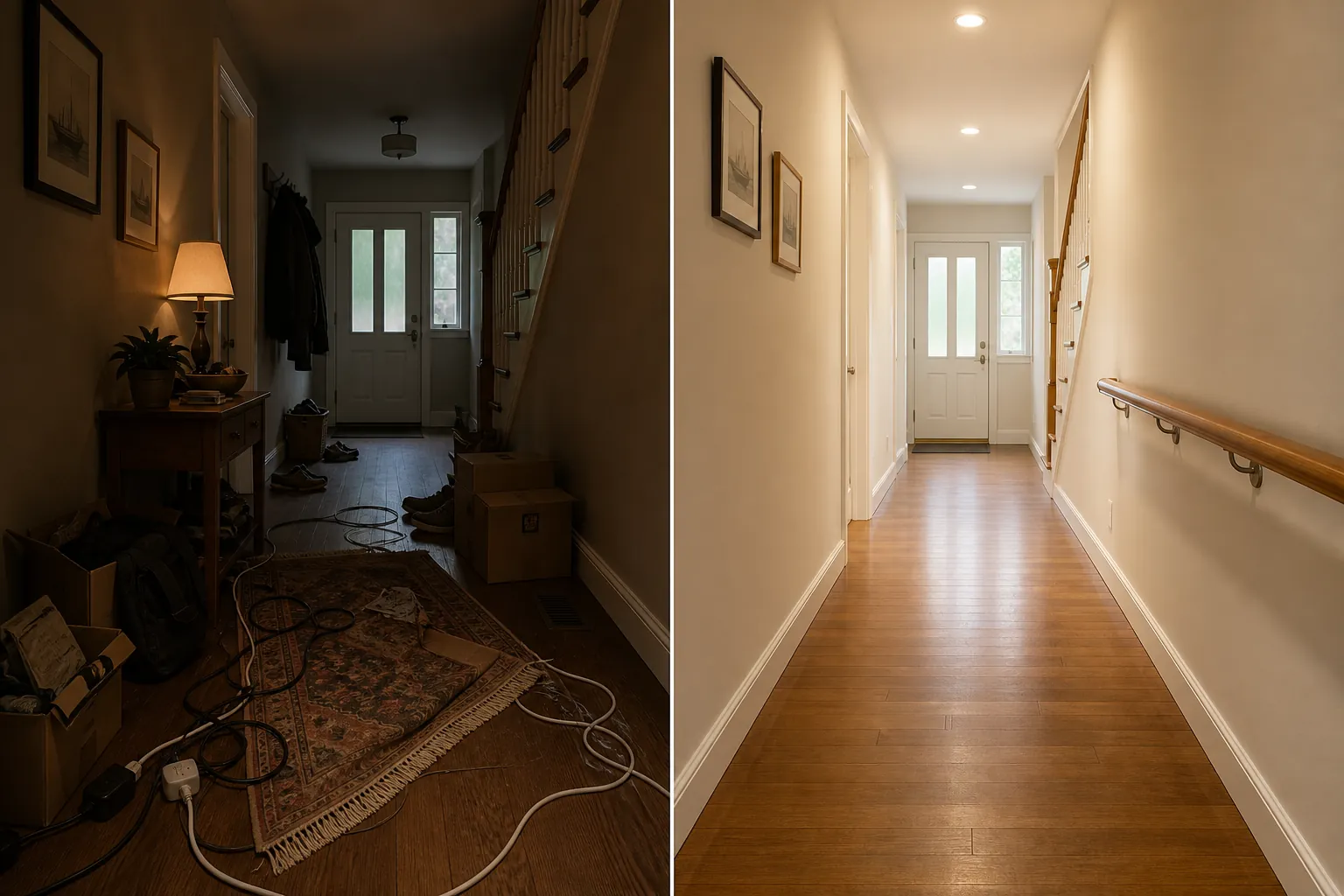
The home adjustment is not complicated: reduce the number of obstacles that require last-second decisions. Loose rugs, cords, low stools, pet bowls, and clutter near turns all ask the person to adapt while already walking less steadily. Good lighting matters most where the task changes: bed to bathroom, hallway to doorway, kitchen chair to sink, and recliner to walker or cane.
Call the clinician's office or send a message when shuffling or speeding steps are new, increasing, connected to near-falls, or showing up during a predictable part of the day. If an assistive device is already being used, this is also the point to ask whether its fit, height, or type should be reassessed by a professional rather than improvised at home.
3. Balance loss during turns, standing, bending, and transfers
A near-fall during a turn tells you more than “balance is worse.” It tells you which movement failed. Did your parent turn too quickly toward the chair? Bend forward to pick up laundry? Stand before fully steady? Step around an obstacle and then lose alignment?
Write down the movement and the recovery. “Reached for the towel bar,” “fell backward onto the bed,” “grabbed the door frame,” and “sat down suddenly” are useful details. They show whether the risk is mostly in walking, turning, transfer setup, bathroom layout, or standing balance.
This is where bathroom and chair checks become more important than general decluttering. Look at the places where the person changes position: toilet, shower, bed, recliner, dining chair, car seat, and the first steps after standing. If they are reaching for furniture or towel bars, treat that as a signal that the environment is being used as emergency equipment. It may be time to ask about proper grab bars, chair height, toilet supports, shower seating, or mobility guidance.
The consequence is not only bruising. The Parkinson's Foundation reports that hip fracture risk is about four times higher in people with Parkinson's than in the general older population.[1] That does not mean every stumble predicts a hip fracture. It does mean that a first pattern of unstable transfers deserves attention before the first serious injury.
4. Dizziness on standing: a fall warning that may not look like Parkinson's
Dizziness after standing can be mistaken for fatigue, dehydration, or “just getting older.” In a person with Parkinson's, it deserves a cleaner description: stood up from where, felt what, for how long, and did it lead to a sit-down, near-fall, or fall?
The immediate home response is to stop the walk before it starts. If your parent feels faint after standing, have them sit back down safely and do not encourage them to “push through” across the room. If dizziness is recurring, appears after medication changes, or is paired with falls or near-falls, raise it with the clinician. A review on Parkinson disease in older adults notes that levodopa plus antihypertensive medications can contribute to syncope, a common emergency-room trigger in Parkinson's.[4]
That point belongs with the prescriber, not with a family medication experiment. Bring the pattern: “Dizziness happens after standing from breakfast, especially on days he has already taken blood-pressure medicine,” or “She nearly fell twice after getting up from the sofa in the evening.” The clinician can decide what blood-pressure checks, medication review, or other evaluation is appropriate.
5. Thinking or judgment changes that lead to unsafe movement
Some fall warnings are not in the feet. They show up when a parent who usually waits for help suddenly tries to rush to the bathroom, forgets the walker, misjudges the distance to the chair, or stands in the dark because they think they can make it.
The Parkinson's Foundation includes cognitive and judgment changes among the non-movement symptoms that can affect daily life in Parkinson's.[5] For fall prevention, the key is whether thinking changes are creating unsafe attempts: getting up without help, carrying items while walking, bypassing equipment, or attempting a transfer that used to be safe but no longer is.
Track the trigger rather than arguing after the fact. Was the person rushing because of urinary urgency? Confused after a nap? Trying to answer the door? Embarrassed to ask for help? Each answer points to a different home change or clinical question.
When a fall happens: the first minutes matter
After a fall, the first job is not to get the person up quickly. It is to decide whether moving them could make an injury worse. If there is any concern for head injury, hip injury, severe pain, a possible fracture, loss of consciousness, new confusion, trouble breathing, chest pain, stroke-like symptoms, or you are unsure whether they can be moved safely, call 911 and do not try to lift them.
If the person appears uninjured, is fully alert, and can move without new pain, still slow the moment down. Ask what happened before the fall. Did their feet freeze? Did they stand and get dizzy? Did they turn too fast? Did they trip over something? Did they fall while reaching, bending, backing up, or trying to sit?
- Act as an emergency: suspected head or hip injury, severe or new pain, possible fracture, loss of consciousness, new confusion, breathing trouble, chest pain, stroke-like symptoms, or inability to get up safely.
- Call the clinician promptly: first fall, repeated falls, fall with dizziness, fall during a freezing episode, fall during a possible medication “off” period, or any fall that changes walking confidence.
- Document for the next appointment: near-falls, brief freezing episodes, new shuffling, furniture-reaching, or transfer trouble that did not cause injury but is becoming a pattern.
A first fall should not disappear into family shorthand as “he just lost his balance.” Write down the room, movement, footwear, lighting, obstacle, time of day, medication timing if known, dizziness, freezing, injury, and how the person got up. If the fall happened in a bathroom or during a transfer, check that area before the next unsupervised attempt.
What to bring to the clinician
The most useful appointment note is brief and concrete. It does not have to prove progression. It only has to show a pattern that the care team can evaluate.
- “Freezing happens at the bathroom doorway and before the recliner, usually late morning.”
- “She takes tiny quick steps when turning left toward the kitchen chair.”
- “He gets dizzy after standing from the dining chair and had one near-fall.”
- “She fell while backing up to sit, with no obvious obstacle.”
- “He forgets the walker after naps and tries to reach the bathroom alone.”
Those sentences lead to better questions: Should gait or balance be reassessed? Could freezing be related to medication “off” periods? Should blood pressure be checked sitting and standing? Does the bathroom need transfer equipment? Is the current cane, walker, or chair setup still appropriate? Are cognitive or sleep changes increasing unsafe attempts?
Progression becomes actionable when someone can name what changed, where it happened, what made it safer that day, and what question now belongs with the care team.
References
- Fall Prevention in Parkinson's, Parkinson's Foundation.
- A Balancing Act — Freezing and Fall Prevention in Parkinson's, Parkinson's Foundation.
- Prevention of Falls in Parkinson's Disease: Guidelines and Gaps, Movement Disorders Clinical Practice, 2023.
- Parkinson Disease in the Elderly Adult, Missouri Medicine, 2013.
- Non-Movement Symptoms, Parkinson's Foundation.
Related reading
Noticed something outdated or inaccurate on this page? Flag a correction. We review every report against CDC, NIA, and AARP HomeFit guidance before updating a page.
Part of the Fall Prevention section.