
STEADI: Intervene
Can a Towel Bar Replace a Grab Bar in a Senior's Bathroom?
A towel bar is built to hold a damp towel, not a person's weight, so it is not a safe substitute for a grab bar. This guide explains the 250-pound standard that separates a real handhold from a bathroom accessory, and where grab bars belong at the toilet, tub, and shower.
No. A towel bar is not a safe substitute for a grab bar in a senior’s bathroom. The practical dividing line is not how similar the two bars look on the wall; it is what they were built and mounted to survive. ADA accessibility guidance requires grab bars, their fasteners, mounting devices, and supporting structures to withstand 250 pounds of force applied at any point on the bar assembly.[1]
That standard is the clean answer when comparing a towel bar with a grab bar for senior bathroom safety. A towel bar is an accessory for a damp towel. A grab bar is support equipment for a person who may suddenly lose balance, twist during a transfer, or reach hard in the half-second before a fall.
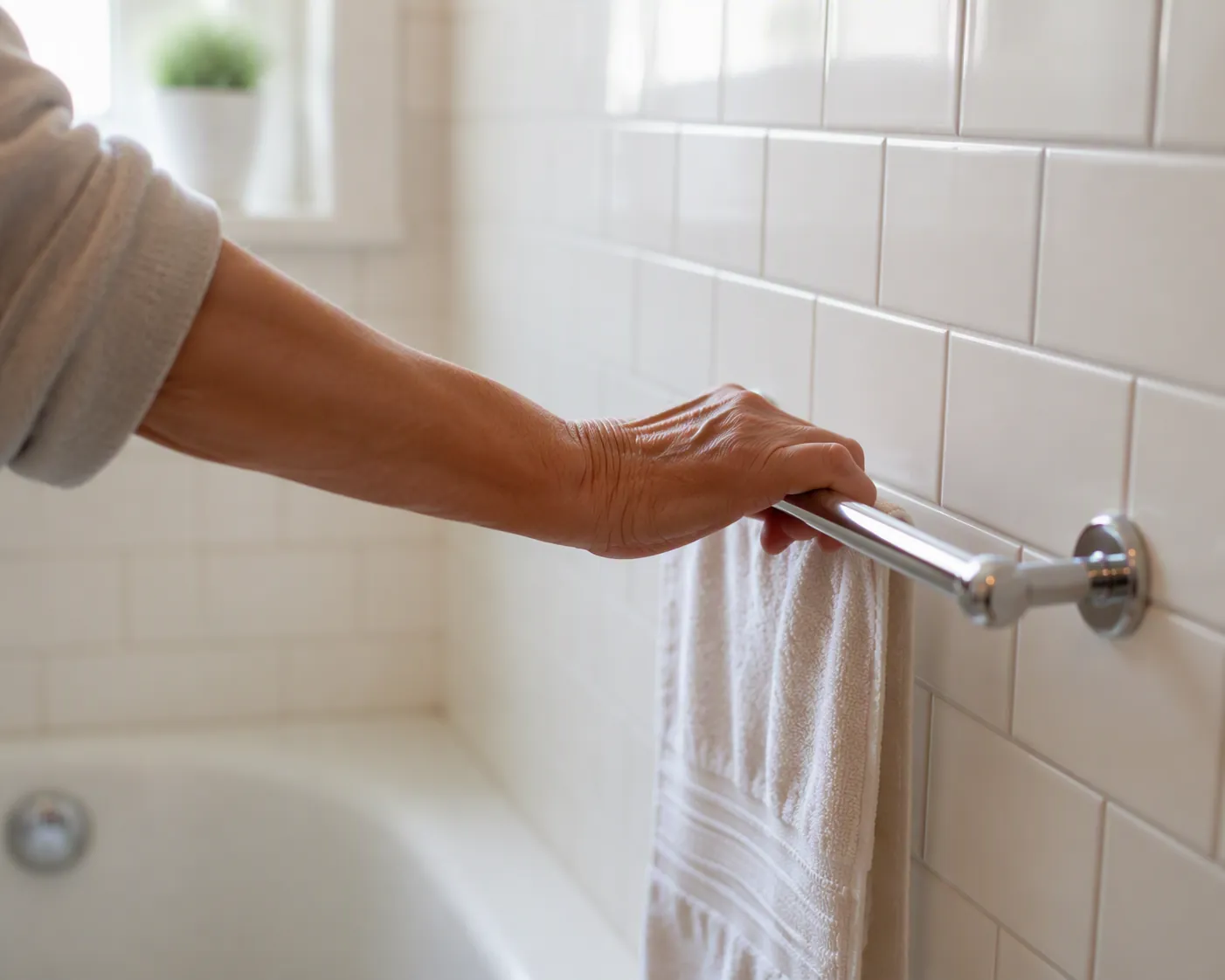
The 250-pound force standard separates a handhold from a bathroom accessory
A soaked bath towel weighs only a few pounds; one manufacturer guide describes a soaked towel as roughly 2 to 4 pounds.[2] Even allowing for heavier towels and a little tugging, that is a very different job from catching part of a person’s body weight during a slip.
The difference shows up in the whole assembly. A real grab bar is usually thicker, has a defined gripping surface, uses larger mounting flanges, and depends on solid backing or appropriate structural anchoring. A towel bar often has slimmer brackets and lighter wall anchors because its normal load is a towel hanging downward, not a person pulling, pushing, twisting, or falling sideways.
This matters because falls do not politely apply weight in the direction a towel bar expects. A person stepping out of a tub may pull outward. Someone lowering onto a toilet may push down and back. A person losing balance in the shower may grab fast, with wet hands, while turning. The bar, the screws, the anchors, the tile, and the wall behind it all have to participate.
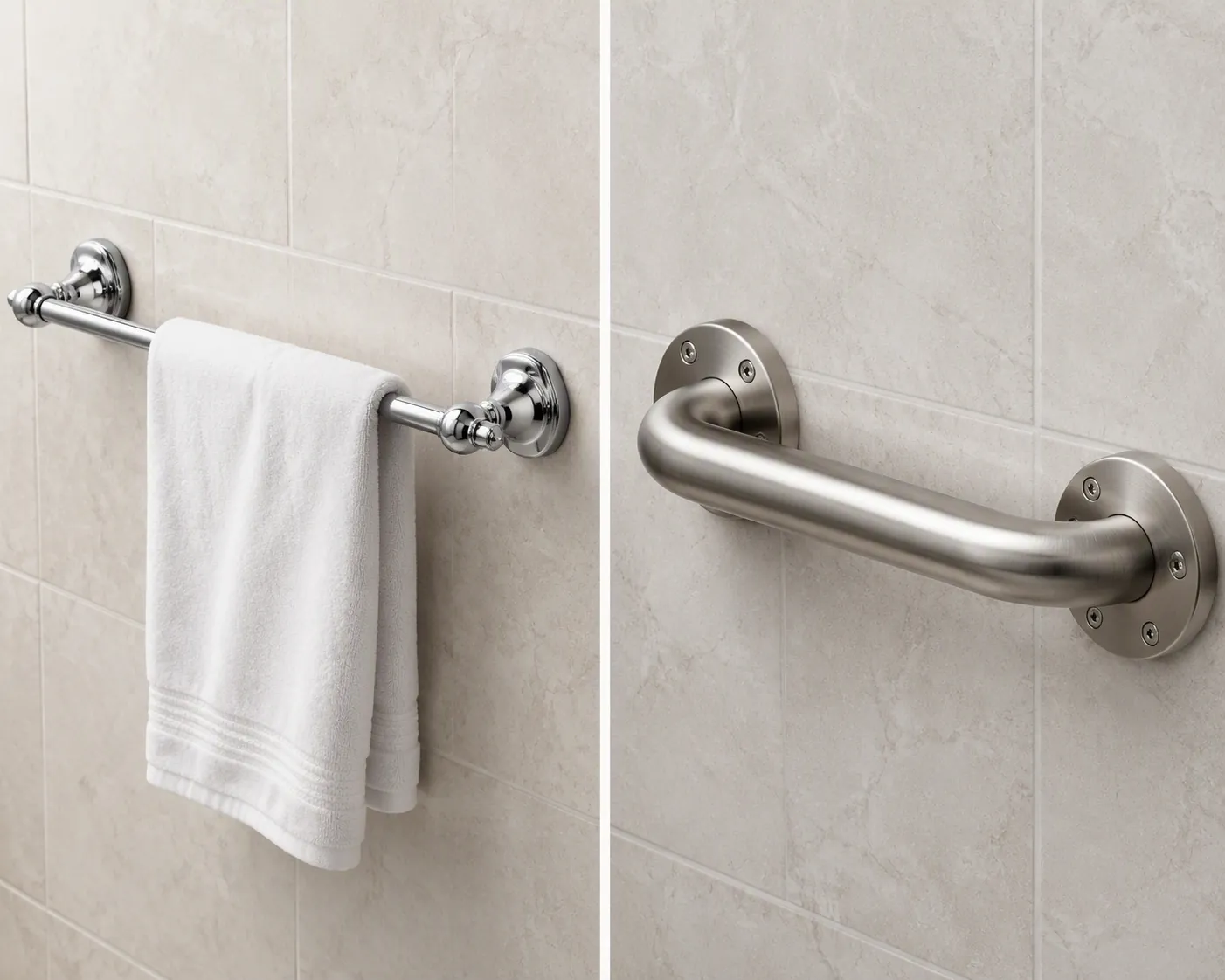
| Fixture | Built to do | Typical load situation | What to check |
|---|---|---|---|
| Towel bar | Hold towels | A few pounds hanging mostly downward | Decorative brackets, light anchors, no support rating, no structural installation details |
| Grab bar | Support balance, transfers, and recovery from a slip | Force from a person pulling, pushing, or suddenly grabbing | Stated load requirement, proper diameter, wall clearance, flanges, fasteners, and structural mounting |
A towel bar beside a toilet or tub is therefore not neutral decoration. If it is the closest thing to a handhold, it invites the exact mistake it cannot safely handle.
Bathroom falls are common enough to plan for, but the numbers should stay honest
Bathroom safety advice often gets padded with dramatic claims. The better number to use here is narrower and more useful: in a 2015 U.S. emergency department analysis of at-home falls among adults 65 and older, bathrooms were the third most common fall location, accounting for 22.7% of fall-related ED visits, behind bedrooms at 25.0% and stairs at 22.9%.[3]
That does not mean every fall happens in the bathroom. It means the bathroom is one of the major places where a handhold decision has consequences. It is also a place where people are often wet, barefoot, turning in a tight space, stepping over thresholds, or shifting weight from sitting to standing.
The gap between need and preparation is visible in national data. Among Medicare beneficiaries age 65 and older who had fallen, 55.5% had bathroom modifications such as grab bars, while an estimated 40.2% of those with repeated falls had no bathroom modifications.[4] That is the weekend-caregiver problem in plain form: the risk is familiar, but the fixture on the wall may still be the wrong one.
What a real grab bar should feel like in the hand
ADA guidance gives several dimensions that are worth borrowing even in a private home, while remembering that ADA standards are accessibility standards and local residential code requirements can vary. For horizontal grab bars, the top of the gripping surface is specified at 33 to 36 inches above the finished floor. The gripping surface diameter should be 1.25 to 2 inches, and there should be 1.5 inches of clearance between the wall and the bar.[1]
Those measurements are not decorative trivia. A bar mounted too close to the wall can trap fingers or prevent a secure wrap. A bar that is too wide can be harder to grip. A bar at the wrong height may be reachable only after the person is already off balance.
For most family bathrooms, the useful question is not “Where would a bar look acceptable?” It is “Where will a wet or tired hand go without thinking?” That is where the support fixture belongs.
Where grab bars belong: the practical bathroom map
The highest-priority zones are the places where the body changes level, crosses an edge, or turns in a wet space: the toilet, the tub entry, the shower entry, and the inside bathing area. In those zones, a towel bar, towel ring, shower door handle, soap dish, or vanity edge should not be counted as support.
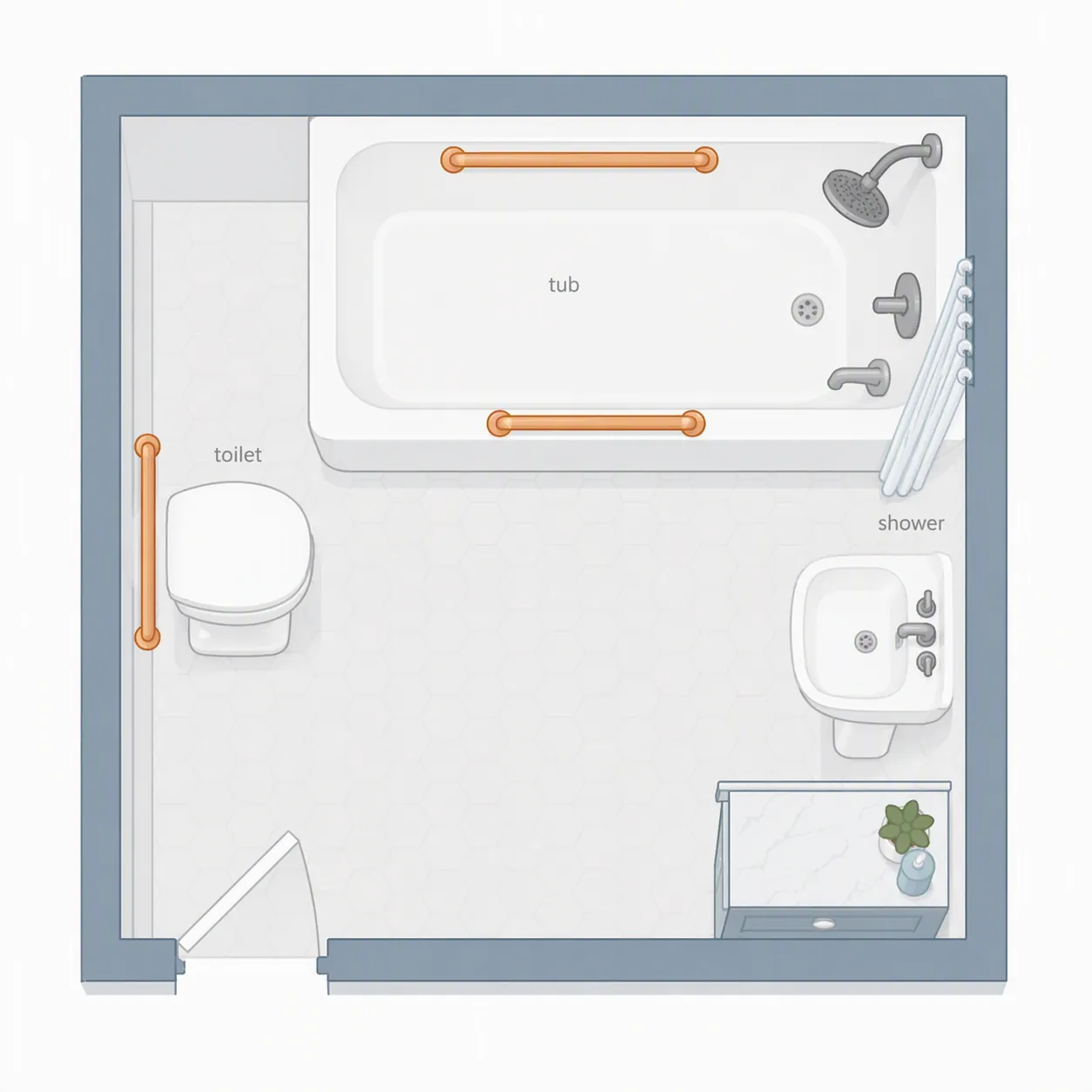
| Bathroom zone | What the person is doing | False handholds to watch for | What belongs there instead |
|---|---|---|---|
| Beside the toilet | Lowering, standing, turning, adjusting clothing, recovering from a sway | Towel bar, toilet paper holder, sink edge, towel ring | A properly mounted grab bar on the reachable side wall when layout allows; use the 33–36 inch horizontal-bar height range as a planning reference.[1] |
| At the tub entry | Stepping over the tub wall, often with one foot on a wet surface | Towel bar on the outside wall, shower door frame, faucet handle | A real grab bar positioned where the hand naturally reaches before and during the step-over movement |
| Inside the tub or shower | Standing, turning, rinsing, reaching for soap, sitting or rising from a bathing seat | Soap dish, towel bar, lightweight shelf, sliding-door rail | Horizontal grab-bar support with a grippable diameter and 1.5 inches of wall clearance; additional vertical or angled bars may help specific movements but still need proper rating and mounting.[1] |
| At a shower entry or curb | Crossing a threshold, turning, or stepping onto a wet floor | Glass door handle, towel bar just outside the shower, nearby towel hook | A rated grab bar placed before the threshold becomes the balance problem |
If the bathroom is small, these zones may overlap. That does not make a towel bar more useful; it makes proper placement more important. A single well-placed grab bar may support more than one movement, but only if it is actually reachable from those movements and installed as support equipment.
The toilet area
Toilet transfers are easy to underestimate because they happen many times a day and do not look dramatic. The risky moment is not only standing up. It is the whole sequence: backing up, bending knees, lowering without dropping, reaching for paper or clothing, then pushing up again.
A towel bar near the toilet is especially misleading because it often sits at a tempting height and distance. If a parent already touches it while sitting or standing, treat that as evidence. The hand has chosen a support point; the wall just has not caught up.
The tub and shower entry
The tub edge is where “just for balance” becomes a poor excuse. Stepping over a tub wall requires a person to stand briefly on one leg, shift weight, clear an obstacle, and land on a surface that may be wet. The hand usually reaches before the foot finishes the move.
That reach should land on a grab bar, not a towel bar outside the tub or a shower door handle. If the existing towel bar is the nearest object at the entry, it is not solving the problem. It is marking the place where a rated handhold is probably needed.
Inside the bathing area
Inside a tub or shower, the bar has to work when hands are wet and attention is divided. A person may be turning to rinse, reaching for shampoo, standing from a shower chair, or correcting a foot slide. Smooth decorative hardware and improvised supports do not belong in that job.
This is also where aesthetics should lose quickly. A bathroom can look clean and still fail the hand test. If the only reachable rail is a towel bar or soap dish, the room is asking a person to discover the difference under stress.
Can a decorative towel bar be replaced with a grab-bar/towel-rod combo?
Sometimes, yes, but the order matters. The product must be a grab bar first and a towel holder second. AARP’s HomeFit bathroom guidance answers the towel-bar question with “Usually no” and recommends actual grab bars rather than relying on ordinary towel bars.[5]
There are dual-purpose products marketed as grab-bar/towel-rod combinations, including manufacturer listings that advertise 250- to 500-pound capacities.[6][7] That is useful because it shows families do not always have to choose between a safe handhold and a place for a towel. But those listings are still vendor claims, not proof that any bar with a towel on it is safe.
- Look for a stated load rating appropriate for support use, not vague words such as “sturdy” or “heavy duty.”
- Check whether the instructions require studs, blocking, or rated anchors, and whether the existing wall can meet those requirements.
- Confirm that the gripping surface, wall clearance, and placement still work as a handhold after the towel is hung.
- Do not install a combo product where the towel itself will cover the only reachable support during bathing or toileting.
A stronger-looking towel bar is not the same thing. The safe category is a rated grab bar that happens to include towel storage, installed according to its support requirements.
A short caution on suction and clamp-on bars
Suction-cup and clamp-on bars are tempting in rentals or in homes where nobody wants to open a wall. Keep the category straight: manufacturers commonly describe suction bars as balance aids rather than load-bearing safety equipment.[8] They should not be treated as the replacement for a properly mounted grab bar in a place where someone may fall or transfer weight.
If the home is rented, the answer is still not to trust a towel bar. The better next step is to ask about approved installation, look for rated equipment that fits the wall conditions, or bring in someone who can identify a non-destructive option that is actually designed for support.
How to do the weekend bathroom pass
Walk the bathroom slowly and ignore, for a moment, what each object is called. Watch the movements instead.
- Where would a hand go while sitting down on the toilet?
- Where would a hand go while standing up from the toilet?
- Where would a hand go before stepping over the tub wall or shower threshold?
- Where would a hand go after a foot slips inside the tub or shower?
- Which towel bars, towel rings, shelves, soap dishes, door handles, or vanity edges are close enough to be grabbed by instinct?
Mark every false handhold in the toilet, tub, and shower zones. If the object there is a towel bar, do not count it as support. If it is exactly where a person would reach during a slip, turn, sit-to-stand transfer, or tub entry, that location needs a properly placed, properly mounted grab bar.
For broader prioritizing beyond this one fixture decision, see home modifications that actually prevent falls or an evidence-based look at an elderly bathroom remodel. Those are larger planning questions. The towel-bar decision is smaller and more immediate.
The replacement for a towel bar is not a heavier-looking towel bar. It is a grab bar rated and installed for the place where a real hand will reach.
References
- Guide to the ADA Accessibility Standards, Chapter 6: Bathing Rooms — U.S. Access Board
- Towel Bar Weight Capacity — KES
- A Descriptive Analysis of Location of Older Adult Falls That Resulted in Emergency Department Visits in the United States, 2015 — PubMed Central
- Bathroom modifications among community-dwelling older adults who experience falls in the United States — PubMed Central
- HomeFit Guide Video: Bathroom — AARP
- Towel Bar Grab Bar Combo ADA 500 lb wt capacity — ezable
- What Makes a Good Grab Bar: Key Features You Can’t Ignore — Quick Tub
- Suction Cup Grab Bars — GBIAA
Related reading
Noticed something outdated or inaccurate on this page? Flag a correction. We review every report against CDC, NIA, and AARP HomeFit guidance before updating a page.
Part of the Fall Prevention section.