
STEADI: intervene
How to Prevent Falls During a Severe Thunderstorm
Thunderstorms create a cascade of fall risks for older adults that generic storm safety advice misses. This guide covers how to prepare before storm season, move safely during a storm, and avoid post-storm falls.
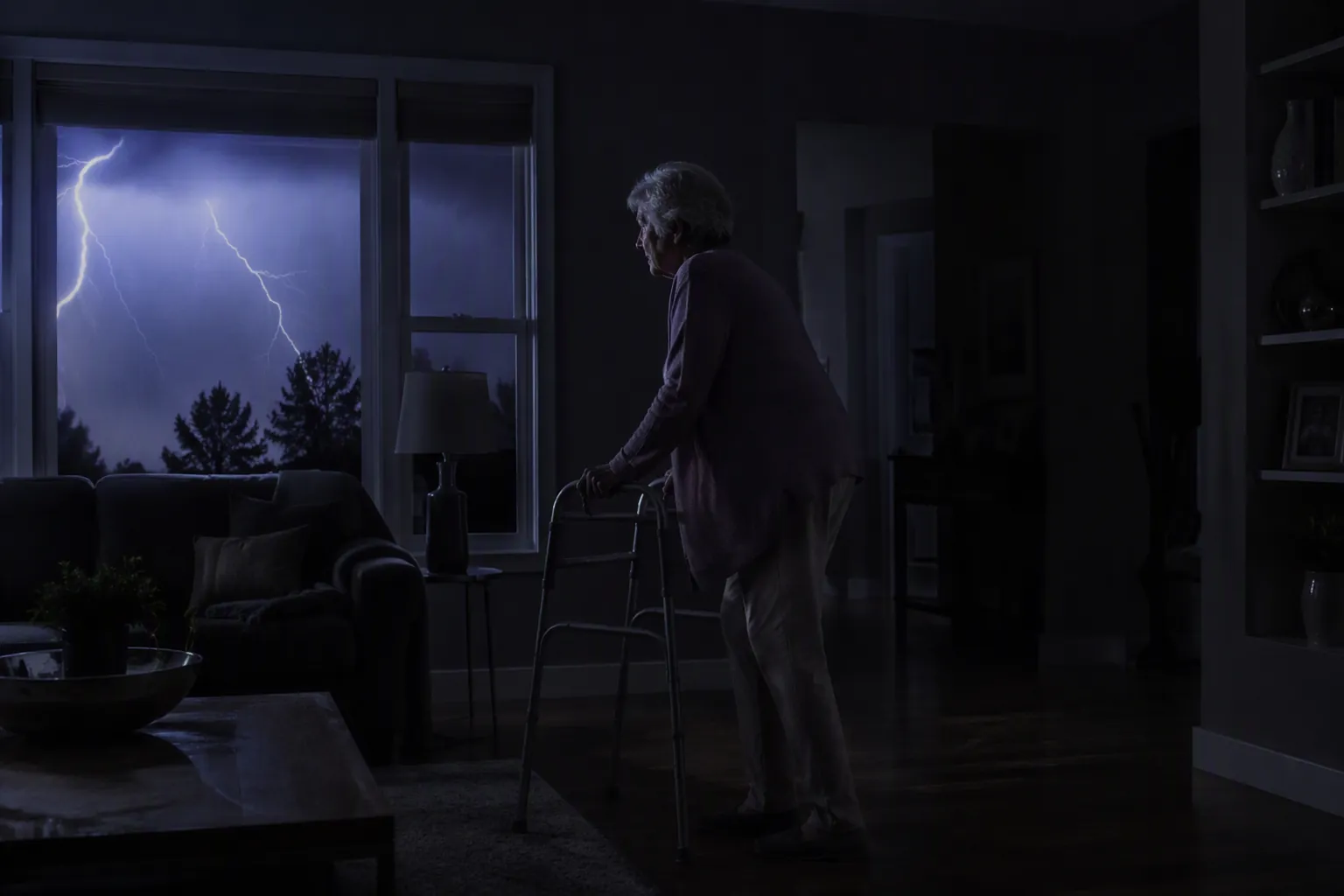
When the lights go out during a severe thunderstorm, the first danger for many older adults is not outside. It is the trip from the recliner to the hallway, the hand reaching for a flashlight that is in the kitchen, the walker left on the far side of the room, or the decision to check a dripping porch while the floor is slick.
That is the missing piece in many severe thunderstorm safety tips for older adults: sheltering only works if the person can shelter without losing access to the things that let them move safely. An interior room on the lowest floor may be the right place to wait out the storm, but it becomes a poor fall-prevention plan if the phone, cane, medications, glasses, hearing aids, and light are all somewhere else.
This guide is not a substitute for medical, emergency-management, or home-safety advice from a qualified professional. It is a practical fall-prevention plan for the part families can control before the next storm: where the older adult will wait, what must already be there, when movement should stop, how movement changes in darkness, and when it is safe to move normally again.
Start With the Safe Room, Not the Storm Kit
Pick the room where the older adult will actually wait during a severe thunderstorm. In many homes, that means an interior room on the lowest practical level, away from windows. But the safest room on paper is not always the safest room for the person using a cane, walker, hearing aids, oxygen equipment, refrigerated medication, or a bathroom schedule that cannot be ignored.
Before storm season, walk the route to that room with the older adult in normal daylight. Notice the ordinary obstacles: a rug edge, a narrow doorway, a side table, a basket near the hall, a pet bed, a lamp cord, a threshold that catches the walker wheel. A thunderstorm will not make those hazards new. It will make them harder to see, harder to hear around, and harder to recover from if balance is lost.
The baseline risk is already high. CDC data show that more than 1 in 4 older adults fall each year, and the age-adjusted fall death rate among adults 65 and older increased 21% from 2018 to 2024.[1] There is no need to pretend that storms have a clean national fall count when the safer conclusion is more modest and more useful: if a person is already at meaningful fall risk, sudden darkness, wet shoes, stress, noise, and misplaced mobility aids make the home harder to navigate.
What Must Already Be in the Room
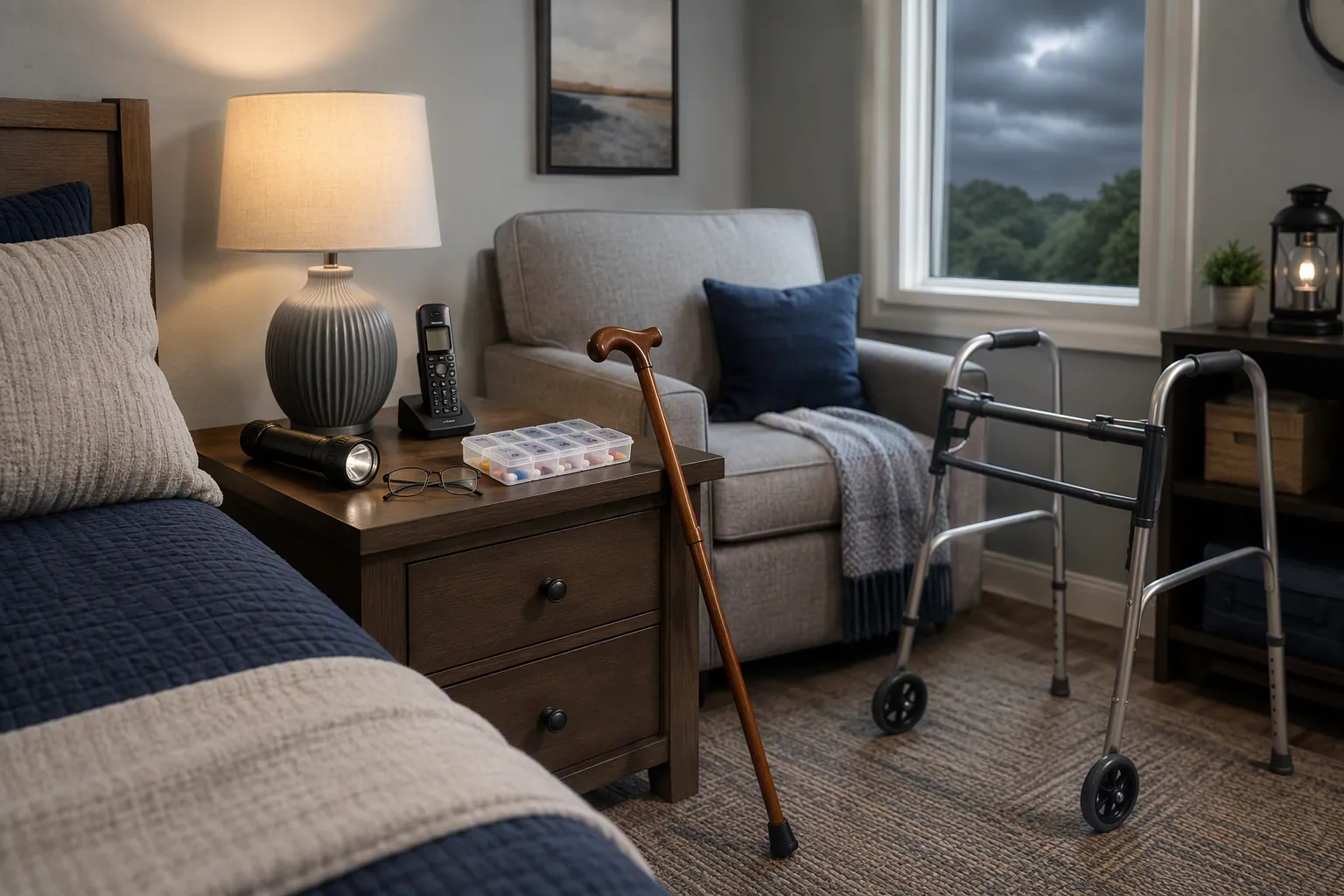
A safe room should be stocked for staying seated, communicating, taking necessary medication, and making one unavoidable short move without improvising in the dark. This is not the whole 72-hour emergency kit. It is the fall-prevention layer that belongs within arm's reach.
- Primary mobility aid: the cane, walker, rollator, or transfer device the person actually uses, placed where it can be reached before standing.
- Lighting: a working flashlight in the safe room, plus a backup if the person cannot safely search drawers or cross the room without light.
- Communication: a charged phone or cordless handset, with emergency contacts accessible without needing to search another room.
- Medication access: the doses that may be needed during the storm window, staged in a way that does not require a dark trip to the kitchen or bedroom.
- Vision and hearing necessities: reading glasses, regular glasses, hearing aids, spare batteries or charging support if those are part of the person's normal routine.
- A clear seat: a stable chair with arms if available, not a low stool, rolling chair, or deep seat that makes standing harder.
Hearing deserves special attention because storm safety often assumes alerts, knocks, shouted warnings, and weather radios will be noticed. CDC materials report that about 22% of adults ages 65 to 74 and 55% of adults 75 and older have disabling hearing loss.[2] If an older adult may not reliably hear an alert or a caregiver at the door, the plan should not depend on sound alone. A visible phone, prearranged text check-in, accessible lighting, and a caregiver who knows where the person is waiting matter.
For broader outage supplies such as food, water, backup power, medication cooling, and medical-device planning, use a fuller resource like a 72-hour senior power outage safety kit. This article stays focused on the pieces that prevent the fall between the chair and the thing the person needs.
A Quick Safe-Room Check
| Question | Why It Matters for Falls |
|---|---|
| Can the person reach the cane or walker before standing? | Standing first and then looking for support is when a routine move can become a fall. |
| Can the person make a phone call from the chair? | Calling for help should not require crossing a dark room. |
| Is the flashlight visible and easy to grip? | A flashlight buried in a drawer is almost the same as no flashlight during an outage. |
| Are needed medications already present? | A dark trip for pills can create more danger than the medication schedule was meant to solve. |
| Is the route to the nearest bathroom dry and clear? | Urgent bathroom trips are one of the movements most likely to happen even when everyone planned to stay seated. |
Before the Storm: Remove the Trip You Can Predict
The most useful preparation happens before the warning, because that is when nobody is rushing and the house still looks familiar. The goal is not to rearrange the whole home. It is to remove the predictable trip from the place the older adult normally sits to the place they are supposed to shelter.
- Clear the path from the usual sitting area to the safe room, including rug edges, cords, laundry baskets, pet items, and small tables.
- Move the walker, cane, or rollator into the safe room before bad weather arrives, not after the power flickers.
- Put the phone, flashlight, medications, glasses, and hearing necessities on one reachable surface, not scattered across the room.
- Check that the chair is stable, high enough to stand from, and positioned so the mobility aid can park beside it.
- Decide which bathroom is safest to use during the storm, and make the path to it as dry, lit, and uncluttered as possible.
- Agree on a check-in method with a caregiver or neighbor, especially if hearing loss makes knocks, calls, or alerts unreliable.
If the home has stairs, the plan should avoid them once the storm is close. A basement may be the lowest level, but it may not be the right shelter location for someone who cannot safely descend and climb stairs under stress, especially if the stairwell lighting depends on power. In that case, choose the safest accessible interior room available and ask local emergency guidance or a home-safety professional about better options before the next storm season.
During the Storm: Treat Darkness as a Different House
Total darkness is not a small inconvenience for an older adult with balance, vision, hearing, or mobility limitations. It changes how the home works. The hallway is narrower because edges are harder to judge. The bathroom floor is riskier because water may not be visible. The familiar chair is harder to stand from because the walker may not be exactly where the hand expects it.
Older adults are also disproportionately harmed in power-outage disasters. AARP's disaster resilience materials report that people age 60 and older accounted for 60% of the 246 deaths from the February 2021 Texas winter storm power outage, with most deaths from hypothermia.[3] That event was not a thunderstorm fall study, and it should not be treated as one. It does show why power loss deserves serious planning for older adults rather than being handled as a temporary inconvenience.
When Not to Move
During peak wind, close lightning, or active power flickering, the safest movement is often no movement. Stay seated in the safe room with the cane or walker parked within arm's reach. Do not get up to look out the window, check the porch, reset a breaker, move patio furniture, or inspect a sound outside. Those jobs can wait.
Bathroom needs are the exception that many tidy safety plans ignore. If the older adult may need to use the bathroom during the storm, plan for the shortest, clearest, driest route ahead of time. If incontinence supplies, a bedside commode, or caregiver assistance are already part of the person's routine, those should be considered before the storm rather than improvised during it.
If Movement Cannot Wait
When movement is unavoidable, slow it down enough that balance has time to catch up. The person should sit upright first, place both feet flat, locate the cane or walker by touch, turn on the flashlight before standing, and stand for a moment before taking the first step. Standing too fast in a dark room is a small action with a large consequence.
- Keep one hand on a stable surface when possible, such as a wall, counter, or sturdy furniture; do not use a rolling chair, towel bar, or lightweight table for support.
- Use the flashlight to scan the floor before stepping, then keep the beam low enough to show obstacles, thresholds, and wet spots.
- Take shorter steps than usual, especially across tile, wood, or vinyl floors where wet shoes can slide.
- Avoid stairs during the storm unless there is an immediate safety reason to move and assistance is available.
- Do not carry loose items in both hands; the mobility aid, wall, or railing needs priority over objects.
- Pause at doorways, thresholds, and turns, because those are the places where walkers catch, feet pivot, and depth perception matters.
A caregiver on the phone should resist giving fast, repeated instructions. Short directions are safer: stay seated, turn on the flashlight, put one hand on the walker, stand slowly, wait, then take the next step. If the older adult sounds confused, short of breath, injured, or unable to move safely, call local emergency services rather than trying to coach a risky crossing through the house.
After the Storm: Do Not Let the Inspection Become the Fall
The storm may pass before the fall risk does. Wet leaves on steps, branches across a walkway, damaged flooring, water near an entry, loose mats, and scattered objects can turn the first inspection into the most dangerous trip of the day. Downed power lines add a separate life-threatening hazard and should be avoided completely.
If there is no urgent danger inside the home, wait for daylight or for another person to assess the path. The older adult does not need to be the first person outside to see whether a branch fell, whether the mailbox is damaged, or whether the porch furniture moved. A phone call to a neighbor, family member, property manager, or local nonemergency line is safer than stepping onto a wet, debris-covered path alone.
- Check indoor walking paths before normal movement resumes, especially from the safe room to the bathroom, bedroom, and kitchen.
- Keep using the flashlight until power is stable and all needed lights are working.
- Assume outdoor steps, ramps, railings, and walkways are slippery until someone has looked at them closely.
- Leave fallen branches, wires, and heavy debris alone; the fall risk and electrical risk are not worth the inspection.
- Put the cane, walker, phone, flashlight, and medications back into their normal places only after the storm threat and outage risk have passed.
What a Good Thunderstorm Fall Plan Looks Like
A good plan does not require turning the home into a bunker. It requires one usable place to wait, one clear route to reach it, and no need to cross a dark house for the items that make movement, medication, and communication possible.
That is the practical standard: the older adult can shelter without leaving behind the tools they need to stand, see, hear, call, and take medication, and they can avoid unnecessary movement until the home and outside path are safe again.
References
Related reading
Noticed something outdated or inaccurate on this page? Flag a correction. We review every report against CDC, NIA, and AARP HomeFit guidance before updating a page.
Part of the Fall Prevention section.