
STEADI: intervene
Protect Your Elderly Parent from Dry Lightning Wildfires
Dry lightning can ignite multiple wildfires simultaneously, compressing evacuation timelines and making generic wildfire preparedness inadequate for older adults. This guide helps caregivers build a plan-ahead strategy with early-evacuation triggers, a senior-specific go-bag, and indoor air quality contingencies.
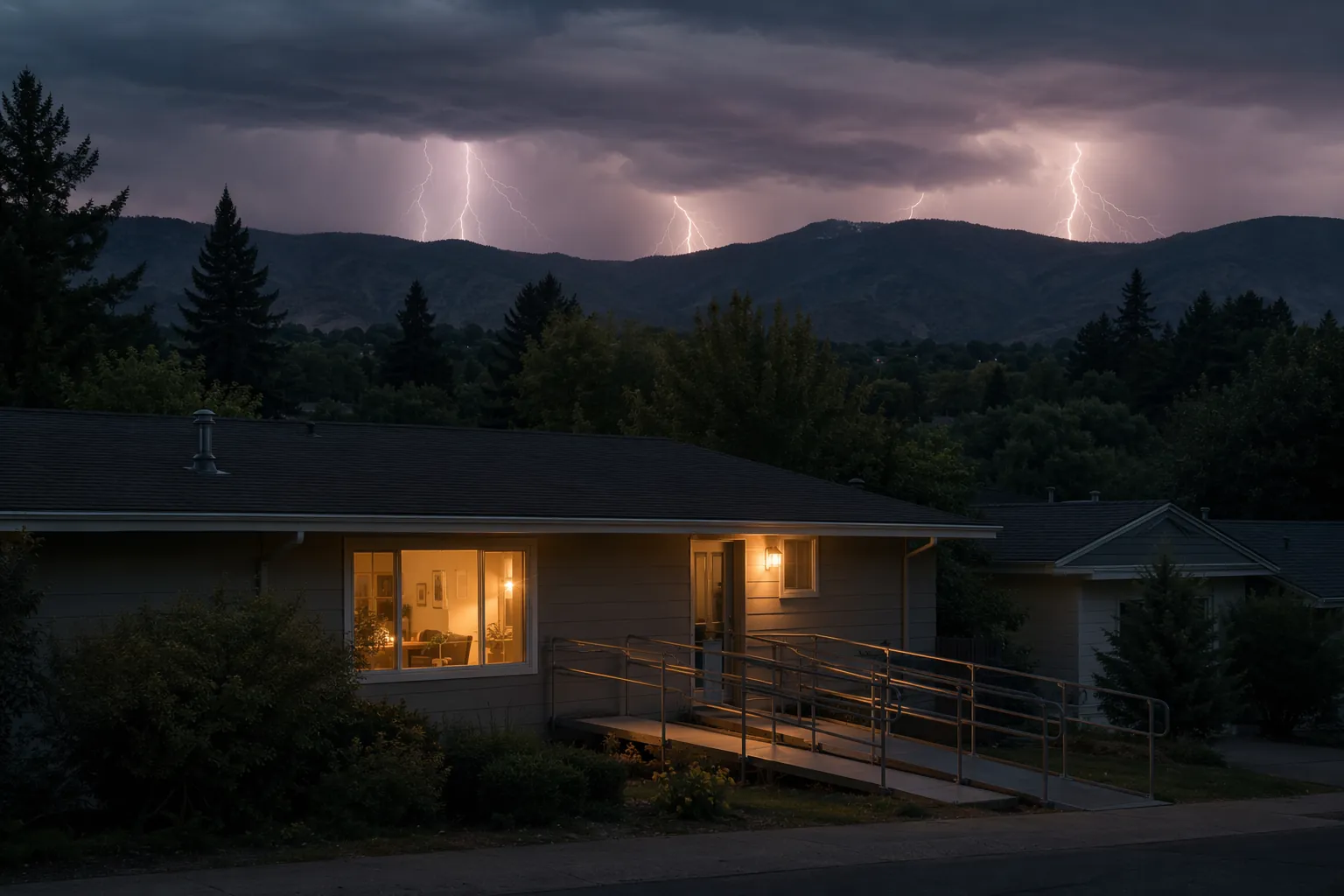
Dry lightning changes the caregiver’s clock. A normal wildfire plan often assumes there will be a visible fire, a familiar evacuation warning, and enough time to gather medication, shoes, chargers, glasses, hearing aids, and a walker before leaving. Dry lightning can break that sequence because cloud-to-ground strikes may ignite several fires across a broad area before one clear front is visible from the house.
That is the practical answer to protecting an elderly parent from dry lightning wildfire risk: move the decision point earlier. Lightning-ignited wildfires account for more than two-thirds of the acreage burned in the western United States, and researchers describe dry lightning as especially dangerous because storms can produce many ignitions over a large landscape rather than a single obvious start.[1] For an older adult who needs extra time to stand, dress, find medications, transfer into a car, or accept help, the danger is not only the fire. It is the delay between “something may happen” and “we are actually out the door.”
Why Dry Lightning Needs an Earlier Caregiver Trigger
Older adults already face a higher fire-safety burden. The U.S. Fire Administration says adults age 65 and older are 2.5 times more likely to die in a fire than the population as a whole.[2] That statistic is not specific to wildfires, but it is a useful warning against treating evacuation as a simple matter of “grab a bag and go.” A parent who is steady at noon may be unsteady at midnight. A hallway that is manageable with the lights on may become a fall hazard in smoke, stress, or a power outage.
Ready.gov’s older-adult guidance tells people to plan around transportation, medical needs, assistive devices, and a support network before an emergency.[3] For dry lightning, that advice needs a sharper trigger. The plan should not begin when evacuation feels obvious. It should begin when the forecast, local fire conditions, and the parent’s mobility limits combine to make a late exit harder than an early one.
A caregiver trigger can be simple, but it has to be written before anyone is tired or defensive. Examples include: a dry lightning watch or warning in the area, new nearby fire starts after a lightning storm, a red flag warning paired with the parent being alone overnight, smoke entering the neighborhood, a planned power shutoff, or any evacuation advisory for a nearby zone even if the parent’s own zone is not yet under order.
The uncomfortable part is that some triggers will sound premature. That is the point. If your parent needs a walker, oxygen equipment, a medication schedule, or help down garage steps, the family’s evacuation time is not the same as a healthy neighbor’s evacuation time. The decision standard should be: leave or relocate when leaving is still boring, not when it has become dramatic.
| If this happens | Caregiver action |
|---|---|
| Dry lightning is forecast for the area during hot, dry, windy conditions | Call the parent, confirm the go-bag location, charge devices, and alert the support network |
| Lightning has passed and multiple new fire starts are reported in the county or nearby region | Move from monitoring to readiness: shoes on, medications packed, car fueled, ride confirmed |
| Smoke is present, power is unstable, or the parent is alone overnight | Consider early relocation to a safer indoor location before visibility, traffic, or fall risk worsens |
| An evacuation advisory, warning, or order applies to the parent’s zone | Follow local emergency instructions and use the preassigned ride and helper roles immediately |
Write the Plan Around the Slowest Necessary Step
The slowest step is rarely “put things in a bag.” It may be convincing a parent to leave. It may be finding the hearing aids that were taken out after dinner. It may be lifting a rollator over a threshold, locating the oxygen supplier’s emergency number, or getting a neighbor to answer the phone. The Red Cross advises older adults to build a support network that can help with transportation, communication, and emergency needs.[4] For a caregiver, that network should be specific enough that no one has to improvise during a lightning siege.
- Name a primary caller who watches alerts and calls the parent first.
- Name a backup caller in case the primary caregiver is driving, working, asleep, or out of cell range.
- Name the person who can physically help the parent leave the house.
- Name the transportation option: family car, neighbor, paratransit, rideshare, community evacuation resource, or medical transport if needed.
- Name the destination: relative’s home, hotel, community shelter, cleaner-air location, or medical facility if the parent’s health requires it.
Do not leave “someone will check on Mom” as the plan. Someone should know whether the parent can manage stairs, whether the walker fits in the car, whether the garage door can be opened during a power outage, and whether the parent is likely to say “I’m fine” when she is not. A good support network is less about goodwill than assigned friction: who has the key, who knows the medication list, who can lift the portable oxygen concentrator, who can stay calm when the parent resists.
This is also where fall prevention belongs. If power fails after a lightning storm, the trip from bedroom to hallway to garage can become the most dangerous part of the evacuation. Keep flashlights where the parent actually walks, remove loose obstacles from the exit path, and make sure the shoes used for evacuation are sturdy enough for uneven pavement, not slippers chosen for comfort inside the house. For a deeper room-by-room setup, use the power outage fall prevention checklist for seniors.
Pack for the Older Body, Not for an Abstract Emergency
A senior wildfire go-bag is not just a smaller camping kit. The National Council on Aging recommends emergency supplies that account for medications, medical information, assistive devices, food, water, lighting, and power needs.[5] For dry lightning, the bag should be ready before the storm arrives because the same storm that starts fires can also unsettle power, roads, phone service, and helpers’ availability.
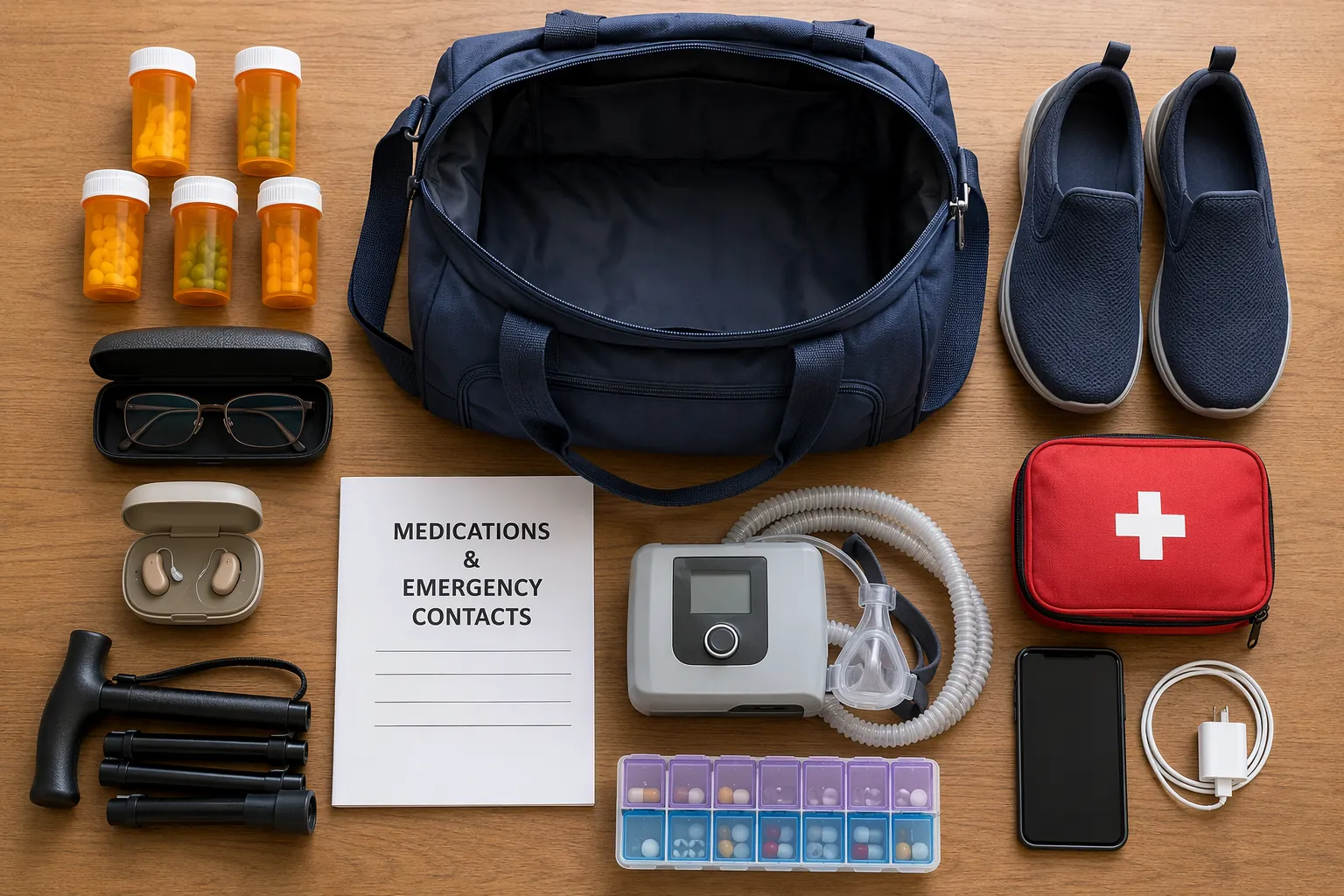
Start with the items that determine whether the parent can function after leaving: prescription medications, a current medication list, pharmacy information, copies of key medical documents, insurance cards, caregiver contacts, eyeglasses, hearing aids and batteries, dentures if used, mobility aids, chargers, and backup power for medical devices. If the parent uses a CPAP machine, oxygen equipment, refrigerated medication, or an electric recliner needed for sleeping safely, the plan must say what happens when the power goes out and who can move the equipment.
The shoe choice deserves more attention than it usually gets. Evacuations happen through gravel driveways, smoky parking lots, school gyms, hotel corridors, and unfamiliar bathrooms. Pack or stage closed-back, non-slip shoes that the parent can put on quickly. If swelling, neuropathy, or arthritis affects footwear, test the shoes before fire season rather than discovering during an evacuation that they pinch or slide.
Documents should be readable by someone outside the family. A one-page caregiver sheet can list diagnoses, medications, allergies, mobility limits, communication issues, preferred hospital, primary doctor, emergency contacts, and whether the parent can be left alone. Put one copy in the go-bag, one near the exit, and one with the primary caregiver. If one helper is unreachable, the next person should not have to reconstruct the parent’s health history by text message.
- Medication: current supply, medication list, pharmacy phone number, dosing schedule, and any refrigeration instructions.
- Mobility: cane, walker, rollator, wheelchair accessories, transfer belt if used, and non-slip shoes.
- Senses and communication: glasses, hearing aids, batteries, phone, charger, backup battery, and written contacts.
- Medical devices: CPAP, oxygen plan, device chargers, extension cord if appropriate, and supplier contact information.
- Identity and care documents: ID, insurance cards, medical summary, advance directive if available, and caregiver authorization documents.
For the broader evacuation packing sequence, use a wildfire evacuation checklist built for seniors. For this dry-lightning plan, the key is timing: the bag should already be packed, visible, and light enough for the assigned helper to carry while still assisting the parent.
When Leaving Is Not Immediate, Smoke Still Requires a Plan
Sometimes the safest move is not a nighttime drive through smoke, traffic, or falling debris. Sometimes the parent is waiting for a ride, emergency officials have not opened a route, or smoke arrives before flames are near. Staying put in that window should still be an active plan, not passive waiting.
The CDC recommends keeping wildfire smoke outside as much as possible, using a portable air cleaner if available, and choosing filters rated MERV 13 or higher when the HVAC system can handle them. It also recommends setting up a cleaner-air room by closing windows and doors and reducing indoor particle sources such as candles, gas stoves, fireplaces, and vacuuming.[6]
For an older adult, the clean-air room should be chosen before smoke season. Pick a room with the fewest exterior leaks, enough space for the walker or wheelchair, a place to sit and sleep safely, phone charging access, medication access, water, lighting, and a clear path to the bathroom. If the parent cannot safely move between the bedroom and that room without help, the plan should say who comes over or when relocation happens instead.
AARP’s wildfire smoke guidance emphasizes that older adults and people with heart or lung disease should monitor symptoms and reduce smoke exposure, including by staying indoors with cleaner air when advised.[7] That turns smoke monitoring into a caregiver task, not just a weather note. Ask about breathing, chest discomfort, dizziness, confusion, fatigue, coughing, and whether the parent is using rescue medications more than usual. If symptoms are concerning, follow medical advice or emergency instructions rather than trying to solve the problem with filters alone.
The health concern is not theoretical. A scoping review on older adults and wildfire smoke describes compounded risks for people with chronic conditions and cites evidence that 33.9% of older adults in one included study had impaired lung function.[8] That does not mean every older adult will have the same reaction to smoke. It does mean caregivers should treat smoke as a possible health trigger, especially for a parent with asthma, COPD, cardiovascular disease, diabetes, limited mobility, or cognitive impairment.
Use the Forecast to Start the Human Chain
Dry lightning planning works best when the forecast starts a human chain, not just private worry. If dry thunderstorms are possible, the primary caregiver checks alerts, the backup caregiver confirms availability, the neighbor knows whether to expect a call, and the parent knows what the day’s plan is. The parent may still prefer routine. Many older adults do. But routine is not worth preserving so tightly that every hard task is left for the smoky, dark, confusing hour.
The August 2020 lightning siege in California is the clearest example of the compressed timeline problem: more than 15,000 lightning strikes were reported, and more than 600 fires ignited.[1] It was an extreme event, not a template for every storm. Its value is that it shows why a caregiver cannot rely on one visible plume or one orderly evacuation sequence. Multiple starts can stretch firefighters, roads, shelters, family drivers, and attention at the same time.
UC Merced’s reporting on the Kalashnikov et al. study also points beyond one past event: damaging lightning-caused wildfires are projected to increase significantly in the 2031–2060 period.[1] That projection is not a reason to panic in 2026. It is a reason to stop treating dry lightning as a rare complication that can be handled with the same last-minute list used for every other wildfire.
The Caregiver Standard for Dry Lightning
A strong dry-lightning plan for an elderly parent has four parts: early triggers that start before official urgency feels obvious, a senior-specific go-bag that supports the body the parent actually has, named helpers with transportation roles, and a cleaner-air fallback if smoke or road conditions make immediate evacuation unsafe.
Emergency officials still set evacuation orders, routes, and public safety instructions. The caregiver’s job is to make sure the parent is not beginning from zero when those instructions arrive. For dry lightning, the safer plan is not a better last-minute checklist. It is a pre-agreed system that can be activated while the hallway is still lit, the shoes are still easy to find, the ride is still available, and leaving still feels early.
References
- Damaging Lightning-Caused Wildfires Likely to Increase in Few Years, Researchers Find, UC Merced, 2025
- Older adults, U.S. Fire Administration / FEMA
- Older Adults, Ready.gov
- Older Adults, American Red Cross
- Emergency Preparedness 101: What to Do Before, During, and After Disaster, National Council on Aging
- How to Safely Stay Safe During a Wildfire, Centers for Disease Control and Prevention
- How to Protect Yourself From Wildfire Smoke, AARP
- Wildfire smoke exposure and health effects in older adults: A scoping review, PMC
Related reading
Noticed something outdated or inaccurate on this page? Flag a correction. We review every report against CDC, NIA, and AARP HomeFit guidance before updating a page.
Part of the Fall Prevention section.