The Real Cost of Hiring a CAPS vs. the Cost of Doing Nothing: When Home Modifications Pay for Themselves
bathroomenvironmentalReviewed: 2026-06-20
The Real Cost of Hiring a CAPS vs. the Cost of Doing Nothing: When Home Modifications Pay for Themselves
A CAPS assessment and home modifications are a one-time investment that can save families tens of thousands of dollars compared to the recurring costs of assisted living or the catastrophic medical bills from a single fall. This article breaks down the hard numbers, ROI, and funding sources to help you make an informed financial decision.
By Editorial Team
CAPS certified
home modification cost
fall prevention
aging in place
funding sources
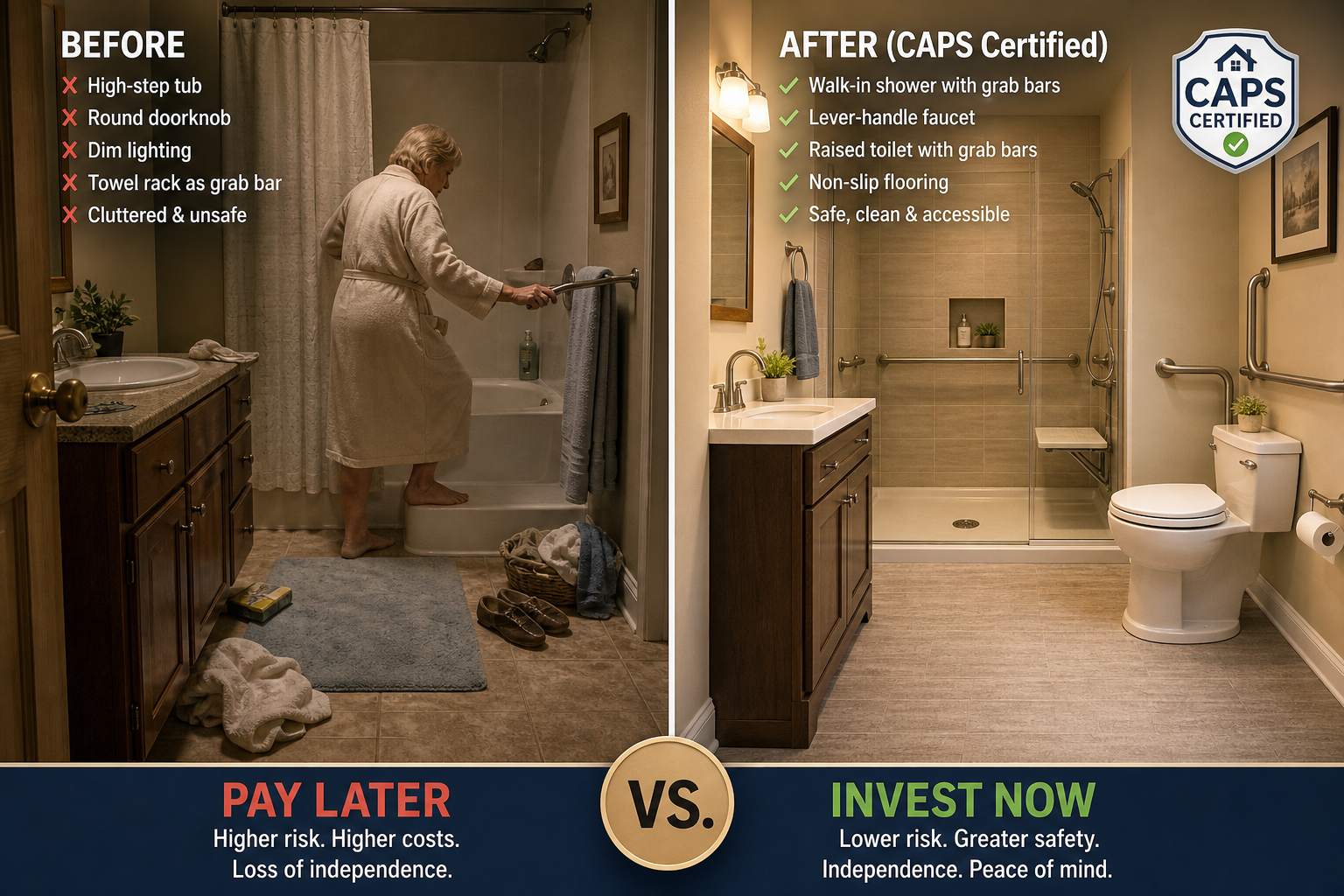
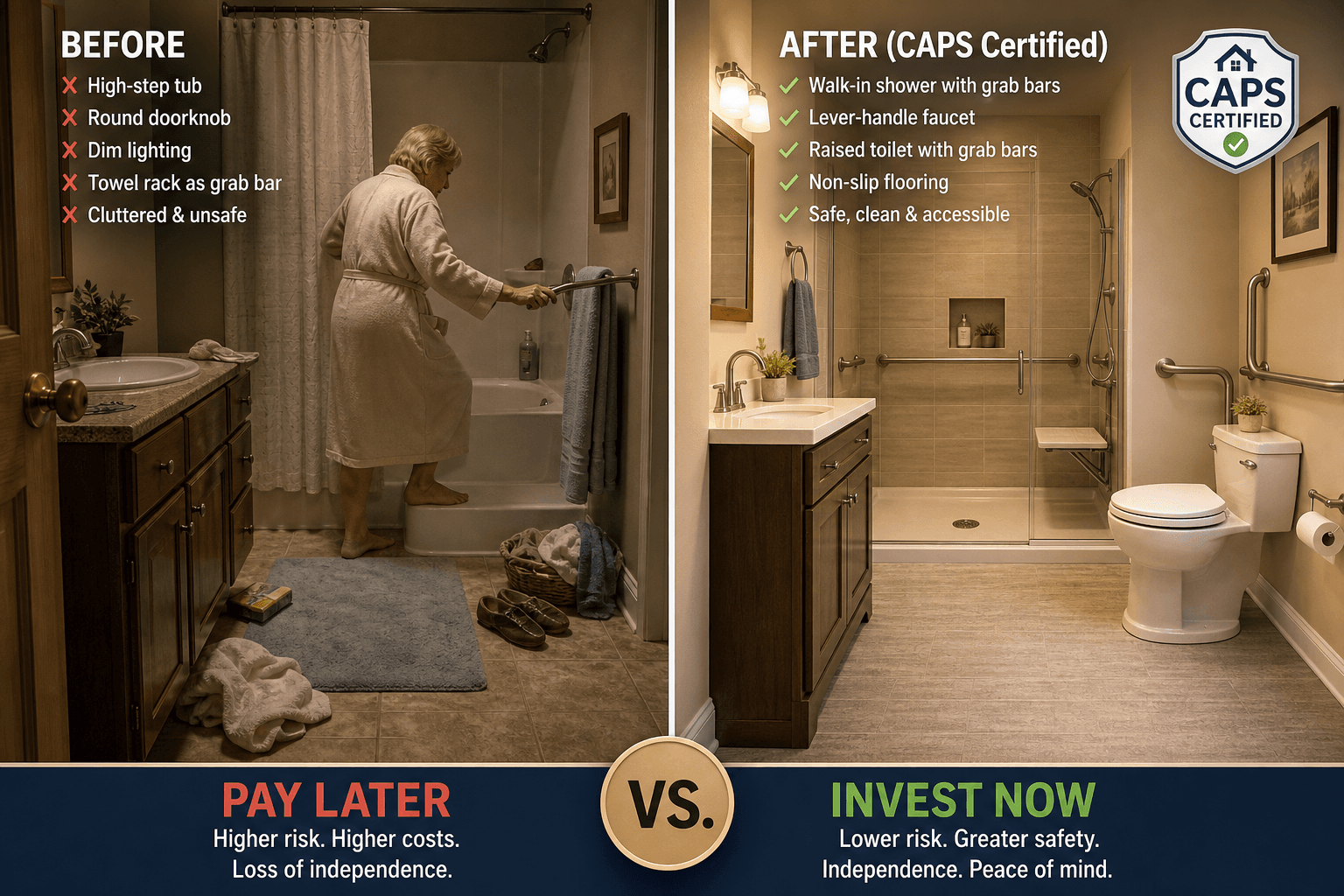
The same bathroom, before and after CAPS-guided modifications. The right side is not just safer — it is a one-time investment that prevents a cycle of recurring costs.
The $80 Billion Problem vs. the $500 Solution
Every year, 14 million older adults in the United States experience a fall. The total healthcare cost of treating non-fatal fall injuries among people 65 and older now sits at $80 billion annually — a figure that has climbed from $50 billion in 2015 and is projected to exceed $101 billion by 2030, according to the National Council on Aging. That is a national price tag, but the individual one is just as staggering: a single fall requiring hospitalization costs an average of $18,658 per inpatient visit, with another $1,112 per emergency department visit.
Now compare that to the cost of a professional home safety assessment from a Certified Aging-in-Place Specialist (CAPS). That assessment typically runs between $300 and $1,000. For roughly the price of a single emergency room co-pay, a CAPS professional can identify the specific hazards in a home and recommend modifications that dramatically reduce fall risk. The gap between the cost of prevention and the cost of a crisis is not small — it is a chasm.
What Does a Fall Really Cost? The Hard Numbers
To understand why home modifications are a sound financial decision, you first need to see the full cost of a fall — not just the medical bill, but who pays it and how it cascades into larger expenses.
The table below breaks down the average costs associated with a fall-related injury, based on data from Reider et al. (2024) and the NCOA.
Fall-related healthcare costs in the United States. Sources: NCOA (2020 data); Reider et al. (2024) for per-visit costs.
Cost Category
Average Amount
Who Pays
Inpatient hospital visit (fall injury)
$18,658
67% Medicare / 29% out-of-pocket
Emergency department visit (fall injury)
$1,112
67% Medicare / 29% out-of-pocket
Annual national cost of non-fatal falls (2020)
$80 billion
67% Medicare / 4% Medicaid / 29% out-of-pocket
Projected annual national cost (2030)
$101 billion
Projected increase driven by aging population
The 29% out-of-pocket share is the piece that hits families hardest. Medicare covers the majority of acute fall-related care, but it does not cover long-term custodial care, rehabilitation co-pays, or the indirect costs of a family member taking time off work to coordinate care after a fall. A single $18,658 hospitalization can wipe out a retirement savings buffer that took decades to build.
The Price Tag of CAPS: Assessment and Modifications
A Certified Aging-in-Place Specialist is a contractor or design professional who has completed specialized training through the National Association of Home Builders (NAHB) in collaboration with AARP. The credential, first developed in 2001, requires passing three courses covering marketing, design concepts, and technical solutions for aging-in-place modifications.
The cost of hiring a CAPS breaks down into two main categories: the assessment and the modifications themselves.
Cost ranges for CAPS assessments and common home modifications. Sources: Aging in Place Directory; Legal Eagle Contractors; Care.com. Prices vary by region, contractor, and material costs.
Service or Modification
Typical Cost Range
Notes
Home safety assessment (CAPS)
$300 – $1,000
One-time fee; includes room-by-room evaluation and written recommendations
Hourly consultation rate (CAPS)
$75 – $200 per hour
For ongoing project management or design consultation
Grab bars (installed)
$100 – $300
Per bar; includes blocking and professional installation
Wheelchair ramp
$1,500 – $5,000
Depends on length, materials, and site conditions
Stair lift
$3,000 – $5,000
Straight stair lift; curved models cost more
Walk-in tub
$5,000 – $15,000
Includes installation; price varies by features and brand
Full bathroom accessibility remodel
$10,000 – $50,000+
Largest variable; depends on scope, finishes, and structural changes
These are one-time costs. A $300 grab bar installation does not recur every month. A $10,000 bathroom remodel does not have a renewal fee. Once the modification is in place, it continues to reduce fall risk for years — often for the rest of the homeowner's life in that home.
The Assisted Living Trade-Off: $75,756 Per Year (Recurring)
The most common alternative to home modifications is a move to assisted living. And that cost is not a one-time expense — it is a recurring monthly bill that continues for as long as the resident lives there.
As of May 2026, the national median cost of assisted living is $6,313 per month, or $75,756 per year, according to SeniorLiving.org. Other sources report slightly different medians — the AHCANCAL figure is approximately $64,200 per year — but the core reality is the same: assisted living costs tens of thousands of dollars every single year, and those costs typically rise with inflation.
One-time modification costs vs. recurring assisted living costs. Even a $50,000 full bathroom remodel is less than a single year of assisted living.
Option
Typical Cost
Cost Structure
CAPS home modifications (full scope)
$10,000 – $50,000+
One-time investment; no recurring fees
Assisted living (1 year)
$64,200 – $75,756
Recurring monthly; increases annually
Assisted living (5 years)
$321,000 – $378,780
Recurring; total cost depends on length of stay
Single fall hospitalization
$18,658
One-time event; may trigger additional rehab and home care costs
The math is straightforward. If a family spends $30,000 on CAPS-guided modifications and those modifications allow an older adult to remain at home for just one additional year instead of moving to assisted living, the modifications have already paid for themselves — and then some. If they allow the person to stay home for five years, the savings exceed $300,000.
The ROI of Prevention: Why Modifications Are a Sound Financial Decision
The return on investment for home modifications is not theoretical. A 2025 systematic review published in PMC examined 20 studies on home modifications for aging in place and found that 65% of the studies confirmed the effectiveness of home modifications in fall prevention, functional independence, and cost savings. The review specifically noted that home modifications are 'a cost-effective intervention, particularly for high-risk populations' and that low-cost modifications such as grab bars and improved lighting are highly cost-effective.
Beyond fall prevention, home modifications offer several additional financial benefits:
Increased home resale value. Accessibility renovations — widened doorways, walk-in showers, lever handles — appeal to a broad range of buyers, not just older adults. A well-executed modification can add to the home's market value rather than detract from it.
Tax deductibility. Some home modifications qualify as medical expenses under IRS guidelines. If the modification is medically necessary (e.g., a ramp for a wheelchair user), the cost may be deductible as part of itemized medical expenses.
Avoided indirect costs. A fall does not just generate a hospital bill. It often triggers a cascade of additional expenses: in-home care during recovery, transportation to follow-up appointments, lost wages for a family caregiver who takes time off work, and the emotional toll of caregiving that is harder to quantify but no less real.
Preserved independence. The ability to remain at home delays or eliminates the need for paid long-term care services, which can cost $20–$40 per hour for home health aides. Every day that a person can manage independently is a day of avoided care costs.
Despite this evidence, the vast majority of older adults have not made any modifications. According to the University of Michigan National Poll on Healthy Aging, only 18% of adults aged 50 and older have made any home modifications to improve accessibility. Meanwhile, 88% of adults in that age group say they prefer to remain in their current homes. There is a massive gap between what people want and what they have done to make it possible — and that gap is where falls happen.
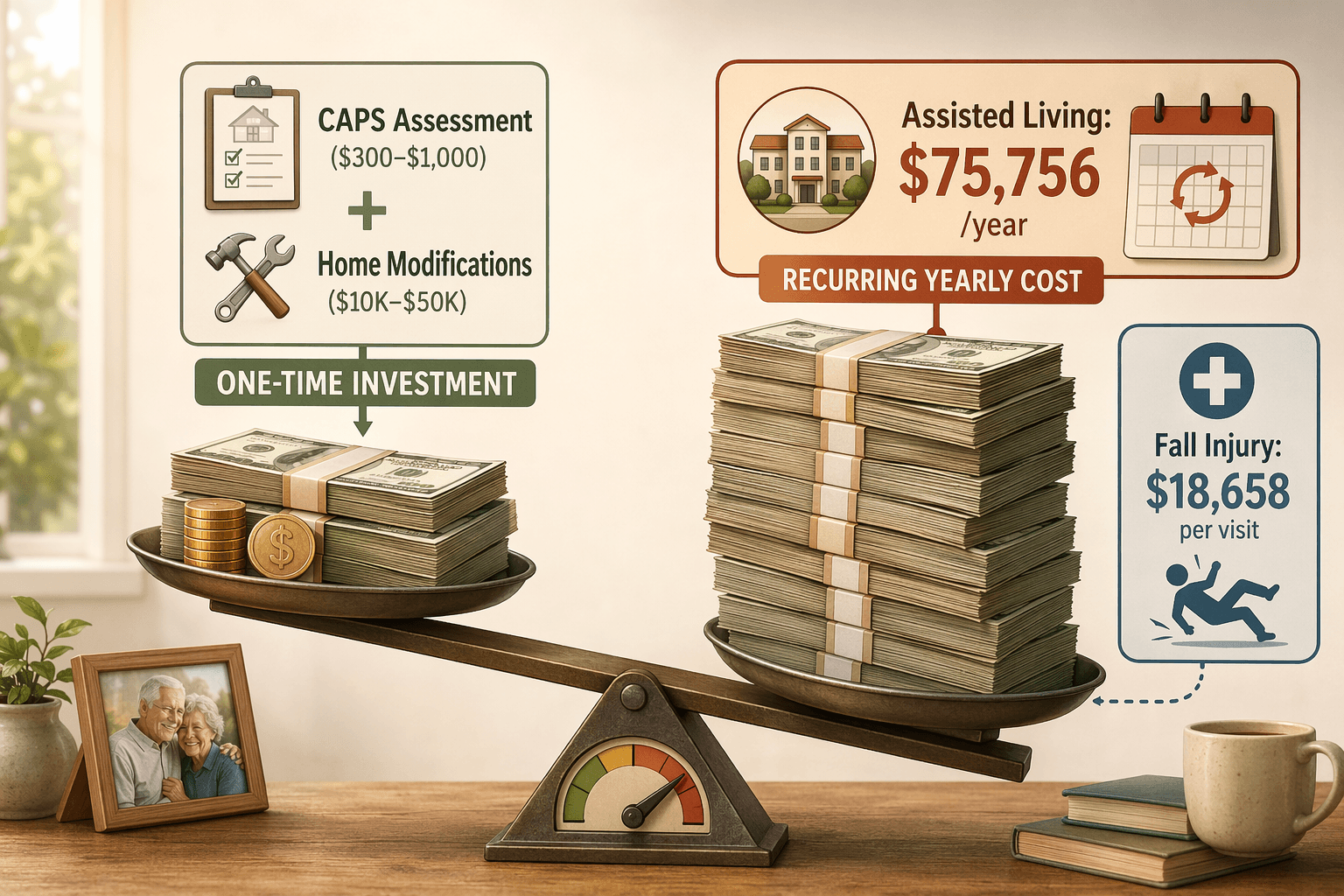
The one-time cost of CAPS modifications (left) compared to the recurring costs of assisted living and fall-related medical bills (right). The scale difference is not exaggerated.
How to Pay for It: Funding Sources for Home Modifications
The biggest barrier to home modifications is not a lack of willingness — it is the upfront cost. Many families assume they have to pay entirely out of pocket. While 77% of modifications are indeed self-funded, according to the University of Michigan National Poll on Healthy Aging, there are several funding sources that can significantly reduce the financial burden.
Funding sources for home modifications. Eligibility requirements, funding limits, and application processes vary. Consult each program directly for current details.
Funding Source
What It Covers
Key Details
Medicaid Home and Community-Based Services (HCBS) waivers
Home modifications that are medically necessary to prevent institutionalization
Varies by state; typically requires a determination of need and a care plan
VA Specially Adapted Housing (SAH) grant
Modifications for veterans with service-connected disabilities
Up to $117,014 (2026); must be used for a home the veteran owns or will own
VA Special Home Adaptation (SHA) grant
Modifications for veterans with specific service-connected disabilities
Up to $23,444 (2026); lower threshold than SAH
USDA Rural Development Housing Repair Loans and Grants
Repairs and modifications for very low-income homeowners in rural areas
Grants up to $10,000; loans up to $40,000; must be age 62+ or unable to obtain credit elsewhere
Nonprofit and community programs (e.g., Habitat for Humanity, Rebuilding Together)
Free or low-cost modifications for low-income seniors
Availability varies by location; often includes volunteer labor
IRS medical expense deduction
Medically necessary home modifications
Deductible as itemized medical expenses if they exceed 7.5% of adjusted gross income
For families who do not qualify for these programs, the most practical approach is often a phased plan. Start with the highest-impact, lowest-cost modifications — grab bars, improved lighting, non-slip flooring — and spread larger projects like bathroom remodels over multiple years. A CAPS professional can help prioritize which modifications deliver the most risk reduction for the least cost.
A Decision Framework: Invest in Your Current Home or Plan to Move?
Not every home is a good candidate for modifications, and not every family should choose to stay. The decision to invest in CAPS-guided modifications versus planning a move to a senior living facility depends on several factors. The framework below can help families weigh their options.
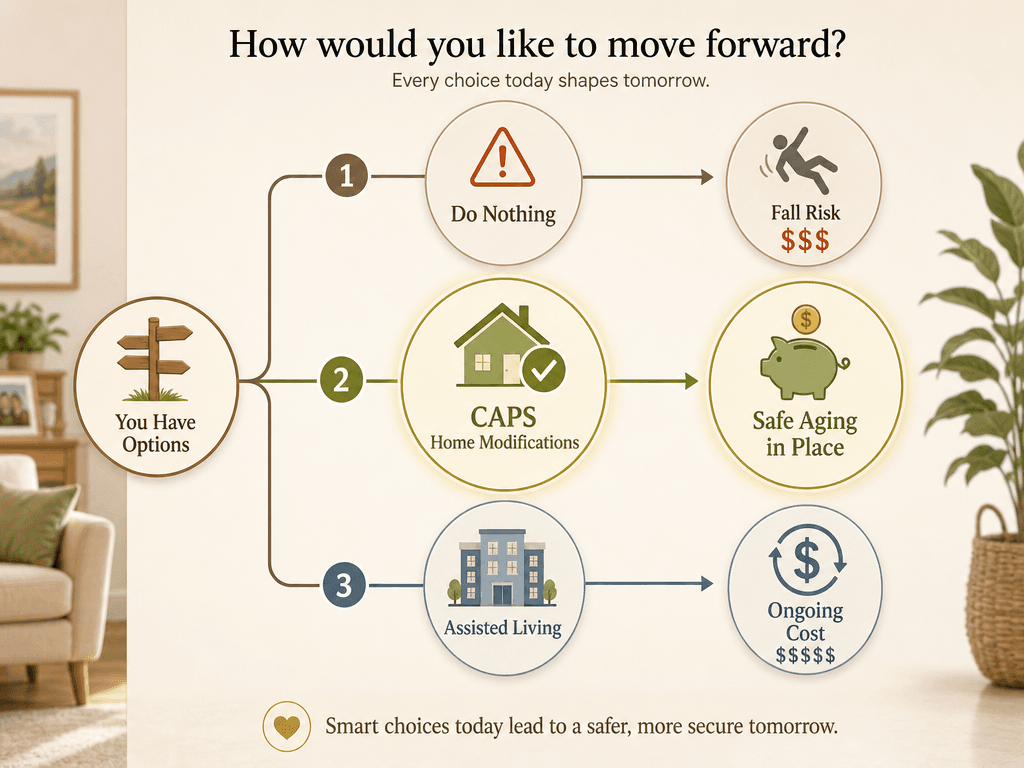
Three pathways for aging in place. The CAPS route (highlighted) is the only one that combines safety, independence, and a one-time cost structure.
Ask these questions before deciding:
Is the home structurally suitable for modifications? A home with a narrow layout, load-bearing walls that cannot be moved, or a foundation that cannot support a ramp may require modifications that are prohibitively expensive. A CAPS assessment can answer this question definitively.
What is the timeline for care needs? If the older adult is currently independent but showing early signs of mobility decline, modifications made proactively are less expensive and less disruptive than emergency renovations after a fall. If the person already requires significant assistance with activities of daily living, assisted living may be the more appropriate choice.
What is the financial picture? Compare the one-time cost of modifications to the recurring cost of assisted living. If the family can afford a $20,000–$50,000 renovation but cannot sustain $75,000 per year in facility costs, modifications are the clear financial winner.
Is there a caregiver support system? Aging in place works best when there is a family caregiver or paid home care available to provide assistance with tasks that modifications cannot address, such as medication management, bathing, and meal preparation. Without a support system, even a perfectly modified home may not be safe.
What does the older adult want? The 88% of adults 50+ who prefer to age in place are not wrong to want that. But the decision must be based on realistic assessment, not wishful thinking. A CAPS professional can provide the objective data needed to make an informed choice.
The bottom line is this: the cost of doing nothing is not zero. It is $80 billion nationally and potentially tens of thousands of dollars for your family. A CAPS assessment is a small, one-time expense that can unlock a path to safer, more affordable aging in place. The question is not whether you can afford the modifications — it is whether you can afford not to make them.

Comments
Join the discussion with an anonymous comment.