
24-Hour Home Care vs. Facility Care: An Honest Cost and Decision Framework for Family Caregivers
A decision framework for adult children facing a crisis moment, comparing 24/7 home care against assisted living and memory care using cost breakpoints, clinical needs, and hidden costs to determine the most realistic option.
The Crisis Moment That Triggers This Decision
It often starts with a single phone call. Your mother has fallen in the bathroom and cannot get up. Your father, who has dementia, wandered out of the house at 2 a.m. and was found by a neighbor. Or the hospital discharge planner is telling you that your parent cannot return home alone after a hip replacement. In that moment, the abstract question of "future care" becomes an immediate, urgent decision: Can we bring round-the-clock help into the home, or is it time to look at a facility?
This guide is built for that moment. It does not rehash the broad spectrum of senior living options — we have covered that elsewhere in our Senior Care Options by Level of Need framework. Instead, it focuses on a single, high-stakes fork in the road: 24-hour home care versus a residential facility. The decision is rarely about which is "better" in the abstract. It is about which option fits your specific constellation of care hours, medical needs, and hidden financial realities.
What 24-Hour Home Care Actually Costs in 2026
The first number most families encounter is jarring. According to A Place for Mom's 2026 Cost of Long-Term Care and Senior Living Report, the national median cost of 24/7 nonmedical home care is approximately $24,733 per month. That figure is based on the national median hourly rate of $34 per hour multiplied across 168 hours of weekly coverage. By comparison, the national median cost of assisted living in 2026 is $5,419 per month.
On its face, the comparison looks absurd — home care appears to cost more than four times as much as a facility. But this raw number comparison is deeply misleading, and understanding why is the first step toward a sound decision.
| Care Model | National Median Monthly Cost (2026) | What It Includes | Staffing Model |
|---|---|---|---|
| 24/7 Home Care (awake shifts) | $24,733 | 168 hrs/week one-on-one care, meals, light housekeeping, companionship | 2-3 caregivers rotating 8-12 hour shifts; at least one caregiver awake at all times |
| Live-In Home Care | $8,000 - $12,000 | One dedicated caregiver present 24 hrs/day; 8-hour sleep break and meal breaks legally required | Single caregiver with legally entitled rest periods; typically 1-2 days off per week |
| Assisted Living | $5,419 | Private or semi-private room, meals, social activities, shared staffing, some personal care | Shared staff-to-resident ratio; no one-on-one care |
| Memory Care | $6,000 - $8,000+ | Secured unit, dementia-specific programming, higher staff-to-resident ratio than assisted living | Specialized staff with dementia training; higher supervision than assisted living |
The critical distinction is that $24,733 buys 168 hours of one-on-one, dedicated attention each week. The $5,419 assisted living figure buys a room, meals, and access to shared staff who may be responsible for 10 to 20 residents at a time. These are fundamentally different products. The question is not which is cheaper — it is which level of attention your parent actually needs.
The Breakpoint Rule: When Home Care Becomes More Expensive Than a Facility
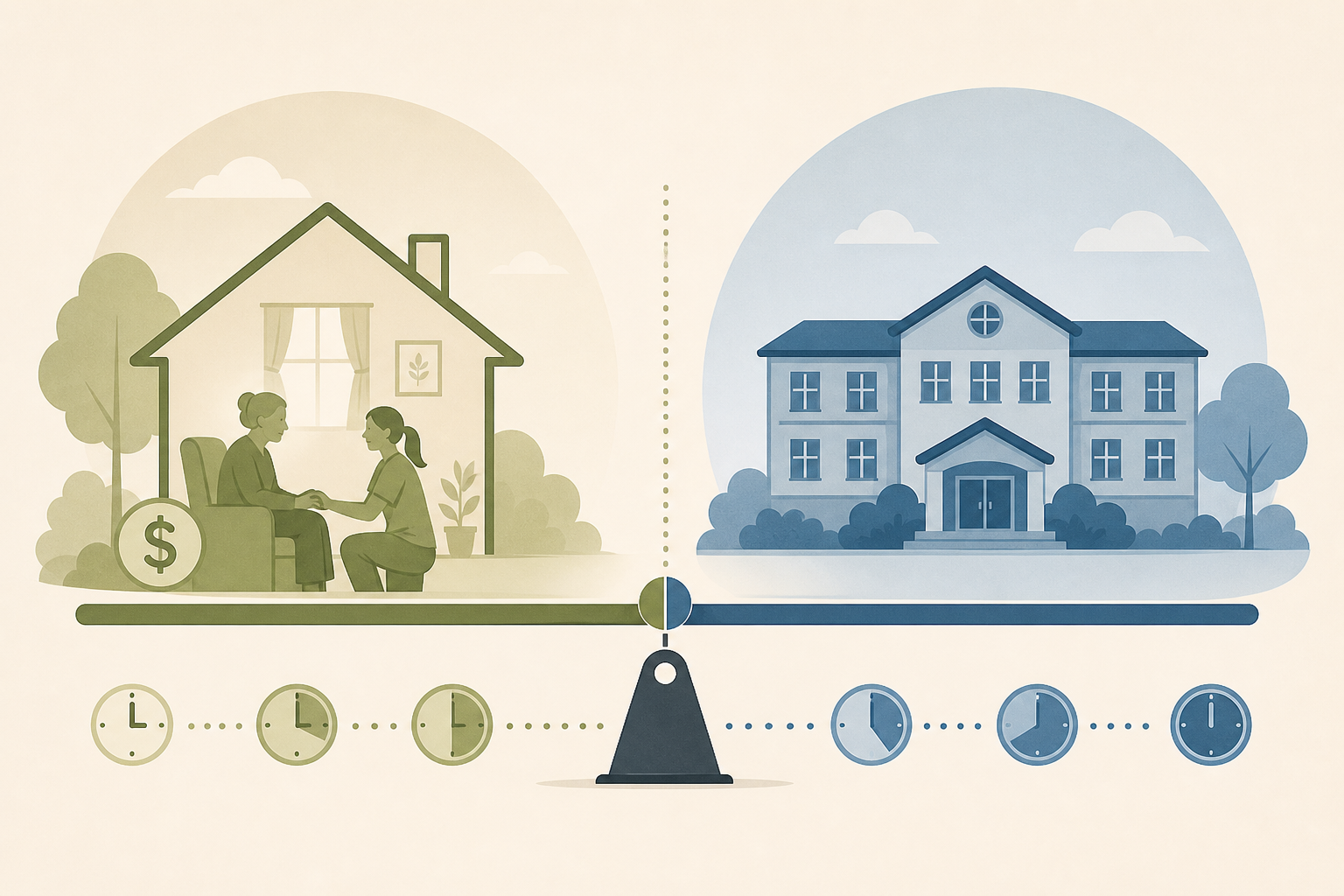
The most useful mental model for this decision is the breakpoint hours concept. Home care is billed by the hour. Facility care is billed by the month. At low weekly hour volumes, hourly care is dramatically cheaper. At high volumes, the math flips.
Using the national median hourly rate of $34, here is how the weekly cost scales:
| Weekly Hours of Care | Hourly Cost at $34/hr | Weekly Cost | Monthly Cost (4.3 weeks) | Cheaper Than Assisted Living ($5,419/mo)? |
|---|---|---|---|---|
| 20 hours (part-time) | $34 | $680 | $2,924 | Yes |
| 30 hours | $34 | $1,020 | $4,386 | Yes |
| 40 hours | $34 | $1,360 | $5,848 | No — slightly more expensive |
| 44 hours (estimated breakpoint) | $34 | $1,496 | $6,433 | No — ~$1,000 more |
| 60 hours | $34 | $2,040 | $8,772 | No — significantly more |
| 168 hours (24/7) | $34 | $5,712 | $24,733 | No — 4.5x more |
The practical implication is straightforward: if your parent needs fewer than 40 hours of care per week, hourly home care is almost certainly the more affordable option. If they need more than 60 hours per week, facility care will almost always win on cost alone. The gray zone between 40 and 60 hours is where the other factors — clinical needs, personal preferences, and hidden costs — become decisive.
Live-In Care: A Cost-Effective Middle Option
Between part-time hourly care and full 24/7 awake care lies a frequently overlooked middle path: live-in care. A live-in caregiver resides in the home and provides care during waking hours, with legally entitled breaks for meals and an uninterrupted eight-hour sleep period each night. According to Care.com and Masonicare data, live-in care typically costs between $8,000 and $12,000 per month — significantly less than the $24,733 for round-the-clock awake care, but more than assisted living.
Live-in care works well for seniors who are stable through the night — they sleep without wandering, do not need bathroom assistance every two hours, and do not have medical conditions that require overnight monitoring. It is a poor fit for someone with dementia who sundowns, wanders, or becomes agitated after dark, because the live-in caregiver is legally entitled to uninterrupted sleep.
Federal Department of Labor regulations require that live-in caregivers receive a private sleeping space and at least eight hours of uninterrupted sleep time. If the caregiver is woken during that period to assist the senior, they must be paid for that time — and if this happens regularly, the arrangement effectively becomes 24/7 awake care, which requires multiple caregivers and a much higher budget.
For families whose parent is safe overnight but needs substantial daytime support, live-in care can cut the monthly cost by more than half compared to 24/7 awake care, while still providing the comfort of remaining at home.
When 24-Hour Home Care Is Clinically Superior — and When It Isn't
Cost is only one dimension of the decision. Clinical appropriateness is the other, and it often overrides cost entirely. There are clear scenarios where 24/7 home care is the safer, more effective choice, and equally clear scenarios where a facility is the better environment.
When 24/7 Home Care Is the Better Choice
- Dementia with nighttime wandering or sundowning: When a person with dementia becomes agitated, confused, or mobile after dark, a live-in caregiver who is sleeping cannot respond. 24/7 awake care with rotating shifts ensures someone is always alert and available to redirect, comfort, or prevent wandering. TheKey's clinical guidance specifically recommends 24-hour care (two caregivers working 12-hour shifts) for dementia patients who may wander or sundown.
- Post-hospital or post-surgical recovery in a familiar environment: After a hip replacement, stroke, or major surgery, the familiarity of home can accelerate recovery and reduce delirium risk — but only if round-the-clock supervision is in place to prevent falls, manage pain schedules, and ensure medication compliance.
- Frequent falls or compromised balance: According to the National Council on Aging, one in four older Americans falls each year, and a senior is treated in an ER for fall-related injuries every 11 seconds. A dedicated caregiver present at all times can intervene before a fall happens — clearing pathways, assisting with transfers, and ensuring safe ambulation.
- Family caregiver exhaustion: TheKey's list of signs that 24/7 care is needed includes "family caregivers suffering sleep deprivation or chronic stress." If you, as the primary family caregiver, are experiencing burnout, sleep deprivation, or declining health, 24/7 professional care may be the only sustainable option — regardless of the cost comparison.
When Facility Care Is the Safer Option
- Isolation risk: A senior living alone at home with 24/7 caregivers still lives at home. If social isolation, loneliness, or depression are primary concerns, a facility with structured social activities, communal dining, and peer interaction may provide better quality of life than one-on-one care in an empty house.
- Need for 24/7 skilled nursing: Home care aides are not nurses. If your parent requires wound care, IV medications, ventilator support, or other skilled nursing interventions around the clock, a skilled nursing facility (SNF) is the appropriate setting. Home health nursing can supplement home care for a few hours per week, but it cannot replace 24/7 skilled coverage.
- Severe behavioral symptoms that require a structured environment: Aggression, severe agitation, or psychosis that does not respond to redirection or medication may require the structured, secured environment of a memory care unit or behavioral health facility. Home care agencies may not be able to staff caregivers with the specialized training needed for these behaviors.
- Home environment is unsafe or cannot be modified: If the home has narrow doorways, stairs that cannot be navigated, no accessible bathroom, or structural issues that make safe care impossible, the cost of modifying the home plus 24/7 care may exceed the cost of a facility. Our
For dementia-specific decisions, our Home Care, Assisted Living, or Memory Care? A Staged Decision Guide for Dementia Caregivers provides a more detailed stage-by-stage framework.
Hidden Costs Families Miss
The cost comparison between home care and facility care is incomplete without accounting for the expenses that do not appear on any agency invoice. These hidden costs can shift the math by thousands of dollars per month.
- Housing costs that continue: When a senior moves to a facility, the family can sell or rent the home. When care comes into the home, the mortgage or rent, property taxes, homeowners insurance, utilities, and maintenance costs continue. For a paid-off home, this may be just property tax and insurance ($300-$800/month). For a home with a mortgage, it could be $1,500-$3,000/month or more.
- Agency backup and shift coverage fees: Most home care agencies charge a premium for last-minute shift coverage, holiday hours, and weekend staffing. If a caregiver calls in sick, the agency may charge a higher rate for the replacement. Over a year, these fees can add 10-15% to the base cost.
- Foregone family caregiver income: According to AARP (2025), nearly half of family caregivers experience at least one major financial impact from caregiving. If you reduce your work hours, take unpaid leave, or leave the workforce entirely to coordinate care, that lost income is a real cost of the home care decision. For a family caregiver earning $60,000/year, even a six-month leave represents $30,000 in foregone income.
- Home modifications and supplies: Grab bars, shower chairs, ramps, stair lifts, hospital beds, and other equipment may be necessary to make the home safe for 24/7 care. These costs can range from a few hundred dollars (grab bars, non-slip mats) to $10,000+ (stair lift, bathroom remodel).
- Service duration: According to Todd Austin, president and COO of Activated Insights, the average in-home care service duration is 15-20 months. This is not indefinite care. Families should plan for a finite period, not a permanent arrangement, and revisit the decision every 12-18 months.
A Question-Based Decision Framework
Rather than offering a one-size-fits-all recommendation, here is a structured set of questions organized around the three breakpoints. Work through them with your family, and the right option will emerge from your answers.
Breakpoint 1: Hours of Care Needed
- How many hours per week does your parent actually need someone present and attentive? Be honest — not how many hours you wish they needed, but the reality based on the past month.
- Can they be left alone for 4 hours? 8 hours? Overnight?
- Do they need someone awake and available throughout the night, or can a live-in caregiver sleep?
- If the answer is under 40 hours/week, hourly home care is likely the most cost-effective option. If it is over 60 hours/week, facility care will almost certainly be cheaper.
Breakpoint 2: Level of Medical Oversight
- Does your parent need skilled nursing care (wound care, IV medications, tube feeding) or just personal care (bathing, dressing, toileting, companionship)?
- Are there behavioral symptoms (aggression, severe wandering, psychosis) that require a secured environment or specialized staff?
- Is the home environment safe and modifiable, or would significant structural changes be needed?
- If skilled nursing is needed 24/7, a facility is the only realistic option. If personal care is sufficient, home care is viable.
Breakpoint 3: True Monthly Costs
- What is the total monthly cost of keeping the home (mortgage/rent, utilities, insurance, maintenance, property taxes)?
- What is the monthly cost of 24/7 home care at local rates? (Call three local agencies for quotes — do not rely on national medians.)
- What is the monthly cost of the most appropriate facility option (assisted living, memory care, or skilled nursing) within a reasonable distance?
- What is the foregone income if a family member reduces work hours or leaves a job to coordinate care?
- Add the home costs + home care costs + foregone income. Compare that total to the facility cost. The difference is the real financial gap.
| Scenario | Home Care Path | Facility Path | Key Deciding Factor |
|---|---|---|---|
| Parent needs 25 hrs/week of companionship and light help | Hourly home care: ~$3,400/month | Assisted living: ~$5,419/month | Home care is cheaper; no need for facility |
| Parent has dementia, wanders at night, needs 168 hrs/week | 24/7 awake care: ~$24,733/month | Memory care: ~$6,000-$8,000/month | Facility is dramatically cheaper and safer |
| Parent is stable overnight but needs daytime support (12 hrs/day) | Live-in care: ~$10,000/month | Assisted living: ~$5,419/month | Cost gap is narrower; clinical and personal preference decide |
| Parent needs 24/7 skilled nursing after a stroke | Not feasible — home health aides cannot provide 24/7 skilled care | Skilled nursing facility: varies by location | Facility is the only clinically appropriate option |
How to Pay for 24/7 Care: A Layered Funding Strategy
Very few families pay for 24/7 care from a single source. The most successful approach is layering multiple funding streams to cover the total monthly cost. Here are the most common layers, from most accessible to most restrictive.
- Private pay (savings, retirement accounts, pension income, Social Security): This is the default layer for most families. According to SingleCare, 56% of Americans mistakenly think assisted living costs under $4,000/month, so the first step is recalibrating expectations about what private pay can realistically cover.
- Long-term care insurance: If your parent has an LTC insurance policy, review the daily or monthly benefit amount, the elimination period (waiting period before benefits begin), and whether the policy covers home care specifically (many older policies only cover facility care).
- VA Aid & Attendance: Veterans and surviving spouses may qualify for up to $2,295/month (2026 rates, subject to annual COLA adjustments) to help pay for home care or assisted living. This benefit is not automatic — it requires an application with medical and financial documentation.
- Medicaid Home and Community-Based Services (HCBS) waivers: These waivers allow Medicaid funds to be used for home care instead of nursing home care. However, availability, eligibility criteria, and waiting list lengths vary dramatically by state. Contact your state's Medicaid office or Area Agency on Aging to determine whether your parent qualifies and how long the wait is.
- Medicare: Original Medicare does not cover long-term home care or custodial care. It covers short-term skilled home health care (typically up to 60 days) after a hospitalization, but only if the patient needs skilled nursing or therapy services. Do not count on Medicare for ongoing 24/7 care.
A realistic funding stack for a family paying $10,000/month for live-in care might look like: $3,000 from the parent's Social Security and pension, $2,295 from VA Aid & Attendance, $2,000 from long-term care insurance, and $2,705 from family contributions. For a family facing $24,733/month for 24/7 awake care, the gap is much wider — and that is precisely why the breakpoint analysis matters. If the hours of care needed push the cost beyond what any realistic funding stack can cover, facility care is not a compromise; it is the only financially sustainable path.
Related reading
Noticed something outdated or inaccurate on this page? Flag a correction. We review every report against CDC, NIA, and AARP HomeFit guidance before updating a page.
Part of the Fall Prevention section.