
STEADI: Intervene
River Cruise Disruption Checklist for Seniors
A phased checklist for seniors and family caregivers planning a European river cruise — what to do before booking, before sailing, and the moment a low- or high-water disruption is announced, with medication, mobility-aid, and fall-risk steps at every stage.
On July 28, 2026, reports from Europe put the Danube at Budapest at a record-low 28 cm, described the river as its lowest since 1996, and noted Rhine depth near Frankfurt at 53 cm. The same late-July disruption cycle included a Viking river ship grounding and altered sailings on the Danube and Rhine.[1][2]
For an older traveler, the practical issue is not just a missed abbey, castle, or wine tasting. It is what happens next: a coach transfer, a ship swap, a hotel night, a moved embarkation point, or a gangway that is steeper than it was supposed to be. A river cruise disruption checklist for seniors has to start there, because cruise lines usually try to operate around water levels rather than cancel the whole trip.

What disruption usually means on a European river cruise
Low water is most common in summer and early autumn; high water is more likely in late winter and spring. Either can interfere with bridges, locks, docks, and navigable depth. The important word is “interfere.” The usual response is not a clean cancellation with a simple refund. River cruise operators may modify the itinerary, swap passengers into a sister ship, lighten the load, move sightseeing to land-based tours, or keep the ship in place as a floating hotel.[3]
That pattern showed up in the 2026 reports. Viking used ship swaps into sister ships with identical stateroom categories. A Uniworld SS Emilie sailing missed three ports, substituted bus excursions, and ended with early disembarkation and a hotel night. Viking’s Rhine Getaway included a five-hour coach transfer, and one embarkation was moved from Basel to Koblenz.[1][2]
Those are not small changes for a 72-year-old with a rollator, heart medication, diabetes supplies, or a bad knee. A five-hour bus ride is not the same risk profile as walking from cabin to dining room. A ship swap is not just “same room, different vessel” if the traveler’s mobility aid is under a bus, the medication bag is in checked luggage, and the group is being hurried over cobblestones.
The financial surprise: itinerary changes usually do not trigger reimbursement
Ordinary itinerary changes are generally built into cruise contracts, and standard travel insurance usually does not reimburse a traveler simply because a port was missed, the order changed, or the line substituted a land tour. Cancel For Any Reason coverage, when available, is different from standard cancellation coverage and must be bought under the policy’s timing rules.[4][5]
That does not mean insurance is useless. It means the useful questions are different. A senior traveler should verify medical coverage abroad, emergency evacuation, pre-existing-condition waiver rules, and CFAR eligibility early, not after the first low-water email arrives. Medicare generally does not cover medical expenses outside the United States, and ship doctors do not accept standard health insurance directly.[6]
Some senior-focused travel-insurance advisors suggest looking for about $100,000 in emergency medical coverage and about $250,000 in medical evacuation coverage, while noting that transatlantic air-ambulance repatriation can cost $100,000 to $150,000. Treat those as recommendation ranges to verify against the actual policy, not as legal requirements or guarantees.[7]
This article is general education, not medical, legal, or financial advice. Before travel, confirm medical plans with a clinician and policy terms with the insurer or licensed advisor.
Before booking: ask about the disruption you are actually likely to get
The brochure sells smooth dock-to-dock travel. The contract and operations team tell you what happens when the river does not cooperate. Before paying the deposit, ask the cruise line or travel advisor to explain the line’s current practice for low water, high water, ship swaps, coach transfers, missed ports, early disembarkation, and hotel substitutions.
- If the ship cannot pass a shallow or high-water section, does the line usually swap passengers into a sister ship, keep the ship docked, move guests by coach, or cancel?
- If a ship swap is used, who handles luggage, and when will passengers be separated from carry-ons, mobility aids, CPAP equipment, or medication bags?
- If sightseeing moves to coaches, how many coach boardings may occur in one day, and are there alternatives for passengers who cannot manage repeated steps?
- If embarkation or disembarkation moves to another city, how long is the transfer likely to be, and is assistance available at both ends?
- If the ship is used as a floating hotel, will passengers still need to cross rafted ships or steep gangways for meals, tours, or departure?
For a senior with limited stamina, the number of transitions matters more than the brand name on the funnel. One bus transfer may be manageable. A bus transfer after breakfast, a walking tour over uneven paving, a return across a rafted vessel, and a luggage handoff before dinner is a different day.
Buy insurance early enough for the terms you care about
Many policies require purchase soon after the first trip deposit to preserve pre-existing-condition waivers or CFAR eligibility; the common window is roughly 10 to 15 days, but the exact deadline varies by policy.[4][5] Do not wait for drought photos or flood warnings to sort this out. By then, the useful options may already be gone.
When comparing policies, keep the questions narrow:
- Does the policy cover emergency medical care in every country on the route?
- Does it include medical evacuation, and who decides whether evacuation is medically necessary?
- What are the exact pre-existing-condition waiver requirements?
- Is CFAR included or available, what percentage is reimbursed, and what is the cancellation deadline?
- What, if anything, is covered when the cruise operates but the itinerary changes?
Screen the route for mobility friction, not just scenery
European river cruising can be a good format for older adults because it reduces hotel changes and long overland travel. That advantage weakens when water disruption turns the trip into repeated transfers. Accessibility guides for river cruising warn that rafted moorings may require passengers to cross another ship, riverbanks can involve steep gangways, coaches have steps, and many port towns have cobblestones or uneven walking surfaces.[10][11]
Ask accessibility questions in plain language. “Can you accommodate a rollator?” is too vague. Better: “If the ship is rafted, can my mother avoid stairs?” “Will a crew member carry the rollator across the gangway, or must she fold and lift it?” “If the bus parks away from the quay, how far is the walk on uneven ground?” “If the itinerary changes, who decides whether she can safely join the substituted excursion?”
If the answer is polished but not specific, keep asking. A senior does not need a perfect guarantee. She needs to know which movements may become unsafe so the family can choose a different cabin, a different sailing month, a different route, a private transfer, or a trip that does not depend on repeated coach substitutions.
Decide now what never goes into checked luggage
The safest packing rule is simple: medications and essential mobility items stay with the traveler. Not “nearby.” Not “with the luggage team.” With the traveler, or with the designated companion who stays physically beside that traveler.
- Prescription medications, including rescue medications and time-sensitive doses
- A written medication list with generic names, doses, timing, allergies, and prescribing clinician contacts
- Copies of prescriptions when available
- Glasses, hearing-aid supplies, chargers, CPAP accessories, glucose-monitoring supplies, and other daily-function items
- Cane, foldable walking stick, rollator accessories, braces, or other equipment needed for safe transfers
This is where a pre-trip medication review belongs. If a medication causes dizziness, sleepiness, dehydration risk, blood-pressure drops, or urgent bathroom trips, that matters on a moving gangway and during a rushed bus stop. Caregivers who want a broader home-based framework can adapt the medication and risk-review habits in the fall prevention handout for seniors before turning them into a travel checklist.
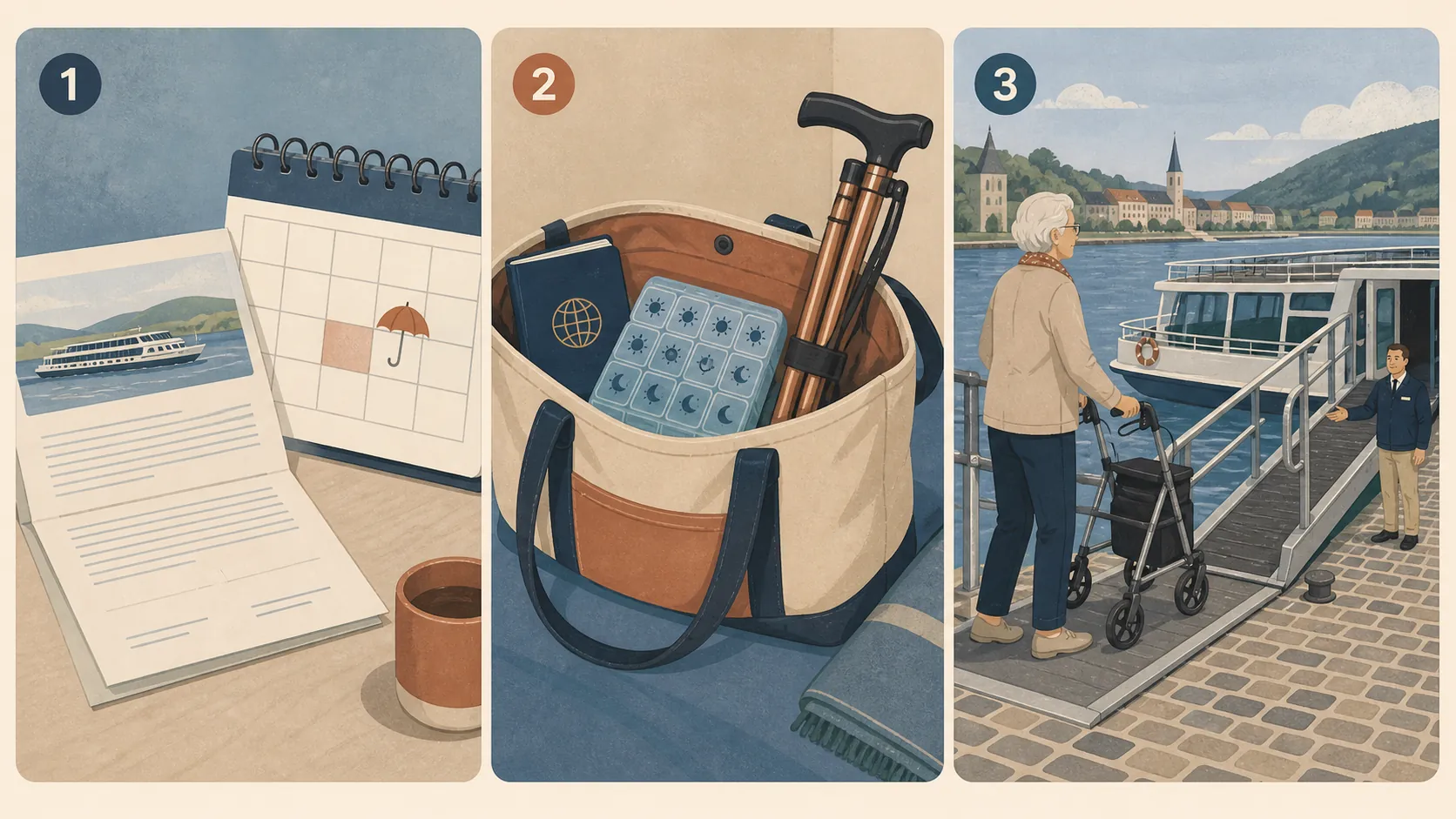
Before sailing: make the disruption kit boring and obvious
The week before departure is not the time for clever packing. It is the time to make important things easy to identify, easy to grab, and hard to misplace.
- Keep medications in original labeled containers when practical, with a medication list in the carry-on and a second copy with the travel companion.
- Put the traveler’s name, mobile number, ship name, and companion contact on the rollator, cane, folding wheelchair, CPAP bag, and medication pouch.
- Choose one small bag that always moves with the senior during transfers. It should be light enough to carry safely and distinctive enough that a crew member does not mistake it for luggage.
- Assign roles before the trip: one person watches the traveler’s footing; one person watches the medication and documents; nobody assumes the cruise staff has both covered.
- Photograph the mobility aid, medication bag, passport page, insurance card, and cruise emergency contact information.
For fall-risk planning, use the same thinking you would use at home, then apply it to the ship and shore. The CDC says falls are the leading cause of injury for adults 65 and older, about 1 in 4 older adults falls each year, and the age-adjusted fall death rate rose 21% from 2018 to 2024.[8] Travel adds unfamiliar surfaces, hurry, fatigue, dehydration, and crowds.
Cruise-specific injury evidence should be used carefully. A three-year study of injuries on an ocean cruise ship, not a river ship, found a median injured-passenger age of 72; slips, trips, and falls accounted for 44.8% of onboard injuries and 69.4% of shore injuries, with cabins and bathrooms the top onboard locations.[9] It is an extrapolation, not river-cruise proof, but it points to the right caution: the risky moment is often ordinary movement in an unfamiliar place.
A caregiver who wants to pressure-test the plan can use the questions in the fall prevention FAQ for seniors and caregivers and apply them to the cabin bathroom, gangway, coach steps, and shore-excursion meeting point.
When a disruption is announced: slow the transfer before it starts
The announcement may sound tidy: “We will transfer guests by coach,” “You will join a sister ship,” “Tonight will be in a hotel,” or “Tours will operate from an alternate port.” The safety work begins before anyone stands up.
| If the line announces | Ask immediately | Safer default for the senior |
|---|---|---|
| Ship swap | How many gangways, stairs, coach rides, and luggage handoffs are involved? | Carry medications and documents personally; keep the mobility aid with the traveler until the last safe handoff. |
| Coach transfer | How long is the ride, how many stops are planned, and are restrooms accessible? | Board slowly, use handrails, and choose safety over staying with the fastest group. |
| Missed port with bus excursions | Is the excursion optional, and what surfaces or walking distances are expected? | Skip or shorten the excursion if fatigue, cobblestones, heat, or steps make it unsafe. |
| Early disembarkation and hotel night | When will checked luggage be unavailable, and where will medications be overnight? | Move all daily medical items into the carry-on before bags leave the cabin. |
| Floating-hotel arrangement | Will passengers need to cross rafted ships or steep gangways for meals or tours? | Treat every ship-to-shore movement as a supervised transfer, not a casual walk. |
Get the movement sequence, not just the destination
Do not settle for “the crew will assist.” Ask for the sequence. Cabin to lobby. Lobby to gangway. Gangway to rafted ship, if any. Stairs or elevator. Quay surface. Walk to coach. Coach steps. Rest stop. Hotel entrance. Room access. Each link is a place where a fall, separation from medication, or loss of the mobility aid can happen.
If the staff cannot answer yet, ask when they will know and where the senior should wait. Standing on cobblestones while the group sorts luggage is not a neutral choice for someone with poor balance. Sitting inside until the path is ready may be safer than being first in line.
Move medications before the luggage plan takes over
The first practical question is: “Where are tonight’s and tomorrow morning’s medications right now?” If they are in the cabin, retrieve them before luggage is collected. If they are in a suitcase, open the suitcase before it leaves the room. If refrigeration, needles, glucose supplies, inhalers, or rescue medications are involved, tell the staff exactly what needs to stay with the traveler.
Do this even if the line says the bags will arrive at the hotel or sister ship. They probably will. “Probably” is not good enough for a medication that is due before bedtime or before breakfast.
Treat the rollator like essential equipment
A rollator, cane, brace, or folding wheelchair is not ordinary luggage. Before the group moves, ask who will handle it at each step and when the traveler will get it back. If it must be folded for the coach, decide how the traveler will safely get from the coach door to the seat and from the coach to the next walking surface.
Do not let the aid disappear into the luggage hold without a plan for the next standing moment. The awkward minute at the coach door is exactly where a tired traveler may reach for a rail that is not there, step down too quickly, or turn on uneven paving.
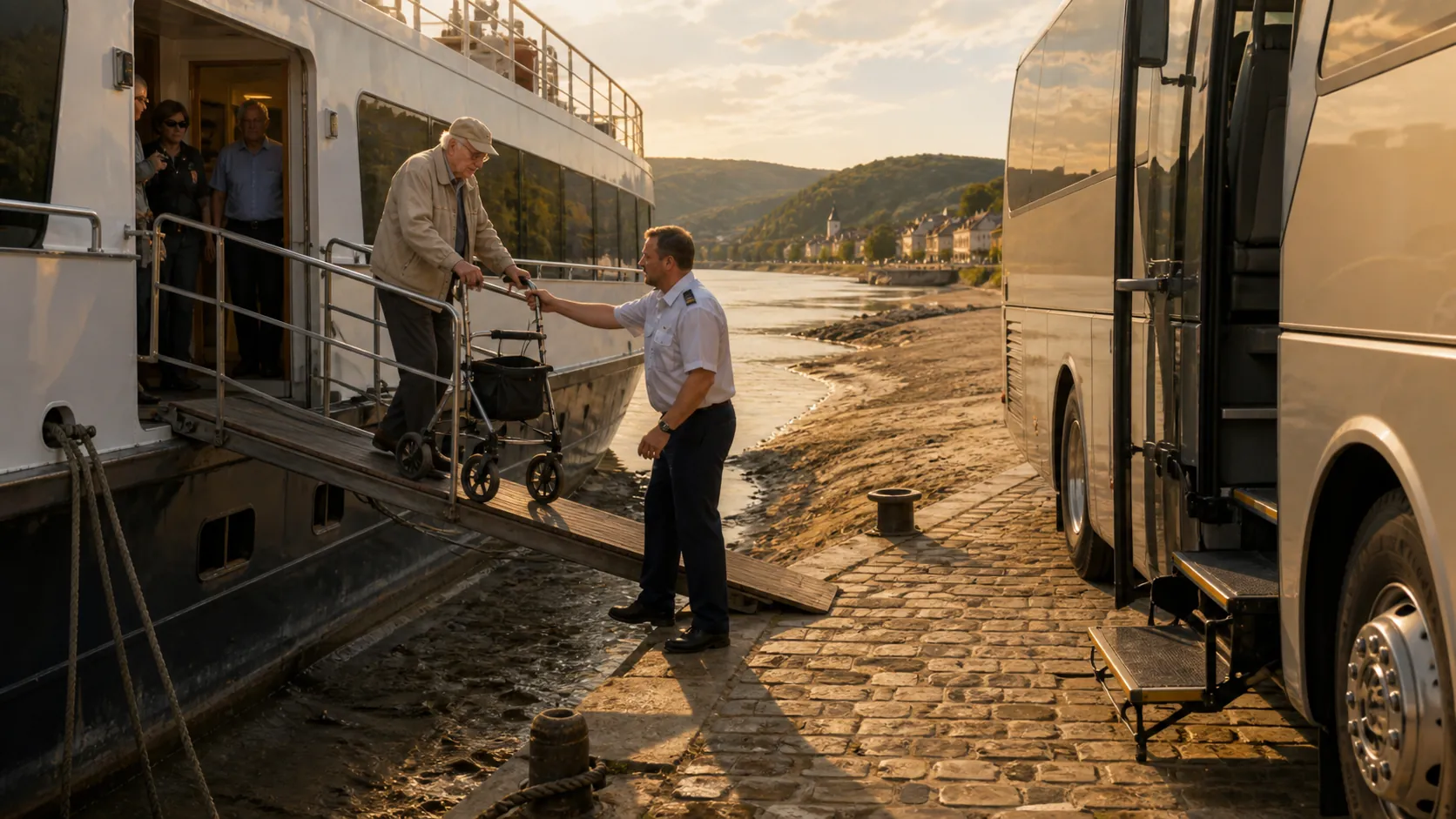
Give yourself permission to refuse the substituted outing
A missed port can be disappointing, and it can feel financially unfair when the substitute is a long bus ride or a shortened tour. That frustration is real. It still should not push a senior into a transfer that is obviously wrong for the day’s stamina, weather, pain level, or balance.
Ask what happens if the traveler stays onboard, remains at the hotel, takes only the first part of the excursion, or uses a taxi or private transfer at personal expense. The answer may not be ideal. It may still be safer than following the group because the tour was included.
Printable checklist: the three phases
Before booking
- Ask how the line handles low water, high water, ship swaps, coach transfers, missed ports, early disembarkation, and floating-hotel arrangements.
- Read the itinerary-change and cancellation language before assuming a refund will apply.
- Buy third-party insurance early enough to preserve any pre-existing-condition waiver or CFAR option you want, then verify exact policy terms.
- Confirm emergency medical and evacuation coverage abroad, especially if relying on Medicare at home.
- Ask accessibility questions about rafted ships, gangways, stairs, coach steps, cobblestones, and substituted land tours.
- Decide that medications, documents, and essential mobility items will not travel in checked luggage during transfers.
Before sailing
- Pack medications in a carry-on with a written medication list, copies of prescriptions when available, allergy information, and clinician contacts.
- Label mobility aids, CPAP bags, medication pouches, and essential equipment with traveler and companion contact information.
- Photograph key documents, equipment, and bags.
- Assign a companion to watch footing during transfers and a companion to track medications and documents.
- Review fall-risk triggers: fatigue, dizziness, bathroom urgency, dehydration, unfamiliar steps, wet surfaces, and uneven paving.
When disruption is announced
- Ask for the full movement sequence: gangways, rafted ships, stairs, coach rides, walking distance, luggage handoffs, hotel access, and timing.
- Move all medications and essential medical supplies into hand luggage before suitcases leave the cabin.
- Confirm where the cane, rollator, brace, or wheelchair will be at every transfer point.
- Ask whether the substituted excursion is optional and what safer alternatives exist.
- Slow the group down before the risky movement begins. Gangways, coach steps, rafted vessels, and cobblestones are fall-risk events, not inconveniences.
River levels are unpredictable. Your response does not have to be: medications stay with the traveler, mobility aids are treated as essential equipment, and every disruption transfer is handled as a fall-risk event.
References
- Low Water Disrupts Danube and Rhine River Cruises, Cruise Critic
- River cruise lines low water levels Danube, The Independent
- Water levels river cruises, World of Cruising
- Travel Insurance Primer for Cruise Travelers, Cruise Critic
- Cruise Travel Insurance, Squaremouth
- Cruise Tips for Senior Travelers, Cruise Critic
- Best Cruise Insurance for Seniors, AARDY
- Older Adult Falls Data, Centers for Disease Control and Prevention
- Injuries aboard a cruise ship, PubMed
- A Guide to Accessible River Cruises, Cruise Critic
- River Cruise Accessibility, River Cruise Advisor, 2018
Related reading
Noticed something outdated or inaccurate on this page? Flag a correction. We review every report against CDC, NIA, and AARP HomeFit guidance before updating a page.
Part of the Fall Prevention section.