
STEADI: intervene
Flash Flood Fall Prevention Checklist for Seniors
A plan-ahead flash flood checklist for seniors that prioritizes fall prevention — covering when to evacuate, how to secure mobility aids and medications, and how to avoid falls during cleanup — based on official safety guidance.
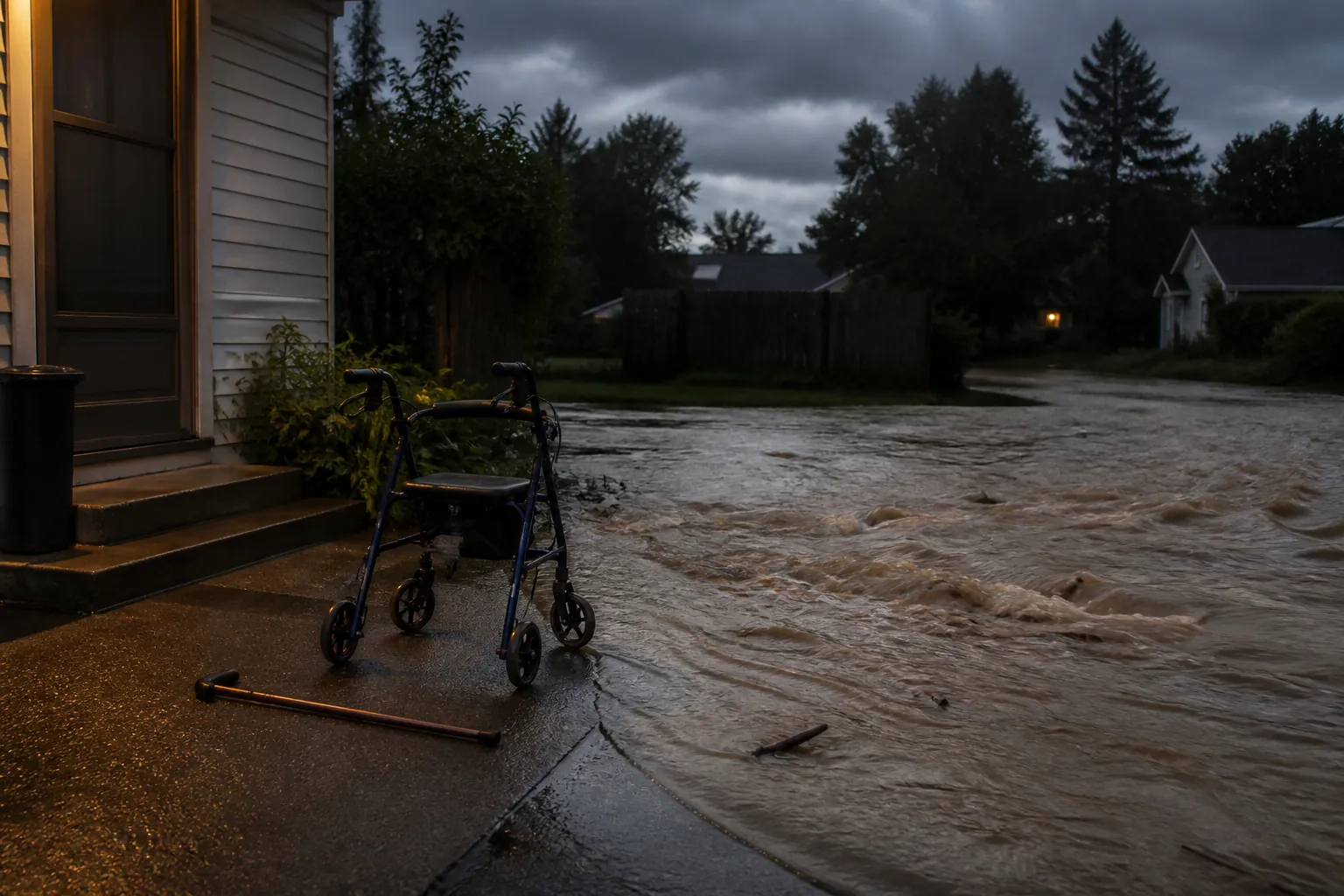
Six inches of fast-moving water can knock an adult off their feet. For an older adult using a cane, walker, oxygen tubing, bifocals, or unsteady knees, that is not an abstract flood fact. It is the moment a doorway, driveway, curb, or wet step becomes impossible to cross safely. The National Weather Service warns that 6 inches of moving water can knock a person down, and 12 inches can carry away most cars; the Red Cross gives the same warning in its flood safety guidance.[1][2]
This is a plan-ahead checklist, not live emergency instructions. If there is an active flash flood warning, evacuation order, trapped person, rising indoor water, electrical danger, or medical emergency, follow local alerts and call emergency services. A web checklist should never outrank local officials, dispatchers, or responders who know what is happening on the ground.
The reason to plan early is simple: a flood watch and a flood warning are not the same thing. A watch means flooding is possible. A warning means flooding is occurring or imminent and immediate precautions are needed.[2] For a person who needs extra time to stand, transfer, gather medication, reach a car, or get help down steps, the useful window may be the watch, not the warning.
Older adults are not a footnote in flash flood planning. AARP reported, citing National Weather Service data, that adults 50 and older accounted for 59% of U.S. flash and river flood deaths in 2024; it also reported that about two-thirds of the roughly 150 Hurricane Ian deaths in 2022 were among people 65 or older.[3] Those figures should be read as a risk signal, not as a prediction for any one household. The practical lesson is enough: the plan has to work for the person who may be alone when the first alert arrives.
The checklist follows the water, not the weather report
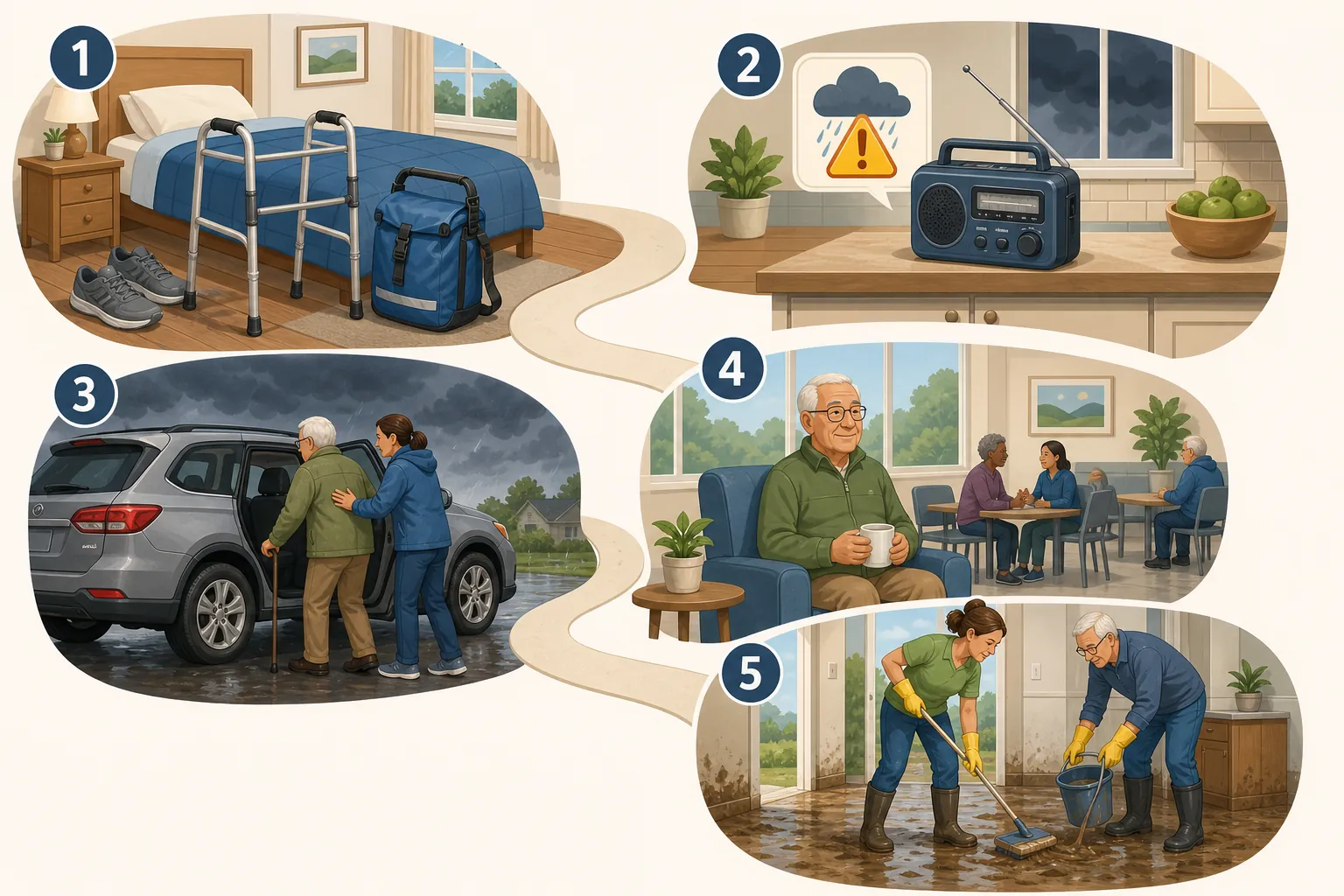
A useful emergency preparedness checklist for seniors during flash flooding has to protect balance before, during, and after the storm. The danger is not only deep water. It is the hurried turn out of bed in poor light, the walker left in another room, the wet threshold, the flooded road that looks shallow, and the mud on the kitchen floor after the water is gone.
| Phase | Main decision | Fall-prevention goal |
|---|---|---|
| Before any watch | Make the home, supplies, transportation, and support network ready | Reduce rushing, reaching, carrying, and last-minute walking hazards |
| During a flood watch | Decide whether to leave early | Move while surfaces are dry, help is available, and daylight or transportation still works |
| During a warning or evacuation order | Follow official instructions immediately | Avoid testing balance against moving water or flooded roads |
| While leaving | Carry only what can be carried without sacrificing stability | Keep hands, footwear, mobility aids, medications, and route choices under control |
| After water recedes | Re-enter and clean only with clearance and help | Prevent falls, electrical injury, mold exposure, and cleanup-related injuries |
Before any watch: make leaving physically possible
The best flood action for many seniors happens on an ordinary dry day: shoes placed where feet can find them, cane and walker labeled, medication packed, phone charged, neighbor assigned. These are small decisions, but they remove the worst kind of emergency movement — the kind done while bending, searching, turning, and arguing with time.
Start by finding out whether the home is actually in a flash-flood-prone place. The CDC advises checking with the county geologist or county planning department to learn whether a property is in an area likely to flood, and it also advises informing local authorities about older adults or people with disabilities in the household where appropriate.[4] This is not paperwork for its own sake. It helps decide whether a watch should trigger early evacuation instead of waiting.
Walk the home as if the lights are dim and the floor is damp. A person using a walker needs more width than an alert headline usually imagines. A person with neuropathy may not feel a small rise at the threshold. A person who keeps a cane by the sofa may not have it by the bed when a nighttime alert sounds.
- Clear two ways out of bedrooms and main living areas whenever the layout allows. The Red Cross recommends older adults plan two ways out of every room.[5]
- Keep a cane, walker, rollator, wheelchair, hearing aids, glasses, dentures, and shoes in consistent places, not wherever they landed at the end of the day.
- Put sturdy, closed-toe shoes near the bed and the main chair. Slippers that twist, slide, or soak through should not be the flood footwear.
- Remove throw rugs, cords, low boxes, and furniture that narrow the path from bed to bathroom, bedroom to exit, and chair to exit.
- Label walkers, wheelchairs, oxygen equipment, and grab bags with the senior’s name and a support contact.
- Keep a flashlight or battery lantern where the senior can reach it without standing on tiptoe, bending into a closet, or crossing the room in the dark.
If this sounds similar to heat, smoke, winter, or neighborhood fall planning, it should. The same household discipline applies: reduce distance, reduce clutter, reduce surprise. For a sister plan-ahead pattern, see the heat and wildfire smoke safety checklist for seniors, and for traction and doorway habits in bad weather, the winter checklist for seniors living alone.
Build the support network before anyone is scared
A support network should be specific enough that no one is improvising from a kitchen table during a warning. The Red Cross recommends older adults create a support network; Ready.gov also tells older adults to include support-network members in their emergency planning.[5][6]
- Choose at least two people who will check in when a flood watch is issued, not only when a warning arrives.
- Write down who can drive, who has a key, who can lift a walker into a vehicle, who can take a pet, and who can stay on the phone while the senior moves through the house.
- Agree on a short script: “Flood watch is active. Are your shoes on? Is your grab bag by the door? Do you want me to come now?”
- Do not make one adult child the entire plan if that person works nights, lives across a bridge, or may be outside the flood area but unable to reach the home.
- Keep printed phone numbers in the grab bag and near the main phone. A phone with a dead battery should not erase the plan.
Choose destinations in more than one direction
Ready.gov advises planning several evacuation destinations in different directions and keeping a vehicle’s gas tank at least half full in case evacuation becomes necessary.[7] For an older adult, “somewhere to go” should not mean one relative’s house across a low-water crossing. It should mean a short list: a relative, a friend, a hotel, a community shelter, or another safe place on higher ground, with routes that do not all depend on the same road.
Write the destinations on paper. Include addresses, phone numbers, whether there are stairs, whether a walker fits through the entrance, whether pets are allowed, and whether the bathroom is usable for the senior. A beautiful guest room is not a safe evacuation destination if the only toilet is upstairs.
Pack for carrying, not for completeness
Emergency kit lists often become too heavy for the person they are supposed to protect. Ready.gov recommends one gallon of water per person per day for several days and says supplies should be stored in airtight plastic bags inside one or two easy-to-carry containers.[8] For a senior with a walker, “easy to carry” may mean a small waterproof crossbody bag plus a rolling bin that a helper can move — not one large tub that blocks both hands.
- Medication list, pharmacy phone number, prescriber names, allergies, diagnoses, and copies of insurance and ID cards.
- Medications in a waterproof bag, with a current pill schedule printed in large type.
- Extra eyeglasses, hearing-aid batteries, denture supplies, incontinence supplies, and any small assistive item that would make walking or communication harder if forgotten.
- Phone charger, backup battery, flashlight, whistle, and printed contact list.
- Water, shelf-stable food, and basic hygiene supplies packed so the senior does not have to lift everything at once.
- A change of socks and sturdy footwear if the senior may leave in house shoes or at night.
- Pet leash, carrier, food, vaccination records, and cleanup bags if pets are part of the evacuation plan.
Medication guidance is not perfectly uniform. The Red Cross tells older adults to keep at least a 30-day supply of medications and medical supplies, while California’s aging disaster tip sheets use a 10-day supply figure.[5][9] Treat that as an attributed range, then ask the prescriber and pharmacist what is realistic for the senior’s medication schedule, refill rules, refrigeration needs, and controlled-substance limits. Do not wait until a storm is forecast to discover that a medication cannot be refilled early.
Falls are already common without floodwater in the doorway. The CDC reports that more than one in four older adults falls each year.[10] Flash flooding adds the worst ingredients: urgency, poor lighting, uneven ground, wet footwear, distraction, and the temptation to carry too much.
During a flood watch: leave early if safe exit depends on conditions staying good
A flood watch is the decision point for many older adults. It is the time to leave if the senior’s safe exit depends on daylight, dry walking surfaces, a helper arriving, accessible transportation, a charged oxygen concentrator, a pet carrier, or extra time to manage a walker, cane, wheelchair, medications, documents, or continence supplies.
Waiting can feel reasonable when rain is still light. It may also quietly remove every advantage the senior needs: the neighbor leaves, the driveway slicks over, the road closes, the phone battery drops, the walker basket fills with too many things, and the person who could have walked slowly now has to hurry.
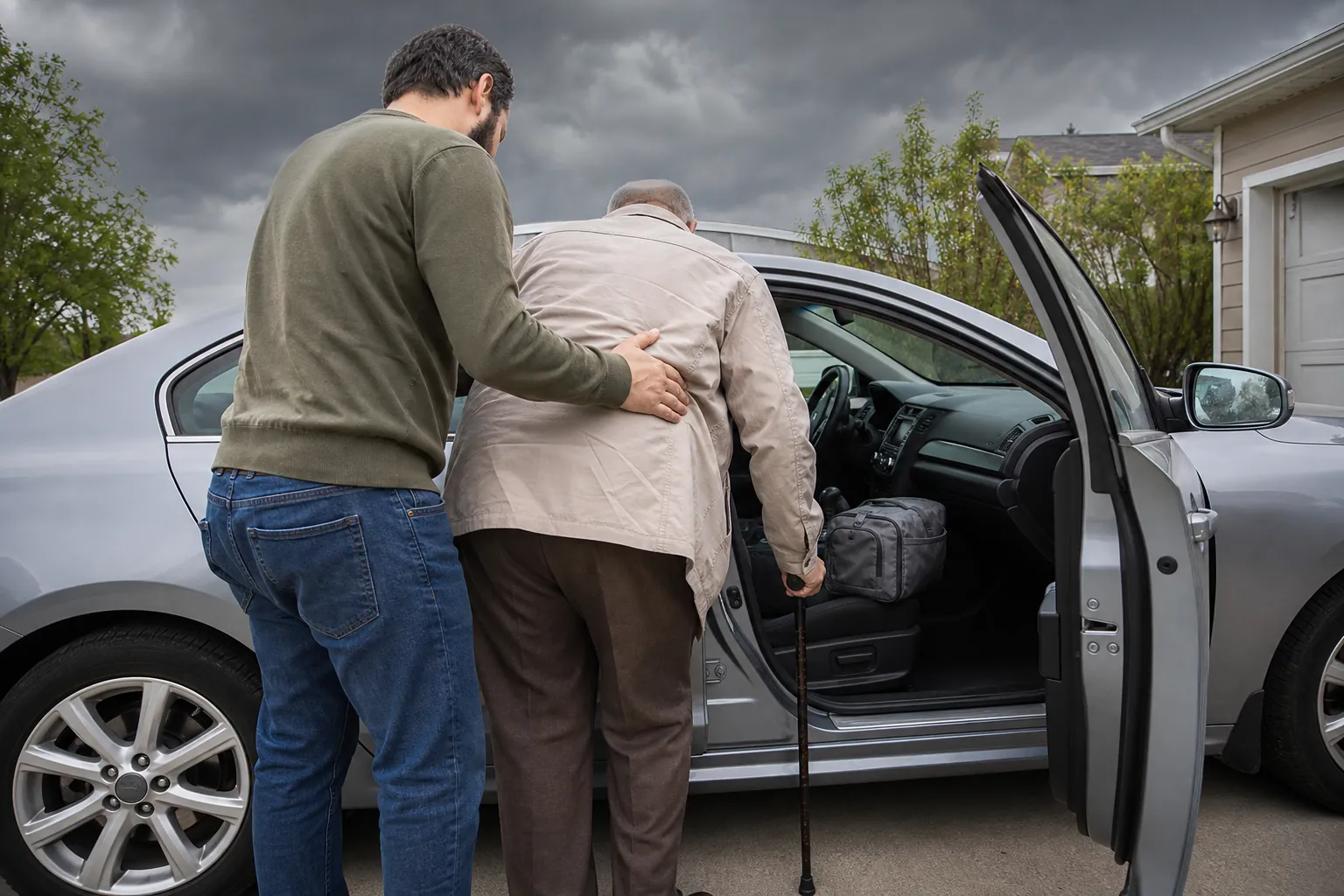
- Leave during the watch if the home has flooded before, sits in a flash-flood-prone area, or depends on a road that often closes.
- Leave during the watch if the senior needs help transferring, walking down steps, loading a mobility aid, or securing oxygen or medical equipment.
- Leave during the watch if nighttime flooding would make the route harder to see or if the senior has low vision, dizziness, neuropathy, or a history of falls.
- Leave during the watch if the planned driver, caregiver, or neighbor may become unavailable once roads worsen.
- Leave during the watch if the senior has pets that will slow departure once rain, thunder, or water alarms make them harder to handle.
This is not overreacting. It is matching the timing of evacuation to the body that has to perform it. The warning phase is for immediate protective action; it is not the best time to test whether a wet step, a rolling walker, and a rising ditch can be managed together.
Transportation with a mobility aid needs its own dry run
Before storm season, practice the boring part: getting the walker into the trunk, folding the rollator, transferring into the passenger seat, buckling the seat belt over a stiff shoulder, and placing the grab bag where it can be reached without twisting. If a bus, paratransit vehicle, or community shuttle is part of the evacuation plan, confirm pickup rules and what happens during weather disruptions before the forecast turns urgent. For everyday transit details that affect evacuation confidence, see these bus safety tips for older adults.
The support person should know what not to do as well: do not pull the senior by one arm, do not rush a walker over gravel, do not stack bags on the senior’s lap until they cannot see their feet, and do not ask them to step into water to save time.
During a warning or evacuation order: do not negotiate with moving water
A flood warning means flooding is occurring or imminent and immediate precautions are required.[2] If officials order evacuation, use official evacuation routes and leave as directed. If local officials say to shelter in place or move to higher ground because evacuation is no longer safe, follow that instruction instead. The right action depends on the local roads, water movement, and rescue conditions.
The non-negotiable rule is water. Never walk through moving floodwater. Never drive through a flooded road. The National Weather Service’s “Turn Around Don’t Drown” guidance exists because shallow-looking water can knock people down or carry vehicles away.[1]
California’s Department of Aging gives senior-specific flood guidance that is unusually direct: 6 inches of moving water can cause a fall, and if walking is unavoidable, walk only where water is not moving and use a stick to check the firmness of the ground in front of you.[9] That advice should not be used as permission to wade through uncertain water. It is a last-resort stability measure when official instructions and immediate conditions leave no safer option.
- Turn around at flooded roads, even if another vehicle has crossed.
- Do not step into moving water to test depth with a foot, cane, walker, or tire.
- Do not use a rollator seat as a place to rest in a wet roadway, driveway, or sloped outdoor surface.
- Do not separate the senior from their mobility aid unless a responder instructs it for rescue.
- Keep listening to official alerts; flood conditions can change faster than a family text thread can update.
While leaving: protect hands, feet, and attention
The actual exit is where good plans either hold or fail. The senior should not be turned into the pack mule for the household. Balance takes priority over one more bag.
- Put on sturdy, closed-toe shoes before standing for the final exit check.
- Use the normal mobility aid, not furniture, doorframes, or another person’s sleeve.
- Carry the waterproof medication and document bag in a way that leaves the hands as free as possible.
- Move one task at a time: stand, steady, pick up the bag, check the route, then walk.
- Keep pets contained before opening doors. A loose pet at the threshold can cause a sudden pivot or reach.
- Use ramps, rails, and well-lit exits when available. Avoid shortcuts over grass, gravel, mud, curbs, or uneven yards.
- If a helper is present, have the helper carry the heavier kit and open doors rather than pulling the senior forward.
Outdoor walking surfaces deserve the same suspicion as indoor clutter. A familiar driveway changes when rain hides the edge, mud covers the slope, or leaves collect underfoot. The same habits used for neighborhood fall safety — scanning ahead, avoiding broken surfaces, and not rushing curbs — become more important, not less, during flood evacuation.
If leaving is no longer safe
Sometimes the early window is missed, the road is already flooded, or officials instruct residents not to travel. At that point, the plan changes from “leave carefully” to “stay alive under official guidance.” Call emergency services if there is immediate danger, follow local alerts, and avoid entering floodwater inside or outside the home unless responders instruct otherwise.
Keep the senior, phone, medications, flashlight, shoes, and mobility aid together. If moving to a higher level is directed or necessary, move slowly and with help if available. Do not climb onto unstable furniture, wet counters, or damaged stairs as a substitute for rescue instructions.
After water recedes: visible floor is not safe floor
The flood is not over for fall prevention when the water line drops. Mud, slick flooring, warped boards, loose thresholds, hidden debris, wet electrical equipment, and fatigue can make cleanup as dangerous as evacuation. The Red Cross warns that many injuries happen during cleanup.[2]
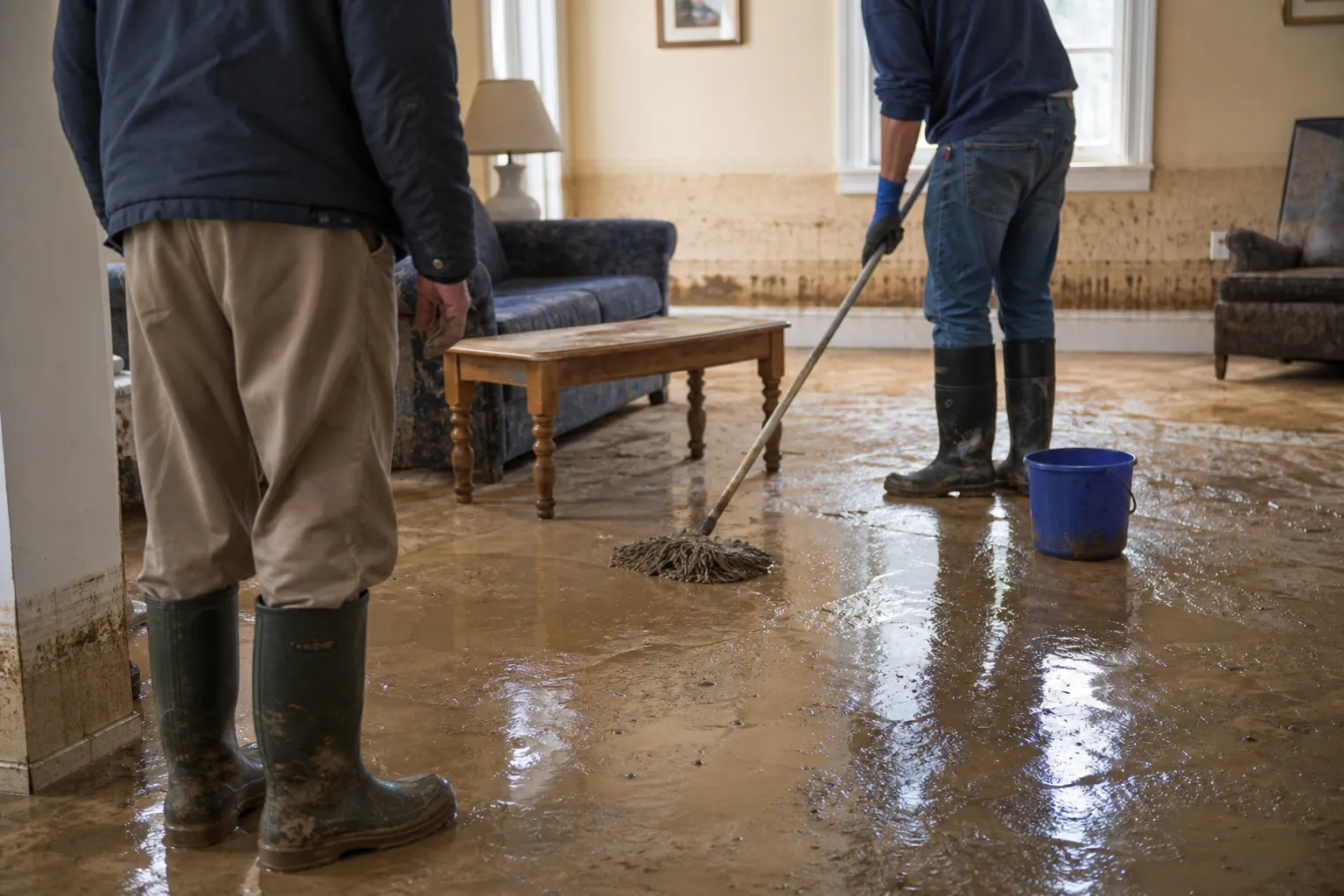
Re-entry should be official-clearance work, not a solo proof of independence. FEMA says to check with local officials before returning, photograph damage, wear long pants and sturdy shoes, and stay off damaged structures.[11] The CDC also warns not to touch wet electrical equipment and advises checking tetanus vaccination status after flood exposure.[4]
- Return only after officials say it is safe to do so.
- Photograph damage before moving items when it is safe.
- Keep the senior out of wet rooms, damaged structures, and areas with sagging floors, loose boards, or electrical hazards.
- Wear long pants, gloves, and sturdy shoes or boots; do not clean in sandals, slippers, or thin-soled shoes.
- Do not touch wet electrical equipment.
- Check tetanus status, especially if there are cuts, punctures, or contact with contaminated flood debris.
- Never run gasoline, propane, natural gas, or charcoal-burning devices indoors.
- Begin drying safely and promptly. The Red Cross says homes should be dried within 24 to 48 hours or mold should be assumed.[2]
Keep the first cleanup goal narrow: wait for clearance, keep the senior away from unstable and wet surfaces, and make cleanup partner-assisted. For the broader fall-prevention side of recovery, use the post-storm guide on avoiding falls during cleanup.
The safe endpoint is plain: the senior is out before water rises, safely waiting under official guidance if evacuation is no longer possible, or delaying cleanup until clearance and help are in place. The checklist protects balance before the flood, during the exit, and after the floor looks solid but is still trying to take a person down.
References
- Turn Around, Don't Drown — National Weather Service
- Flood Safety — American Red Cross
- Texas Flood Victims — AARP
- Preparing for Floods — Centers for Disease Control and Prevention
- Older Adults Emergency Preparedness — American Red Cross
- Older Adults — Ready.gov
- Evacuation — Ready.gov
- Build A Kit — Ready.gov
- Disaster Preparedness Disaster Tip Sheets — California Department of Aging
- Facts About Falls — Centers for Disease Control and Prevention
- Stay Safe Cleaning Up After a Flood — FEMA
Related reading
Noticed something outdated or inaccurate on this page? Flag a correction. We review every report against CDC, NIA, and AARP HomeFit guidance before updating a page.
Part of the Fall Prevention section.