
STEADI: Intervene
Flood Evacuation Safety Checklist for Seniors
A complete flood evacuation checklist built for older adults — from knowing your flood risk and deciding to leave early, to the go-bag, home shut-down, shelter, and drying out within the 24–48-hour mold window. It gives a sourced fix for each point where senior plans typically fail: waiting too long, no ride arranged, medications left behind.
A flood evacuation safety checklist for seniors has one job: make the hard parts happen before the water is at the curb. The usual failures are predictable. The ride is assumed, not confirmed. The medication list lives in a phone that may be dead. The walker is still beside the bed. Someone waits for a mandatory order even though leaving takes longer with oxygen, poor night vision, a wheelchair, refrigerated insulin, or no nearby driver.
Floodwater is not a judgment call. The National Weather Service gives three useful stop rules: 6 inches of fast-moving water can knock over an adult, 12 inches can carry away most cars, and 2 feet can carry away SUVs and trucks.[1] CDC flood guidance also notes that more than half of flood-related drownings happen when a vehicle is driven into hazardous floodwater.[2]
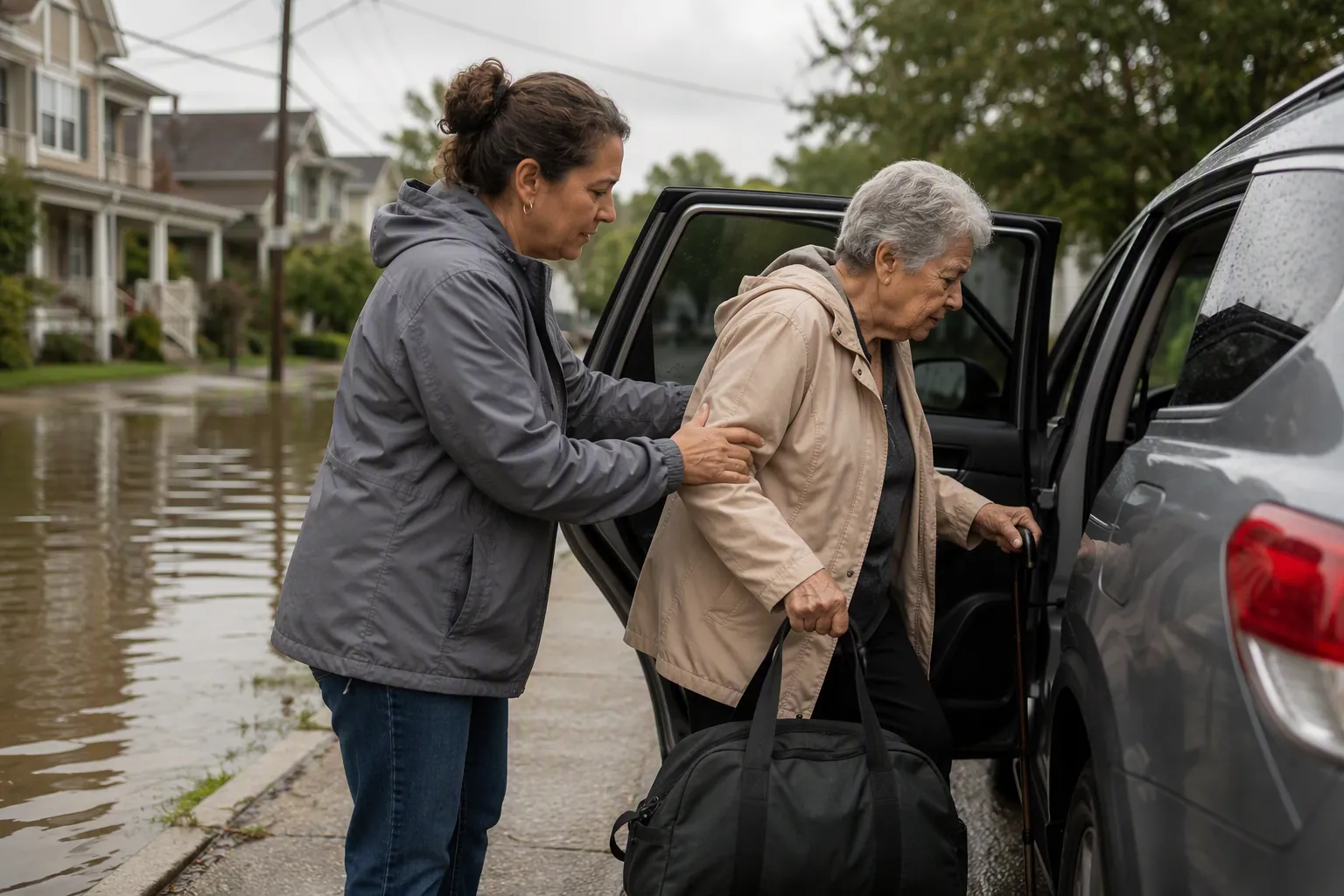
Before you print the checklist, put alerts where they will actually reach someone. Ready.gov says the FEMA app can send weather alerts for up to five locations, and its older-adult guidance recommends having at least one support-network person with a spare key who knows where emergency supplies are kept.[3] That is the difference between “Call me if it gets bad” and “Mara has the key, knows where the oxygen charger is, and will leave work when a flood warning is issued.”
Use this checklist in order
This is meant to be used twice: once on a quiet day, when everyone can think, and again when a flood watch or warning appears. Do not skip ahead to the go-bag if no one has confirmed the ride.
| Phase | Do this | What it prevents |
|---|---|---|
| 1. Know the risk | Check the home’s flood risk, local evacuation routes, county emergency management instructions, and weather-alert settings for the older adult’s address. | A plan based on memory, old routes, or one person’s phone. |
| 2. Decide when to leave | Set early triggers: flood watch plus mobility limits, flood warning, road closures nearby, loss of power for medical equipment, or any official evacuation instruction. | Waiting until evacuation is physically harder or impossible. |
| 3. Confirm the ride and support network | Name the driver, backup driver, and support person with a spare key. Put hard-copy phone numbers in the go-bag. | The “a neighbor can probably drive” failure. |
| 4. Pack the senior-specific go-bag | Pack current medication list, prescriptions or emergency supply, medical-device supplies, glasses, hearing aids, dentures, mobility aids, incontinence supplies, chargers, documents, water, and comfort items. | Leaving with clothes but without the things that keep the older adult safe and oriented. |
| 5. Shut down the home only if safe | If authorities advise it and there is time, follow local instructions for utilities. Do not delay evacuation to do one more task. | A caregiver taking unnecessary risk for the house. |
| 6. Leave using water rules | Do not walk or drive through moving water. Turn around if a road is covered. Treat wheelchair users and people with poor balance as having an even lower threshold. | Falls, vehicle sweep-away, and delayed rescue. |
| 7. Choose the destination | Use family or friends outside the flood area first if possible. If a shelter is needed, check county rules, accessibility, pet policies, medical-equipment rules, and special-needs registration. | Arriving somewhere that cannot handle the older adult’s needs. |
| 8. Return only when safe | Wait for officials to say re-entry is safe. Avoid contaminated water, generator fumes, unstable structures, and mold risk after wet materials sit. | Treating evacuation as over when the road reopens. |
Medication, oxygen, insulin, dialysis, and equipment decisions are medical decisions. Use this checklist to prepare the right questions, then ask the prescribing clinician, pharmacist, oxygen supplier, or home-health agency what is safe for this person.
Know the flood risk before anyone is tired, wet, or scared
Start with the older adult’s actual address, not a general feeling about the town. Check the county emergency management office for flood zones, evacuation routes, transportation programs, shelter information, and special-needs or access-and-functional-needs registration. Local rules change, and shelter capacity is local by nature, so a county page beats a confident national checklist here.
Then write down the practical weak points of that address:
- Which roads flood first?
- Is the driveway steep, gravel, or already hard to navigate with a walker?
- Can the older adult get into a car without a transfer board, ramp, or extra person?
- Does the garage door require power?
- Does the older adult rely on refrigerated medication, oxygen, a nebulizer, a CPAP machine, a power wheelchair, or an elevator?
- Can the main support person arrive if their own street floods?
For powered medical equipment, battery planning, generator placement, and medication storage during outages, build this flood plan alongside a 72-hour power outage safety checklist for seniors. Floods often bring power loss long before they bring a clean decision about evacuation.
Set the leave-early triggers while everyone still has choices
For many older adults, “wait for the mandatory order” is not conservative. It may be the risky option. Mandatory orders often arrive when roads are already crowded, rain is heavier, aides may be unavailable, and the person who needs two hours to dress, transfer, pack medications, and load a walker now has twenty minutes of calm left.
The mortality data that exist are disaster-wide, not river-flood-specific, so they should not be used as flood scare statistics. They do show why older adults deserve an earlier branch in the evacuation plan. AARP reports that people age 75 and older were about 6% of New Orleans’ population but about 50% of Hurricane Katrina deaths; it also reports that, in Hurricane Ian in 2022, 61 of 87 fatalities with released ages were age 60 or older.[4] Justice in Aging reports that 70% of Katrina deaths were older adults and that older adults made up about half of Hurricane Sandy deaths.[5]
The practical lesson is not that every flood is the same. It is that an older adult’s evacuation clock usually starts earlier than the public order.
Use these early triggers
- Leave when local officials recommend voluntary evacuation if the older adult has mobility limits, cognitive impairment, oxygen, refrigerated medication, dialysis needs, no night-driving option, or no nearby caregiver.
- Leave before dark if vision, balance, confusion, or transfer needs make nighttime evacuation harder.
- Leave when the driver says, “I can come now, but maybe not later.” A real ride now is safer than a theoretical ride after roads close.
- Leave when power loss would make the home unsafe for oxygen concentrators, stair lifts, elevators, CPAP equipment, refrigeration, heat, or cooling.
- Leave immediately when an official evacuation order applies to the address.
Plan with the older adult, not around them
A plan made over someone’s head is fragile. The Conversation’s hurricane-planning guidance for aging parents emphasizes planning with the older adult, not for them, and keeping hard-copy phone numbers because many older adults rely on preprogrammed phones.[6] That matters during a flood evacuation because a dead phone can erase the whole support network.
The conversation can be plain: “If the county issues a voluntary evacuation and the creek is rising, do you want to go to Karen’s house or the hotel near my work?” That keeps the decision specific without pretending the older adult has no say.
Confirm the ride before the watch becomes a warning
A support network is not a contact list. It is a set of people who have agreed to do named jobs. Red Cross older-adult guidance and AAGP disaster-preparedness guidance both support building a personal support network of at least three people.[7][8] For flood planning, give those people assignments that can be checked.
| Person | Job | What they need now |
|---|---|---|
| Primary driver | Picks up the older adult when the early trigger is met. | Address, route, mobility needs, car-seat height needs, and go-bag location. |
| Backup driver | Takes over if the primary driver is delayed or blocked by flooded roads. | Same information as the primary driver, plus permission to call directly. |
| Spare-key person | Can enter if the older adult cannot reach the door or phone. | Spare key, alarm code if applicable, and supply locations. |
| Medication checker | Confirms medication list, refrigerated items, device supplies, and chargers are packed. | Printed medication list and prescriber/pharmacy contacts. |
| Out-of-area contact | Receives status updates and tells others where the older adult went. | Hard-copy phone numbers and destination options. |
Do one short practice call: “If a flood warning is issued tomorrow at 3 p.m., can you come?” The answer may reveal the real plan. Someone who cannot leave work, does not drive in rain, or has a low-clearance car may still be useful, but not as the only ride.
Pack the go-bag for what this older adult would lose in fifteen minutes
Generic emergency kits are too easy to pack around the person. The senior-specific go-bag should answer a harsher question: if this older adult had to leave in fifteen minutes, what would be left behind that they cannot safely function without?
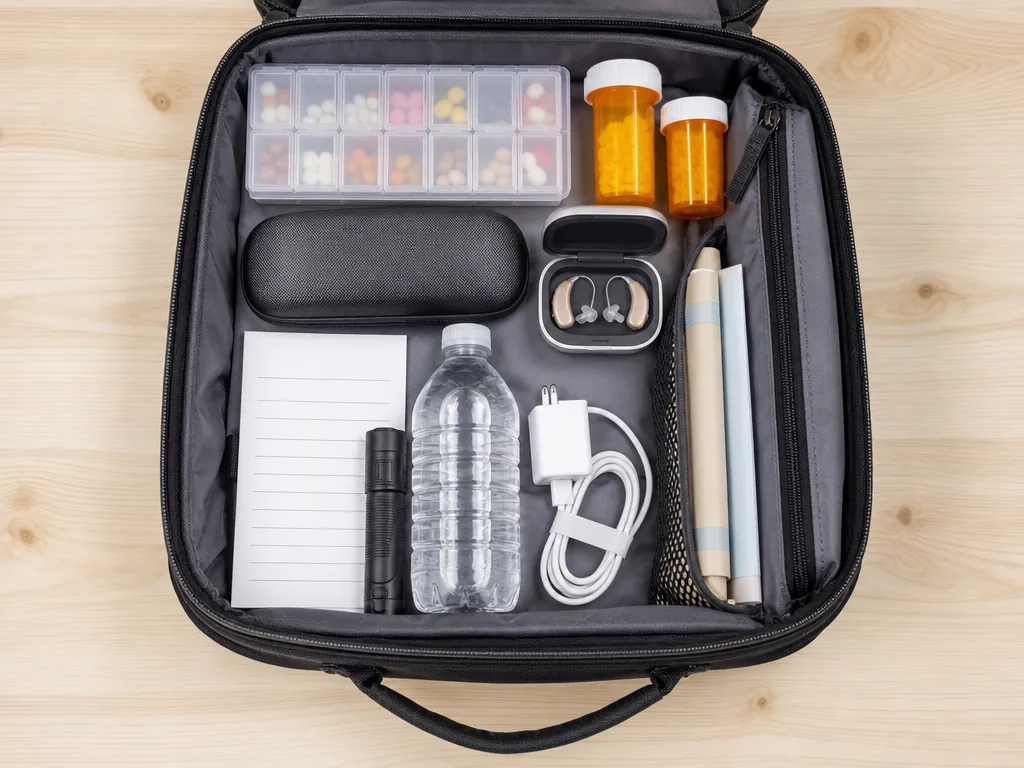
This is not theoretical. A scoping review of 20 studies found that many elderly evacuees did not bring prescriptions and could not recall medication names or dosages under stress. The reviewed literature specifically points to insulin supplies, glucometers, oxygen cylinders, nebulizers, wheelchairs, hearing aids, canes, walkers, dentures, glasses, and incontinence briefs as preparedness items for older adults.[9]
Medication and medical supplies
- Printed medication list with drug names, dosages, timing, prescribing clinicians, pharmacy phone number, allergies, and major diagnoses.
- Current prescriptions or an emergency supply approved by the prescriber or pharmacist.
- Insulin supplies, cooling method if required, glucometer, test strips, lancets, and batteries.
- Oxygen supplies, tubing, portable oxygen plan, concentrator battery plan, and supplier phone number.
- Nebulizer, inhalers, CPAP supplies, wound-care supplies, catheter supplies, or ostomy supplies as applicable.
- Copies of Medicare, Medicaid, insurance, prescription, and medical-device supplier information.
Do not rely on one universal medication-stockpile number. Red Cross advises a 30-day supply for older adults; NCOA and AAGP advise two weeks; California Department of Aging disaster tip sheets advise 10 days.[7][10][8][11] Treat that as an attributed range, then ask the pharmacist or clinician what emergency quantity is legal, safe, and refillable for this person’s medications.
Mobility, hearing, vision, and daily-living items
- Cane, walker, wheelchair, transfer board, wheelchair charger, cushion, or repair kit.
- Hearing aids, extra batteries or charger, cleaning tools, and a labeled storage case.
- Glasses, backup glasses if available, magnifier, and sunglasses if glare worsens vision.
- Dentures, denture cup, adhesive, and cleaning supplies.
- Incontinence briefs, wipes, barrier cream, disposable bags, and a change of easy-on clothing.
- Lightweight blanket, familiar sweater, small comfort item, or written routine for a person with memory loss.
Communication, documents, water, and power
- Hard-copy phone numbers for family, caregivers, doctors, pharmacy, oxygen supplier, home-health agency, veterinarian if applicable, and the out-of-area contact.
- Phone charger, backup battery, labeled charging cords, and hearing-aid or wheelchair charging cords.
- Photo ID, emergency contacts, advance directive or medical power of attorney if used, key medical records, and copies of important cards in a waterproof pouch.
- Water. Ready.gov’s older-adult guidance uses the standard rule of 1 gallon per person per day, with at least a three-day supply.[3]
- Shelf-stable foods that match medical needs and chewing/swallowing limits.
- Flashlight, batteries, whistle, cash in small bills, house key, car key, and written destination plan.
Pack the bag where the support person can find it, not where it looks tidy. If the older adult uses a walker every day, do not “pack” the walker in a closet. Put a tag on it: “Take this in evacuation.”
Shut down the home only if time and officials allow it
Home shut-down is conditional. If local officials tell residents to turn off utilities and it can be done safely before leaving, follow those instructions. If water is already rising, the caregiver should not wade to a shutoff, climb around a dark garage, or delay departure to save appliances. People leave first.
If there is time, do the boring things that reduce damage without trapping anyone:
- Move medications, documents, chargers, and mobility-device accessories into the go-bag or vehicle.
- Unplug small appliances if safe and dry.
- Move important items higher, but do not carry heavy boxes upstairs during an active evacuation.
- Lock doors, take keys, and tell the out-of-area contact when the older adult has left.
- Follow official instructions for gas, electricity, and water; do not improvise utility work.
CDC flood safety guidance is the baseline for avoiding floodwater, contaminated water, electrical hazards, and unsafe structures during and after flooding.[2] When local officials give more specific instructions, use the local rule.
Leave-day rules: do not negotiate with moving water
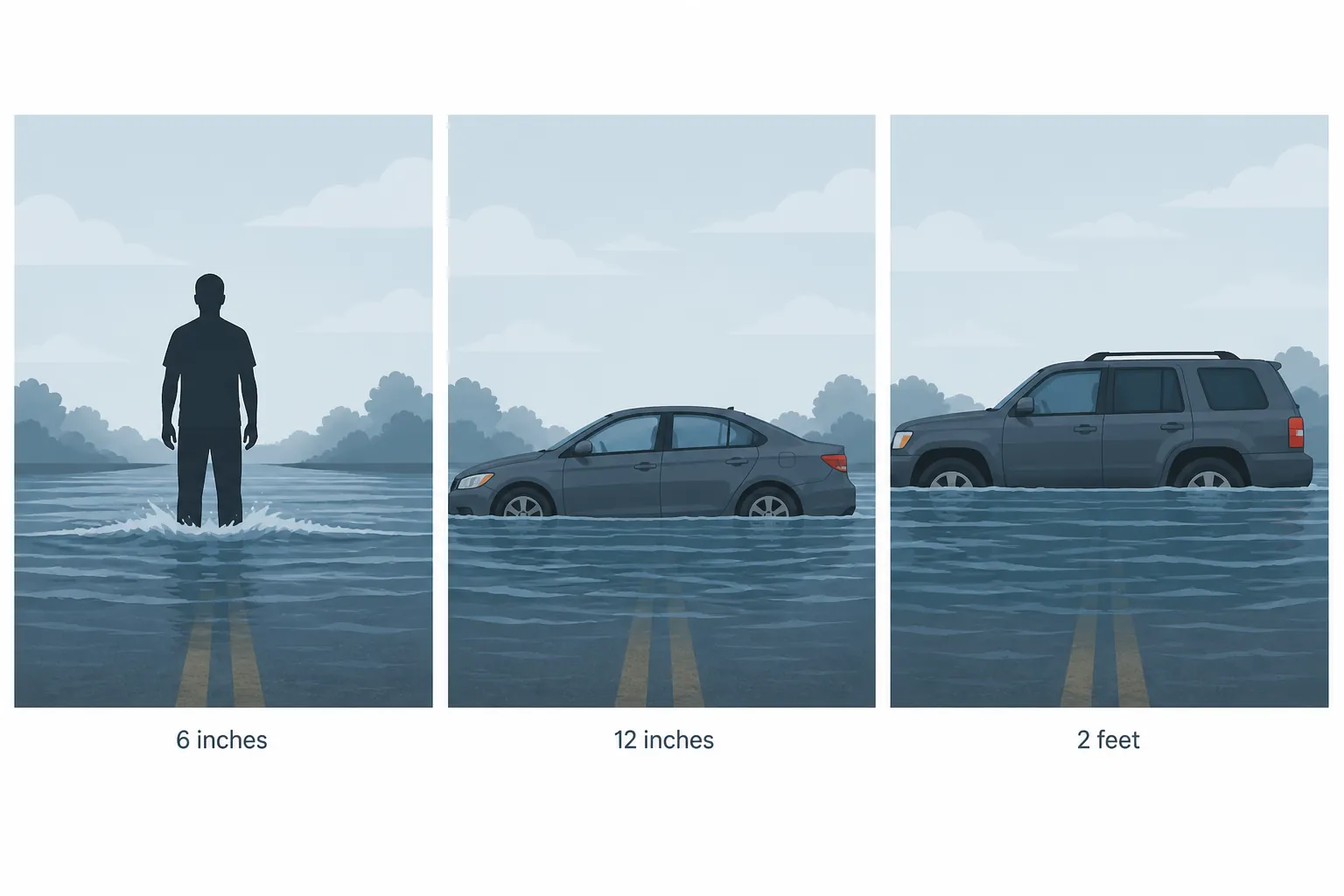
On leave day, the rule is simple enough to sound rude: turn around. A familiar road can have a washed-out shoulder, a hidden current, or a stalled car blocking the far side. The National Weather Service depth rules belong in the car and on the refrigerator: 6 inches can knock down an adult, 12 inches can carry away most cars, and 2 feet can carry away SUVs and trucks.[1]
For an older adult who uses a wheelchair, walker, cane, or has poor balance, the practical threshold is lower. Vantage Mobility’s wheelchair-focused flood safety guidance warns that just 3 inches of water can create a crossing problem for wheelchair users.[12] Treat that as a conservative mobility warning, not a license to test deeper water.
- Do not walk through moving water to reach a car, mailbox, neighbor, or pet.
- Do not drive through water covering the road, even if trucks ahead are going through.
- Do not move barricades.
- Do not assume daylight makes water safe; it only makes danger easier to see.
- If the planned route is blocked, use the preselected alternate route or call local emergency management for current guidance.
- If the older adult cannot safely transfer into the vehicle, call for help before conditions worsen; do not rush a lift in rain and poor footing.
Choose the destination before the shelter is the only option
For many older adults, the best shelter is not a public shelter. It is a relative, friend, hotel, or accessible apartment outside the flood area where medications can be refrigerated, a walker can fit through the bathroom door, and someone can sleep nearby. First Contact’s disaster-preparedness guidance supports a family-and-friends-first, shelter-last order and recommends advance registration where local systems offer it.[13]
Public shelters still matter, especially when the flood changes faster than the plan. Check the county emergency management office for:
- Which shelters accept people with access and functional needs.
- Whether advance registration is available for medical, mobility, transportation, or communication needs.
- Whether registration helps emergency planners but does not guarantee rescue, transportation, or a specific placement.
- Rules for oxygen, powered medical equipment, caregivers, service animals, pets, medications, and bedding.
- Whether the older adult needs to bring a caregiver, aide, or family member to assist with personal care.
If the older adult lives alone, write the destination plan on paper in this order: first choice, second choice, shelter contact, out-of-area contact. A plan that lives only in one caregiver’s head is not a plan the rest of the family can use.
At the destination, protect the routine
The first hour after arrival is where small omissions become medical problems. Put medications somewhere visible and safe. Plug in the phone, hearing aids, wheelchair battery, oxygen equipment, or CPAP backup if power is available. Confirm the next medication time. Text or call the out-of-area contact. If the older adult has memory loss, repeat the location calmly and keep familiar items in sight.
If the destination uses a generator, place carbon monoxide safety above convenience. Red Cross flood guidance says never to use generators indoors.[14] AAGP also warns about generator-related carbon monoxide risk, citing roughly 500 deaths and 15,000 emergency-room visits per year, with adults 65 and older especially vulnerable.[8]
Keep shoes, cane, walker, glasses, and a flashlight within reach overnight. Flood evacuation often means unfamiliar bathrooms, cords on the floor, pets underfoot, and poor sleep. The fall risk is not the main story of a flood plan, but it is part of the first night away from home.
Return home only after the all-clear, then move quickly on water damage
Do not let “the road is open” become “the house is safe.” Wait until officials say it is safe to return. Floodwater can leave electrical hazards, contaminated water, unstable flooring, displaced animals, sewage, chemicals, and debris. CDC flood safety guidance covers the basic return hazards: avoid floodwater, prevent injuries during cleanup, and be careful with contaminated water and electrical risks.[2]
If the home got wet, time matters. Red Cross flood guidance says to dry the home and everything in it within 24 to 48 hours if possible; if that cannot be done, assume mold growth is present.[14] That window is not a reason for an older adult with breathing problems, balance problems, or fragile health to do cleanup. It is a reason to call help early.
- Do not re-enter if officials have not cleared the area.
- Do not turn utilities back on yourself unless local authorities and utility providers say it is safe.
- Do not run a generator in a garage, porch, doorway, or indoor space.
- Do not let an older adult with asthma, COPD, immune compromise, wounds, or severe frailty handle moldy or contaminated cleanup.
- Photograph damage if it can be done safely, but do not delay medical care, medication replacement, or safe housing to document the house.
- If distress, panic, grief, or exhaustion becomes overwhelming, the Red Cross flood page lists the Disaster Distress Helpline at 1-800-985-5990.[14]
Build the flood plan into the rest of the emergency folder
A flood plan should sit with the other hazard plans, because the same older adult may face different evacuation decisions in different seasons. If the home is also in a fire, earthquake, tornado, or severe-storm risk area, use matching checklists rather than trying to stretch one flood plan across every emergency.
Useful companion plans include the senior wildfire evacuation checklist, wildfire smoke safety checklist, earthquake preparedness checklist for seniors, tornado preparedness checklist for seniors, and severe weather emergency plan for elderly parents. Keep the flood checklist separate enough that the water rules, early-leave trigger, and mold window do not get buried.
Keep it alive
Confirm the ride. Update the medication list. Check the go-bag. Make sure the spare-key person still has the key. Practice the call tree and the car transfer twice a year. Revise the plan after every medication change, mobility change, caregiver change, address change, oxygen or equipment change, and new diagnosis.
References
- Turn Around Don't Drown — National Weather Service
- Flood Safety — Centers for Disease Control and Prevention
- Older Adults — Ready.gov
- Disaster Risks to Older Adults — AARP, 2022
- Unnatural Disaster: Seniors Hit Hardest by Floods, Fires — Justice in Aging
- 5 tips for hurricane disaster planning with aging parents, starting now, before the storms — The Conversation
- Older Adults — American Red Cross
- Older Adults and Disaster Preparedness and Response — American Association for Geriatric Psychiatry
- Disaster Preparedness and Response for Older Adults: A Scoping Review — PMC
- Emergency Preparedness 101: What to Do Before, During and After Disaster — National Council on Aging
- Disaster Tip Sheets — California Department of Aging
- Flood Safety Tips for Wheelchair Users — Vantage Mobility
- Disaster Preparedness for Older Adults and Caregivers — First Contact
- Flood Safety — American Red Cross
Related reading
Noticed something outdated or inaccurate on this page? Flag a correction. We review every report against CDC, NIA, and AARP HomeFit guidance before updating a page.
Part of the Fall Prevention section.