
STEADI: Intervene
Power Outage Checklist for Seniors on Medical Equipment
Keep oxygen concentrators, CPAPs, feeding pumps, power wheelchairs, stair lifts, and refrigerated medications working through an outage with a device-by-device plan. Learn what to document, test, and rehearse in advance — and when an outage is no longer safe to ride out at home.
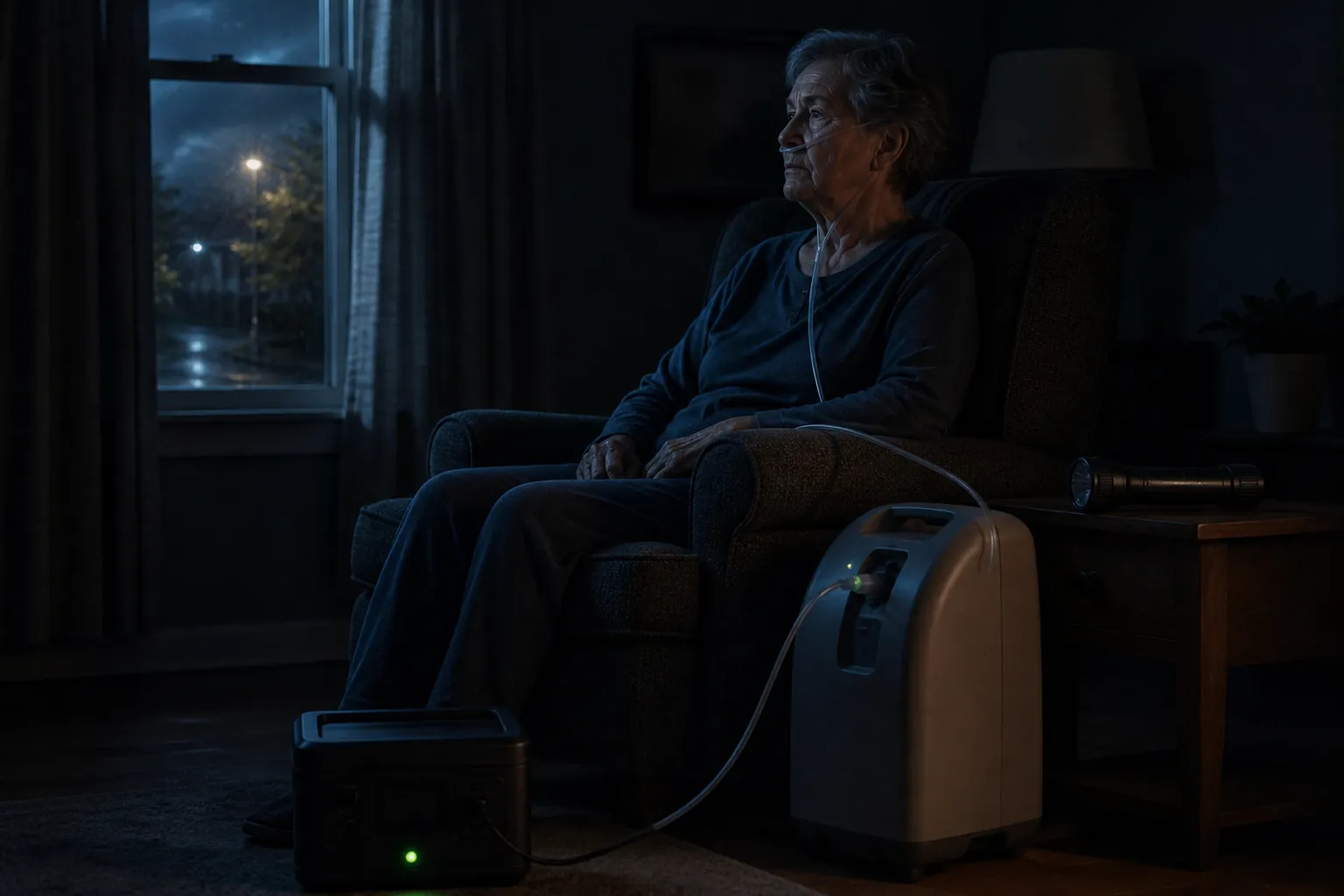
If the power is already out and the device your parent depends on has stopped, this is not the moment to compare battery packs or hunt through product manuals. Banner Health’s emergency guidance is blunt: call 911 if life-sustaining equipment stops, backup power or oxygen is running out, or symptoms such as trouble breathing, chest pain, confusion, or blue lips appear. It also advises going to a pre-identified backup location before batteries or oxygen are nearly gone. [1]
This is the medical-equipment deep dive, not a full pantry-and-generator list. For food, lighting, generator placement, carbon monoxide basics, and household supplies, use the 72-Hour Power Outage Safety Checklist for Seniors as the companion plan. For a senior on oxygen, CPAP, a feeding pump, a power wheelchair, a stair lift, a medical alert system, or refrigerated medication, the emergency preparedness checklist for seniors during a power outage starts with one question: what happens to the device tonight?
Use this as a planning worksheet, not medical advice. Oxygen flow settings, medication storage, feeding schedules, and safe alternatives for missed treatments belong in writing from the clinician, pharmacist, equipment supplier, or home health team before the outage.
Start with a device inventory sheet
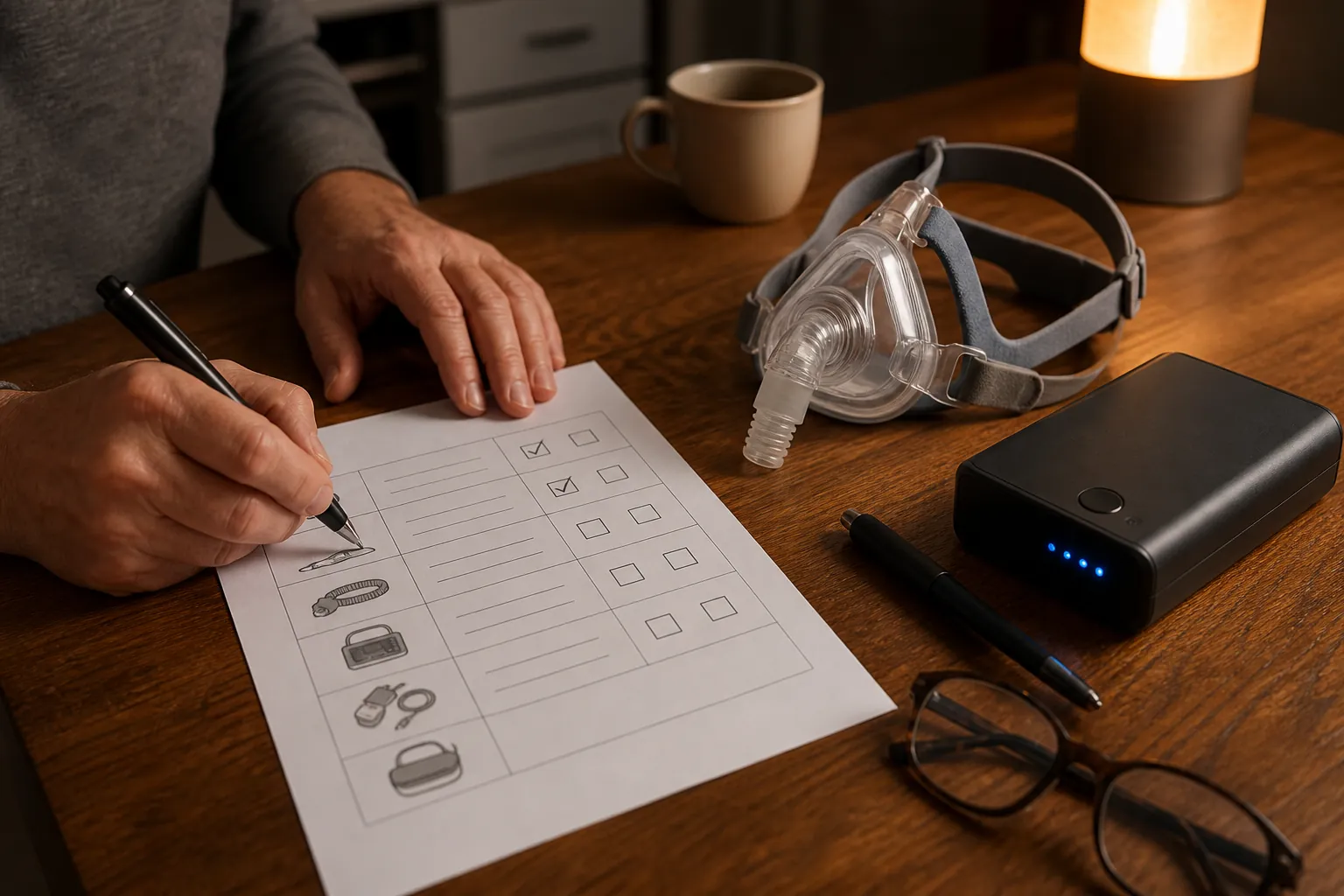
A useful outage plan is something another person could follow at 2 a.m. without guessing. That means one sheet per older adult, kept on paper near the main care station and saved digitally for family caregivers. The American Lung Association notes that CPAP machines and nebulizers may be able to run on charged battery packs or portable power stations, and that oxygen suppliers should help provide stand-alone oxygen tanks that do not rely on electricity. [2] Those options only help if someone has written down which device uses which backup, how to connect it, and when the backup is no longer enough.
| Field | What to write |
|---|---|
| Device name | Example: oxygen concentrator, CPAP, nebulizer, feeding pump, power wheelchair, stair lift, alert base station, medication refrigerator |
| What it does | The plain-language consequence if it stops: breathing support, sleep therapy, medication delivery, mobility, transfer access, emergency calling, medication safety |
| Normal power source | Wall outlet, rechargeable internal battery, base station, charger, refrigerator, or other source |
| Battery runtime | The runtime confirmed from the manual, supplier, or a supervised test; include the date checked |
| How to switch to backup | Exact button, cable, connector, tank regulator, manual release, or setup step |
| Backup option | Charged battery, portable power station, non-electric oxygen tank, manual transfer plan, cooler with thermometer, backup location |
| Supplier or clinician contact | Name, phone number, after-hours number, account number if useful |
| Relocate or call 911 threshold | The point when staying home stops being safe |
Do not leave “battery lasts a while” on the sheet. Write the actual runtime you are willing to plan around, who confirmed it, and what conditions were used. If the device has an internal battery, document whether it switches automatically or needs a button, cable, setting, or adapter. If the backup is stored in another room, write that too; in the dark, “in the closet” is not a plan.
Plan the devices that keep breathing safe first
Oxygen concentrator
An oxygen concentrator deserves the first line on the inventory sheet because its normal job depends on electricity. The backup plan should name the non-electric option, not just the supplier. The American Lung Association says oxygen suppliers should help provide stand-alone tanks that do not depend on electricity. [2] Write down how many tanks are in the home, where they are stored, who can move them safely, and how long the supplier says each tank will last at the prescribed setting.
The caregiver should also know whether the older adult can switch from the concentrator to the tank independently. If not, the worksheet needs a named helper and a deadline: for example, “If power is out and no helper is in the home, call the neighbor by the time written on the sheet, then relocate or call 911 according to the written threshold.” The exact timing belongs to the clinical and supplier plan; the important part is that it is decided before the room is dark.
- Ask the oxygen supplier for a written outage plan, including tank setup steps and after-hours contact.
- Label the regulator, tubing, and tank key or wrench if one is needed.
- Keep the oxygen backup path clear of rugs, cords, storage bins, and furniture that would make a rushed transfer more dangerous.
- Write the relocation threshold beside the tank count, not on a separate page.
CPAP
For CPAP, the inventory sheet should answer one practical question: if the power fails at bedtime, can the person complete the night safely, and what is the backup if not? The American Lung Association includes CPAP among devices that can use charged battery packs or portable power stations. [2] Do not buy a backup and leave it in the box. Confirm the connector, charging routine, and where the machine plugs into the backup supply.
The plan also needs a clinician-approved instruction for what to do if CPAP cannot be used. That instruction may be different for someone with mild obstructive sleep apnea than for someone with more complex breathing problems. The worksheet should not pretend those risks are interchangeable.
Nebulizer
Nebulizers are often treated as small appliances until someone needs a treatment during an outage. The American Lung Association notes that nebulizers may be powered by battery packs or portable power stations. [2] On the worksheet, write the treatment schedule, backup power method, and the clinician’s instruction for missed or delayed treatments. If rescue medications are part of the plan, their location and expiration checks belong on the same sheet.
Feeding pump
A feeding pump plan should come from the prescribing team or durable medical equipment supplier. The worksheet needs the pump’s battery runtime, charging instructions, backup method, feeding schedule, and the point at which a missed or interrupted feed requires a call to the clinician, home health agency, supplier, or 911. Do not fill that threshold with a guess. If the person cannot safely disconnect, flush, reposition, or manage tubing without help, write who does each step.
Mobility devices can turn an outage into a fall risk
Power wheelchair or scooter
A power wheelchair failure is not only an inconvenience. It can strand someone away from the bathroom, the bed, the medication refrigerator, or the exit. The inventory sheet should include the chair’s current battery health, charging location, charger location, manual freewheel instructions if applicable, and who is allowed to push or transfer the person without causing injury.
If the home has a backup battery or portable power station for the chair, test the charging connection before it is needed. If the safer plan is to relocate before a long outage, write the accessible destination, transportation option, ramp or elevator details, and the person who will help. A backup location that cannot handle the wheelchair is not a backup location.
Stair lift
For a stair lift, the problem is usually discovered when the person is on the wrong floor. Write down whether the lift has a battery backup, how long that backup is expected to work, how to park or charge the chair, and whether there is a manual release. Keep the manufacturer or service company number on the worksheet.
Then make the floor decision ahead of time. If the person needs a bathroom, bed, medication, oxygen, or exit route on one level, decide which level is the safer waiting area during a storm or utility outage. Move the walking aid, flashlight, phone charger, water, and essential medical items there before the weather arrives when possible. The same idea appears in hurricane safety planning: a fixed safety station with radio, flashlight, and walking aid within reach reduces unnecessary trips through a dark home. For that setup, see How Seniors Can Monitor Hurricane Updates Safely.
Medical alert devices need their own outage test
A pendant or wrist button is only as useful as the system behind it. Some systems depend on a base station, some on cellular service, some on Wi-Fi, and some on more than one connection. The outage worksheet should say what happens when household power fails, how long the base station backup lasts, whether the pendant itself needs charging, and what the older adult should do if the device announces low battery or loss of connection.
Test the alert company’s power-failure instructions in advance, following the provider’s recommended method. If cell service or internet also fails, the check-in plan needs another route. Use Cell Service Down? 5 Steps Caregivers Must Take Right Now for the communication branch, and use A Decision Framework for Choosing an Elderly Monitoring System when comparing alert-device backup features before buying or replacing equipment.
Refrigerated medications: write the cooler protocol before the outage
Medication storage is one of the places where vague advice becomes dangerous. Marin County Health and Human Services says a closed refrigerator keeps refrigerated medications cold for only about 2 to 3 hours during a power outage, then recommends moving them to a cooler with ice packs and monitoring the temperature with a thermometer. [3] That cooler, thermometer, and ice-pack plan belongs on the same device worksheet as the machines.
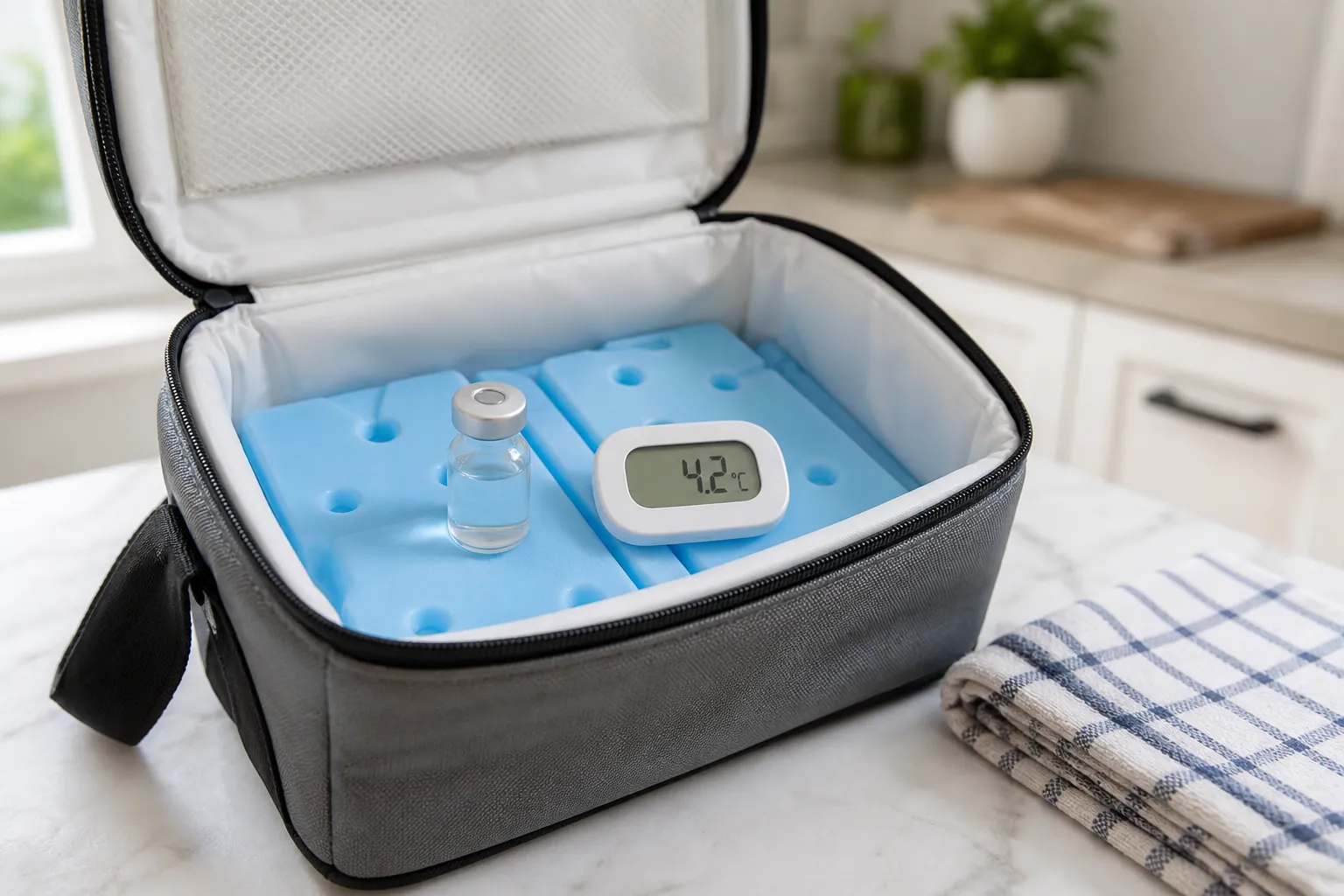
The American Lung Association advises keeping temperature-sensitive medications below about 46°F, or 8°C, and contacting a pharmacist or provider if the power is out beyond a day. [2] Write the pharmacist’s number on the sheet, along with the medication names, storage ranges from the label or pharmacist, and what to do if the thermometer shows the cooler is too warm or too cold.
Insulin deserves extra care because many people have heard a room-temperature rule but do not know whether it applies to their product, their storage history, or their health situation. Marin County HHS relays CDC guidance that insulin from opened or unopened vials can be used at room temperature, 59°F to 86°F, for up to 4 weeks. [3] Treat that as a fact to verify for the exact insulin and prescription in the home. The safest worksheet entry is the pharmacist’s written instruction, not a caregiver’s memory of a general rule.
- Keep a small insulated cooler available for medication only, not mixed with drinks or food that people will open repeatedly.
- Store reusable ice packs where they will be frozen before storm season or planned utility shutoffs.
- Put a thermometer in or with the cooler, and write the acceptable temperature range on the worksheet.
- Write the “call pharmacist/provider” point clearly, especially for outages expected to last beyond a day.
- Do not discard or use questionable medication based only on appearance; call the pharmacist or prescriber.
Decide now: stay, relocate, or call 911
The hardest part of the plan is the decision no one wants to write: when the older adult stops waiting at home. Put it in plain language. If the person relies on oxygen, a ventilatory device, a feeding pump, powered mobility for safe transfers, refrigerated medication, or an alert system that no longer works, “we’ll see how it goes” is not enough.
| Situation | Pre-decided action |
|---|---|
| Power is out, but the device is running on a tested backup and the person is stable | Start the written outage log: time power failed, battery or oxygen remaining, next check time, caregiver notified |
| Battery, oxygen, medication cooler, room temperature, or mobility access is trending toward the written limit | Relocate to the named backup location before the backup is nearly gone |
| Life-sustaining equipment stops | Call 911 |
| Backup oxygen or backup power is running out | Call 911 |
| Trouble breathing, chest pain, confusion, blue lips, or another emergency symptom appears | Call 911 |
Those 911 triggers come directly from Banner Health’s guidance for people who rely on oxygen or medical equipment. [1] The relocation trigger is just as important: if a battery is expected to last several hours, the move should not begin in the final minutes. Moving an older adult with equipment, medications, a walker, oxygen tanks, or a wheelchair takes time, light, transportation, and another person who knows the plan.
The backup location should be named, accessible, and willing. It may be a relative’s home, a neighbor’s home, a cooling center, a shelter that can support medical needs, or a facility recommended by the care team or local emergency management. Write the address, phone number, transportation method, entrance details, and what equipment must go along. If extreme heat is part of the outage, use the heat-specific relocation guidance in the Extreme Heat Safety Checklist for Older Adults and Heatwave Safety Checklist for Seniors Living Alone.
The supporting calls that make the worksheet usable
Ready.gov and the American Red Cross both emphasize planning ahead with older adults, including considering medical needs, support networks, and emergency communication. [4][5] For a medical-equipment outage plan, that planning becomes a short call list. Each call should produce something written on the inventory sheet.
- Medical provider: Ask what an outage changes for oxygen, CPAP, nebulizer treatments, feeding, medication timing, symptoms, and relocation.
- Pharmacist: Ask for storage ranges, cooler instructions, and what to do if refrigerated medication warms outside the recommended range.
- Equipment supplier: Ask for battery runtime, backup options, charger instructions, manual release steps, service number, and replacement supply process.
- Utility company: Ask about medical-need, medical-baseline, or life-support notification programs.
- Backup location: Confirm access, transportation, pets if relevant, refrigeration, outlets, oxygen rules, and whether medical equipment can be used there.
Utility registration can help with communication and outage planning, but it is not a rescue plan. Banner Health specifically cautions that registering with the utility does not guarantee faster power restoration. [1] Keep the registration confirmation with the worksheet, then still plan for charged backups, non-electric oxygen if prescribed, medication cooling, and relocation.
For general outage safety, the American Red Cross covers household power-outage preparation and safety practices. [6] Keep that material in the general home checklist. Here, only add household items that directly support the medical plan: flashlight at the device, written instructions, charged phone or backup charger, walking aid within reach, and a way to hear local updates.
Rehearse the plan while the lights are on
A plan that has never been touched is still a guess. Rehearsal does not mean interrupting medically necessary therapy or creating a dangerous test. It means walking through the sequence with the older adult and any caregiver who may be responsible: where the sheet is, which device is first, how the backup connects, who is called, where medications go, and what threshold ends the wait.
- Stand at each device and read the worksheet out loud.
- Confirm the backup power, oxygen tank, charger, manual release, or cooler supplies are actually present.
- Have the person who would be there at night show how they would switch to the backup, without performing any unsafe medical step.
- Call or text the backup contact as a drill, and confirm they know their role.
- Check that the backup location can still accept the person and equipment.
- Update the sheet when a device, medication, phone number, supplier, prescription, or caregiver changes.
The finished standard is simple: a completed device worksheet, charged and tested backups, medication cooler supplies ready, a named backup location, and a written relocate-or-911 threshold that removes guessing when the outage begins.
References
- How to Prepare for a Power Outage if You Use Oxygen or Medical Equipment — Banner Health
- Preparing for a Power Outage as a Medical Device User — American Lung Association
- Managing Health Conditions and Food Safety During a Power Outage — Marin County Health and Human Services
- Older Adults — Ready.gov
- Older Adults Emergency Preparedness — American Red Cross
- Power Outage Safety — American Red Cross
Related reading
Noticed something outdated or inaccurate on this page? Flag a correction. We review every report against CDC, NIA, and AARP HomeFit guidance before updating a page.
Part of the Fall Prevention section.