Senior Care Advisors After a Fall: Why You Should Call During the Hospital Stay, Not After
A parent's fall and hospitalization is the most common trigger for seeking a senior care advisor, but most families call too late. This guide explains why engaging an advisor during the hospital discharge window is critical, how they differ from hospital social workers, and what to ask before hiring in a time-sensitive situation.
By Editorial Team
senior care advisors
hospital discharge planning
geriatric care manager
post-fall care
care transitions
The Crisis Moment: A Parent Falls and Goes to the Hospital — Now What?
The phone rings at 2:00 PM on a Tuesday. It's your father's neighbor, or maybe it's the hospital itself. Your mother fell. She's at the emergency room. The words blur together — hip fracture, laceration, observation, CT scan. You grab your keys and start driving, your mind already racing through a dozen questions you aren't prepared to answer: Can she go home? Is the house safe? Who will check on her tomorrow? What about her medications?
This scene plays out thousands of times every day across the country. And in nearly every instance, families make the same mistake: they wait. They wait until discharge papers are signed. They wait until they bring Mom home to a house that hasn't been fall-proofed. They wait until a second fall, or until caregiver burnout sets in, before picking up the phone to call for professional help.
The research is clear: a recent fall or hospitalization is the single most common reason families contact a senior care advisor. Yet most families reach out after the crisis has already compounded — after a rushed discharge, after an unsafe return home, after a preventable rehospitalization. The counterintuitive truth is that the best time to call an advisor is not after your parent is home. It's while they are still in the hospital.
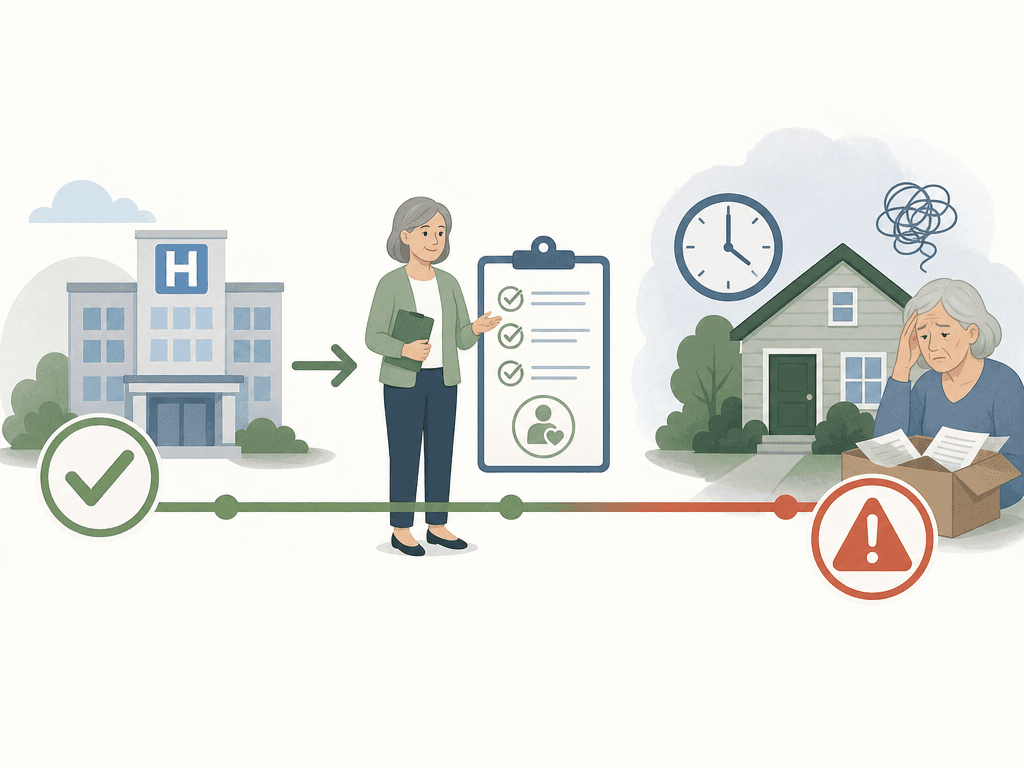
A senior care advisor helps families visualize and compare care options during a critical decision window.
Why the Hospital Discharge Window Is Critical (and Why Families Make Rushed Decisions)
Hospital discharge planning operates on a compressed timeline — often 24 to 48 hours from the moment a physician clears a patient for discharge. In that window, a hospital social worker or discharge planner will assess the patient's immediate needs, coordinate any necessary home health services, and arrange for a safe transition. But here's what families discover too late: the hospital's job is to discharge the patient, not to solve the long-term care puzzle.
Under pressure, families default to one of three unsafe patterns:
Bringing a parent home to an unprepared house. The bathroom has no grab bars. The bedroom is upstairs. The shower has a high step-over threshold. The home that was 'fine' last week is now a hazard zone.
Choosing a rehab or skilled nursing facility without touring it. A social worker hands over a list of three facilities that have beds available. The family picks one based on a name and a Google review, never having walked through the door.
Deferring all decisions until 'after we get through this week.' This deferral often leads to a second crisis — a fall at home, a medication error, or a caregiver collapse — that lands the parent back in the hospital within 30 days.
The statistics bear this out. Nearly 70% of older adults will require some form of long-term care services, according to the Harvard Joint Center for Housing Studies. And with roughly 59 million Americans providing unpaid care for an adult — contributing an estimated $1.01 trillion in unpaid care annually — the margin for error is razor-thin. A rushed decision made in a 48-hour discharge window can have consequences that last for years.
How a Senior Care Advisor Fits Into the Discharge Process vs. the Hospital Social Worker
One of the most common misconceptions families have is that the hospital social worker or discharge planner will handle everything. They won't — and they can't. Hospital social workers are responsible for managing discharge logistics and ensuring insurance requirements are met, but their caseloads are heavy and their time with any single patient is limited. They are not in a position to tour multiple facilities with you, conduct a home safety evaluation, or provide ongoing follow-up after discharge.
A senior care advisor fills the gap that the hospital system leaves open. Here is how the two roles compare in a post-fall crisis:
Comparison of roles during a post-fall hospital discharge.
Function
Hospital Social Worker
Senior Care Advisor
Discharge logistics
Primary responsibility; coordinates with insurance and facility bed availability
Coordinates with the discharge planner but does not replace them
Facility knowledge
May have a list of in-network or available facilities; limited time for personalized matching
Dedicated time to match the patient's specific needs, preferences, and budget to appropriate facilities
Home safety evaluation
Rarely performed; not within standard discharge scope
Can conduct or arrange a home safety assessment before the patient returns
Facility touring
Cannot tour facilities with the family
Can coordinate and accompany tours, or pre-vet options based on the patient's profile
Post-discharge follow-up
Typically ends at discharge
Continues after move-in; can monitor transition and adjust the care plan
Cost to family
Free (hospital employee)
Free (placement agency) or $75–$200/hr (geriatric care manager)
The key distinction is bandwidth and scope. A hospital social worker is a critical part of the discharge team, but they are not a substitute for the dedicated, personalized guidance a senior care advisor can provide — especially when the decision involves whether the patient can safely return home or needs a higher level of care.
Types of Advisors Who Specialize in Post-Hospital Transitions
Not all senior care advisors are the same. In a crisis, understanding the differences between the three main types can save you time, money, and a bad placement decision.
Three types of senior care advisors relevant to post-hospital transitions.
Advisor Type
How They Are Paid
Best For
Key Limitation
Placement agency (e.g., A Place for Mom, local agencies)
Free to families; paid 85–100% of one month's rent by the facility (up to $20,000 per placement)
Families who need fast, free help finding an assisted living or memory care community
May only recommend facilities in their network; limited home safety or clinical assessment
Geriatric care manager (GCM)
$75–$200 per hour; initial assessment $500–$5,000 flat fee; paid by the family
Comprehensive, unbiased assessment including home safety, care coordination, and ongoing monitoring
Out-of-pocket cost; not covered by Medicare
Aging life care professional (often a GCM with advanced certification)
Same as GCM ($75–$200/hr)
Complex cases involving multiple chronic conditions, family conflict, or legal/financial coordination
Same cost barrier; may be harder to find in rural areas
There is also the Certified Senior Advisor (CSA) credential, held by approximately 2,800 professionals across the U.S. as of the certification body's most recent data. The CSA certification requires passing an exam with a $395 fee and is accredited by the ANSI National Accreditation Board and the National Commission for Certifying Agencies. While a CSA designation indicates specialized knowledge of aging issues, it does not guarantee a particular compensation model or scope of practice — always ask about both.
Timeline: When to Call — Ideally Before Discharge, Not After
This is the central thesis of this guide, and it bears repeating: call a senior care advisor during the hospital stay, ideally within 24 hours of admission. Do not wait until discharge. Do not wait until your parent is home and you realize the house is unsafe. Do not wait until you are exhausted and out of options.
The optimal window for engaging a senior care advisor is during the hospital stay, not after discharge.
Here is what an advisor can do in that critical window that becomes exponentially harder after discharge:
Coordinate directly with the hospital discharge planner. The advisor becomes your advocate in the discharge meeting, ensuring that the plan accounts for your parent's full care needs — not just the minimum required for insurance coverage.
Evaluate home safety before return. A geriatric care manager can conduct a home safety assessment while your parent is still in the hospital, identifying fall hazards and recommending modifications — grab bars, non-slip flooring, stair railings — before the patient walks through the door.
Identify appropriate care settings. The advisor can determine whether the patient needs short-term rehab, long-term skilled nursing, assisted living, or in-home care with support — and match those needs to available options before the family is pressured into a decision.
Prevent the 'revolving door' of rehospitalization. Studies consistently show that poorly planned transitions are a leading cause of 30-day hospital readmissions. An advisor who is involved from the start can build a transition plan that addresses medication management, follow-up appointments, and daily support — reducing the risk of a second crisis.
Multiple sources confirm that families who contact an advisor 'before a crisis' have more time to compare options, understand costs, and avoid rushed decisions. The hospital stay is that before-crisis window. Use it.
What a Crisis-Engaged Advisor Actually Does
When you engage a senior care advisor during a hospital stay, the process typically follows a structured sequence. Understanding these steps helps you know what to expect and what to ask for.
Needs assessment. The advisor conducts a comprehensive evaluation of the patient's medical condition, functional status (ability to perform activities of daily living), cognitive status, financial resources, and family support system. This assessment forms the foundation of all subsequent recommendations.
Home safety evaluation. For families considering a return home, the advisor (or a geriatric care manager they coordinate with) assesses the home environment for fall hazards — loose rugs, poor lighting, lack of grab bars, high step-over thresholds, stair safety. This connects directly to the fall-prevention mission of this site.
Care option matching. Based on the assessment, the advisor presents a range of options: in-home care with aides and modifications, short-term rehabilitation at a skilled nursing facility, assisted living, or memory care. They explain the trade-offs of each option in plain language.
Facility tour coordination. If a facility placement is appropriate, the advisor pre-screens options based on the patient's needs and preferences, coordinates tours, and often accompanies the family to ask the right questions about staffing, therapy services, and level of care.
Transition follow-up. After the patient moves — whether home or to a facility — the advisor checks in to ensure the transition is going smoothly, that services are in place, and that the care plan is working. This follow-up is what distinguishes a good advisor from a referral service that disappears after the placement fee is collected.
Cost Implications: Free Placement Services vs. Fee-Based Geriatric Care Management
In a crisis, cost is often a deciding factor — and the two primary models (free placement agencies vs. fee-based geriatric care managers) have very different trade-offs that families need to understand before choosing.
Free placement agencies and fee-based geriatric care managers serve different needs in a crisis.
Cost models for senior care advisor services in a crisis situation.
Cost Model
How It Works
Typical Cost
Key Caveat
Free placement agency
Facility pays the agency a referral fee (85–100% of one month's rent) when the client moves in; family pays nothing
$0 to the family; facility pays up to $20,000 per placement
Agency may only recommend facilities in its network; no home safety evaluation or clinical assessment
Fee-based geriatric care manager
Family pays the GCM directly for time and expertise; no facility commissions
$75–$200 per hour; initial assessment $500–$5,000 flat fee
Out-of-pocket cost; not covered by Medicare; provides unbiased, comprehensive assessment including home safety
Fee-based placement service
Family pays a flat fee for placement assistance; no facility commissions
$500–$5,000 flat fee
Less common than commission-based agencies; offers unbiased facility recommendations
The critical distinction in a crisis is scope. A free placement agency can be an excellent resource if you already know your parent needs assisted living or memory care and you simply need help finding an available, appropriate community. But if you are unsure whether your parent can safely return home — which is the most common scenario after a fall — a geriatric care manager's comprehensive assessment, including a home safety evaluation, may be worth the out-of-pocket cost.
The commission structure for placement agencies is significant: national referral agencies like A Place for Mom charge facilities approximately one month's rent per move-in, and local agencies often charge 50% to 100% of the first month's rent. In some markets, the average commission has been reported at around $3,500 per placement (based on a 2010 investigation in Washington's King County). This means the agency has a financial incentive to place your parent in a facility — any facility in its network — rather than to recommend a home safety modification that would allow your parent to stay home safely.
5 Questions to Ask Before Hiring an Advisor in a Time-Sensitive Situation
When time is short — and in a hospital discharge crisis, it always is — you need a condensed vetting process. These five questions will help you determine whether an advisor is the right fit for your specific situation, without requiring hours of research.
"How are you compensated?" This is the most important question. If the answer is "free to you, paid by the facility," ask whether they only recommend facilities in their network. If the answer is "I charge by the hour or a flat fee," ask what that includes — does it cover a home safety evaluation? Post-placement follow-up?
"How many facilities do you work with, and do you have any exclusivity agreements?" A placement agency that works with 10 facilities may not be showing you the best option — only the ones that pay them. A good advisor should be willing to recommend options outside their network if appropriate.
"What is your experience with hospital discharge transitions?" Not all advisors specialize in crisis situations. Ask how many post-hospital placements they have handled in the past year, and whether they are familiar with the discharge planners at the hospital where your parent is currently admitted.
"Can you conduct or arrange a home safety evaluation?" This is especially critical after a fall. If the advisor cannot assess whether the home is safe for return, they are not addressing the root cause of the crisis. A geriatric care manager can do this; a placement agency typically cannot.
"What happens after my parent moves in? Do you provide follow-up?" Some advisors disappear after the placement fee is collected. A crisis-engaged advisor should check in at 30 days, 60 days, and 90 days to ensure the transition is working and adjust the plan if needed.
A fall is a frightening event, but it is also an opportunity — an opportunity to pause, assess, and make a thoughtful decision about what comes next. The families who navigate this moment best are the ones who recognize that they don't have to do it alone, and that the right time to ask for help is not after the crisis has passed, but right in the middle of it.
If your parent is in the hospital after a fall, pick up the phone. Call a senior care advisor. The discharge clock is ticking, and every hour counts.




Comments
Join the discussion with an anonymous comment.