
Caregiver decision guide
Senior Care Advisors: What They Do, How They're Paid, and When to Hire One
This guide helps adult children understand what senior care advisors do, how the 'free to families' compensation model works, and how to evaluate whether an advisor is trustworthy. It covers the difference between placement-focused advisors and fee-for-service geriatric care managers, key questions to ask before hiring, and red flags to watch for.

When an older parent has a fall, receives a new diagnosis, or can no longer manage daily tasks alone, the search for the right care arrangement often begins with a single Google query. Within minutes, families encounter a category of professional they may never have heard of: the senior care advisor. These intermediaries present themselves as free guides through the maze of assisted living, memory care, and in-home services. But the phrase "free to families" raises an immediate and reasonable question: if the family isn't paying, who is, and does that create a conflict of interest?
This guide is written for adult children in their 40s and 50s who have just entered this unfamiliar territory. It explains what senior care advisors actually do, how the referral-based compensation model works, and how to distinguish a trustworthy advisor from one who is primarily serving their own bottom line. Understanding this landscape is the critical first step before you can use any facility comparison tool or cost-planning resource.
What Is a Senior Care Advisor?
A senior care advisor is a professional who helps families evaluate and select senior living arrangements — typically assisted living communities, memory care units, and sometimes in-home care providers. The role exists because the senior living market is fragmented, opaque, and emotionally overwhelming for families facing a crisis. Advisors act as local experts who know the communities in their area, understand the differences between levels of care, and can translate a family's needs into a short list of appropriate options.
It is important to distinguish between two broad categories of professionals who may call themselves senior care advisors:
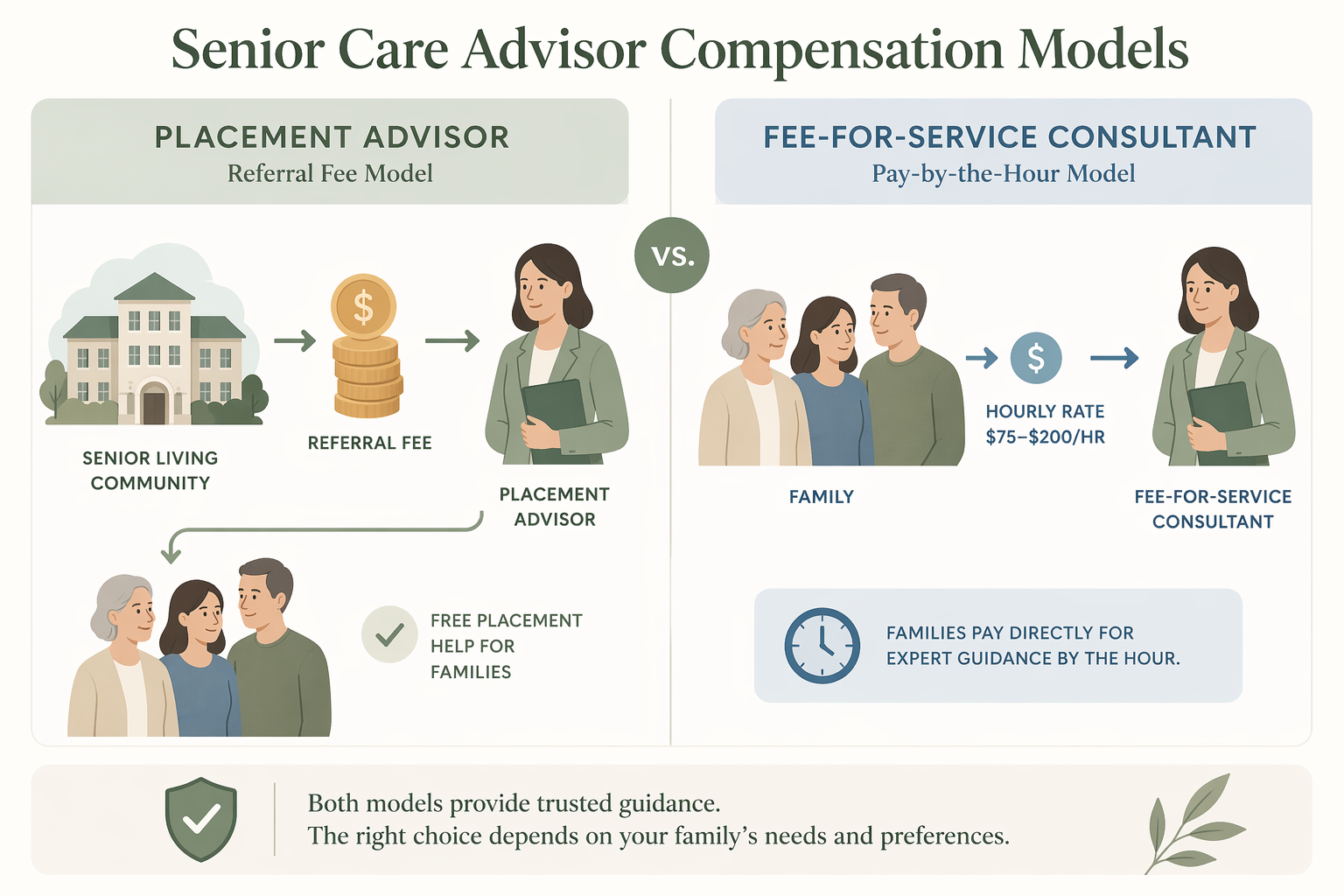
- Placement-focused advisors: These are the most common type families encounter. Their primary service is helping families find and move into a senior living community. They are typically compensated by the community through a referral fee, which means their services are free to the family. Most operate locally and have relationships with a network of facilities in their region.
- Comprehensive elder care consultants / geriatric care managers: These professionals are often licensed social workers, registered nurses, or certified care managers who provide a broader range of services — including medical care coordination, legal and financial planning, emotional support, and ongoing case management. They charge the family directly, typically by the hour.
Most families encounter placement-focused advisors first, often through online searches or referrals from hospital discharge planners. Understanding which type you are speaking with — and how they are paid — is the foundation of making an informed decision.
Core Services: What a Senior Care Advisor Actually Does
A thorough senior care advisor provides a structured process that goes far beyond emailing a list of facility names. The best advisors treat each family as a unique case, investing time to understand the older adult's physical, cognitive, and emotional needs before making any recommendations.
The typical service sequence includes the following stages:
- Initial needs assessment: A detailed conversation (often by phone or in person) covering the senior's medical conditions, mobility level, cognitive status, personal preferences, budget, and geographic requirements. Some advisors also conduct in-home assessments.
- Care option education: The advisor explains the differences between independent living, assisted living, memory care, skilled nursing, and in-home care, helping the family understand which level of care matches the senior's current and anticipated needs.
- Personalized community recommendations: Based on the assessment, the advisor curates a short list of communities that meet the family's criteria. A good advisor draws from a broad network of facilities — not just the ones that pay the highest referral fees.
- Tour coordination and accompaniment: The advisor schedules tours of the recommended communities and, critically, attends them with the family. An advisor who tours in person can ask informed questions, observe care quality, and provide real-time perspective that a family alone might miss.
- Move-in coordination: Once a community is selected, the advisor helps with paperwork, coordinates with the facility's move-in team, and can assist with logistics like arranging movers or cleaning services.
- Post-placement follow-up: Ethical advisors stay involved after the move. Many provide follow-up for at least 90 days to ensure the transition is going smoothly and to address any issues that arise.
The value of a good advisor lies in this hands-on, local support. They know which communities have recently changed management, which ones have a reputation for responsive nursing staff, and which ones are a poor fit despite a polished website. A list of names from a national referral website cannot replace this kind of localized knowledge.
How Senior Care Advisors Are Paid: Understanding the Compensation Model
The compensation model is the single most important thing to understand about senior care advisors, because it directly affects the trustworthiness of their recommendations. The vast majority of placement-focused advisors do not charge families anything. Instead, they are paid by the senior living community after a resident moves in.
This referral fee typically ranges from 85% to 100% of one month's rent at the community. In some cases, particularly for high-cost memory care units or luxury facilities, the fee can reach up to $20,000 per placement. These fees are built into the community's marketing budget — the community would spend that money on advertising or sales staff regardless, so using an advisor does not increase the price the family pays.
This model is fundamentally different from fee-for-service professionals, such as geriatric care managers, who charge the family directly. The table below summarizes the key differences.
| Dimension | Placement-Focused Advisor | Geriatric Care Manager / Fee-for-Service Consultant |
|---|---|---|
| Who pays | Senior living community (referral fee) | Family (hourly or flat fee) |
| Typical cost to family | $0 | $75–$200 per hour (initial assessment may cost several hundred dollars) |
| Primary service | Facility placement and move-in coordination | Comprehensive care coordination (medical, legal, financial, emotional) |
| Typical credentials | Varies widely; some hold CSA certification | Often licensed social workers, registered nurses, or certified care managers |
| Scope of engagement | Short-term (weeks to a few months) | Ongoing (months to years) |
| Potential bias risk | Referral fee may incentivize recommending higher-commission communities | No referral fee; client is the only customer |
The core question families must grapple with is whether the referral fee creates bias. The honest answer is that it can, but it does not have to. A reputable advisor builds their business on trust and referrals from satisfied families — they cannot afford to recommend a poor fit just for a higher commission. However, an advisor who works with a limited network of communities, or who fails to disclose their compensation structure, may be prioritizing their own income over the family's best interest.
Senior Care Advisor vs. Geriatric Care Manager: Which Does Your Family Need?
Choosing between a placement-focused advisor and a geriatric care manager depends on your family's specific situation. The decision is not about which type is "better" — it is about which type matches your current needs.
When a Placement-Focused Advisor Makes Sense
- Your family has already decided that a move to a senior living community is necessary.
- You need help narrowing down the overwhelming number of options in your area.
- You are on a tight timeline (e.g., after a hospitalization) and need someone to expedite the process.
- Your budget is limited, and the free service model is attractive.
When a Geriatric Care Manager Makes Sense
- Your parent has complex medical needs that require ongoing coordination between doctors, therapists, and home care providers.
- You are a long-distance caregiver and need a local professional to monitor your parent's condition and advocate on their behalf.
- You are not yet sure whether a facility move is needed and want an objective assessment of your parent's ability to remain at home with support.
- You are uncomfortable with the referral-fee model and prefer a professional whose only client is your family.
Some families use both: a geriatric care manager for the assessment and care plan, then a placement advisor to help execute a facility move if that becomes necessary. The key is to understand what each professional offers and to be clear about your family's priorities.
If you are still exploring whether a facility move is the right path, our guide on when home care isn't enough can help you recognize the tipping points that signal a need for more support. For families who have decided to explore residential options, our decision framework for senior residential homes provides a structured way to compare communities.
Questions to Ask Before Hiring a Senior Care Advisor
Vetting a senior care advisor is not complicated, but it requires asking direct questions that many families are uncomfortable posing. The following list covers the essential topics. Write down the answers and compare them across any advisors you interview.
- How many communities do you work with in this area? A good advisor should have relationships with a broad range of communities — at least 20 to 30 in a metropolitan area. A very small network (fewer than 10) may indicate that the advisor only works with facilities that pay the highest fees.
- Do you personally tour each community you recommend? The answer should be yes. An advisor who relies on brochures or website information cannot provide the kind of firsthand insight that justifies their role.
- How are you compensated? A transparent advisor will explain the referral-fee model clearly, including the typical percentage and whether it varies by community. Be wary of anyone who is vague or evasive on this point.
- Can you provide references from families you have helped in the past year? Speaking with past clients is one of the best ways to gauge an advisor's thoroughness, communication style, and follow-through.
- Do you offer post-placement follow-up, and for how long? Ethical advisors provide follow-up for at least 90 days after move-in. This period is critical for identifying and resolving transition issues.
- What certifications or credentials do you hold? The most common voluntary credential is the Certified Senior Advisor (CSA) designation. To earn it, candidates must pass a rigorous exam, complete an ethics module, and pass a background check. The exam fee is $395, and the certification is accredited by both ANSI (ANAB) and NCCA. Over 2,800 professionals across the U.S. currently hold the CSA designation. CSAs must also complete 30 hours of continuing education (including 3 ethics credits) every three years to recertify.
- Do you accept affiliate fees from other service providers? Some placement companies accept fees from movers, cleaning services, or home care agencies. These arrangements can lead to higher prices for seniors if the costs are passed through. Ask directly whether the advisor receives any compensation beyond the community referral fee.
Red Flags: When to Walk Away
Most senior care advisors are honest professionals who genuinely want to help families. But the industry's lack of centralized oversight means that unethical operators can and do exist. The following red flags should prompt you to end the conversation and look for another advisor.
- Limited provider network: An advisor who only recommends three or four communities — especially if they are all from the same ownership group — is likely prioritizing their commission structure over your family's needs.
- Refusal to tour in person: An advisor who will not accompany you on tours, or who recommends communities they have never visited, cannot provide the hands-on guidance that justifies their role.
- Undisclosed compensation or affiliate fees: If an advisor is unwilling to explain how they are paid, or if they downplay the referral-fee model, consider it a serious warning sign. Transparency is the foundation of trust in this relationship.
- High-pressure tactics: An advisor who pressures you to make a quick decision, claims that a community's best unit will be gone by tomorrow, or discourages you from visiting multiple facilities is not acting in your family's best interest.
- No post-placement follow-up: An advisor who disappears after the lease is signed is not providing the full service that ethical advisors offer. Post-placement support is a standard part of the process, not an extra.
- No state licensure check: In states that regulate senior referral services, an ethical advisor will check state licensure for the communities they recommend. If an advisor cannot tell you whether they verify licensure, that is a gap in their due diligence.

Making the Decision: A Framework for Families
The decision to hire a senior care advisor — and which type to hire — comes down to three factors: your family's current situation, your timeline, and your comfort with the compensation model. The following framework can help you work through the choice systematically.
| Your Situation | Recommended Professional | Why |
|---|---|---|
| You have decided a facility move is needed, but you are overwhelmed by options | Placement-focused senior care advisor | They can narrow the field, arrange tours, and handle logistics at no cost to you |
| You are unsure whether a move is needed and want an objective assessment | Geriatric care manager (fee-for-service) | They provide an unbiased evaluation and can recommend in-home support or a facility move based on need, not commission |
| You are a long-distance caregiver and need ongoing local oversight | Geriatric care manager (fee-for-service) | They can monitor your parent's condition, coordinate care, and advocate on your behalf over months or years |
| Your parent has complex medical needs requiring coordination between multiple providers | Geriatric care manager (fee-for-service) | Their clinical background (often as a nurse or social worker) is essential for managing medical complexity |
| You have a very tight timeline (e.g., hospital discharge in 1–2 weeks) | Placement-focused senior care advisor | They can expedite the search and move-in process, leveraging existing relationships with communities |
| You are uncomfortable with the referral-fee model and want a professional whose only client is your family | Geriatric care manager (fee-for-service) | Paying directly removes any concern about commission-driven recommendations |
If you decide to work with a placement-focused advisor, take the time to interview at least two or three before committing. Use the questions from the previous section as your interview guide. A good advisor will welcome your diligence and will be transparent about their network, compensation, and process.
For families who are still in the early stages of understanding their options — perhaps after a recent fall or hospitalization — our 5-step roadmap for adult children who don't know where to start can provide foundational orientation before you engage any professional. And once you have a clearer picture of the level of care needed, our guide on senior care options by hours of need can help you match care arrangements to the specific amount of daily assistance required.
Finally, remember that the senior care advisor is just one resource in a broader ecosystem of support. Understanding federal, state, and local benefits can help you fund the services an advisor or care manager recommends. And if you are considering in-home help as an alternative to a facility, our guide to senior home services provides a practical framework for when to hire help, what it costs, and how to start.
Questions to bring to a clinician or OT
This is not medical, legal, or a family's final decision — only a framework. Bring these questions to a clinician, occupational therapist, or your local Area Agency on Aging.
Find Local HelpRelated reading
Noticed something outdated or inaccurate on this page? Flag a correction. We review every report against CDC, NIA, and AARP HomeFit guidance before updating a page.