
STEADI: Intervene
Best Senior Workout Videos for Strength and Balance
Not every senior workout video is worth following for fall prevention. This guide explains which strength-and-balance components actually matter, how to match a video to the exerciser's ability level, and how to set up a safe home space — plus when to get a clinician's clearance first.
The risky moment is usually quiet: someone sits down with a tablet or TV remote, searches for the best senior citizen workout videos for strength and balance, and gets a wall of cheerful thumbnails. Some are excellent. Some are harmless but too light to build much strength. Some move far too quickly for a person who already reaches for the counter when turning around.
Popularity is a poor safety filter. A good senior strength-and-balance video should match the person watching it today, not the person they hope to be after six weeks. It should show safe setup, include balance practice and lower-body strengthening, offer seated or supported options, and avoid leaving the viewer stranded in a floor move or fast side-step sequence with no alternative.
One boundary comes first. If the exerciser has already fallen recently, feels dizzy, has unexplained pain, needs hands-on help to stand, has significant frailty, or is unsure whether they can balance safely while exercising alone, a clinician, physical therapist, or occupational therapist should weigh in before an independent video routine starts. Mayo Clinic and Cleveland Clinic both discuss balance exercises with the caution that people with existing balance problems should check with a healthcare professional, and the Otago Exercise Program materials specifically note that frail older adults should be assessed by a physical therapist before doing strength-and-balance work independently.[1][2][3]
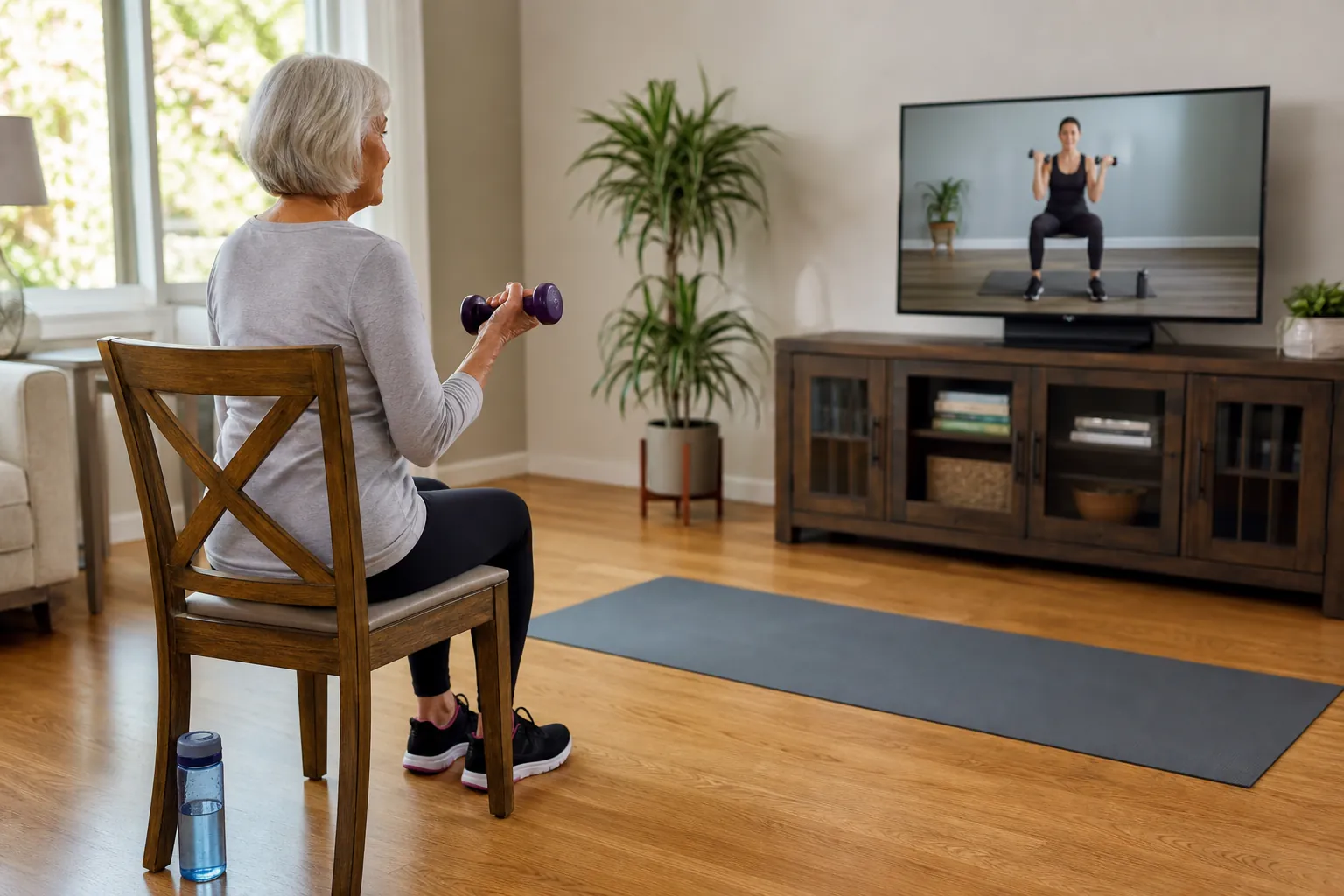
Why strength-and-balance videos are worth choosing carefully
Exercise deserves real respect in fall prevention. A Cochrane review of exercise for community-living older adults found that exercise reduced the rate of falls by about 23%, based on 59 studies with 12,981 participants and high-certainty evidence.[4] That does not mean any video labeled “senior balance” prevents falls. It means the right kind of exercise, done safely and consistently, can matter.
The useful clue is what those better programs tend to contain: balance challenge, leg and hip strengthening, practice that progresses over time, and enough repetition to become more than a one-off living room experiment. Otago makes that concrete. The National Council on Aging describes the Otago Exercise Program as 17 strength and balance exercises plus walking, done about three times per week, and associated with a 35% to 40% reduction in falls; it also notes the program is most effective for frailer older adults.[3]
The weekly activity target for adults 65 and older is broader: the CDC recommends 150 minutes of moderate-intensity aerobic activity, muscle-strengthening activities on at least 2 days a week, and balance activities each week.[5] That is a useful frame, but a single video does not have to solve the whole week. The job of a strength-and-balance video is narrower: practice the movements that help someone stand up, steady themselves, step, turn, and recover safely.
Use this checklist before pressing play
A video does not need studio lighting or a celebrity instructor. It does need the basics below. If a routine misses several of them, save it for entertainment and choose another.
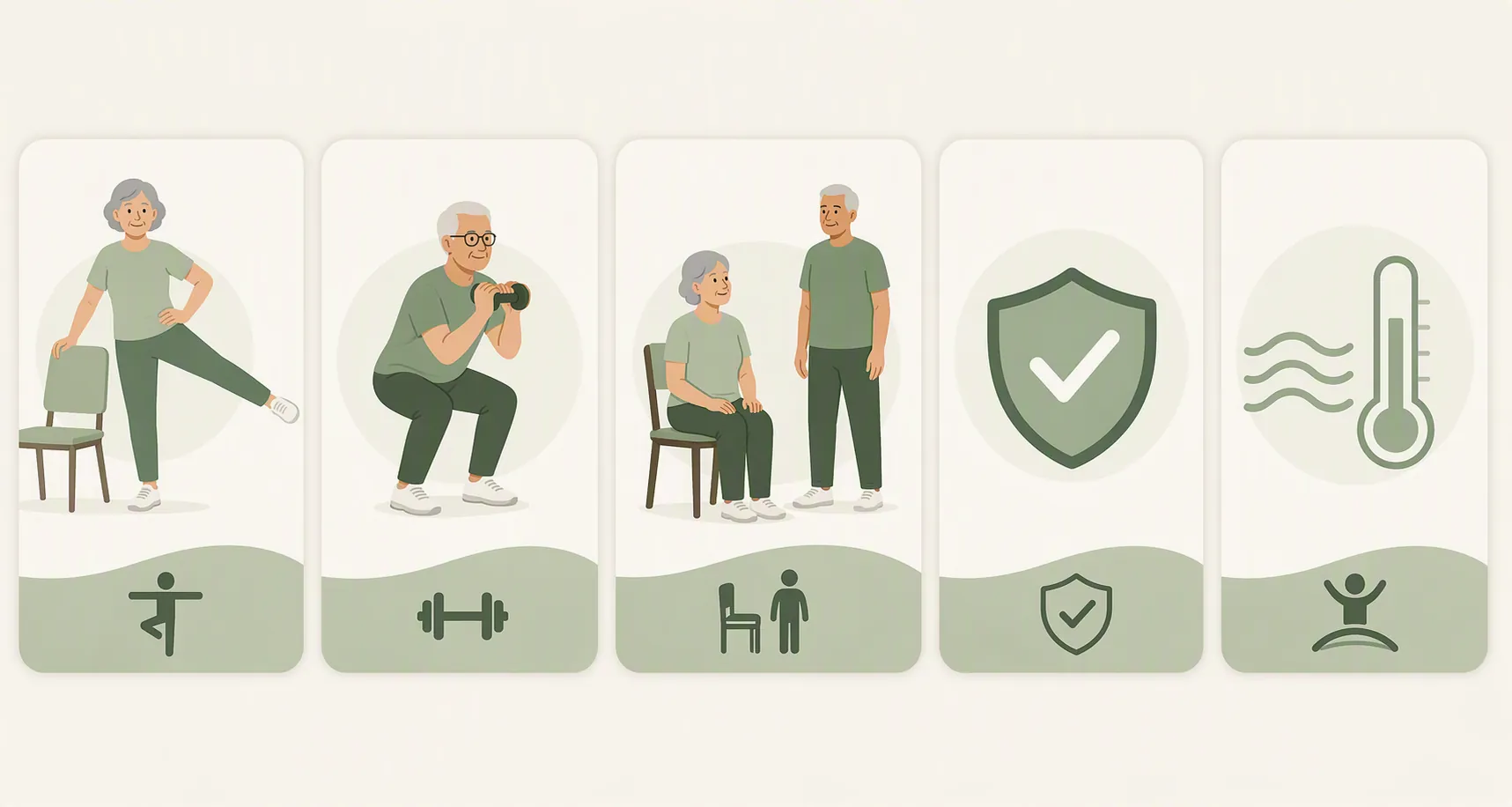
| What to check | What a safer video shows | Why it matters |
|---|---|---|
| Balance work | Weight shifts, heel-to-toe practice, single-leg preparation, side steps, marching, or turning practice with a chair or counter option. | Fall-prevention exercise needs actual balance practice, not only seated arm movements. |
| Lower-body strength | Sit-to-stands, mini-squats, calf raises, hip abduction, step-back practice, or similar leg and hip work. | Standing, climbing stairs, and recovering from a stumble rely heavily on leg and hip strength. |
| Supported options | The instructor clearly shows how to use a sturdy chair, countertop, or seated variation. | A viewer should not have to improvise support after losing balance. |
| Seated entry point | A seated version is available for warm-up, strength work, or the whole routine when needed. | For many people, seated exercise is the safer first step, not a downgrade. |
| Progression | The routine explains how to make a move easier or harder, or how to repeat it over several weeks. | A video that never progresses may become too easy; one that progresses too fast can become unsafe. |
| Warm-up and cool-down | The session starts gently and ends by slowing the body down. | Abrupt starts and stops are unnecessary, especially for someone exercising alone. |
| No surprise floor transitions | Floor exercises are optional, clearly previewed, or avoided in beginner balance videos. | Getting down to and up from the floor is its own skill and should not be sprung on the viewer. |
| Clear instructor qualifications | The instructor is a physical therapist, occupational therapist, certified senior-fitness instructor, or otherwise clearly qualified for older-adult exercise. | Credentials do not guarantee a perfect video, but vague authority claims are not enough. |
| Calm pacing and camera angle | The feet, chair, and body position stay visible; the instructor does not rush transitions. | The viewer should be able to copy the movement without guessing. |
The strongest warning sign is not a hard exercise by itself. It is a hard exercise with no exit ramp. Fast grapevines, twisting steps, backward walking, eyes-closed balance, deep lunges, and floor work may be appropriate for some older adults under the right conditions. They are poor choices when a beginner video offers them without a chair, counter, seated alternative, or instruction to skip the move.
Match the video to current ability, not age
Age labels are blunt. “For seniors” could mean a seated joint-mobility class, a dance-cardio routine, or a weighted squat workout. A better filter is what the person can do safely before the video starts.
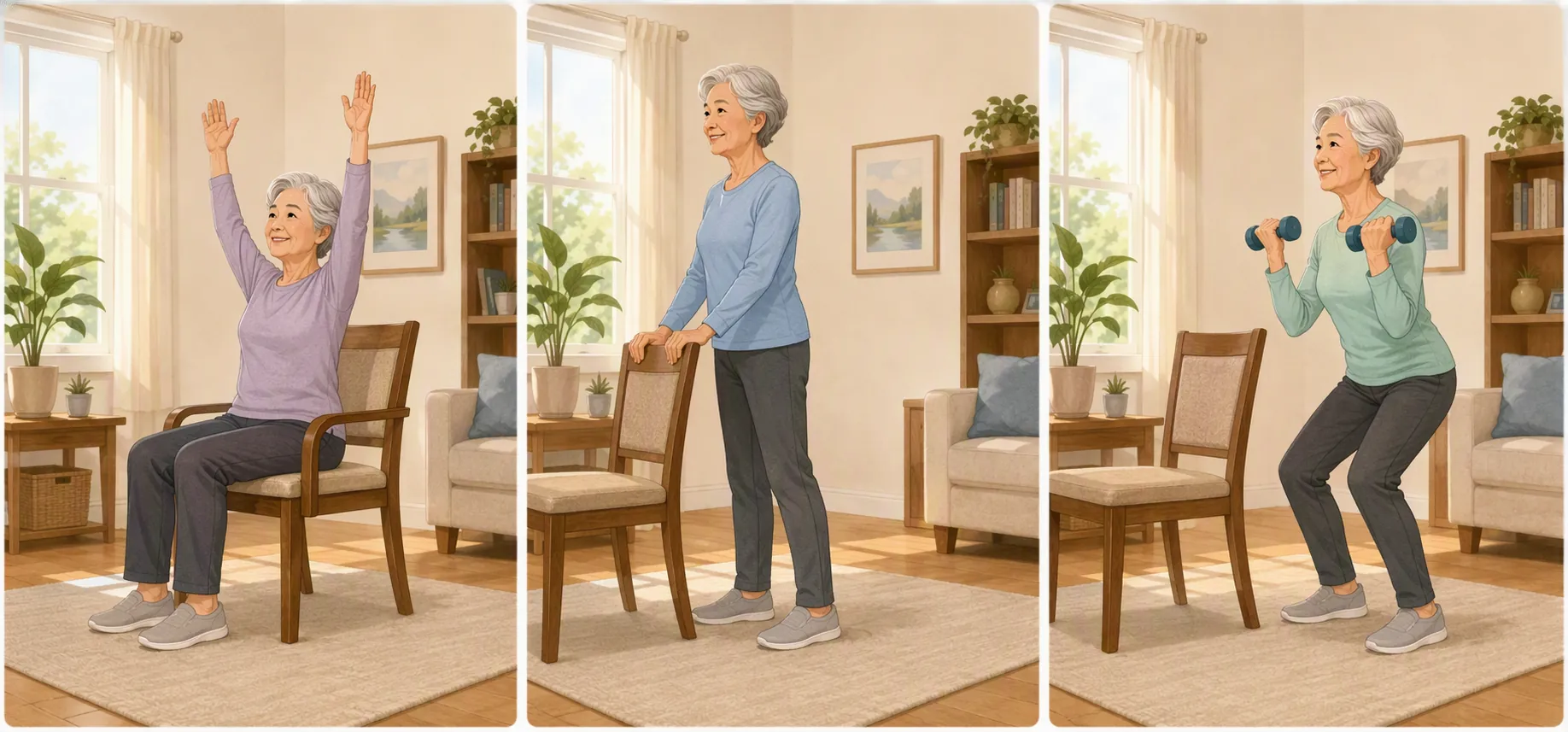
Start with seated videos when standing exercise feels uncertain
Choose a seated routine if the person feels unsteady standing still, uses a walker for most indoor movement, becomes anxious when both hands are off support, or is rebuilding after illness. A good seated video can still train posture, hip movement, ankle strength, knee extension, marching, arm strength, breathing control, and coordination. It can also build the habit of exercising without turning the living room into an obstacle course.
For fall prevention, seated work is usually a starting point rather than the whole plan. Standing balance has to be practiced standing at some point, but it should happen when the person is ready and, if needed, after professional guidance. If seated exercise is the only safe independent option today, that is still better than a standing routine that ends with panic-grabbing a bookshelf.
Use supported standing videos for the middle ground
Supported standing is often the most useful category for home strength and balance. Look for routines where a sturdy chair or counter is present from the first minute, not mentioned as an afterthought. The instructor should show hand placement, remind viewers to keep the support close, and offer permission to keep one or both hands down.
Good moves in this category include sit-to-stands from a firm chair, heel raises, toe raises, gentle marching, side leg lifts, hip extensions, shallow squats, and weight shifts. These are not glamorous exercises. They are the kind of movements that show up when someone gets out of a dining chair, reaches into a cabinet, steps around a pet bowl, or steadies after turning.
Active standing videos are for people who already move well
More active standing videos may be appropriate for an older adult who can stand from a chair without using their arms, walk around the house without furniture-walking, turn safely, and follow multi-step instructions while moving. Even then, the best videos keep support nearby and explain how to reduce the challenge.
This is where many “fun senior fitness” videos get too casual. A quick mambo step, diagonal reach, or twisting pattern may be fine for one viewer and a bad idea for another. If the feet move faster than the explanation, or if the instructor never shows what to do when balance wobbles, choose a slower routine.
Places to look for senior strength-and-balance videos
Think of the following as libraries to screen, not a ranked list. Access changes, videos move, and a familiar brand name still does not replace checking the actual routine.
| Source | Best use | Caveat |
|---|---|---|
| Nutrition.gov exercise examples and videos | A public starting point that aggregates exercise examples and videos, including older-adult resources from federal sources such as NIA-linked material and VA videos. | Verify the specific NIA video page before sharing a direct link, because Nutrition.gov may point indirectly to NIA-linked material.[6] |
| SilverSneakers On-Demand | A large on-demand fitness option for adults 65+ who have access through participating Medicare plans. | Eligibility depends on the person’s health plan; do not assume every older adult can use it.[7] |
| AARP fitness videos | A place to look for older-adult fitness content from a familiar nonprofit publisher. | Some AARP fitness videos or features may require membership or login, so check access before recommending one to a parent or client.[8] |
| Other senior-focused YouTube or app videos | Useful when the instructor is clearly qualified and the routine passes the safety checklist. | Do not rely on search snippets or channel branding for credentials. Open the video, check the instructor bio, and watch the first few minutes before following it. |
When screening any library, preview the routine before using it. Watch for the first standing transition, the first balance challenge, and the first moment the instructor changes direction. That is where a polished video often reveals whether it was built for real home use or merely labeled for older adults.
What the best videos include inside the workout
A useful strength-and-balance session usually has a simple shape: gentle warm-up, leg and hip strengthening, balance practice, and a cool-down. It does not have to be long to be worthwhile, but it should be organized enough that the viewer is not guessing what comes next.
- Warm-up: easy marching, shoulder rolls, ankle circles, seated or standing weight shifts, and breathing cues.
- Lower-body strength: sit-to-stands, mini-squats, calf raises, toe raises, side leg lifts, hip extensions, and gentle step practice.
- Balance practice: narrow stance, semi-tandem stance, heel-to-toe preparation, side stepping, marching, and controlled reaching near support.
- Progression: clear ways to add repetitions, reduce hand support, slow the movement, or increase range only when the current version is steady.
- Cool-down: slower movement, gentle stretching, and enough time for breathing and heart rate to settle.
The phrase “balance work” needs a little honesty. Waving arms while seated may be mobility or coordination work, but it is not the same as training balance in standing. On the other hand, asking a beginner to stand on one leg in the middle of a room is not automatically better. The useful challenge is the one the viewer can practice with control, close to support, repeatedly.
Strength matters because balance is not only an inner-ear issue. Weak calves, hips, thighs, and glutes make it harder to rise, step, slow down, and recover. Nutrition can support muscle, but it does not replace loading the muscles. For the food side of that conversation, see How Much Protein Seniors Need to Prevent Falls.
Set up the room before the video starts
A safe video can become unsafe in a bad room. The setup takes only a few minutes, and it should happen before the warm-up begins, not while the instructor is already moving.
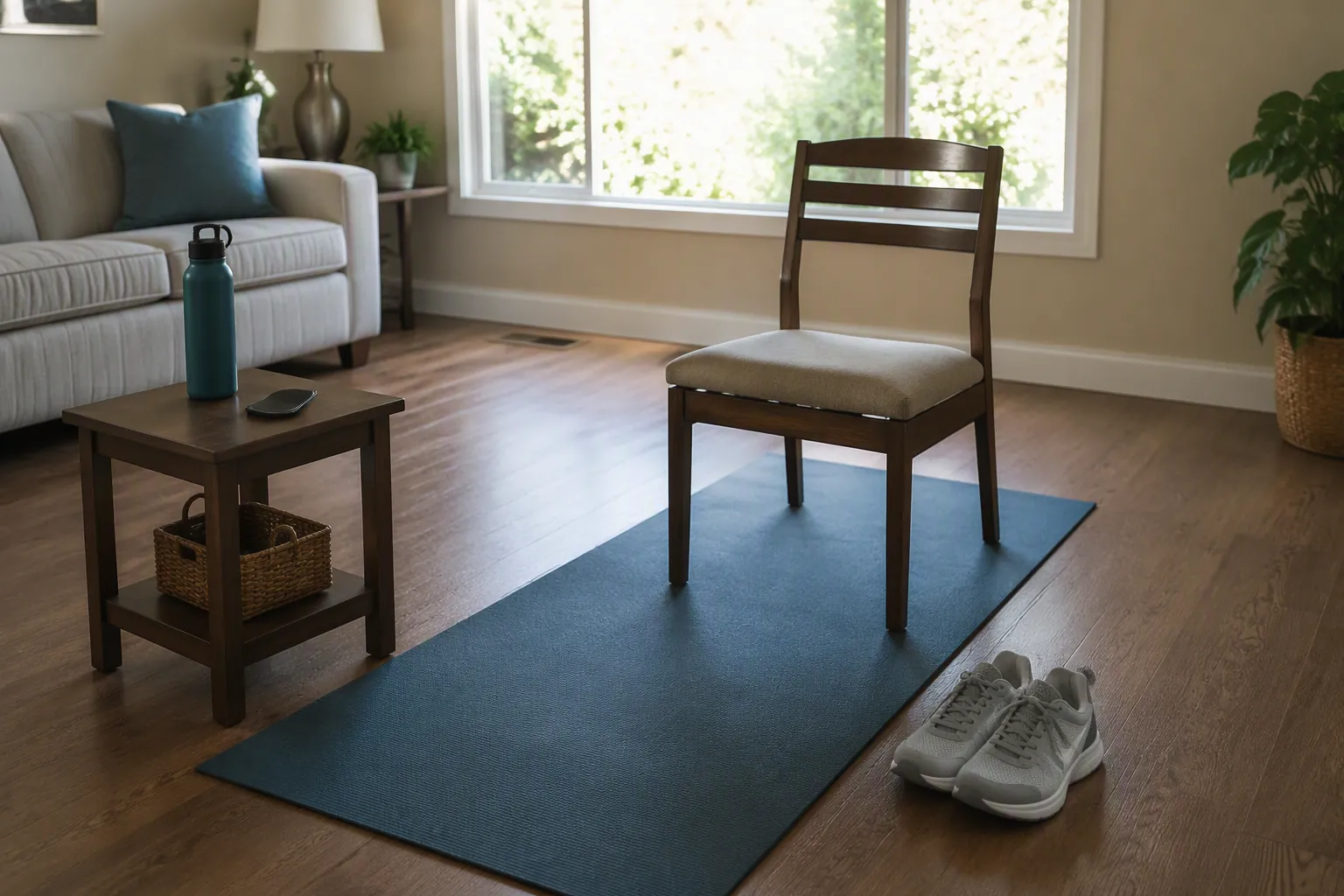
- Use a sturdy chair with a firm seat and stable legs. Avoid rolling chairs, soft recliners, and lightweight folding chairs that slide.
- Clear the floor of throw rugs, cords, pet toys, laundry baskets, and small tables.
- Place the chair near a wall or counter if extra support may be needed.
- Use good lighting so foot placement is visible.
- Wear supportive shoes if they help the person feel steadier; avoid slippery socks on hard floors.
- Keep water nearby, but not where it can be kicked over.
- Keep a phone within reach in case help is needed.
- Set the screen where the instructor can be seen without turning the head sharply or stepping around furniture.
Stop the routine for chest pain, severe shortness of breath, new dizziness, faintness, sudden weakness, sharp pain, or a level of imbalance that feels unsafe. Do not “push through” balance loss alone at home. For a fuller first-week setup, clearance questions, chair choice, and stop-signals, use How Seniors Can Start Strength Training Safely at Home.
When a video should not be the first step
Some situations call for individual assessment before a home video. That includes recent falls, repeated near-falls, dizziness, fainting, new numbness or weakness, worsening walking pattern, major vision changes, severe joint pain, recent surgery, or a new medical condition affecting movement. It also includes the quieter case where a person is simply afraid to stand and move without someone nearby.
A physical therapist or occupational therapist can test strength, gait, balance reactions, home setup, and assistive-device use. That is especially relevant for frailer older adults, where the Otago material points to physical-therapy assessment before independent strength-and-balance work.[3] A video cannot see whether someone is locking their knees, dragging a foot, turning too fast, or using a walker unsafely.
This article is general education, not personal medical advice. Fall prevention is also bigger than exercise: medication review, vision care, footwear, home hazards, assistive devices, and medical causes of dizziness all matter. For the broader prevention picture, start with the fall-prevention hub.
A safer way to choose “the best” video
The best senior workout video is not the one with the biggest audience. It is the one that fits the viewer’s current ability and contains the pieces that matter: lower-body strength, balance practice, a reasonable pace, supported options, a warm-up and cool-down, and no surprise moves that require more balance than the viewer has today.
For a confident, active older adult, that may be a standing strength-and-balance class with light weights and a chair nearby. For someone rebuilding steadiness, it may be supported heel raises, side leg lifts, sit-to-stands, and weight shifts at the kitchen counter. For someone who feels unsafe standing, it may begin seated while a clinician helps decide when and how to progress.
A playlist cannot promise fall prevention. A well-matched routine, practiced safely and repeated over time, is a better bet than a random viral recommendation.
References
- Balance exercises, Mayo Clinic.
- Balance Exercises: 13 Moves with Instructions, Cleveland Clinic.
- Evidence-Based Program: Otago Exercise Program, National Council on Aging.
- Exercise for preventing falls in older people living in the community, Cochrane.
- Older Adults: Physical Activity Guidelines, Centers for Disease Control and Prevention.
- Exercise Examples and Videos, Nutrition.gov.
- SilverSneakers On-Demand, SilverSneakers.
- Fitness Videos, AARP.
Related reading
Noticed something outdated or inaccurate on this page? Flag a correction. We review every report against CDC, NIA, and AARP HomeFit guidance before updating a page.
Part of the Fall Prevention section.