
STEADI: Intervene
When Seniors Must Leave Before a Flood Warning
This article explains why older adults with mobility limitations cannot wait for a Flood Warning to evacuate — and why acting at the Watch stage is critical to avoid the fall dangers and life-threatening risks of moving floodwater.
A flood evacuation plan for seniors cannot use the same clock as a plan for someone who can stand up, grab keys, step over a wet threshold, and drive away in five minutes. The National Weather Service describes a Flood Watch as the point when flooding is possible and people should be prepared, while a Flood Warning means flooding is imminent or already happening and action is required [1]. For an older adult who needs a helper, accessible transportation, a wheelchair, a walker, oxygen equipment, or extra transfer time, that distinction changes the whole leave-or-stay decision.
By the time a Warning is issued, the family may still be solving problems that should have been settled at the Watch: Who is physically coming to the house? Is the accessible van available? Can the ramp be used safely in rain? Is the walker by the exit or across the room? The American Association for Geriatric Psychiatry notes that mobility limitations, wheelchair use, dependence on assistive devices, and reliance on others can delay or prevent urgent evacuation for older adults [2]. That is why the practical evacuation decision point is earlier than many families want it to be.
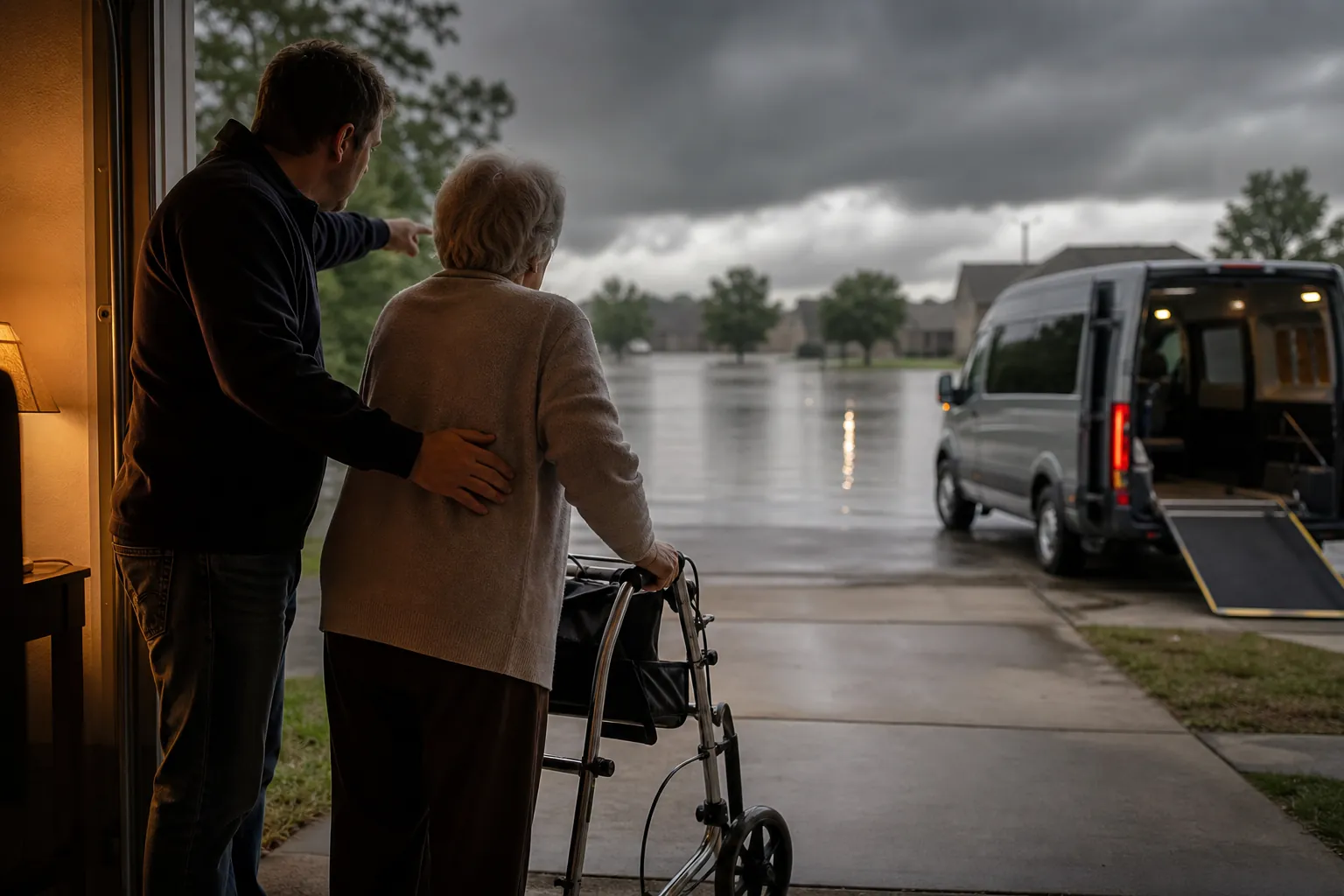
The Flood Watch is when the senior’s plan has to become real
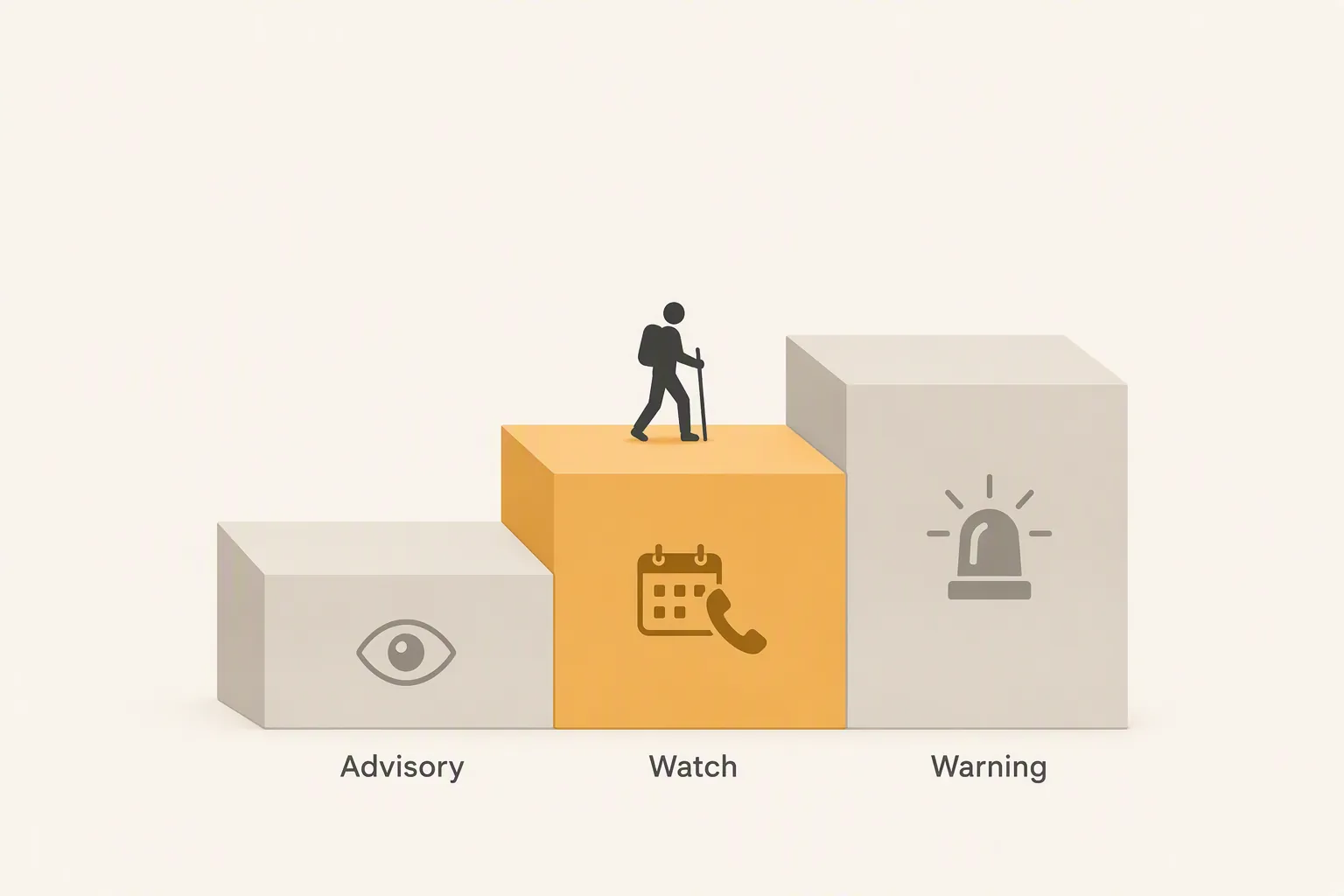
The alert ladder is simple on paper. It is not simple at a doorway when one person is trying to guide another person with poor balance, limited stamina, or a walker through rain. For seniors, each alert level should trigger a different level of action.
| NWS alert | What it means | What it should mean for an older adult who may need help |
|---|---|---|
| Flood Advisory | Be aware. | Check that the older adult is reachable, awake if needed, and near the mobility aids, phone, shoes, and glasses they would need if conditions worsen. |
| Flood Watch | Flooding is possible; be prepared. | Treat this as the senior-specific decision point. Contact helpers, confirm accessible transportation, move mobility aids to the exit path, check the ramp or threshold, and decide whether leaving now is safer than waiting. |
| Flood Warning | Flooding is imminent or occurring; take action. | Leave immediately if the route and transportation are still safe. This is not the stage for starting the family debate or calling around for a ride. |
The Watch stage is where the plan either holds or quietly fails. A daughter who lives 35 minutes away may need more than 35 minutes once roads are wet, traffic is heavy, or other relatives are also calling. A neighbor who can help with a transfer may not be home. A paratransit or accessible van option may not be available on demand. A portable ramp that works on a dry morning can become the slickest part of the route in a storm.
This is also the point to stop treating “prepared” as a vague word. Prepared means a real person has agreed to come. Prepared means transportation has been confirmed, not assumed. Prepared means the walker, wheelchair, cane, hearing aids, phone charger, shoes, and outerwear are where the older adult can reach them. Prepared means the family has decided whether the senior leaves before the Warning, instead of trying to make that decision while water is already in the street.
The fuller household work still matters: routes, contacts, supplies, documents, and where to go. Those belong in a complete flood evacuation checklist for older adults and a broader flood preparedness checklist for seniors and caregivers. This article is narrower: it is about the trigger. If the older adult cannot leave quickly without help, the trigger is the Watch.
Why waiting for the Warning can trap the caregiver, too
Many families delay because leaving early feels disruptive. It may mean convincing a parent to leave a familiar bed, arranging a pet, explaining the choice to relatives, or spending a night somewhere uncomfortable when the worst flooding may not happen. Those are real burdens. They are not as dangerous as discovering, during a Warning, that the older adult cannot transfer safely, the helper cannot get there, or the only route out has water over it.
A caregiver also needs a defensible rule because hesitation is contagious. One relative says, “Let’s wait and see.” Another says the last storm was overhyped. The older adult may reasonably worry about dignity, privacy, money, pets, or leaving the house unattended. A Watch-stage rule gives the caregiver something firmer than anxiety: if help is required to evacuate, the family starts moving before the public “take action” alert arrives.
For seniors who live alone or have complex support needs, the Watch is also the time to make sure local authorities know who may need help. CDC flood guidance advises people with special needs to inform local authorities so responders know who may require assistance, and it states that evacuation orders should never be ignored [3]. That does not mean waiting for responders is the plan. It means the formal system should know about the person before conditions close in.
Named helpers and practice matter because the Warning stage leaves little room for improvising body mechanics. If the family has never tested how long it takes to get from the bedroom to the car, or how hard it is to fold the walker while supporting a parent’s balance, the estimate is probably too optimistic. A separate emergency evacuation plan for elderly parents can carry the helper assignments and drills; the flood-specific rule is to activate those assignments at the Watch.
Floodwater is a fall hazard before it looks like a disaster
The most dangerous mistake is picturing floodwater only as deep, dramatic water. For an older adult, shallow moving water is already a fall-prevention problem. The danger begins at the feet: a slick ramp, a hidden curb, a soft shoulder, a walker wheel that catches, a cane tip that slips, a shoe that loses traction, a person who cannot recover quickly once their balance is gone.
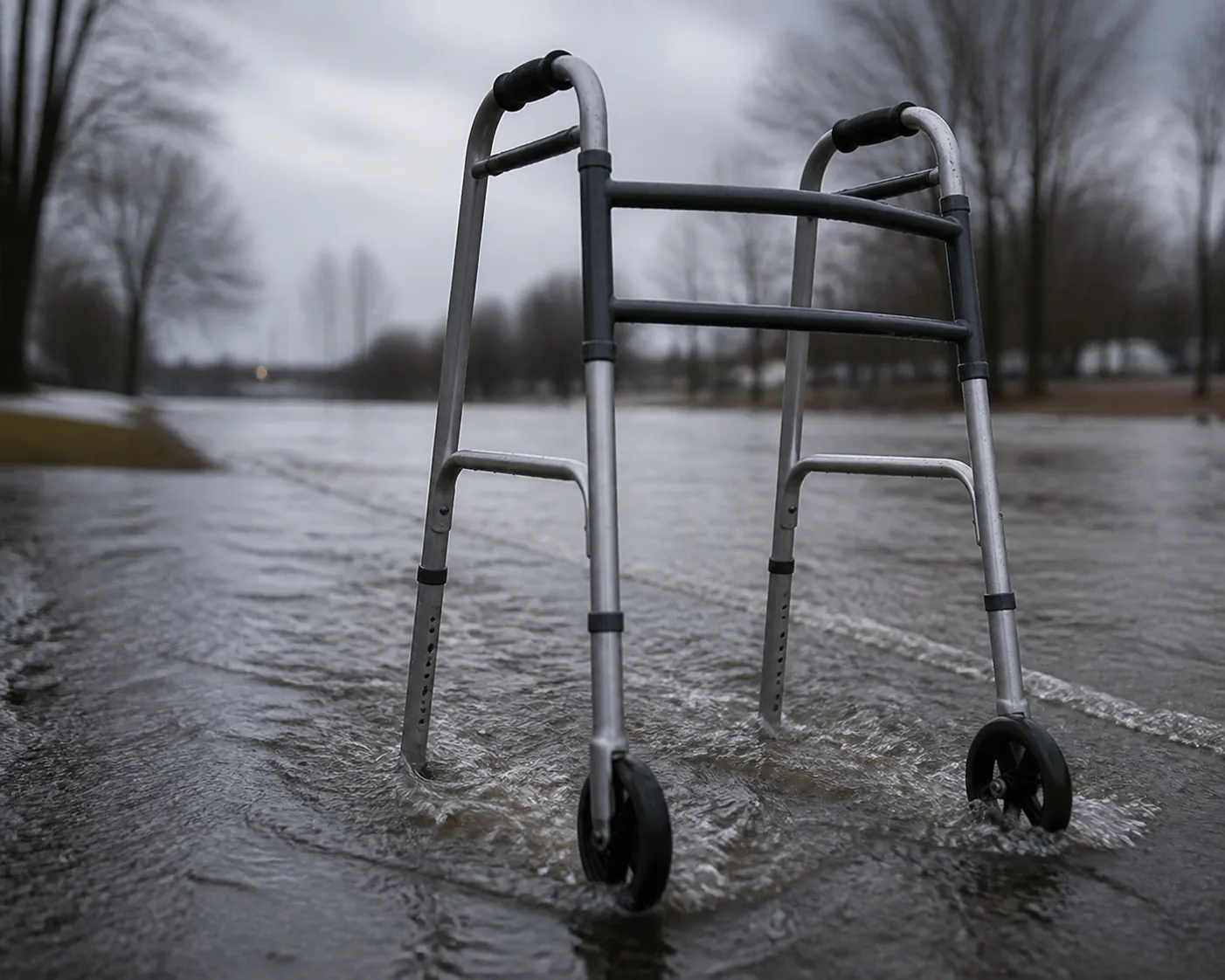
The water does not need to be high. The National Weather Service says six inches of fast-moving water can knock over an adult, 12 inches of rushing water can carry away most cars, and two feet of rushing water can carry away most SUVs and trucks [4]. The American Red Cross gives the same practical warning: six inches, or about 15 centimeters, of fast-moving water can knock a person over, while 12 inches can carry most cars and two feet can carry SUVs and trucks [5].
Those numbers matter differently when the person is older. A younger adult may stumble and recover. An older adult using a walker may have both hands committed to the device, slower reaction time, weaker balance responses, and less ability to step sideways quickly. Underwater ground is unreadable. A driveway edge, storm drain, broken pavement, or softened soil may be invisible. Once someone falls in moving water, the caregiver may not be able to lift them without falling too.
Driving is not the safe workaround once water is on the road. The National Weather Service, citing CDC data, states that more than half of flood-related drownings occur when a vehicle is driven into hazardous floodwater [4]. For a senior evacuation, that means the car is only part of the safety plan if it is used before the water reaches the route. A vehicle that arrives late can become another trap, especially if the passenger needs extra time to transfer in rain.
If someone must move on foot because there is no safer option, California Department of Aging disaster tip sheets advise walking only where water is not moving and using a stick to check that the ground is firm [6]. That should be read as last-resort caution, not permission to cross floodwater. A cane, walker, or wheelchair does not make moving water safer; in many cases, it gives the water more ways to destabilize the person.
The reason “early” is not overcautious for older adults
Older adults are not all equally vulnerable, and one storm’s numbers should not be stretched into a universal rule. Still, the event-specific figures are hard to ignore. AARP reports that people age 75 and older were about 6% of New Orleans’ population before Hurricane Katrina but made up about half of the deaths [7]. AARP also reported, citing National Weather Service hazard statistics, that adults age 50 and older accounted for 59% of U.S. flash and river flood deaths in 2024 [8].
Those figures do not prove that every older adult should leave for every Watch. They do support a stricter decision rule for seniors who cannot evacuate quickly. When mobility, transportation, health equipment, and helper availability all have to line up, waiting for certainty can mean waiting until the safe transfer window is gone.
If a Warning or evacuation order arrives before the senior has left
At the Warning stage, the question is no longer whether the plan should begin. If the route is still dry and official guidance says to leave, leave. CDC guidance is direct that evacuation orders should never be ignored [3]. For an older adult, that means using the already-confirmed helper and transportation, not opening a fresh round of calls.
If leaving is no longer possible because water blocks the route, the safer branch is vertical movement inside the home, if the person can do it safely. FEMA advises going to the highest level of the building, getting on the roof only if necessary, and never sheltering in a closed attic because rising floodwater can trap a person there [9].
That last-resort branch should be planned before storm day. Can the older adult reach the second floor? Is there a safe place above expected water level that does not require stairs they cannot climb? Would power loss stop a stair lift, oxygen concentrator, adjustable bed, or medical device? Flood planning overlaps with power-outage fall prevention and backup planning for medical equipment, but the immediate rule stays simple: do not walk or drive through floodwater to make a late evacuation work.
After the flood, keep watching for health and fall-risk changes
The danger does not end when the water line stops rising. A study reported by Harvard T.H. Chan School of Public Health, using Medicare data from 2000 to 2016 across 72 major flood events, found increased hospitalization rates among adults 65 and older during and up to four weeks after major floods. The reported relative increases included skin diseases at 3.1%, nervous system conditions at 2.5%, musculoskeletal conditions at 1.3%, and injuries or poisonings at 1.1% [10].
That finding is about hospitalization rates, not a claim that every flooded household will see those outcomes. It is still a reason to watch older adults closely after evacuation or sheltering: new pain, dizziness, confusion, skin problems, medication disruption, dehydration, or a change in walking can turn the return home into another fall-risk period.
Re-entry should wait until officials say it is safe, and the first walk through the home should be treated like a fall inspection: wet flooring, loose rugs, warped thresholds, debris, moldy surfaces, poor lighting, and damaged steps all matter. A separate after-storm home safety guide for seniors can carry that work.
The rule to decide before the rain
If an older adult can leave independently, the family may have more room to follow public alerts as written. If the older adult cannot evacuate quickly without a helper, accessible transportation, or assistive devices, the Flood Watch is the practical evacuation decision point. The Flood Warning is for immediate action, not for beginning the debate.
Leaving early can be inconvenient, embarrassing, expensive, and sometimes unnecessary in hindsight. Waiting too long can put a senior at a wet threshold, beside a stalled vehicle, or in moving water with a walker that no longer helps. For fall prevention, that is the moment the plan was supposed to avoid.
References
- Flood Warning VS. Watch, National Weather Service.
- Older Adults and Disaster: Preparedness and Response, American Association for Geriatric Psychiatry.
- Preparing for Floods, Centers for Disease Control and Prevention.
- Turn Around Don't Drown, National Weather Service.
- Flood Safety, American Red Cross.
- Disaster Tip Sheets, California Department of Aging.
- Disaster Risks to Older Adults, AARP.
- Texas Flood Victims, AARP.
- 7 Flood Safety Tips, FEMA.
- Flooding increases hospitalization risks in older adults, Harvard T.H. Chan School of Public Health.
Related reading
Noticed something outdated or inaccurate on this page? Flag a correction. We review every report against CDC, NIA, and AARP HomeFit guidance before updating a page.
Part of the Fall Prevention section.