
STEADI: Intervene
Assistance for Seniors After a Wildfire Destroys Their Home
A first-30-days recovery plan for older adults and the caregivers acting on their behalf after a wildfire destroys their home. It covers senior-specific steps generic aid lists often miss: registering for FEMA assistance, replacing medications and mobility equipment, protecting benefits, and fall-proofing the temporary home.
After the fire is out and the evacuation order has moved from immediate danger to damage assessment, the first question is not rebuilding. It is where an older adult will sleep tonight, how the official aid file gets opened, and how to replace the pills, walker, oxygen, CPAP, glasses, hearing aids, insurance cards, and benefit mail that may have disappeared with the house.
Phone access matters here. AARP reports that 15% of people age 50 and older lack internet access, and more than half have no emergency savings; a senior recovery plan that assumes online forms and cash reserves will fail many of the families who need it most.[1] Older adults also have a different disaster-risk profile: 71 of the 84 people who died in California's 2018 Camp Fire were age 60 or older, and USFA/FEMA reported that adults 65 and older had 2.5 times the fire-death risk of the general population in 2020.[1][2]
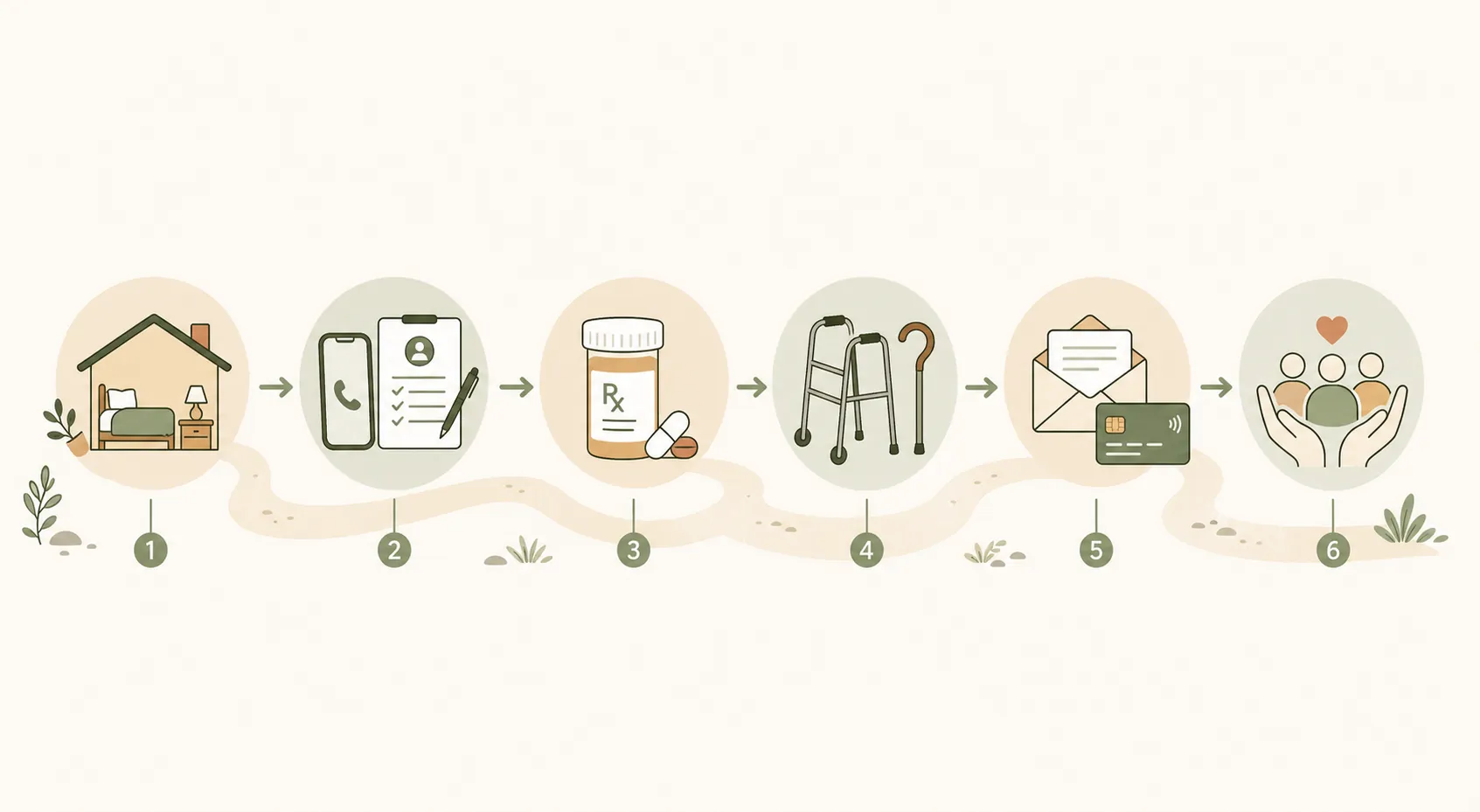
This guide is general information, not legal, medical, insurance, or financial advice. In a declared disaster, rules can change quickly. Use official agencies first, write down case numbers, and re-check any dollar amount or eligibility rule before relying on it.
The first-30-days sequence
| When | Do this first | Why it matters |
|---|---|---|
| Tonight to 72 hours | Get shelter or hotel help started. Register with FEMA at DisasterAssistance.gov or 1-800-621-3362 if a presidential disaster declaration applies; Ready for Wildfire also lists TTY 800-462-7585.[3] | Many later steps attach to the FEMA application, inspection, insurance file, or temporary address. |
| First 72 hours | Call the pharmacy, prescriber, Medicare plan, medical supplier, and insurer. Replace essential medications and durable medical equipment. | Missed cardiac, diabetes, breathing, pain, seizure, or psychiatric medications can turn a housing crisis into a medical crisis. |
| Days 3 to 10 | Protect money, benefit payments, mail, and identity documents. | A burned mailbox should not mean a lost Social Security payment, missed insurance letter, or unanswered FEMA request. |
| Days 3 to 14 | Call the Eldercare Locator at 1-800-677-1116 for the Area Agency on Aging and local senior-service routing. | Local aging offices often know transportation, meals, caregiver support, replacement documents, and senior housing options that national sites do not. |
| First 30 days | Fall-proof the temporary home: hotel room, relative's house, rental unit, shelter, RV, or assisted-living placement. | Unfamiliar bathrooms, beds, stairs, lighting, and pathways raise the risk of a second injury while the family is focused on paperwork. |
Open the FEMA and shelter file before the paper trail scatters
If the wildfire is part of a presidentially declared disaster, register with FEMA as early as possible. The two basic paths are online at DisasterAssistance.gov or by phone at 1-800-621-3362; for people using TTY, Ready for Wildfire lists 800-462-7585.[3] If the older adult cannot manage the call alone, sit with them, use speakerphone if appropriate, and keep a written log: date, time, agency, representative name if given, application number, and the next document requested.
Do not treat FEMA registration as a promise that every loss will be paid. FEMA housing and other-needs assistance is tied to a declared disaster, verification steps, and citizenship or qualified noncitizen status for some assistance. Help may include categories such as Transitional Sheltering Assistance hotel stays, rental assistance, and lodging-expense reimbursement when the program and the survivor's situation qualify.[4] A home inspection may also be part of the process.[3]
FEMA's 2024 Individual Assistance reforms are important for older adults because they created or streamlined several doors that may matter in the first weeks: upfront Serious Needs Assistance, Displacement Assistance, no Small Business Administration loan-first requirement before certain FEMA help, accessibility improvements such as grab bars, an exterior ramp, or a paved path even when the disability pre-existed the disaster, and appeals that no longer require a signed written letter.[5]
As of August 3, 2026, FEMA's Serious Needs Assistance quick reference lists a $750 one-time payment per household, described as inflation-adjusted. Re-verify the live FEMA amount before telling a parent or landlord that the money is available or sufficient.[6] It is emergency money for serious needs, not a full replacement for insurance, housing assistance, prescriptions, mobility equipment, or caregiving support.
What to keep in the first folder
- FEMA application number and any inspection information.
- Temporary address, hotel name, room number, and phone number.
- Photo ID or the fastest path to replacement ID.
- Insurance policy numbers for homeowners, renters, auto, Medicare, Medicaid, Medicare Advantage, Medigap, Part D, and long-term care insurance.
- Medication list, pharmacy name, prescribers, medical-equipment supplier, and device model names if known.
- Receipts for hotels, replacement clothing, medications, equipment, transportation, and accessibility items.
- A page for every call: agency, date, person reached, case number, and next step.
A notebook is not sentimental paperwork. It is how a caregiver prevents one agency's partial answer from disappearing before the next agency asks for it.
Replace medications before the refill calendar becomes dangerous
Start with the medications that keep the person medically stable: insulin and diabetes supplies, heart and blood-pressure medications, blood thinners, seizure medications, inhalers, oxygen-related supplies, transplant drugs, psychiatric medications, pain medications, antibiotics, and anything the doctor has told the family not to stop suddenly. If the older adult uses a pill organizer and the bottles burned, do not guess from memory if there is any way to reach a pharmacy record.
Chain pharmacies may be able to pull prescription records and fill refills at another location, which is often faster than trying to reconstruct the whole list from memory. Cedars-Sinai notes that during a declared emergency, pharmacies may be able to provide an emergency supply without a prescription, but controlled substances remain more difficult and may require prescriber involvement or stricter review.[7]
- Call the usual pharmacy first. Ask whether the records can be accessed from a nearby open branch or transferred to a pharmacy near the shelter, hotel, or relative's home.
- Ask for the exact refill barrier. Is the problem no remaining refills, insurance saying it is too soon, lack of stock, controlled-substance rules, or the pharmacy not having the record?
- Call the prescriber for emergency replacement orders, especially for controlled substances, oxygen-related prescriptions, insulin, and medications that cannot be safely interrupted.
- Call the Part D plan, Medicare Advantage plan, Medicaid plan, or other insurer and say the medication was lost in a declared wildfire disaster. Ask about disaster overrides, early refill procedures, and an in-network pharmacy near the temporary address.
- If the older adult is uninsured and the disaster has an active Emergency Prescription Assistance Program, call EPAP at 855-793-7470. Do not assume EPAP exists for every wildfire.
EPAP is narrow by design. ASPR/HHS describes it as a program that can replace prescriptions and certain medical supplies or equipment for uninsured residents, but only when activated for a specific declared disaster.[8] If EPAP is not activated, the next practical calls are the pharmacy, prescriber, insurer, local health department, disaster recovery center, and Area Agency on Aging.
Replace the equipment that lets the person breathe, walk, sleep, toilet, and transfer
A walker burned in the garage can be as urgent as a missing bank card. So can a CPAP machine, wheelchair charger, oxygen tubing, commode chair, hearing aids, eyeglasses, prosthetic supplies, shower chair, cane, scooter, hospital bed, or lift-related equipment. The first call is usually the supplier if the family knows it; the second is the doctor or plan; the third is Medicare, Medicaid, the Medicare Advantage plan, or the insurer that paid for the original device.
Medicare Part B covers many types of durable medical equipment when medically necessary, including walkers, canes, wheelchairs, scooters, commode chairs, hospital beds, oxygen equipment, and CPAP equipment, generally with 20% coinsurance after the deductible and with a doctor's order and a Medicare-enrolled supplier.[9] HHS Empower's disaster DME guidance says lost or damaged Medicare DME can be replaced after a disaster, but families should verify the current claim process with Medicare, the plan, or the supplier before paying out of pocket.[10]
| If this was lost | First call | What to ask |
|---|---|---|
| Walker, cane, wheelchair, scooter, commode chair, hospital bed | DME supplier, doctor, Medicare or Medicare Advantage plan | Do we need a new order? Can the prior claim record support replacement? Which nearby supplier is enrolled or in network? |
| CPAP, oxygen equipment, tubing, mask, concentrator supplies | Supplier and prescriber the same day | Can emergency replacement be delivered to the hotel, shelter, or relative's home? Does the plan require prior authorization? |
| Hearing aids, glasses, dentures, prosthetic supplies | Original provider, insurer, Medicaid or Medicare Advantage plan if applicable | Is there disaster replacement coverage, a repair record, or a local provider who can fit temporary replacements? |
| Shower chair, raised toilet seat, transfer bench, grab bar, ramp | Doctor, DME supplier, FEMA case contact, local aging agency | Is it DME, an accessibility improvement, a temporary housing accommodation, or a home-modification cost? |
The boundary between medical equipment and home modification matters. Medicare may cover DME, but it generally does not turn a bathroom into a safer bathroom just because a person needs one. FEMA's 2024 reforms are different in disaster context because they allow certain accessibility improvements, including grab bars, an exterior ramp, or a paved path, when eligible.[5] For the longer funding question, keep this crisis file separate and use CareWise Guide's explanation of home-modification funding when Medicare will not pay.
Protect benefits, mail, and the accounts that keep paying
Once the older adult has a temporary address, make the benefits and insurance accounts findable. A stopped mailbox can delay checks, cards, notices, appeal deadlines, and replacement documents. Ready.gov's older-adult guidance recommends switching Social Security and other benefits to direct deposit or Direct Express so disrupted mail does not stop payments, and keeping copies of Medicare, Medicaid, and insurance cards.[11]
- Social Security or SSI: confirm direct deposit or Direct Express, and update the temporary mailing address if needed.
- Medicare, Medicaid, Medicare Advantage, Part D, Medigap, VA, pension, or long-term care insurance: ask where replacement cards and notices should go.
- Homeowners or renters insurance: open the claim, ask how additional living expenses are handled, and keep receipts separate from FEMA receipts.
- Bank and credit-card accounts: replace cards, watch for address-change problems, and set alerts if the older adult can use them.
- Postal mail: set a reliable forwarding or hold arrangement through official channels, and do not depend on a destroyed or inaccessible mailbox.
If an adult child is helping from another city, this is the point where shared access becomes less abstract. Put the older adult on the phone when agencies require permission. Ask each agency what form is needed for a caregiver, representative payee, authorized representative, agent under power of attorney, or plan-approved helper. The title changes by agency; the need is the same.
Get routed through aging services, not only disaster services
National disaster pages can open federal doors. Local aging offices can often tell you who will drive an older adult to a pharmacy tomorrow morning. The Eldercare Locator, run through the Administration for Community Living, connects people to Area Agencies on Aging and local senior services at 1-800-677-1116.[12]
Use that call to ask for practical routing, not a general list. Say: "My parent is an older adult whose home was destroyed in the wildfire. We need temporary housing support, transportation to medical appointments and pharmacy, meals, replacement benefits documents, caregiver support, and help finding local disaster services." If the older adult has dementia, mobility limitations, oxygen needs, dialysis, home-health services, or no nearby family, say that early in the call.
- Ask whether the Area Agency on Aging has a wildfire-specific intake line or disaster case-management partner.
- Ask about transportation before scheduling replacement appointments.
- Ask about meal delivery or congregate meals near the temporary address.
- Ask whether they know local organizations replacing assistive devices, glasses, hearing aids, or basic household items.
- Ask what documentation they need if the caregiver is calling on the older adult's behalf.
Fall-proof the temporary home before the first bad night
This is the step many disaster-aid lists skip. It should not wait until permanent housing is solved.
The strongest displacement-fracture evidence is not wildfire-specific. It comes from a Hurricane Katrina Medicare Advantage cohort of 25,019 older adults. In that study, people still displaced at 12 months had 1.53 times greater odds of hip fracture and 1.24 times greater odds of other fractures in the following year.[13] That does not prove the same numbers after wildfire. It does show why prolonged displacement belongs in the safety plan, not just the housing file.
The baseline risk is already high. CDC reports that more than 1 in 4 older adults falls each year, about 37% of those who fall are injured, and falling once doubles the chance of falling again.[14] Now put that person in a hotel room with a low toilet, a soft mattress, a suitcase on the floor, a bathroom light switch in the wrong place, no shower grab bar, and a walker that has not yet been replaced.

A 20-minute safety pass through the room
- Path from bed to bathroom: remove rugs, cords, bags, shoes, boxes, and low furniture. The walker or cane should fit the whole route without turning sideways.
- Lighting: put a nightlight between bed and bathroom. Leave the bathroom light on if the switch is hard to find. Keep a flashlight where the older adult can reach it from bed.
- Bed height: if feet do not reach the floor safely, ask the hotel or host for a lower bed, a firmer chair for transfers, or another room.
- Bathroom transfers: check toilet height, shower entry, slick floors, towel bars that look like grab bars but are not, and whether a shower chair or transfer bench is needed.
- Assistive devices: replace the walker, cane, wheelchair, hearing aids, glasses, and properly fitting shoes as safety equipment, not comfort items.
- Medication side effects: after emergency refills or substitutions, ask the pharmacist about dizziness, sleepiness, blood-pressure drops, or timing changes that could increase fall risk.
- Stairs and exterior routes: if there are steps, gravel, steep walks, poor lighting, or long parking-lot distances, ask for a different room or placement before accepting that this is just temporary.
If the older adult needs grab bars, an exterior ramp, or a safer path to enter temporary or repaired housing, ask FEMA, the insurer, the landlord, the hotel, and the local aging agency which part of the request each can handle. FEMA's accessibility-improvement reform may matter here when the disaster and survivor qualify.[5] For permanent relocation or rebuilding, use a separate funding search such as CareWise Guide's 2026 guide to aging-in-place remodel grants and loans rather than trying to solve structural modifications from a hotel room.
Keep scam pressure out of the recovery file
Disaster paperwork creates openings for people who want deposits, account numbers, benefit information, or quick signatures. The American Red Cross tells older adults to use trusted sources and avoid scam contractors.[15] In practical terms, do not sign a repair contract in a parking lot, do not give a stranger Medicare or Social Security numbers to "speed up" aid, and do not let a contractor take over FEMA, insurance, or benefits communication.
If the family rebuilds or makes permanent accessibility changes, slow the contractor decision down. CareWise Guide has a separate checklist on choosing an aging-in-place contractor and avoiding costly mistakes. In the first month, the priority is not the most complete rebuilding plan. It is keeping the older adult housed, medicated, mobile, paid, reachable, and less likely to fall.
By day 30, aim for handoff rather than closure
Thirty days after a wildfire destroys a home, most families are not finished. A realistic handoff looks like this: FEMA and insurance files are open; the older adult has a safe temporary address; essential prescriptions are replaced or in process; DME replacement is documented; Social Security, Medicare, Medicaid, insurance, and bank contacts know where to send notices; the Area Agency on Aging has been contacted; and the temporary room has been checked for falls.
That is enough structure for the next set of decisions to have somewhere to land.
References
- The Impact of Disasters on Older Adults — AARP Livable Communities
- Fire Safety for Older Adults — USFA/FEMA
- Who Can Help? — Ready for Wildfire
- Assistance for Housing and Other Needs — FEMA.gov
- Reforming Individual Assistance: New Benefits and Streamlined Processes — FEMA
- Serious Needs Assistance Quick Reference — FEMA
- L.A. Wildfires: How to Manage Medications During a Disaster — Cedars-Sinai
- Emergency Prescription Assistance Program — ASPR/HHS
- Durable Medical Equipment (DME) Coverage — Medicare.gov
- Replacing Medicare DME After a Disaster — HHS Empower
- Older Adults — Ready.gov
- Eldercare Locator — ACL
- Disaster-related injuries in the period of recovery: The effect of prolonged displacement on risk of injury in older adults — Journal of Trauma, 2009
- Facts About Falls — CDC
- Emergency Preparedness for Older Adults — American Red Cross
Related reading
Noticed something outdated or inaccurate on this page? Flag a correction. We review every report against CDC, NIA, and AARP HomeFit guidance before updating a page.
Part of the Fall Prevention section.