
When to worry about your parent's sleep and Alzheimer's risk
Many family caregivers dismiss their parent's poor sleep as normal aging, but research shows conditions like sleep apnea and chronic insomnia are treatable risk factors for Alzheimer's. This guide helps you distinguish concerning sleep changes from typical age-related shifts and take actionable steps to lower cognitive decline risk.
A parent's sleep can change in ways that look harmless at first: the new afternoon nap, the joke about snoring, the 4 a.m. kitchen light, the complaint that they are "just tired lately." Some of that can come with aging. Older adults may sleep more lightly, wake earlier, or need more time to feel rested. The question is not whether every changed night points toward Alzheimer's disease. It does not. The question is when a sleep pattern is persistent enough, disruptive enough, or tied closely enough to memory and attention changes that it deserves to be written down and brought into the next medical conversation.
For families trying to understand sleep and Alzheimer's risk in older adults, the most useful distinction is between an occasional rough night and a pattern with consequences. A parent who wakes early but functions well the next day is different from a parent who snores loudly, gasps, dozes during conversations, forgets appointments, or says they have not slept normally in months. Those second patterns are not background noise. They are evidence.

What changes are worth tracking
Before anyone starts arguing about whether a sleep change is "normal," collect the parts that tend to disappear in a short appointment: when it started, how often it happens, what the night looks like, what the next day looks like, and whether thinking or mood changed around the same time. A clinician can do more with "she wakes at 3 or 4 most mornings, naps after lunch, and has missed two bill payments since April" than with "she sleeps badly."
| Usually less concerning when isolated | Worth discussing with a clinician |
|---|---|
| Occasional early waking after stress, travel, illness, or a schedule change | Insomnia that persists for weeks or months, especially with daytime fatigue or new forgetfulness |
| A short nap after a poor night | Daily naps that are new, long, or hard to interrupt |
| Light snoring without daytime symptoms | Loud snoring, gasping, choking, witnessed breathing pauses, morning headaches, or heavy daytime sleepiness |
| One confused morning after poor sleep | Repeated memory, attention, mood, or decision-making changes that appear alongside sleep disruption |
| A known medication taken briefly as directed | Sedating medications, alcohol, or sleep aids that may be worsening balance, alertness, or memory |
This is also where families can avoid two opposite mistakes. One is panic: assuming that every bad night is dementia starting. The other is dismissal: assuming that because older people often sleep differently, nothing treatable is happening. If you are already trying to separate ordinary aging from cognitive red flags, a broader guide to normal aging versus concerning disclosure patterns can help frame what belongs in the medical visit.
Sleep apnea is the one families most often miss
Sleep apnea deserves special attention because it can sound ordinary from the hallway. Snoring becomes a family joke. Pauses in breathing are noticed once and then forgotten. Daytime sleepiness gets blamed on age, boredom, or retirement. Yet at least 80% of moderate to severe obstructive sleep apnea in the United States remains undiagnosed, which means many families are living with a treatable problem without knowing its name.[1]
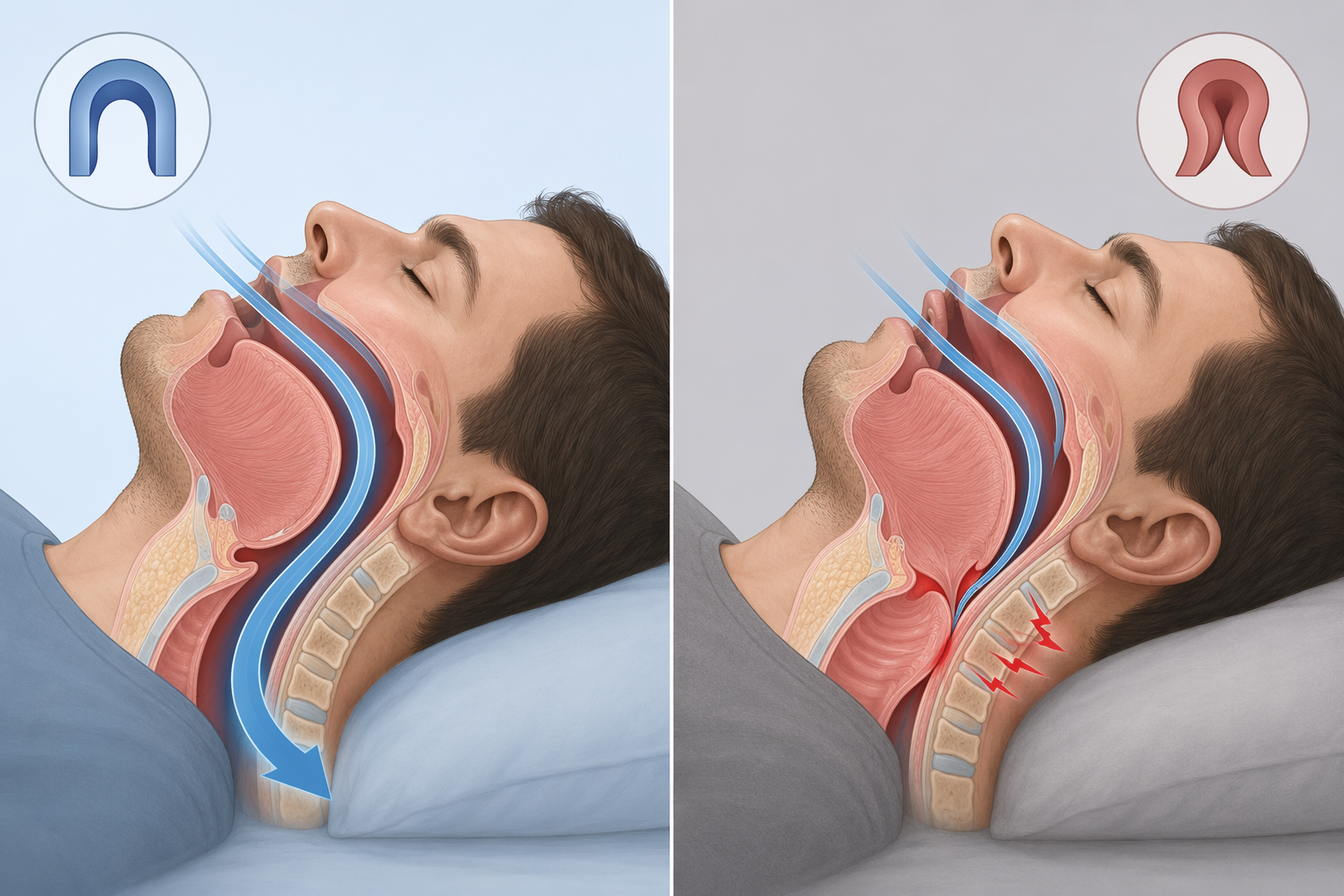
The cognitive concern is not just that apnea interrupts sleep. It can repeatedly lower oxygen while the brain is supposed to be recovering. A 2025 UC Irvine study followed 37 cognitively normal older adults, average age 73, and found that lower oxygen levels during REM sleep were associated with thinning of the entorhinal cortex, a brain region affected early in Alzheimer's disease, and with poorer overnight memory retention.[2] That study is small, and it should not be treated as proof that REM oxygen drops cause Alzheimer's. But it gives caregivers a useful warning: a parent can have a sleep report that sounds mild by one measure and still have oxygen patterns worth asking about.
That matters because the usual severity score for sleep apnea can flatten the night into one average. A family, however, may be seeing the lived pattern: worse snoring on the back, more confusion after restless nights, morning fog that clears by noon, or dozing during the day after what looked like a full night in bed. Those observations do not diagnose apnea, but they can justify asking whether a sleep study is appropriate.
There is a hopeful side here, and it should not be overstated. Nebraska Medicine neurologist Daniel Murman, MD, notes that treating obstructive sleep apnea can improve memory, focus, and thinking; in some cases, cognitive symptoms that looked like early dementia resolve after apnea is treated.[3] That does not mean apnea treatment reverses Alzheimer's disease. It means exhaustion and oxygen disruption can sometimes imitate or worsen cognitive decline, and treating them may reveal what is really left to evaluate.
What to write down before the appointment
- Snoring pattern: loudness, position, whether it is new, and whether it happens most nights.
- Breathing changes: gasping, choking, pauses, restless movements, or waking short of breath.
- Morning signs: headaches, dry mouth, confusion, irritability, or taking a long time to become alert.
- Daytime signs: unplanned naps, dozing while reading or watching TV, missed tasks, near-misses while driving, or trouble following conversations.
- Context: alcohol use, sedating medications, pain, nasal congestion, weight change, and whether symptoms worsen after sleeping on the back.
Chronic insomnia should not be filed under old age
Insomnia is quieter than apnea. There may be no dramatic snoring, no gasping, no one else awake to witness it. The parent may simply say, "I don't sleep anymore," and the family adjusts around it. That is exactly why it can be missed.

A Mayo Clinic study reported in 2025 followed 2,750 participants and found that insomnia was linked to a 40% increased risk of cognitive impairment over about 5 years. The part families should underline is the treatment distinction: participants who treated their insomnia did not show the same detriment. Mayo sleep specialists also noted that older adults are more likely to have a sleep disorder while also being more likely to perceive poor sleep as normal aging, which can lead to underreporting and undertreatment.[4]
That does not turn one restless week into an emergency. It does mean persistent insomnia belongs on the problem list, especially when it travels with daytime fatigue, mood changes, forgetfulness, falls, medication changes, depression, anxiety, pain, or nighttime wandering. If a parent is awake for long stretches night after night, the family does not have to solve the cause at the kitchen table. The useful step is to stop treating it as an unavoidable personality trait.
The caution is equally important: sleeping pills are not the shortcut. Many sedating medications can worsen memory, balance, alertness, and daytime functioning in older adults. A sleep conversation should include medications, but it should not begin with self-treating a parent into unconsciousness.
Hours in bed do not tell the whole story
Families often start with the number of hours: "She was in bed for 9 hours" or "He only slept 5." Hours matter, but they can mislead. A parent can spend a long time in bed and still get poor-quality sleep. Another can report "enough" sleep but cycle through fragmented, oxygen-poor, or medication-heavy nights.
Washington University researchers studied 119 adults age 60 and older, most of whom were cognitively normal, and found that decreased slow-wave sleep was directly correlated with higher tau protein levels. The notable finding was that people with higher tau pathology slept more at night and napped more during the day, but their sleep quality was worse.[5] That is a useful correction for caregivers: more time asleep, or more time trying to sleep, does not always mean the brain is getting the kind of rest it needs.
The biological explanation is still developing, but one pathway is the brain's nighttime clearance system. During deep sleep, cerebrospinal fluid circulates through the brain and helps clear neurotoxic proteins, including amyloid and tau; Cedars-Sinai describes the brain as clearing about double the protein during deep sleep compared with the awake state.[1] This is not a promise that better sleep prevents Alzheimer's. It is a reason to take fragmented sleep seriously, because the architecture of sleep appears to matter.
Newer brain-aging research points in the same direction without settling causality. A Karolinska Institutet study of 27,500 UK Biobank participants found that each 1-point decrease in a healthy sleep score corresponded to a brain-age gap widening by about 6 months; people with poor sleep had brains appearing about 1 year older than their chronological age. The study relied on self-reported sleep data and UK Biobank participants tend to be healthier than the general UK population, so it should be read as an association, not a personal forecast.[6]
Sleep problems can imitate decline, worsen decline, or be part of decline
This is where the family conversation can get tangled. Poor sleep may raise risk for later cognitive problems. Early brain changes may also disturb sleep. Pain, depression, isolation, medications, bladder problems, and irregular routines can all sit in the middle. The direction is not always obvious from the outside, and current evidence does not support a simple one-way claim that sleep problems alone cause Alzheimer's disease.
The practical response is not to wait until the science is tidier. If poor sleep is making a parent inattentive, irritable, confused, or unsafe, that is already enough reason to evaluate it. A sleep disorder does not have to be the original cause of a memory problem to be worth treating. It may be a contributor that makes every other problem harder to measure.
This matters in early dementia conversations because families often need to know what is reversible before they can understand what is progressive. A parent who forgets because they stop breathing repeatedly at night, take a sedating medication, wake in pain, and nap through the afternoon may look further along than they are. Cleaning up those factors will not answer every question, but it can make the next cognitive assessment more honest.
If your family is already sorting out a diagnosis, care needs, or what changes at home, a broader dementia care guide for families may help keep sleep in proportion with safety, supervision, finances, transportation, and daily support.
How to bring this up without turning the visit into guesswork
The strongest appointment is not the one where the caregiver arrives with a diagnosis. It is the one where the caregiver arrives with a pattern. Write down 2 to 3 weeks if you can. If you cannot, write down the last several examples that made you worry. Dates are useful. So are exact observations. "Dad nodded off during breakfast three times this week" is better than "Dad is tired."
- Ask directly whether symptoms suggest obstructive sleep apnea and whether a sleep study is appropriate.
- Ask whether insomnia has lasted long enough to need evaluation rather than reassurance.
- Review prescription drugs, over-the-counter sleep aids, antihistamines, alcohol, and supplements that may affect memory or alertness.
- Mention depression, anxiety, pain, nighttime urination, restless legs, reflux, and breathing symptoms, even if they seem unrelated.
- Connect the sleep pattern to daytime consequences: missed medications, falls, driving concerns, confusion, mood changes, or worsening memory.
If the parent resists, keep the ask narrow. You are not asking them to accept a dementia label. You are asking whether a treatable sleep disorder, medication effect, pain problem, mood problem, or breathing problem is making daily life harder. That is a different conversation, and often an easier one.
For caregivers who are new to this role, the sleep log can also become part of a larger handoff system: what changed, who noticed, who called, what the clinician said, and what happens next. A stage-based caregiver roadmap can help organize those responsibilities before everything depends on memory and panic.
Your sleep belongs in the picture too
The adult child keeping track is often not sleeping well either. That is not a side note. An NHLBI-funded study published in 2024 found that adults who had more interrupted sleep in their 30s and 40s were more likely to perform worse on cognitive function tests a decade later; in that study, sleep quality, not duration, predicted the later outcomes.[7]
This does not mean a caregiver should add guilt to an already crowded life. It means the same standard applies: look for persistent, disruptive patterns and treat them as health information. If caregiving has turned your own nights into alarms, listening for falls, late-night calls, or 4 a.m. worry, that is not just stress to admire. It is a risk to manage.
Sleep is one modifiable brain-health factor, not the only one. Air quality, social connection, movement, hearing, mood, vascular health, and safe routines all matter in different ways. Families who are building a broader prevention mindset may also want to read about air quality and the aging brain, the health case for senior companionship, or activity-based approaches such as dance therapy for brain health.
The threshold for action
Poor sleep in an older parent is worth documenting and discussing with a clinician when it is persistent, disruptive, associated with breathing changes or daytime impairment, or accompanied by new cognitive symptoms. The action does not have to be dramatic. Ask about sleep apnea. Ask about chronic insomnia. Ask whether medications, depression, pain, nighttime wandering, alcohol, or untreated medical problems are interfering with sleep. Ask whether a sleep evaluation makes sense.
Do not self-treat with sedatives. Do not accept "that happens with age" if no one has asked what the nights actually look like. And do not promise yourself that fixing sleep will prevent dementia. The fairer promise is smaller and still worthwhile: better sleep may remove a treatable burden from an older brain, and it may make the next memory conversation clearer.
References
- Can Sleep Lower Alzheimer's and Dementia Risk? Cedars-Sinai.
- Study links REM sleep apnea to brain changes, memory loss in older adults UC Irvine News, May 7, 2025.
- Preventing Alzheimer's disease and dementia by treating obstructive sleep apnea Nebraska Medicine.
- Addressing your insomnia now could protect against dementia later CNN, September 11, 2025.
- Decreased deep sleep linked to early signs of Alzheimer's disease WashU Medicine.
- Poor sleep speeds brain aging and may raise dementia risk ScienceDaily, October 2, 2025.
- Sleep quality in midlife associated with cognitive health years later NHLBI/NIH, 2024.
Related reading
Noticed something outdated or inaccurate on this page? Flag a correction. We review every report against CDC, NIA, and AARP HomeFit guidance before updating a page.
Part of the Fall Prevention section.