How Dementia Changes the Senior Care Equation: A Family Guide
Reviewed: 2026-06-29
How Dementia Changes the Senior Care Equation: A Family Guide
A dementia diagnosis transforms every senior care decision — from home safety to residential placement. This guide helps families understand disease-stage realities, the true cost picture, and the care continuum so they can plan proactively rather than react in crisis.
By Editorial Team
early-stage Alzheimer's
middle-stage Alzheimer's
late-stage Alzheimer's
wandering
sundowning
agitation
repetitive questioning
sleep disturbances
eating refusal
dementia communication
safety planning
hospice and end-of-life
BPSD
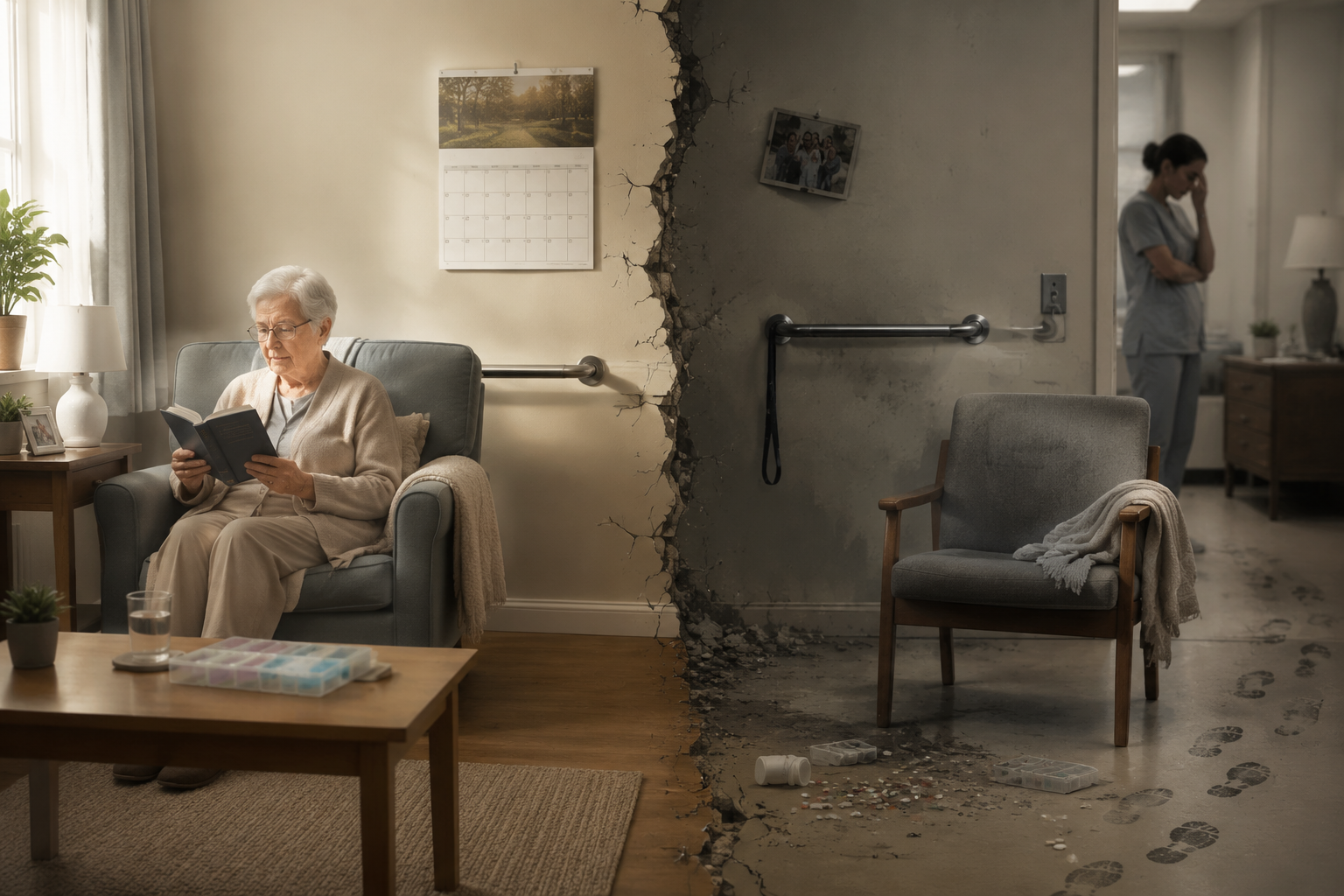
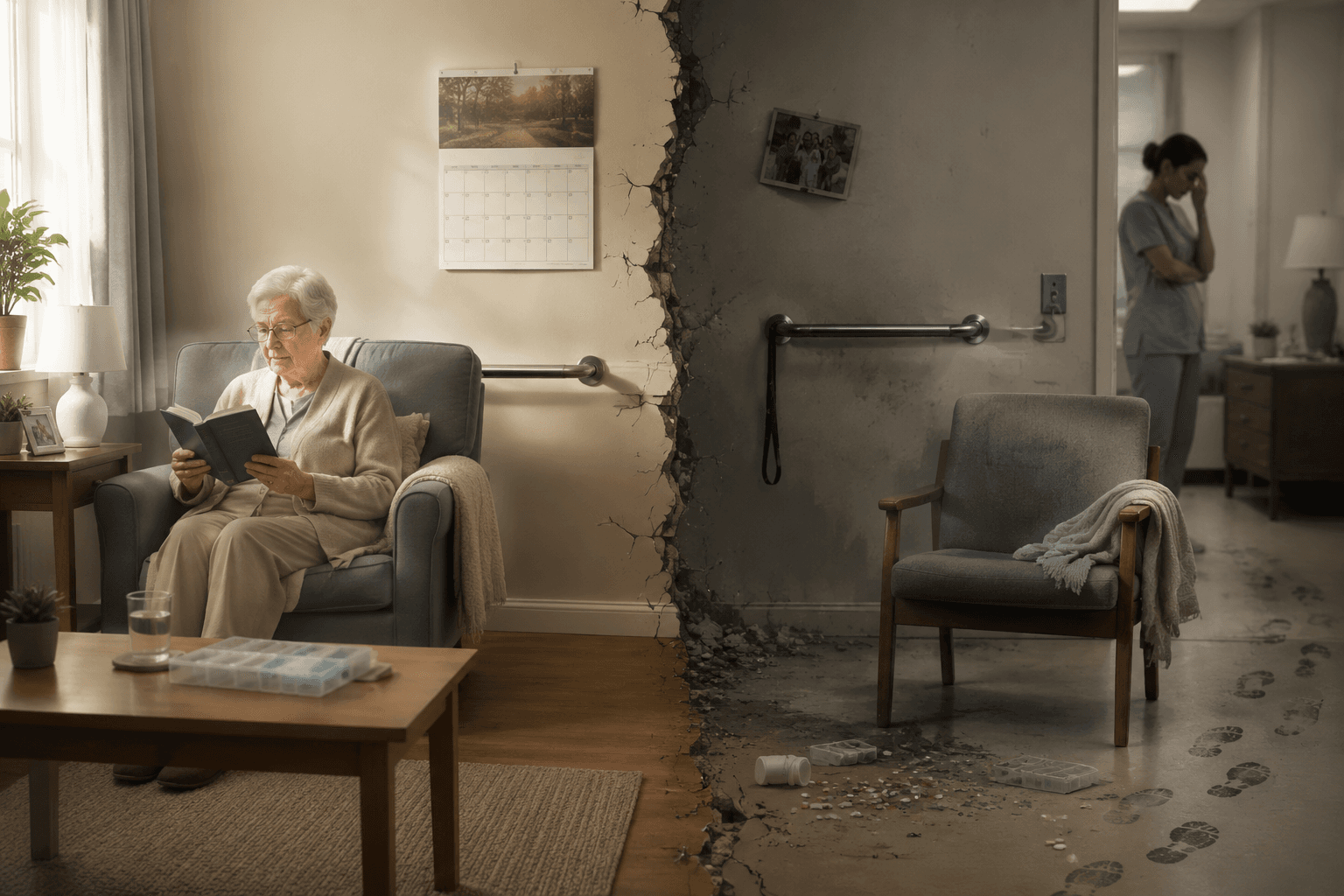
A dementia diagnosis does not simply add memory support to an existing senior care plan. It changes what the plan is for. The pill organizer may still be useful, but only if someone can tell whether Tuesday’s pills were taken on Tuesday. A grab bar may prevent a fall in the bathroom, but it does nothing for a parent who leaves the house at dusk because she believes she needs to get to work. A few hours of help may cover laundry and lunch, but it may not cover the long, anxious stretch when no one is sure whether the stove is off, the door is locked, or the person at home understands why a stranger has arrived.
That is the first practical difference between ordinary aging support and dementia care: the problem is not only what help is needed today. It is how quickly the assumptions underneath that help can stop being true.
In 2026, 7.4 million Americans age 65 and older are living with Alzheimer’s, about 1 in 9 older adults in that age group.[1] That number matters because families often experience dementia as if they have failed to organize well enough. They have not. Dementia care is harder because the disease changes memory, judgment, language, behavior, sleep, mobility, and eventually the ability to accept or cooperate with help.
The family workload is not a side issue. Nearly 13 million Americans provide unpaid dementia care, and the Alzheimer’s Association values that unpaid care at $446.3 billion. Families bear about 70% of total lifetime care costs, while 59% of dementia caregivers report high to very high emotional stress. About 30% of dementia caregivers are themselves age 65 or older.[1] Those figures explain why the question cannot be, “Can we keep things the same a little longer?” The better question is, “Which parts of the current arrangement are already depending on luck?”
What Dementia Changes First
Most senior care planning starts with visible needs: meals, bathing, transportation, medication reminders, housekeeping, fall prevention. Dementia moves the center of the plan toward interpretation and supervision. Someone has to notice whether a person understands a medication instruction, whether an unpaid bill is a mistake or a pattern, whether a new bruise came from a fall, whether a refusal to bathe is fear, confusion, pain, modesty, or depression.
That shift can make familiar care categories misleading. “Independent living” may sound plausible if a parent still dresses well and chats pleasantly with neighbors. “Home care” may sound sufficient if the care plan lists meal preparation and light housekeeping. “Assisted living” may look like enough if the brochure mentions medication management. But dementia often breaks the link between a service menu and actual safety. A person may be able to perform a task once while observed and still be unable to initiate it reliably, repeat it safely, or understand what to do when something interrupts the routine.
Families comparing options need to ask a different set of questions than they would for general aging support. Who notices missed steps? Who responds when the person refuses care? Who is responsible when a parent leaves the building? What happens at 2 a.m.? Who calls the doctor, updates the medication list, watches for delirium, and explains the same change to three siblings who remember last month’s version of Mom better than this week’s?
A general senior care decision framework can still help families compare cost, staffing, location, and quality. Dementia adds another layer: the chosen setting must be able to adapt as cognition and behavior change, not just meet today’s checklist.
The Care Continuum Has to Follow the Disease, Not the Calendar
Dementia staging is useful only if it helps families make decisions. It should not become a rigid label that overrides the person in front of you. Two people can both be described as “middle stage” and still need very different support: one may wander, another may become suspicious during bathing, another may sleep during the day and become agitated in the evening.
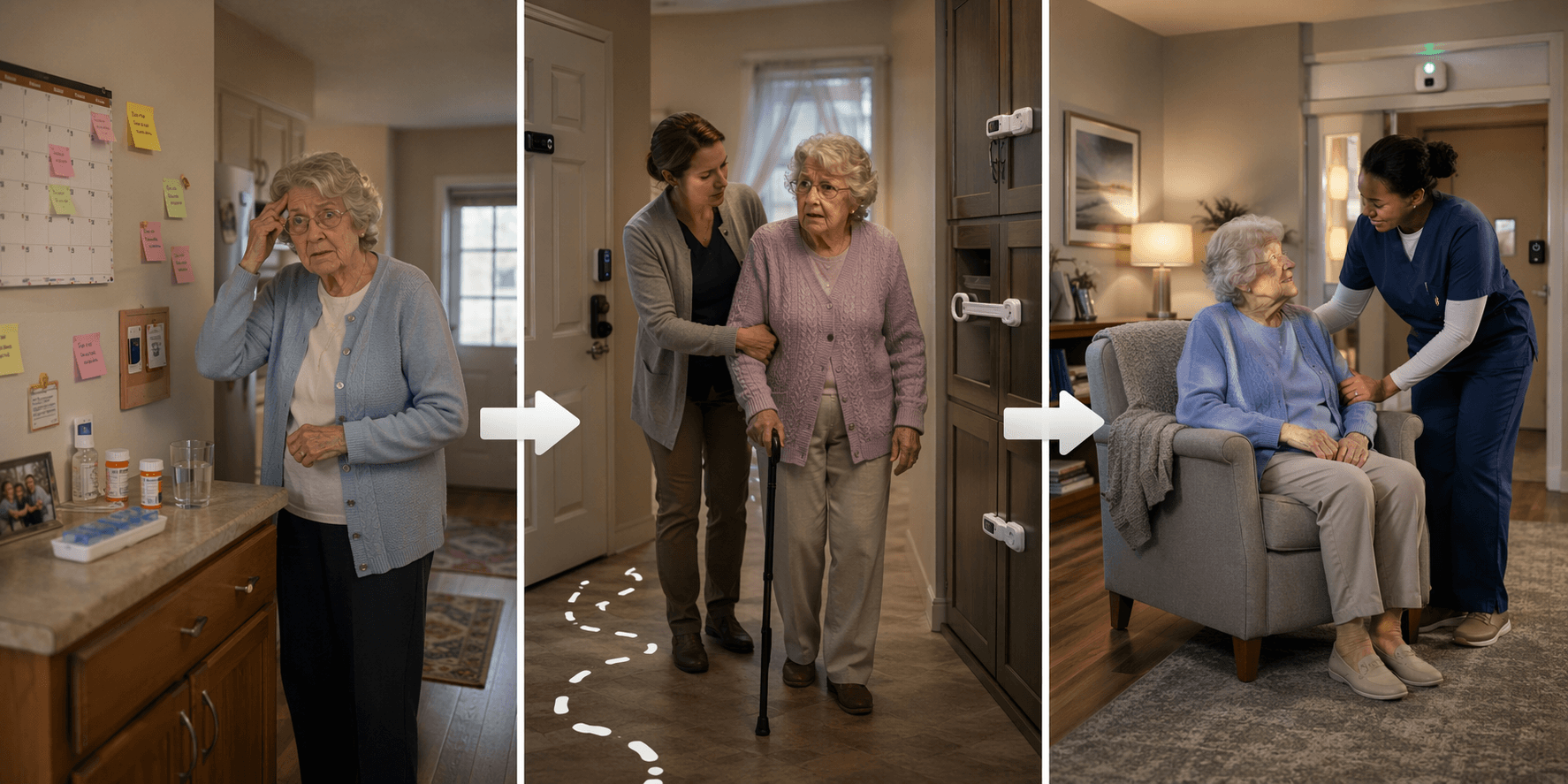
Still, the broad progression matters because each stage changes the weak points in the care plan. The goal is not to predict the exact next problem. It is to avoid building a plan that only works for the easiest hour of the day.
Disease stage
What families often see
What the care plan must start covering
Early dementia
Missed appointments, repeated questions, trouble managing bills or medications, increased dependence on routines
Financial and legal organization, medication oversight, driving review, home safety checks, trustworthy daily structure
More supervision, behavior-aware care, adult day programs, respite, door and stove safety, backup coverage
Later dementia
Need for help with most daily activities, mobility decline, incontinence, swallowing or nutrition concerns, limited communication
Hands-on personal care, 24-hour coverage or secured residential care, clinical coordination, caregiver health protection
Early Dementia: Independence Needs Guardrails
In early dementia, families can be lulled by competence that appears in familiar settings. A parent may still make coffee, greet friends, fold laundry, and insist nothing has changed. The risk is that the family keeps judging safety by the parent’s best performance instead of the pattern. Medication errors, unpaid bills, spoiled food, missed refills, confusing phone calls, and small driving incidents are often more important than one good conversation at Sunday dinner.
This is the stage for unglamorous work: confirm powers of attorney, simplify accounts, remove obvious hazards, review driving, organize medical information, and decide who is actually responsible for monitoring changes. A calendar on the refrigerator helps only if someone checks whether it is being used. Automatic bill pay helps only if someone reviews the statements. A medication dispenser helps only if someone can see whether doses were missed or doubled.
Families should also bring brain health and cognitive changes into medical visits directly. The Alzheimer’s Association’s 2026 special report found that only 14% of Americans have discussed brain health with their doctor, even though 66% want brain health guidance from their provider and do not get it.[1] That does not mean every family will receive clear answers quickly. It does mean families may need to name the concern plainly and bring examples: the missed rent payment, the duplicate prescriptions, the stove left on, the night drive to an old address.
Middle Dementia: Supervision Becomes the Expense
Middle dementia is where many senior care plans start to collapse, not because families did nothing, but because the required type of help changes. The person may no longer be safe alone for long stretches. They may resist the aide who arrives at noon, refuse to shower, hide medications, walk out the door, accuse a spouse of stealing, or become agitated as daylight fades.
At this point, “a few hours of help” can still be valuable, but it rarely solves the whole problem. The uncovered hours become the family’s real care setting. If an aide comes from 10 a.m. to 2 p.m., someone still owns the morning confusion, the evening pacing, the overnight wakeups, and the weekend gaps. That person may be an adult daughter with a job, a spouse with arthritis, or a neighbor who was never formally asked to become part of the care team.
Adult day programs can be especially useful in this middle space when the person can participate safely and the program is prepared for dementia-related needs. They can provide structure, meals, activities, social contact, and several hours of relief for the family caregiver. The important word is “prepared.” Families should evaluate whether the program can handle wandering risk, toileting help, redirection, medication timing, and changes in behavior, not just whether it serves older adults. A deeper dementia-capable adult day care evaluation guide can help with those questions.
Home safety also becomes less about installing devices and more about anticipating behavior. Door alarms, stove shutoff devices, medication lockboxes, lighting, bathroom safety, and simplified layouts can all help. But a door alarm is not a plan unless someone can respond when it sounds. Families dealing with night wandering or evening agitation need a specific sundowning and wandering safety plan, because those behaviors can turn a familiar home into an unsafe place very quickly.
Later Dementia: The Question Becomes Coverage
Later dementia often shifts care from prompting to hands-on assistance. The person may need help bathing, dressing, toileting, transferring, eating, and moving safely. Communication may become limited. Pain, infection, dehydration, constipation, medication side effects, and environmental stress can show up as agitation or withdrawal rather than clear complaints.
This is where families have to be honest about whether home care is truly staffed or merely hoped for. Around-the-clock care at home can preserve familiarity and may be the right choice for some families. It also requires scheduling, backup coverage, supervision of paid caregivers, overnight reliability, and a realistic budget. A 24-hour care at home decision guide is useful when the family is trying to separate what is emotionally preferred from what can actually be maintained.
Memory care becomes part of the conversation when supervision, behavior support, personal care, and secured space need to be available as a system rather than assembled hour by hour. That does not make the decision easy. A move can be wrenching. It can also reduce danger and caregiver collapse when the home plan has become too fragile. Families who are unsure whether they are approaching that point can use an is it time for memory care guide to look at functional signs instead of waiting for a single dramatic incident.
Why Dementia Care Costs More Than Families Expect
Dementia care costs more because it buys time, supervision, and behavioral skill, not just tasks. A home care aide helping with laundry and lunch is one cost. A reliable plan for someone who may wander, refuse care, wake overnight, or need help with toileting is a different cost structure.
National figures can orient a family, but they should never be treated as a quote. Memory care has been reported at a national median of $8,019 per month, with state-level figures ranging from $5,538 to $14,399.[2] Those numbers are useful mainly because they show the width of the field. Geography, staffing needs, room type, community pricing, move-in fees, medication management, incontinence support, and level-of-care charges can all change the actual bill.
The same caution applies to home care comparisons. Families sometimes compare one month of memory care with a few weekly aide visits and conclude home is cheaper. That may be true in early stages. It may stop being true when care expands into evenings, weekends, and overnights. The real comparison is not “home versus facility.” It is the full cost of the supervision required in each setting. A focused 24-hour home care versus memory care cost comparison can help families run that math before the schedule is already breaking.
The broader economic picture is just as sobering. Secondary reporting on the USC Cost of Dementia Model estimated U.S. dementia-related expenses at $818 billion in 2026, including $237 billion in unpaid family care hours and $320 billion in reduced quality of life.[2] Those figures should not be read as a family budget worksheet. They do show why dementia is not simply a medical diagnosis with a care add-on. It reorganizes household labor, retirement plans, work schedules, health, and relationships.
The most easily hidden cost is the unpaid person filling every gap. A spouse who stops sleeping through the night, an adult child who uses vacation days for appointments, a sibling who handles insurance appeals, a daughter-in-law who delivers groceries, a neighbor who checks the door after dark: none of that may appear on a facility invoice. It is still part of the cost of care.
Families who need to go deeper than orientation should work through the full financial picture of dementia care: income, assets, home equity, long-term care insurance, Medicaid eligibility, veterans benefits, tax issues, and what Medicare does and does not cover. The earlier that work starts, the more choices a family usually has.
The Caregiver Needs a Plan Too
Dementia care often fails quietly before it fails visibly. The person with dementia may still be fed, dressed, and housed, while the caregiver is sleeping in fragments, missing medical appointments, snapping at work, withdrawing from friends, and making increasingly complicated decisions alone. By the time the family calls it a crisis, the caregiver may have been in one for months.
The emotional stress data should be taken literally. When 59% of dementia caregivers report high to very high emotional stress, that is not a complaint about inconvenience.[1] It is a warning about sustainability. Dementia caregivers are often managing grief while the person they love is still present, negotiating with siblings who see different versions of the disease, and absorbing behavior that can feel personal even when it is illness-driven.
Older spousal caregivers deserve particular attention because they may present as capable long after the arrangement has become unsafe for them. A husband may minimize how often his wife wakes him. A wife may lift her husband after near-falls until her own back gives out. An older partner may avoid asking adult children for help because the request feels like surrender. When 30% of dementia caregivers are 65 or older, the caregiver’s health cannot be treated as a footnote.[1]
A practical caregiver plan names the backup person, not just the primary person. It says who can arrive within an hour, who handles medical messages, who has authority to pay bills, who can take over for a weekend, and what event triggers a higher level of care. It also includes respite before resentment or exhaustion becomes the only signal that something must change.
Where Medicare GUIDE Fits
Medicare’s GUIDE model, launched in 2024, is one of the more meaningful policy developments for families trying to navigate dementia care. GUIDE stands for Guiding an Improved Dementia Experience, and the model is designed to support people living with dementia and their unpaid caregivers through care coordination, caregiver education and support, and respite-related services.[3]
Families should ask clinicians, health systems, and Medicare-connected providers whether GUIDE participation is available to them. The model does not erase the cost of long-term care, and actual utilization rates as of mid-2026 were not verified in the available sources. Its value is more specific: it gives families another door to knock on for dementia-focused coordination and caregiver support, especially when they are otherwise being bounced between primary care, neurology, home care agencies, and family members who each hold one piece of the problem.
How to Reassess the Plan Before It Breaks
The hardest decisions in dementia care often arrive disguised as ordinary bad days. One missed dose may be a fluke. Repeated missed doses are a system failure. One episode of nighttime confusion may be manageable. A pattern of exit-seeking changes the safety calculation. One angry refusal of care may pass. Repeated resistance during bathing may mean the current caregiver or setting needs better dementia training, more time, or a different approach.
A family does not need to move directly from home to memory care at the first sign of trouble. It does need to stop treating each incident as separate. The useful question is what the incident reveals about the level of supervision now required.
If the person is mostly independent but losing track of finances, medications, appointments, or driving safety, the plan needs oversight and legal-financial organization.
If the person is unsafe alone for predictable parts of the day, the plan needs scheduled supervision, adult day care, home care, or family coverage that matches those hours.
If the person is unsafe alone unpredictably, the plan needs backup coverage and a serious look at whether intermittent help is still adequate.
If the caregiver’s health is declining, the plan needs to count that as a care need, not as private weakness.
If behavior, wandering, toileting, mobility, or overnight needs require continuous response, the family should compare 24-hour home care, memory care, and other higher-support settings.
Some families will also need a broader review of senior housing categories, especially when they are sorting through independent living, assisted living, nursing homes, and memory care for the first time. A general senior retirement homes guide can help clarify the basic landscape. For dementia, the next step is to ask whether each option can manage cognitive decline, behavior changes, and supervision needs as they progress.
The best dementia care plan is not the one that predicts every turn. No family can do that. It is the one that is honest about progression, names the caregiver burden before the caregiver breaks, treats supervision as a real cost, and identifies the next level of care before a fall, wandering episode, hospitalization, or exhausted spouse makes the decision for everyone.

Comments
Join the discussion with an anonymous comment.