
How Air Quality Alerts Harm the Aging Brain
Air pollution is a recognized risk factor for dementia, and for older adults already living with cognitive decline, air quality alerts can worsen confusion, raise fall risk, and accelerate symptom progression. This article explains why caregivers must treat alert days as brain-health emergencies and provides actionable steps to protect cognition indoors.
The air quality alert usually arrives as a color, a number, and a short instruction: older adults should reduce prolonged or heavy exertion. For a parent with mild cognitive impairment, Alzheimer’s disease, or another dementia, that is not enough. AQI Orange, which runs from 101 to 150, already matters for older adults because AirNow classifies them as a sensitive group.[1] In a dementia household, the practical question becomes: who is going to keep the day quieter, safer, and more predictable?
That is the overlooked part of air quality alerts for elderly adults. The alert is not only a lung warning. It is a day to lower cognitive load, prevent unnecessary movement, protect medication and hydration routines, and watch for the small changes that can turn into a fall, a wandering episode, or a hard evening.
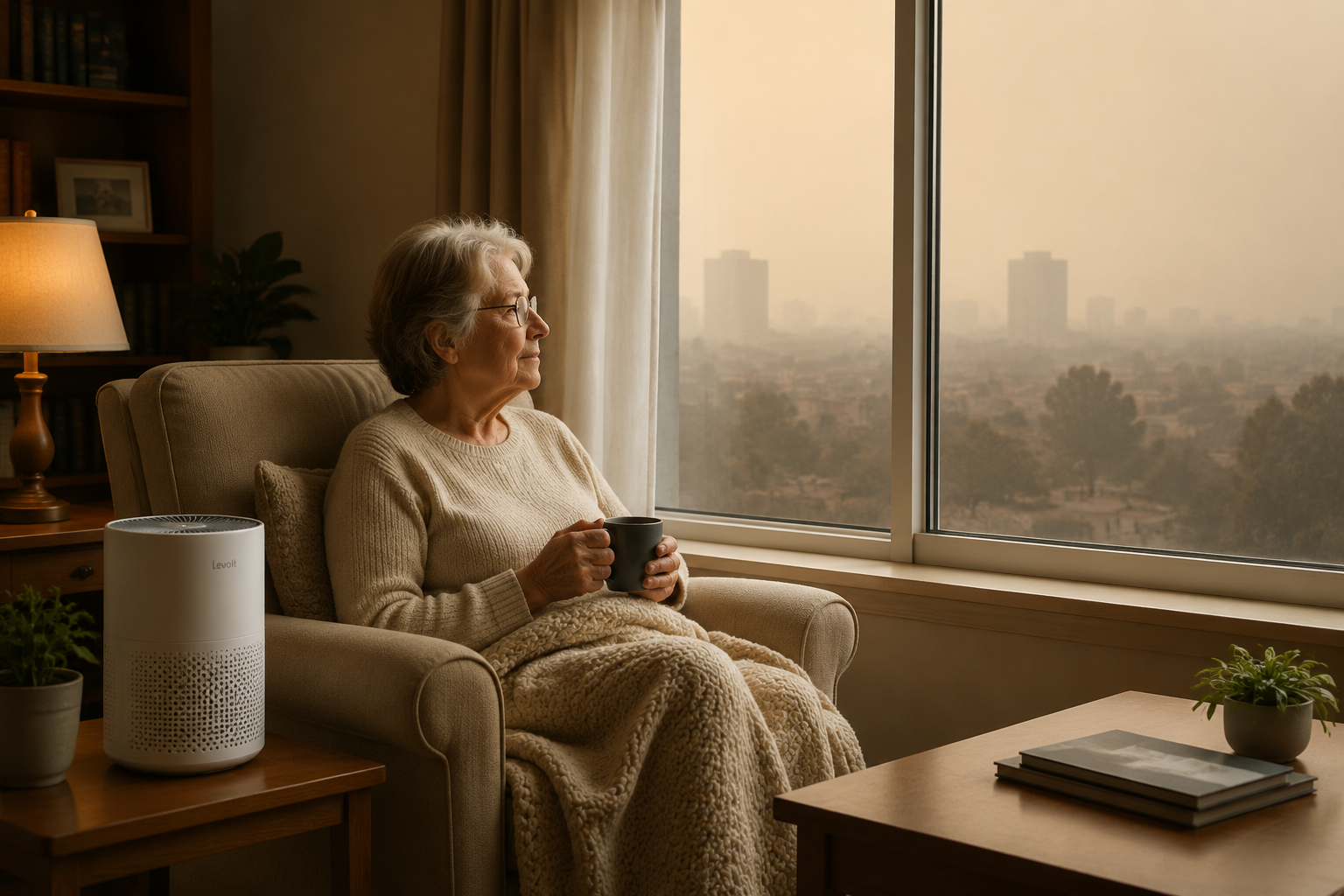
Why An Air Alert Is A Brain-Health Day
The strongest dementia evidence is about exposure over time, not one bad afternoon. That distinction matters. A single smoky day should not be described as causing dementia progression. But air pollution is no longer outside the dementia conversation. The Lancet Commission added air pollution as a modifiable dementia risk factor in 2020, and addressing 12 modifiable risk factors was estimated to prevent or delay about 40% of dementia cases.[2]
Other findings point in the same direction without proving more than they can prove. A 2021 Nature Communications study reported that high pollutant exposure appeared to speed cognitive decline in Alzheimer’s patients who were already experiencing advanced symptoms.[2] A 2022 PNAS study found that dementia risk declined in women over 74 after PM2.5 and NO2 were reduced over a 10-year period.[2] Those are chronic-exposure findings. They justify taking air quality seriously as part of brain health; they do not justify telling families that one AQI Orange day caused a parent’s decline.
The shorter-term caregiving concern is more immediate and more ordinary: dirty air can add strain to a brain that is already working with less reserve. USC Ostrow describes chronic air pollution as accelerating cognitive impairment in aging populations through systemic inflammation and oxidative stress affecting brain tissue.[3] On an alert day, that biological concern meets the household reality of fatigue, coughing, poor sleep, skipped fluids, disrupted walks, closed windows, and a parent who does not remember why the porch is off-limits.
Caregivers cannot see inflammation or oxidative stress at the kitchen table. They can see a parent who is slower to rise, more irritable after losing an outdoor routine, more short of breath crossing the room, or more determined to open the door because the house feels stuffy. The evidence does not prove every behavior on an alert day is pollution-driven. It does support treating poor air as one more environmental stressor that can worsen an already fragile day.
The Fall Risk Is Not A Side Issue
For dementia caregivers, the most actionable risk may be a fall. A 2025 Maturitas study using a Chinese cohort found that older adults with cognitive impairment had the highest fall risk from moderate-to-high PM2.5 exposure, with odds ratios reported up to 1.29.[4] The study does not prove the same risk level in every U.S. home, but it puts numbers behind something caregivers often notice: when breathing is harder, routines are disrupted, and attention is weaker, safe movement becomes harder too.

This is where standard alert advice needs a dementia layer. “Stay indoors” may reduce outdoor exposure, but it can also remove the walk that usually settles agitation, the porch visit that anchors the morning, or the neighborly check-in that tells everyone Dad is having a good day. Indoors can be safer only if someone has made it safer.
For families already working on home safety, an alert day belongs beside other fall-prevention routines. If you use an AQI color guide such as how AQI affects aging parents, add a dementia question to it: does this color change who supervises standing, stairs, bathing, or the trip to the mailbox?
Before The Alert: Decide Who Changes The Day
The best air-quality plan is made before the text alert arrives. Long-distance caregivers especially need a named person, not a hopeful chain of assumptions. If the daughter checks AirNow but the spouse opens the windows, the aide handles medications but the neighbor is the one who notices wandering, nobody owns the day.
A workable plan answers four questions in plain language:
- Who checks the AQI each morning during wildfire season, ozone season, or local pollution events?
- At what AQI color does the household change the routine for this parent?
- Which room becomes the cleanest primary living space?
- Who watches for confusion, unsteady walking, shortness of breath, or repeated attempts to go outside?
AQI Orange is the point many families miss because it does not sound dramatic. For a healthy adult, Orange may be a mild inconvenience. For an older adult in a sensitive group, AirNow already advises reducing exposure.[1] For someone with dementia, Orange should also trigger a supervision and routine check, even if the sky does not look alarming.
The pre-alert setup does not need to be elaborate. Put the air purifier where the parent actually spends the day, not in a guest room. Keep a water glass, pill organizer, phone charger, hearing aids, glasses, and familiar activities in that space. If the parent is prone to leaving the house, review the same barriers and notification routines used for Silver Alert and wandering prevention. Air alerts do not create wandering risk from nothing, but they can disrupt the routines that usually keep it contained.
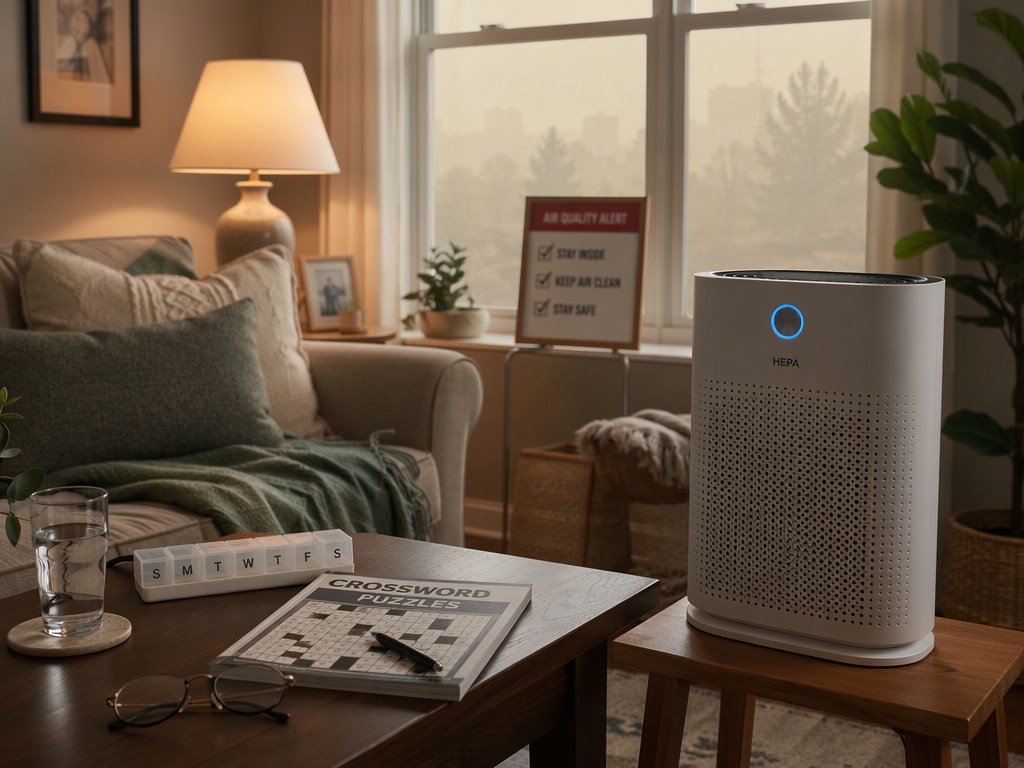
During The Alert: Make The Indoor Day Safer, Not Smaller
On an alert day, the goal is not to make the parent sit still in a chair until the air improves. That often backfires. The goal is to reduce polluted-air exposure while preserving enough structure, movement, hydration, medication timing, and human contact to keep the day from unraveling.
| Caregiving task | What changes on an alert day |
|---|---|
| Air check | Check AirNow or the local AQI source before the parent’s first outdoor habit begins. |
| Room choice | Keep the parent in the cleanest main living space, ideally with HEPA filtration if available. |
| Movement | Reduce outdoor exertion and replace the usual walk with short, supervised indoor movement. |
| Medication and fluids | Keep inhalers, routine medications, and water visible to the caregiver or aide, not only to the parent. |
| Behavior | Plan familiar activities before restlessness starts; do not wait until the parent is already trying the door. |
| Falls | Increase supervision for standing, toileting, stairs, and transitions after long sitting. |
The cleanest room is usually the room where you can close windows and doors, run filtration, avoid smoke or strong indoor irritants, and keep the parent comfortable without isolating them. If only one portable HEPA purifier is available, place it near the parent’s primary daytime location. A perfect clean-air room is not realistic for many households; a better-used room beats a technically better room the parent refuses to stay in.
Medication routines need more oversight than usual. A parent with memory loss may not connect chest tightness, fatigue, or coughing with the inhaler, hydration, or rest instructions already in the care plan. The caregiver’s job is not to invent new medical orders during a bad-air day. It is to make the existing plan happen reliably and to call the clinician when symptoms exceed the plan.
Indoor engagement should be chosen for calm familiarity, not novelty. Fold towels, sort family photos, work on a simple puzzle, listen to familiar music, water indoor plants, or do seated range-of-motion with supervision. Families who already use a dementia behavior toolkit can move the alert-day version of those activities into the cleanest room before agitation builds.
For long-distance caregivers, this is the point to be specific with the person in the home. “Keep Mom inside” is too vague. “Please have breakfast in the den with the purifier on, skip the mailbox trip, set out water and morning pills, and call me if she tries the front door more than once” is a plan someone can follow.
What To Watch For
The warning signs that matter are often plain household observations. More confusion than usual. New dizziness. A slower or shuffling gait. Standing up too fast after a long stretch indoors. Repeatedly asking to go outside. More coughing, wheezing, or fatigue. A missed meal or skipped fluids. None of these proves pollution is the cause, but each one changes the safety level for the rest of the day.
If the parent has Lewy body dementia, Parkinsonism, orthostatic blood pressure problems, COPD, asthma, heart disease, or a recent fall, the margin is smaller. The alert-day plan should be more conservative because a little extra fatigue or unsteadiness can have larger consequences. Families looking at broader cognitive conditions can connect this plan with resources on Lewy body dementia in seniors, but the immediate rule remains simple: if the air is bad and the brain is vulnerable, reduce demands on both.
Wildfire Smoke Days Need A Larger Safety Margin
Wildfire smoke is not just a worse-looking version of ordinary haze. It often lasts longer, changes plans faster, and can push families into urgent decisions about windows, evacuation, appointments, and backup care. Oregon Health Authority data reported that during the 2020 Oregon wildfires, asthma-like emergency visits increased about 25% statewide, a reminder that severe smoke events can create acute health burdens quickly.[5]
That Oregon data is about respiratory emergency visits, not dementia behavior. It still matters to dementia caregivers because respiratory strain is one of the pathways by which a parent’s day can become unsafe. A parent who is coughing, sleeping poorly, or short of breath is also less steady, less patient, and less able to follow reminders.
During wildfire season, families need backup plans that go beyond the daily AQI check: extra medication supply if prescribed, charged phones, transportation options, a cleaner-air location if the home cannot be kept safe, and a written threshold for calling the clinician or seeking urgent care. For broader smoke preparation, use a dedicated elderly wildfire smoke safety guide or a wildfire smoke safety checklist so the dementia-specific plan is not carrying the whole emergency.
After The Alert: Look For The Delayed Problems
When the AQI improves, do not assume the household is immediately back to baseline. The parent may be deconditioned from a day or two of less movement, behind on fluids, sleepier than usual, or eager to make up for missed outdoor time. The first clear-air morning can be when someone overdoes it.
The after-alert check is short:
- Compare today’s confusion, mood, breathing, and walking to the parent’s usual baseline.
- Resume outdoor activity gradually instead of making up all missed errands at once.
- Ask the in-home caregiver whether medications, meals, fluids, sleep, or toileting changed during the alert.
- Record any fall, near fall, wandering attempt, unusual agitation, or respiratory symptom.
- If the same problems repeat across alert days, revise the plan before the next one.
A pattern is more useful than a single impression. If Dad is always more unsteady after two indoor days, the plan may need scheduled seated exercise, more supervision after naps, or a safer route to the bathroom. If Mom always tries to leave when the porch routine is canceled, the substitute activity needs to start before the usual porch time, not after she reaches the door.
A Repeatable Alert-Day Routine
Families do not need to turn every alert into a crisis. They need a routine that activates early enough to prevent the avoidable problems. The routine can be written on one page and shared with siblings, aides, neighbors, and the parent’s spouse.
- Check the AQI before the parent starts the morning routine, especially when Orange or worse is possible.
- Move the day’s essentials into the cleanest living space: purifier, water, medications, phone, glasses, hearing aids, and calm activities.
- Reduce outdoor exertion and replace it with brief, supervised indoor movement.
- Assign a person to watch for wandering attempts, impulsive standing, gait changes, and respiratory symptoms.
- Keep the medical plan steady: prescribed medications, hydration, meals, rest, and symptom thresholds for calling a clinician.
- Recheck the parent after the alert for delayed confusion, weakness, near falls, or behavior changes.
This is the practical center of the issue. Air quality alerts do not single-handedly cause dementia decline, and filtration is not a cure. But alerts are predictable environmental stressors. For an older adult living with cognitive impairment, treating a bad-air day as a brain-health and fall-prevention day gives the caregiver something concrete to change before the hardest part of the day begins.
References
- Older Adults. AirNow.gov.
- Air Pollution, Mental Health, and America's Aging Population. National Environmental Education Foundation. 2023.
- The Alarming Impact of Air Pollution on the Health of Aging Adults. USC Ostrow. May 2026.
- Maturitas 2025 study on PM2.5 exposure and fall risk in older adults with cognitive impairment. Maturitas. 2025.
- OHA data show poor air quality linked to more emergency visits. Oregon Health Authority. November 2025.
Related reading
Noticed something outdated or inaccurate on this page? Flag a correction. We review every report against CDC, NIA, and AARP HomeFit guidance before updating a page.
Part of the Fall Prevention section.