
STEADI: Assess
Supplement Safety Checklist for Older Adults' Cabinets
Audit every supplement an older adult takes with a printable, one-bottle-at-a-time checklist that screens labels, flags prescription conflicts, and guides keep-vs-stop decisions before a pharmacist review. It's the medication-review step that fall-prevention frameworks like CDC STEADI already call for.
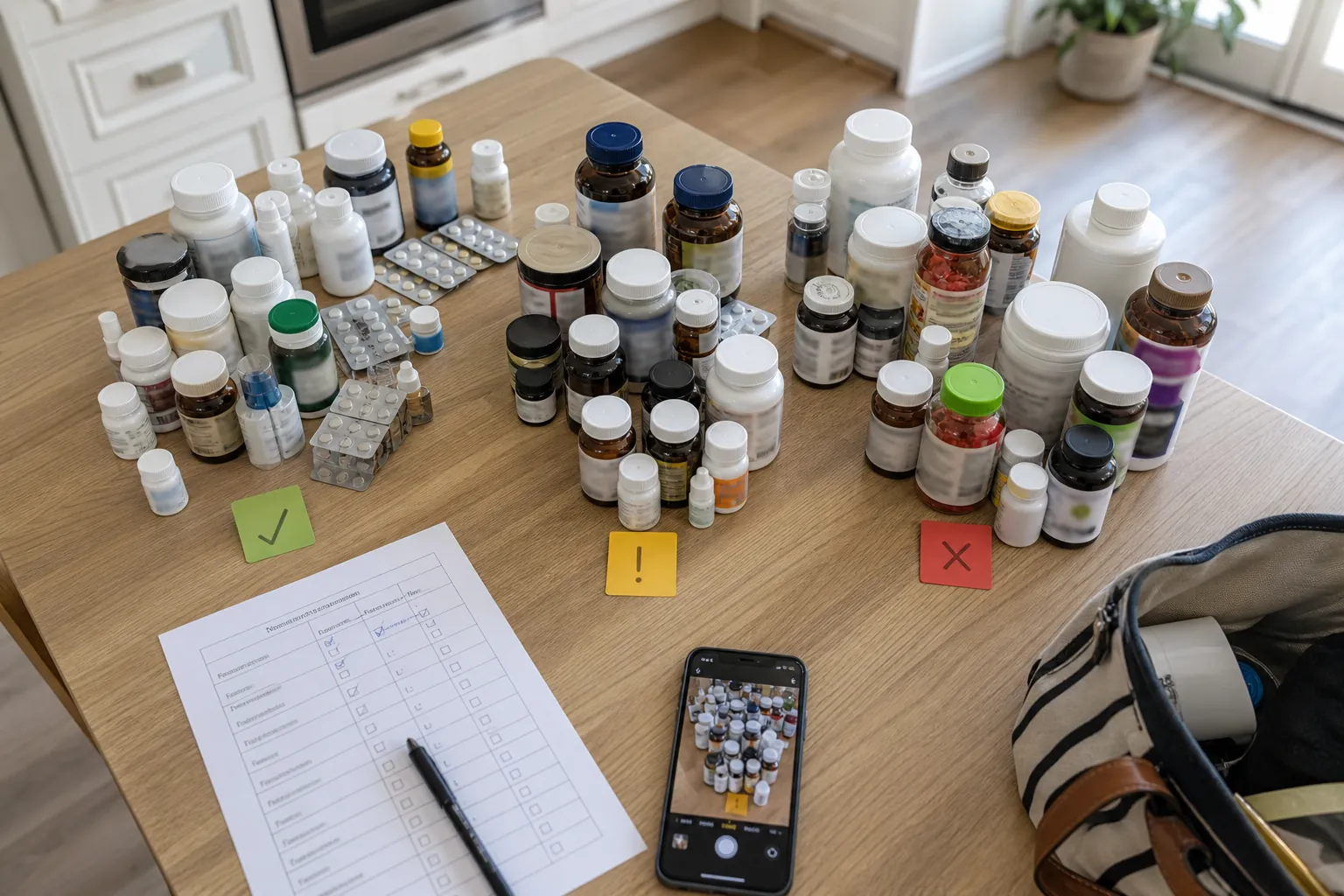
Start at the cabinet, not the supplement aisle. Put a trash bag nearby for expired products, open your phone camera for label photos, and clear one kitchen-table space where every bottle has to become visible. This supplement safety checklist for older adults is meant for that one sitting: gather everything, inspect one product at a time, sort it, and end with a pharmacist review rather than a pile of half-remembered “probably fine” bottles.
This is general safety information, not personal medical advice. Do not stop a prescribed medication, a clinician-directed vitamin, or a treatment for a diagnosed deficiency without checking with the prescriber or pharmacist. The point is to make the whole cabinet reviewable.
The cabinet audit in one sitting
Treat supplements like part of the medication list until a clinician tells you otherwise. That means vitamins, minerals, herbals, gummies, protein powders, sleep aids, eye drops, topical pain products, laxatives, antacids, cold medicines, and anything bought online all go on the table next to prescriptions and over-the-counter drugs.
| Step | What to do | Where the bottle goes |
|---|---|---|
| 1. Gather | Collect every prescription, OTC drug, supplement, gummy, powder, drop, and topical product from the whole house. | Unsorted table pile |
| 2. Make the prescription list | Write the current prescription name, dose, schedule, and reason if known. Add OTC medicines used often. | Beside the supplement pile |
| 3. Audit one bottle | Check expiration, reason for use, label quality, ingredient list, dose, claims, and overlap with other products. | One bottle in hand |
| 4. Screen for conflicts | Compare the product with prescriptions, fall-risk symptoms, bleeding risk, sedation, dizziness, and stimulant effects. | Keep / ask / stop-for-now |
| 5. Photograph and list | Take front and Supplement Facts photos. Record brand, full product name, dose, how often it is taken, and who recommended it. | Pharmacist-ready list |
| 6. Review | Bring the list or the actual bag of bottles to a pharmacist, then send updates to the primary clinician. | Reviewed cabinet |
| 7. Repeat yearly | Put a repeat date on the calendar, and redo the audit after a fall, hospitalization, new diagnosis, or new prescription. | Annual safety habit |
The scale of the job is easy to underestimate. In NHANES data from August 2021 through August 2023, 75.9% of adults age 60 and older used at least one dietary supplement in the past 30 days; 56.4% used two or more, 39.9% used three or more, and 26.5% used four or more. [1]
Layering is normal. Silence is the problem. AARP reports that about 75% of American adults take a supplement daily, but fewer than half tell their doctors. [2] A clinician cannot review the vitamin D, turmeric, sleep gummy, magnesium powder, or “heart health” capsule that never makes it onto the medication list.
Make the prescription list before judging supplements
Before the first supplement gets a verdict, write down the medications that are not optional: blood thinners, blood pressure pills, diabetes drugs, antidepressants, sleep medications, seizure medications, pain medications, heart rhythm drugs, thyroid medication, osteoporosis drugs, and any recent antibiotic or steroid. Include dose and timing if you can read it from the bottle or medication portal.
Add regular OTC medicines to the same page. Aspirin, ibuprofen, naproxen, diphenhydramine sleep aids, laxatives, antacids, allergy pills, and cold products belong next to prescriptions because they can affect bleeding, dizziness, alertness, hydration, and blood pressure. If the older adult uses a pill organizer, compare it with the bottles. The organizer often shows what is actually taken, not what the bottle says.
This is the practical version of the medication-review step used in fall-prevention frameworks such as CDC STEADI: the reviewer needs the full mix of prescription drugs, OTC medications, and herbal supplements. If you are doing this after a fall rather than before one, pair the audit with the medication-review steps in Your Parent Just Fell: A Caregiver's Guide to the First 72 Hours. If medication confusion is becoming a pattern, it also belongs with the broader warning signs in Is It Time to Step In? 5 Signals of Declining Capacity.
Do not give supplements an easier pass because they came from a grocery store or health website. FDA says dietary supplements are not reviewed for safety and effectiveness before marketing; manufacturers are responsible for safety, quality, and accurate labeling, and FDA action generally comes after a product is found adulterated or misbranded. [3] That does not make every bottle dangerous. It means the household screen and pharmacist review are not busywork.
Pick up one bottle and run the label screen
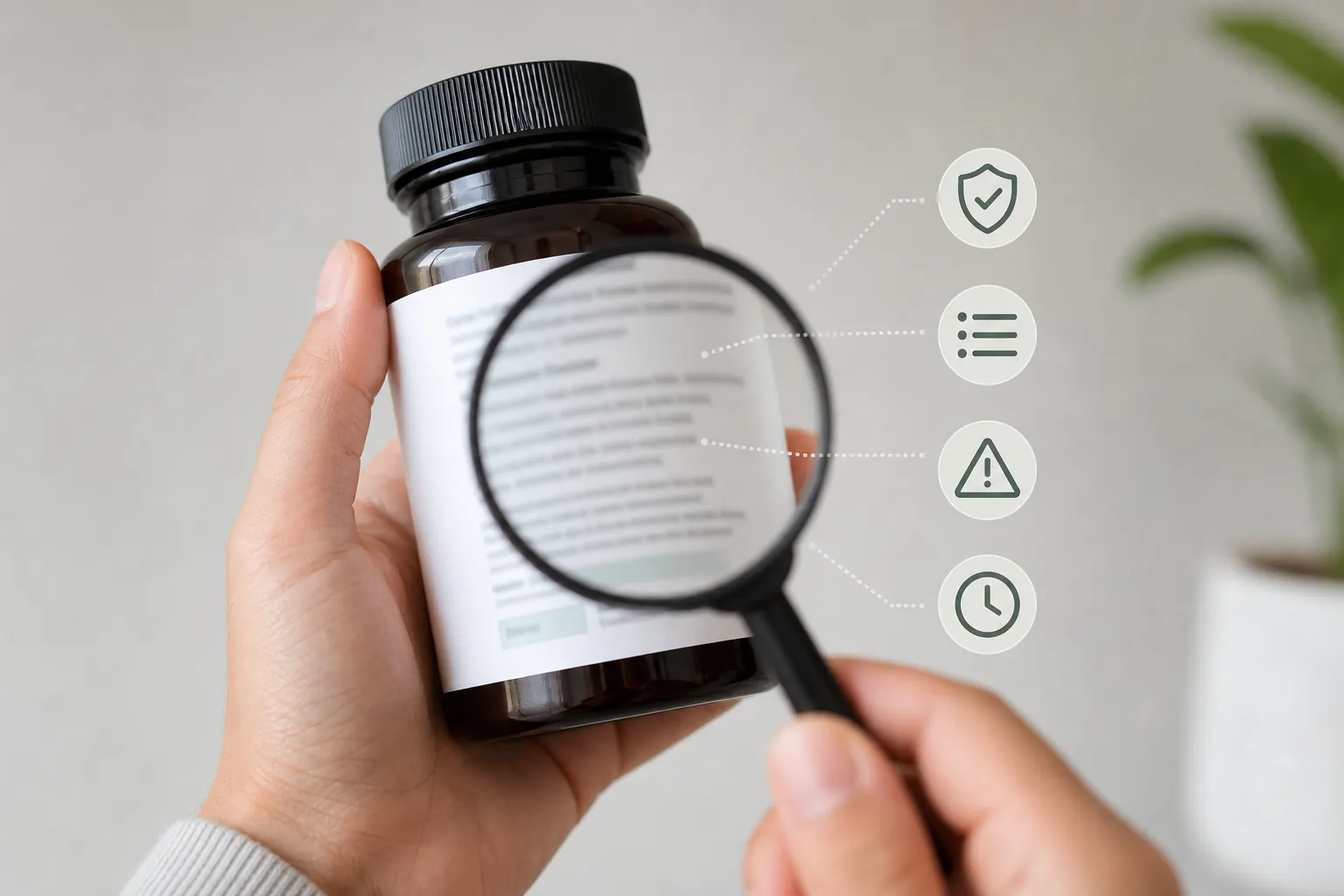
Work one bottle at a time. Do not try to remember later. Hold the product, photograph the front label and Supplement Facts panel, and answer these seven questions before deciding where it goes.
| Label question | Yes is reassuring when… | Why it matters |
|---|---|---|
| 1. Is there a recognized third-party certification seal? | The label shows a real quality seal such as USP or NSF, not a vague “tested” badge. | It is not a guarantee of benefit, but it is better than a product with no independent quality signal. |
| 2. Are there fewer than six ingredients? | The active and added ingredients are short enough to understand. | Long blends make it harder to spot duplicates, stimulants, allergens, and interaction risks. |
| 3. Does the label avoid “proprietary blend,” “matrix,” “complex,” or similar wording? | Each ingredient amount is plainly listed. | Proprietary blends can hide how much of each substance is actually in a serving. |
| 4. Can you pronounce and recognize the ingredients? | The ingredient names are understandable enough to look up and discuss. | If no one at the table can identify what is being taken, the pharmacist needs to see it. |
| 5. Is caffeine at or below 200 mg per serving, or absent? | Caffeine is clearly listed and not above the OPSS threshold. | Stimulants can matter for palpitations, sleep, anxiety, blood pressure, and fall risk. |
| 6. Are the claims modest? | The product avoids disease-treatment promises, miracle language, and urgent cure claims. | Aggressive claims often tell you more about marketing than safety or usefulness. |
| 7. Are % Daily Values under 200%? | Vitamins and minerals are not loaded far above daily needs unless a clinician directed it. | High-dose products can turn a routine habit into a medication-review question. |
Those questions come from the Operation Supplement Safety scorecard. OPSS treats fewer than four “yes” answers as a screen that is too risky, and it notes that fewer than 1% of roughly 100,000 supplement products carry the USP mark. [4] A low score does not prove the product is harmful; it proves the label has not earned the right to stay in the “easy keep” pile.
What to write on the audit sheet
- Product name exactly as printed on the front label.
- Brand and form: tablet, capsule, gummy, liquid, powder, tea, drop, or topical.
- Serving size and how many servings are actually taken.
- Reason for taking it: prescribed, lab deficiency, clinician suggested, friend suggested, online recommendation, habit, or unknown.
- Start date if known, or “years” if it has been around too long to remember.
- Any symptoms that began after starting it: dizziness, sleepiness, loose stools, constipation, nausea, bruising, palpitations, confusion, dry mouth, appetite change, or worse balance.
- OPSS label score: yes/no for each of the seven questions.
- Photo taken: front label and Supplement Facts panel.
Expiration date is a separate screen. Expired products do not need an argument; set them aside for proper disposal. If an expired supplement was still being taken, mark that on the list so the pharmacist can see whether the habit needs a safer replacement or should end.
Check conflicts with the prescription list
Now put the supplement in one hand and the prescription list beside it. The conflict check is not a chemistry exam. It is a sorting step: which bottles need pharmacist eyes before they go back into daily use?
| Flag | Put in this pile | What to ask |
|---|---|---|
| Blood thinner or bleeding concern | Ask pharmacist; stop-for-now if no clinician has approved it and risk seems immediate | “Does this product increase bleeding risk with warfarin, aspirin, or another blood thinner?” |
| St. John’s wort | Stop-for-now until reviewed | “Could this make any prescription less effective?” |
| Energy, weight-loss, metabolism, pre-workout, or high-caffeine product | Ask pharmacist; stop-for-now if palpitations, chest pain, tremor, insomnia, or dizziness occurred | “Is there a stimulant here, and could it affect heart rate, blood pressure, sleep, or falls?” |
| Sleep, calm, anxiety, pain, or relaxation product | Ask pharmacist | “Could this add sedation or worsen nighttime bathroom falls?” |
| Duplicate nutrients across several bottles | Ask pharmacist | “What is the total daily dose from the multivitamin plus this separate product?” |
| High-dose vitamin or mineral without a lab result or clinician instruction | Ask pharmacist | “Is this dose appropriate for this person, or is it just a habit?” |
| New supplement started near a fall, dizziness episode, medication change, or hospitalization | Ask pharmacist | “Could the timing matter?” |
FDA specifically warns that dietary supplements can interact with medications and gives examples involving warfarin with vitamin E, ginkgo, or garlic. [3] That is the kind of bottle that should not be waved back into the cabinet because “it’s natural.”
St. John’s wort deserves its own line on the sheet. AARP notes that it can speed drug clearance, making some prescriptions less effective. [2] If the older adult takes medications for mood, heart rhythm, transplant protection, infection, seizures, blood thinning, or other serious conditions, do not try to solve that interaction at the kitchen table.
Be equally unsentimental about products sold for energy, weight loss, or metabolism. AARP’s supplement-safety coverage cites research estimating roughly 23,000 supplement-related emergency department visits per year and reports that about 71.8% of supplement-related adverse events involving palpitations, chest pain, or tachycardia were tied to weight-loss or energy products. [2] For an older adult already managing blood pressure, atrial fibrillation, poor sleep, anxiety, or balance problems, that is enough to move the bottle out of routine use until reviewed.
Fall risk does not come only from dramatic interactions. A product that causes loose stools can contribute to dehydration and rushed bathroom trips. A sleep aid can leave a person groggy at 2 a.m. A calming product can stack on top of prescription sedatives. A stimulant can disturb sleep and make the next day shakier. If the older adult is also taking drugs with dizziness or appetite-related side effects, use the same monitoring logic you would use for prescription changes, including the symptom tracking in Which GLP-1 Side Effects Raise Fall Risk in Seniors.
Sort each bottle: keep, ask, or stop-for-now
Use three physical piles. Do not leave the answer in your head. A green sticky note can mean “likely keep pending clinician input,” amber can mean “ask pharmacist,” and red can mean “probably stop until reviewed.” The red pile is not a trash pile unless the product is expired, contaminated, duplicated, or clearly no longer used. It is a safety pause.
| Pile | A bottle belongs here when… | Next action |
|---|---|---|
| Likely keep pending clinician input | It was prescribed or recommended for a documented reason, has a clear dose, has no obvious duplicates, has a decent label screen, and has not caused concerning symptoms. | Keep on the list and confirm at the next medication review. |
| Ask pharmacist | The reason is unclear, the dose is high, the label score is weak, the product overlaps with another bottle, the older adult takes several prescriptions, or symptoms may have changed after starting it. | Bring the bottle or photos to a pharmacist before continuing long term. |
| Probably stop until reviewed | The product is expired, makes disease-cure claims, contains St. John’s wort, appears stimulant-heavy, may conflict with blood thinners, was started near a fall or new symptom, or no one can explain why it is being taken. | Hold it aside and ask the pharmacist or prescriber what to do next. |
Some bottles are boring and appropriate. A clinician-recommended B12 supplement may make sense when absorption is impaired or a deficiency has been identified. Vitamin D may be appropriate when a clinician is treating deficiency or monitoring risk. A standard multivitamin may be reasonable for some people. The audit should not turn those into villains.
The mistake is letting “reasonable once” become “automatic forever.” For vitamin D in particular, separate deficiency treatment from routine fall-prevention use. If the bottle is being taken because of a blood test, osteoporosis plan, limited intake, or clinician instruction, write that down. If it is being taken because someone heard more vitamin D prevents falls, put it in the ask pile and confirm the dose, blood-test plan, and need for calcium or other bone-health treatment with the clinician. More is not automatically safer.
Duplicates are where cabinets quietly get ridiculous. One multivitamin, one “bone health” product, one immune gummy, and one eye-health capsule may all contain overlapping vitamins or minerals. The person taking them may not think of that as a high-dose regimen; they think of it as four separate promises. Add the totals when the labels make that possible, and mark “possible duplicate” when they do not.
Why the pharmacist still needs to see the list
A careful label screen is useful, but it cannot prove that what is in the bottle matches the label. Harvard Health summarized research by Dr. Pieter Cohen finding that 25 brands of melatonin gummies contained up to 347% more melatonin than listed, and some contained undisclosed CBD. [5] That is a vivid example, not a reason to assume every supplement is contaminated. It is a reason to stop pretending the label is the final authority.

Bring the actual bottles if possible. If that is too much, bring clear photos of the front label and Supplement Facts panel, plus the prescription and OTC list. Ask the pharmacist to check interactions, duplicates, doses, timing, and whether any product should be stopped before surgery, a procedure, or a new prescription.
- “Which of these could increase bleeding risk?”
- “Which could worsen dizziness, sedation, confusion, blood pressure, heart rate, or nighttime falls?”
- “Are any of these reducing the effectiveness of prescriptions?”
- “Are we duplicating vitamins or minerals across products?”
- “Which products need a blood test or clinician decision before continuing?”
- “Which products can go on the stop list, and how should we document that for the prescriber?”
After the review, update the medication list the same day. Do not leave “pharmacist said stop the sleep gummy” as a memory. Write “stopped,” the date, and the reason. Send the updated list to the primary clinician or bring it to the next visit. If a specialist originally recommended a supplement, note that too, so the primary clinician can reconcile the plan instead of guessing.
Set the repeat date before the bottles go back
The cabinet is not finished when the table is clean. It is finished when the current list is printed or saved, questionable bottles are set aside, the pharmacist review is scheduled or completed, clinician updates have been sent, and the next audit date is on the calendar.
Repeat the audit yearly, and do it sooner after a fall, hospitalization, emergency visit, new prescription, new diagnosis, surgery plan, or noticeable change in dizziness, sleepiness, appetite, bruising, bowel habits, confusion, or balance. That is how supplements stop being invisible medicine and become part of the fall-prevention medication review they should have been in all along.
References
- Dietary Supplement Use Among Adults: United States, August 2021–August 2023 — CDC/NCHS
- Supplement Safety Tips for Older Adults — AARP
- Mixing Medications and Dietary Supplements Can Endanger Your Health — FDA
- OPSS Scorecard — Operation Supplement Safety
- Start vetting your supplements — Harvard Health
Related reading
Noticed something outdated or inaccurate on this page? Flag a correction. We review every report against CDC, NIA, and AARP HomeFit guidance before updating a page.
Part of the Fall Prevention section.