
STEADI: intervene
How to Support Your Parent During Rehab and Recovery
Supporting a parent through rehab and recovery involves a sequence of phases from admission to home recovery. This guide covers what to do at each stage—partnering with the therapy team, preparing the home, and addressing emotional recovery—to help your parent heal safely and avoid another fall.
The hardest part of supporting an aging parent during rehab and recovery is that the responsibility arrives before the plan feels clear. One day your parent is in the hospital after a fall, fracture, joint replacement, stroke, or surgery. A few days later, someone is talking about short-term rehab, therapy goals, insurance days, discharge dates, equipment, home health, and whether the bathroom is safe enough.
The useful way to think about rehab is not as one stay in one facility. It is a handoff sequence: admission, inpatient therapy, discharge planning, home preparation, the first days home, and then the slower work of rebuilding movement and confidence. Each phase gives the family a different job.
| Phase | What is happening | What the family should be trying to learn |
|---|---|---|
| Admission | The facility reviews the hospital record, current function, medications, pain, and therapy needs. | What brought your parent here, what they can safely do today, and who is coordinating care. |
| Inpatient rehab | PT, OT, and sometimes speech therapy work on mobility, daily tasks, swallowing, cognition, or communication. | What your parent can do with help, what still fails, and what “safe” means in real home conditions. |
| Discharge planning | The team decides what support, equipment, home changes, and services are needed after rehab. | Whether the home setup matches your parent’s current ability, not their pre-fall ability. |
| First days home | The family carries out medication routines, follow-up care, transfers, bathing plans, meals, and appointments. | Which tasks are still too risky, confusing, painful, or exhausting. |
| Ongoing recovery | Mobility, endurance, mood, sleep, and confidence continue to change. | Whether therapy gains are carrying over into daily life without creating new fall risks. |
Short-term rehab stays often average one to four weeks, and Medicare’s skilled nursing facility coverage framework can create real urgency around discharge planning: after a qualifying three-day inpatient hospital stay, Medicare may cover up to 100 days, with full coverage for days 1–20 and coinsurance for days 21–100.[1] That does not mean every parent gets 100 days, needs 100 days, or is ready at day 20. It means planning cannot wait until someone says, “We’re thinking about discharge Friday.”
In well-managed settings, rehab may begin within 48 hours of admission, and some patients regain limited mobility over six to twelve weeks.[2] Treat those numbers as orientation markers, not promises. A parent with pain, dizziness, memory changes, poor sleep, depression, multiple medications, neuropathy, or a bathroom that requires a tight turn with a walker may not follow a neat timeline.

Start by Learning the Rehab Team’s Language
Families are often told to “encourage participation,” but encouragement is not very helpful if you do not know what the therapists are trying to accomplish. The first practical step is to learn who is doing what and what each discipline sees that the family may miss.
- Physical therapy usually focuses on mobility: bed mobility, standing, balance, transfers, walking distance, stairs, strength, endurance, and safe use of a walker, cane, wheelchair, or other device.
- Occupational therapy focuses on daily function: toileting, bathing, dressing, grooming, getting in and out of bed, kitchen tasks, reaching cabinets, conserving energy, and using adaptive equipment.
- Speech therapy may be involved after stroke, neurological illness, swallowing problems, cognitive changes, communication issues, or memory and sequencing concerns.
That division matters because a parent can look “better” in one setting and still be unsafe in another. Walking 40 feet in a therapy gym does not automatically mean they can reach the toilet at night, turn in a narrow bathroom, manage clothing, and get back to bed without rushing. Daughterhood’s rehab guidance makes this distinction plainly: PT builds mobility and strength, OT translates recovery into daily tasks, and speech therapy may address swallowing and cognition when those are part of the recovery picture.[3]
Ask early for the names of the PT, OT, speech therapist if assigned, nurse, social worker or discharge planner, attending clinician, and the person who schedules family meetings. Write them down. In a short rehab stay, losing two days because everyone assumes someone else explained the plan is not a small thing.
Attend Therapy Before You Decide What Home Will Require
If you can attend even one PT session and one OT session, do it. Caregivers who partner with the rehab team during the inpatient stay have been associated with lower stress and better outcomes, but the value is also very immediate: you see what your parent can do when a trained person cues them, guards them, and sets up the environment correctly.[4]
Stand where the therapist tells you to stand. Watch the therapist’s hands. Notice whether your parent pushes up from the chair or pulls on the walker. Notice whether they freeze before stepping over a threshold. Notice whether they say they are fine while gripping the armrest so hard their knuckles change color. Those details are not drama; they are discharge information.
During therapy, ask questions that turn facility progress into home instructions:
- What level of help does my parent need right now: supervision, standby assist, contact guard, hands-on assist, or two-person assist?
- What does a safe transfer look like for this parent from bed to chair, chair to toilet, and car to walker?
- Can they get up from the height of their actual bed, recliner, toilet, and dining chair?
- Do they remember safety cues without being prompted?
- Are stairs realistic now, or do we need first-floor living for a while?
- What would make you nervous if this were your parent going home tomorrow?
The last question is not meant to corner anyone. It gives the therapist permission to say the part families need most: “The walking is improving, but the bathroom is the problem,” or “She can do it when rested, but not when pain spikes,” or “He is strong enough, but he forgets the sequence.”
When a Parent Refuses Therapy, Look for Pain and Fear First
Rehab refusal can look like stubbornness from the doorway. Sometimes it is. More often, there is something underneath it: pain, fear of falling again, embarrassment about needing help in the bathroom, dizziness, fatigue, confusion, or a bad experience during a previous attempt.
Pain is a major driver of refusal, and older adults may understate symptoms even when pain is limiting movement.[5] If your parent keeps declining therapy, ask the nurse and therapist whether pain medication timing is lining up with therapy sessions, whether movement is triggering fear of pain, and whether your parent is showing signs of kinesiophobia, or fear of movement, after the injury.[2][5]
A useful family sentence is: “I’m not asking you to pretend this doesn’t hurt. I’m asking the team to help us make it safe enough and controlled enough that you can try.” That preserves dignity better than a pep talk and gives the staff something concrete to solve.
Do Not Let Discharge Planning Happen Only on Paper
Discharge planning is where families often discover the real workload. AARP reports that nearly half of family caregivers perform follow-up medical and nursing tasks after discharge, while many receive inadequate training before the person leaves the facility.[6] That is the statistic to keep in mind when someone hands you instructions in a folder. If a task will become yours at home, you need to practice it before discharge whenever possible.
Ask for a discharge meeting early enough that changes can still be made. If you are the main caregiver, try not to let the meeting happen without you. If you cannot attend in person, ask to join by phone or video and request written instructions afterward.
Before your parent leaves rehab, get clear answers to these questions:
- What is my parent’s current diagnosis list, and what problems are still active?
- Which medications changed during the hospital and rehab stay, and why?
- What symptoms should make us call the doctor, home health nurse, surgeon, or 911?
- What follow-up appointments are already scheduled, and who is responsible for transportation?
- Will home health provide nursing, PT, OT, speech therapy, a bath aide, or social work?
- What equipment must be in the home before arrival: walker, wheelchair, commode, shower chair, hospital bed, bed rail, ramp, grab bars, or raised toilet seat?
- What tasks does family need to perform: wound care, injections, compression garments, blood pressure checks, blood sugar checks, medication setup, toileting help, transfer assistance, or exercise reminders?
- What would make discharge unsafe or premature?
The question about unsafe discharge matters. A facility may be coordinating medical status, therapy progress, insurance rules, bed availability, and staffing realities. The family is looking at a particular house, a particular hallway, a particular shower lip, and a parent who may say “yes” to everything because they want to go home. Those two views need to meet before the discharge date.
Ask for a Home Safety Assessment Before the Discharge Date Is Fixed
The home safety assessment is one of the highest-leverage parts of the whole recovery path. A PT or OT home assessment before discharge can identify hazards such as grab bar placement, poor lighting, and trip risks that may affect readmission risk.[7] It also forces the plan to answer a practical question: can this parent move through this home with this level of strength, balance, judgment, pain, and endurance?
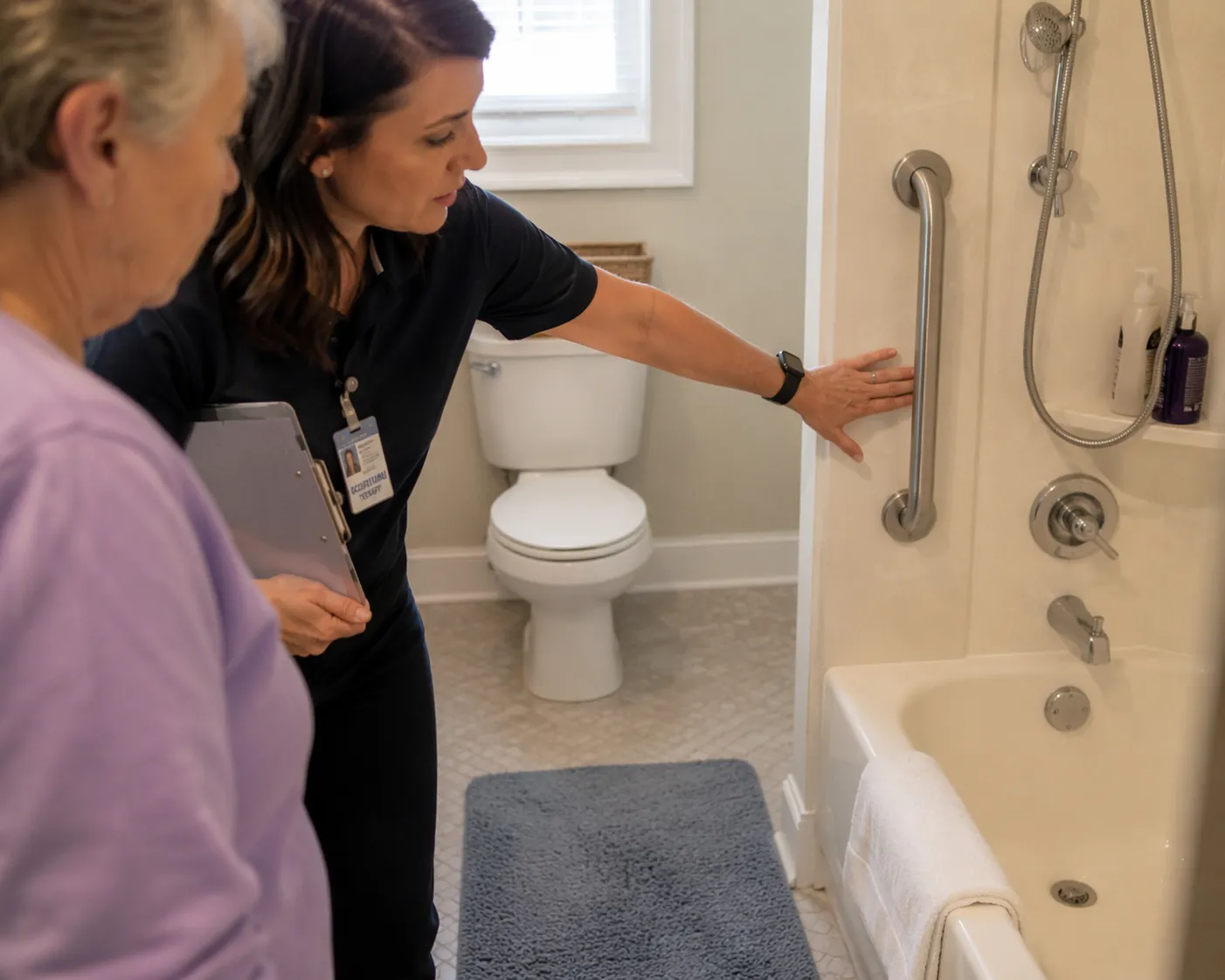
During a home assessment, therapists may look at maneuverability, safety, and accessibility: door width, steps, furniture placement, lighting, handrail stability, floor coverings, handheld shower access, cabinet height, and whether the person can safely move through the rooms they actually use.[7] That is more useful than a generic fall-prevention checklist because it connects risk to your parent’s current function.
If the facility cannot send someone to the home, ask whether the OT can review photos or a phone video of the main entrance, bedroom, bathroom, kitchen, stairs, and the path from bed to toilet. Measure doorway widths, bed height, toilet height, and the height of the chair your parent normally uses. Do not rely on “It should be fine” if no one has matched the equipment to the space.
The bathroom deserves special attention because it combines wet surfaces, clothing management, turning, fatigue, urgency, and embarrassment. Ask specifically whether your parent should use a shower chair, tub transfer bench, handheld shower, raised toilet seat, bedside commode, grab bars, non-slip surfaces, or supervised bathing at first. If you need a room-by-room way to prioritize changes, use a practical home modification guide rather than trying to fix the whole house at once.
Some modifications are temporary. A commode beside the bed may be the safest answer for two weeks if nighttime walking is still shaky. A first-floor sleeping arrangement may make more sense than pushing stairs before the therapist says stairs are safe. Other changes, like better lighting, removed throw rugs, secure handrails, and well-placed grab bars, may continue to protect independence long after the injury heals.
Costs can affect the plan, so bring them up early. If equipment, home care, or modifications are becoming the barrier, compare the discharge recommendations with a current home modification cost guide and review what may pay for senior home healthcare in 2026. Coverage rules and prices change, so verify current Medicare, plan, and local provider details before making a final decision.
Train for the Tasks You Will Actually Inherit
Family training should not be a hallway explanation given while your parent is dressed and waiting for transport. If you will help with transfers, ask to practice transfers. If you will change a dressing, ask to do it once while a nurse watches. If you will manage medications, ask for the final medication list and compare it with the pre-hospital list before discharge.
A short list on discharge day is better than a thick packet no one can interpret at 9 p.m. Put these items in one place:
- Final medication list, with new, stopped, changed, and temporary medications marked.
- Follow-up appointments, including the reason for each appointment.
- Home health agency name, first visit date if known, and phone number.
- Therapy precautions: weight-bearing limits, hip precautions, swallowing precautions, lifting limits, wound restrictions, or blood pressure parameters.
- Transfer instructions in plain language: where the walker goes, where the caregiver stands, and when the parent should not attempt the move alone.
- Red flags: fever, worsening pain, shortness of breath, confusion, wound drainage, sudden weakness, fall, medication reaction, or other condition-specific warnings from the clinical team.
If instructions conflict, ask the team to reconcile them before your parent leaves. It is common for the hospital discharge list, rehab medication list, specialist instructions, and family memory to differ. The family should not have to guess which blood thinner dose, pain medication schedule, or wound instruction is current.
The First Days Home Are a Test of the Plan, Not a Graduation
Coming home can make everyone relax too soon. The parent is relieved. The family is relieved. Then the first bathroom trip takes twenty minutes, the walker catches on a rug edge, the medication schedule is different from what everyone expected, and the parent is too tired to eat after a morning appointment.
For the first several days, keep the routine smaller than your parent may want it to be. The goal is not to prove they are back to normal. The goal is to see whether the rehab gains carry over safely when the hallway is narrower, the lighting is worse, the dog is underfoot, and no therapist is giving perfectly timed cues.
Track what actually happens:
- How many times did your parent get up overnight, and did they use the planned route?
- Did pain stop them from doing prescribed exercises or daily activities?
- Did they remember walker safety without reminders?
- Did bathing, toileting, dressing, or meal preparation require more help than expected?
- Did they avoid walking because they were afraid, dizzy, embarrassed, or exhausted?
- Did the equipment fit the home, or did it create new obstacles?
Share that information with home health, outpatient therapy, or the primary clinician. “She walked 60 feet at rehab” is less useful than “She can get from the bed to the bathroom in daylight, but at night she reaches for the towel bar and forgets the walker.”
Emotional Recovery Changes Physical Recovery
After a fall or surgery, the visible injury often improves before confidence does. A parent may be medically stable and still afraid to stand. They may say they are tired when they are really afraid of falling again. They may refuse the shower because they feel exposed and unsafe, not because they do not care about hygiene.

Depression also belongs in the main recovery path, not as an afterthought. Health in Aging’s caregiver guidance describes depression in older adults as something caregivers should take seriously and respond to with observation, communication, and professional help when needed.[8] Guidance focused on older adults after injury also notes that depression can follow an injury and interfere with recovery behaviors.[9]
Watch for changes that affect participation: sleeping too much or too little, loss of appetite, irritability, withdrawal, crying, hopeless comments, refusing visitors, skipping exercises, avoiding movement, or saying life will not return to anything meaningful. These are not just mood issues if they keep your parent from moving, eating, sleeping, taking medication correctly, or attending therapy.
Fear of falling needs the same practical treatment as a weak leg or painful incision. Ask the therapist to show the safest way to practice the feared activity. Break the task down: standing from the chair, pausing, placing hands correctly, taking three steps, turning, sitting. Let the parent succeed at the smallest safe version before pushing distance or speed.
Sleep problems can raise the risk level, especially if your parent is getting up in the dark, rushing to the bathroom, or feeling groggy from medication. If sleep disruption is becoming part of the fall-risk picture, connect it to the safety plan rather than treating it as a separate annoyance; light exposure, nighttime routines, pain control, and bathroom access all matter. For more on the sleep-and-fall-risk connection, see this guide to senior sleep health and fall risk.
Keep Independence as the Goal, Not Total Protection
There is a point in recovery where family help can quietly become over-help. It is natural after a frightening fall to hover, carry everything, answer for the parent, and make every movement feel supervised. Some of that may be necessary at first. But if the parent is capable of a safe task, doing it for them can steal practice they need.
Ask therapists which activities your parent should do independently, which need supervision, and which still require hands-on help. Then set up the home so the safe version is easy: frequently used items at reachable heights, clear paths, a stable chair with arms, good lighting, shoes that fit, assistive devices within reach, and a bathroom plan that does not depend on luck.
Occupational therapists with aging-in-place expertise can recommend modifications that help older adults maintain independence as mobility changes.[3] That may mean grab bars and lighting now, a stair strategy later, or a broader decision about whether the home can keep working. If the family is weighing larger changes, compare modification costs, safety needs, and housing options instead of making the decision in a crisis.
A simple weekly check-in can keep recovery grounded:
- What can my parent do this week that they could not do last week?
- What task is still unsafe, painful, or avoided?
- What cue or setup makes the task safer?
- What home hazard has appeared now that my parent is moving more?
- What does the therapist want the family to stop doing so the parent can practice?
Supporting a parent through rehab and recovery is not doing everything for them. It is coordinating the right help at the right phase: learning from the therapy team while your parent is still in rehab, making the home match current ability before discharge, practicing the tasks the family will inherit, and treating fear, pain, sleep, and depression as part of the recovery plan. That is the kind of support that protects safety without quietly giving up on independence.
References
- Rehab Care for Seniors, A Place for Mom
- Broken Bones, Pain and Rehab: A Family Guide After a Fall, Centers Health Care
- A Go-To Guide for Understanding Your Aging Parents’ Rehabilitation, Daughterhood.org
- Family caregivers’ experiences during rehabilitation, NIH/PMC
- How to Convince a Loved One to Participate in Senior Rehab, AgingCare
- Transitioning from Hospital or Rehab to Home, AARP
- All Better Now What? Post Rehab Tips for Your Parent, Optalis Healthcare
- Caregiver Guide: Depression, Health in Aging
- Senior Parents’ Depression After Injury, Be Health & Rehab
Related reading
Noticed something outdated or inaccurate on this page? Flag a correction. We review every report against CDC, NIA, and AARP HomeFit guidance before updating a page.
Part of the Fall Prevention section.