
STEADI: intervene
Wildfire Safety for Older Adults During a Heat Dome
Wildfire smoke and a heat dome can pull safety advice in opposite directions: sealing the home keeps smoke out but traps heat, and losing power can take out the air conditioning. This plan-ahead guide for caregivers of older adults provides a dual-hazard go-bag checklist and a heat-safe sheltering sequence with a named, reachable cool destination — built before the crisis window opens.
The hard part of wildfire safety for older adults during a heat dome is that the safest move for one danger can make the other danger worse. Closing the house helps keep smoke out. But closed windows, a hot house, and a power outage can take away the air conditioning that an older adult may be depending on. A daughter calling from work, a father who does not want to leave, a walker by the door, hearing aids on the dresser, and pills that cannot be forgotten are not separate checklist items in that hour. They are one problem.
EPA guidance for a clean air room centers on closed windows and doors and better filtration, and AirNow says that room should stay cool without pulling in outdoor air. The American Red Cross, meanwhile, warns that fans alone may not prevent heat illness in high-90s heat and points people toward air-conditioned space as the main protection during extreme heat.[1][2][3] That is the conflict to solve before the smoke is visible from the porch.
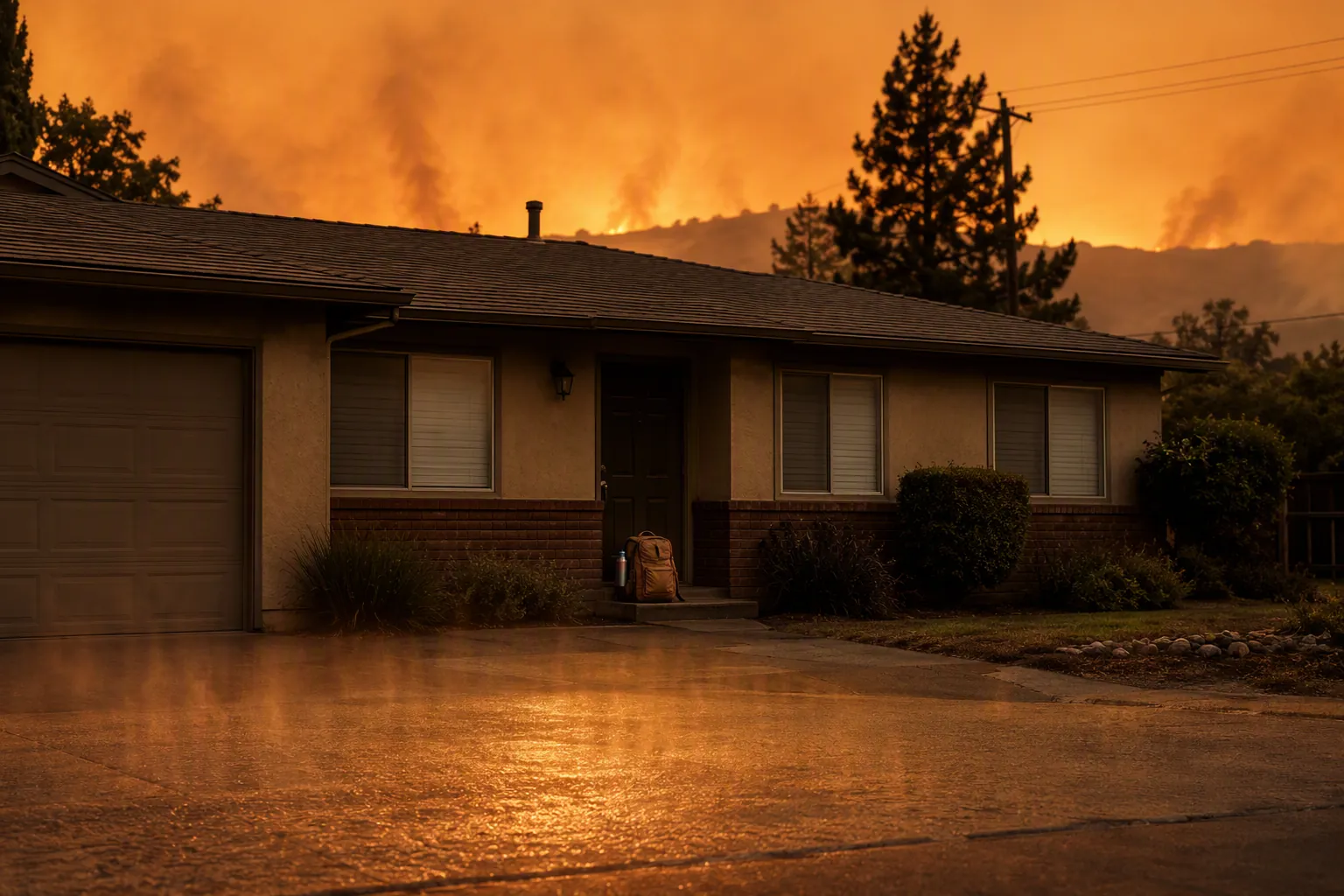
Older adults and people with disabilities need a more concrete plan because delay hits them harder. Los Angeles County Aging & Disabilities reported that, in the January 2025 Los Angeles County fires, 26 of the 31 people killed were over 65 or living with a disability. The same article cited a national survey finding that fewer than one in three adults ages 50–80 had an emergency kit.[4] That does not prove every future fire will look like that event. It does show why a “we’ll figure it out if we need to” plan is too thin for a parent who may need help standing, cooling down, hearing instructions, or getting to a car.
Decide the fork before the warning window
The most important decision is not “evacuate or shelter?” in the abstract. It is who gets to make that call, at what trigger, while leaving is still practical. If the older adult needs a walker, oxygen equipment, help with stairs, or time to gather medications, “wait and see” quietly becomes “stuck.”
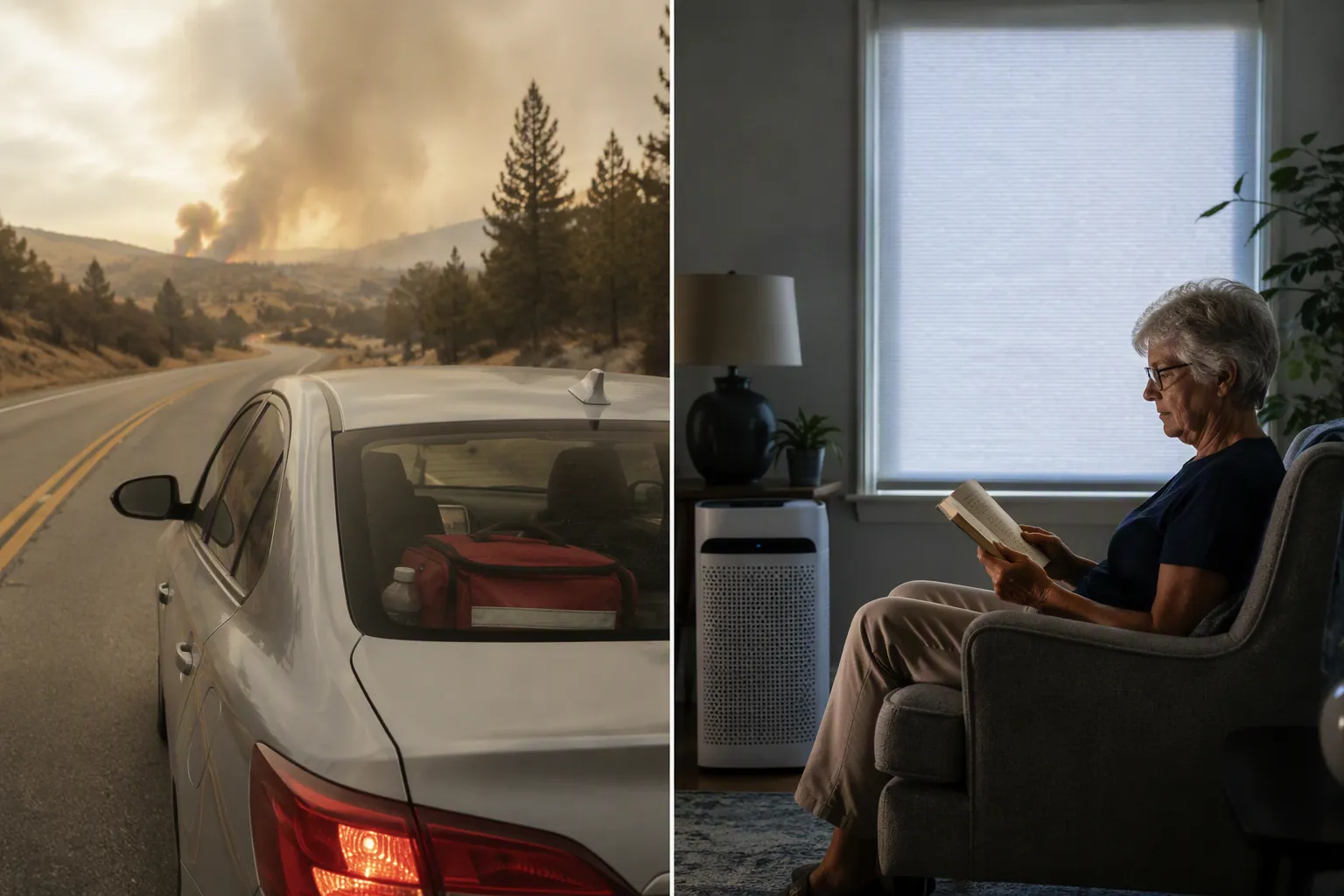
Build the fork while everyone can still think clearly:
- One caller: name the person who tells the older adult to leave or to start the sheltering sequence. Do not make three siblings negotiate it during the evacuation alert.
- One backup caller: if the first person cannot get through, someone else owns the next call.
- One driver or check-in person: name who can physically arrive, help with the bag, fold the walker, lock the door, and leave.
- Two mapped evacuation routes: CAL FIRE recommends knowing at least two ways out of the community.[5]
- One destination for evacuation: a relative’s home, accessible hotel, community shelter, or other confirmed place where the older adult can sleep, charge devices, take medications, and use mobility equipment.
- One cool destination if home cooling fails: this is not a vague “cooling center somewhere.” It needs a name, address, route, transportation plan, hours or confirmation process, and accessibility check.
A useful fork is plain enough to follow over the phone:
| Condition | Pre-decided action |
|---|---|
| Evacuation order, direct instruction from local officials, visible nearby fire threat, or caregiver cannot safely reach the home later | Leave early using the mapped route and the packed bag. The driver or backup driver starts the transportation plan. |
| Evacuation warning, heavy smoke expected, extreme heat forecast, and the older adult needs help moving quickly | Strongly consider leaving before the order if the destination is ready and the route is still workable. |
| No evacuation order, roads are unsafe or blocked, and the home still has a working cool clean-air room | Shelter using the clean-air and cooling sequence, with scheduled check-ins. |
| Power fails, indoor temperature rises, AC cannot operate, medical equipment loses power, or the older adult shows heat warning signs | Move to the named cool destination if reachable. If not reachable or symptoms are serious, escalate to emergency help. |
The fork should include permission. Many older parents resist leaving early because they do not want to overreact, impose on family, or abandon the house. That conversation belongs on a quiet afternoon, not after the power flickers. Write down the sentence the caller will use: “Dad, this is the point we agreed on. I’m coming now, and the bag is by the door.”
Pack one bag for smoke, heat, medications, and mobility
The bag is not a camping fantasy. It is the thing that keeps evacuation from turning into a scavenger hunt. Ready.gov recommends one gallon of water per person per day for several days, and CAL FIRE lists three gallons of water per person and a three-day supply of nonperishable food in a wildfire go bag.[5][6] For an older adult, the bag also has to cover the ordinary items that become urgent when a house is locked behind them.
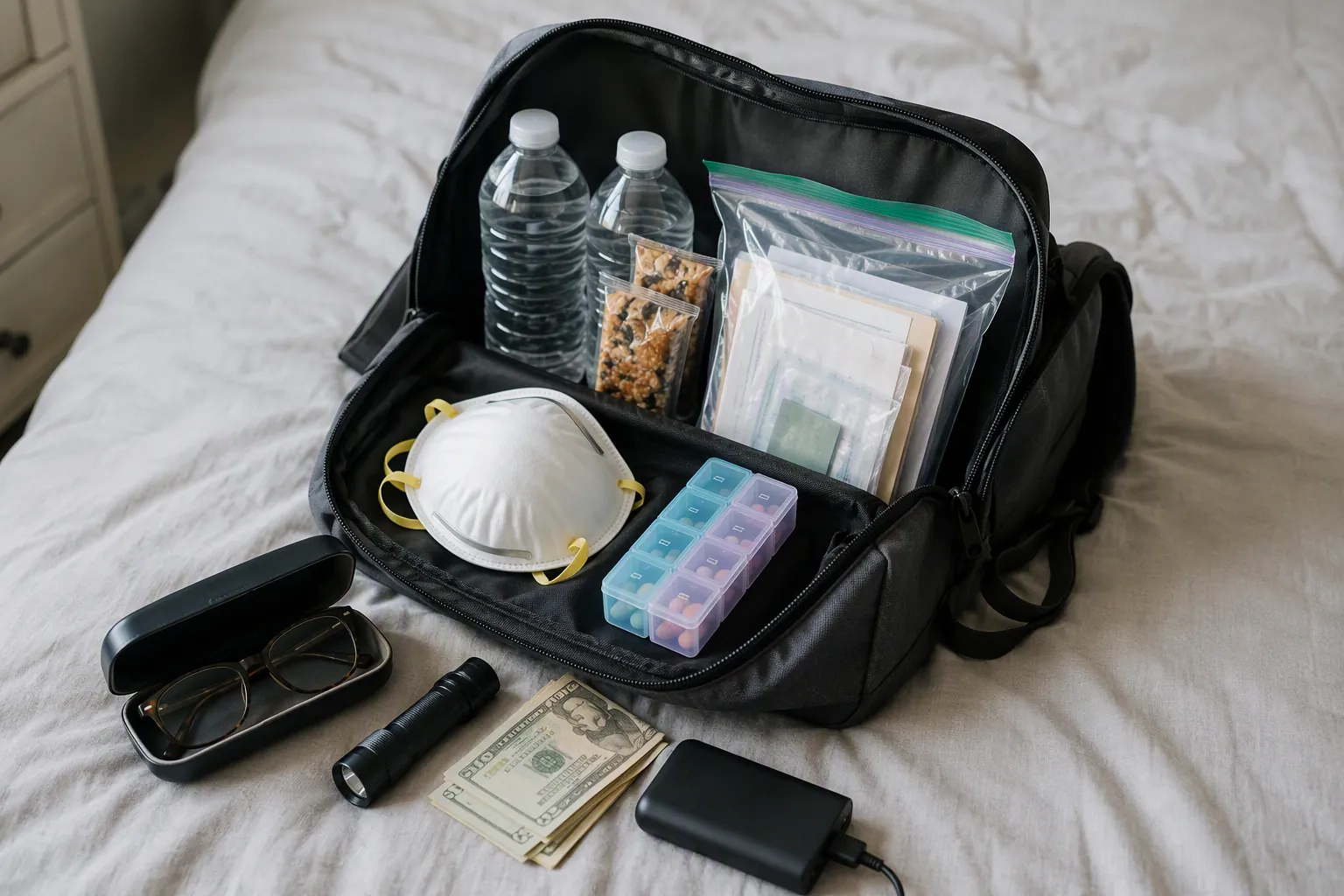
- Water: enough for the household’s realistic evacuation window, using Ready.gov’s one-gallon-per-person-per-day guidance and CAL FIRE’s wildfire go-bag baseline as planning anchors.[5][6]
- Food: at least a three-day supply of nonperishable food that the older adult can actually chew, digest, and open without special tools.[5]
- Medications: CDC recommends a 7- to 10-day supply of medications in a waterproof container for people with chronic conditions preparing for wildfire smoke.[7]
- Medication list: drug names, doses as prescribed, prescribing clinician, pharmacy, allergies, and emergency contacts. This article is not medical advice; refill timing, heat-sensitive medications, and condition-specific plans should be discussed with the prescriber or pharmacist.
- Respiratory protection: NIOSH-approved N95 respirators if the older adult can safely tolerate and properly use them. For some people with breathing or cognitive issues, this needs clinician input rather than guesswork.
- Documents: copies of ID, Medicare or Medicaid cards, insurance cards, advance directives if used, medication list, contact list, and key medical-device information. Ready.gov’s older-adult guidance emphasizes planning around medical, disability, and support needs.[8]
- Cash: small bills for situations where card systems are down or transportation requires cash.
- Vision and hearing: extra eyeglasses, hearing-aid batteries or charger, cleaning supplies, and labeled storage cases. CAL FIRE specifically includes extra eyeglasses in its go-bag list.[5]
- Power: phone charger, charged power bank, backup batteries, and a battery-powered or hand-crank radio. AARP also recommends power banks, radio access, N95 masks, and copies of insurance information in wildfire-smoke planning for older adults.[9]
- Heat support: electrolyte drinks or packets if appropriate for the person’s medical conditions, cooling towels, a brimmed hat, light clothing, and a written note about any fluid restrictions from a clinician.
- Mobility and fall-prevention items: walker label, cane, rollator accessories, spare tips, gait belt if a caregiver has been trained to use one, sturdy shoes, and a flashlight for uneven pavement or dark hallways.
- Medical-device support: batteries, charging cords, extension cord, outlet adapter, written instructions, and the phone number for the equipment supplier.
- Personal care: incontinence supplies, wipes, spare clothes, masks, hand sanitizer, and any comfort item that reduces agitation during relocation.
Keep the bag liftable. If it becomes too heavy, split it: one evacuation bag by the door, one labeled medication-and-documents pouch that rides in the older adult’s lap, and one small mobility-device bag attached to the walker or rollator. If you are still sorting out the safest walking aid, the comparison in walker vs. rollator for balance problems can help frame that decision before an evacuation makes it urgent.
Sheltering only works if the clean-air room can stay cool
Sheltering is not just staying home. During wildfire smoke and extreme heat, it is a sequence. If the sequence has not been built, the older adult may end up in a closed, hot room with no good next move.
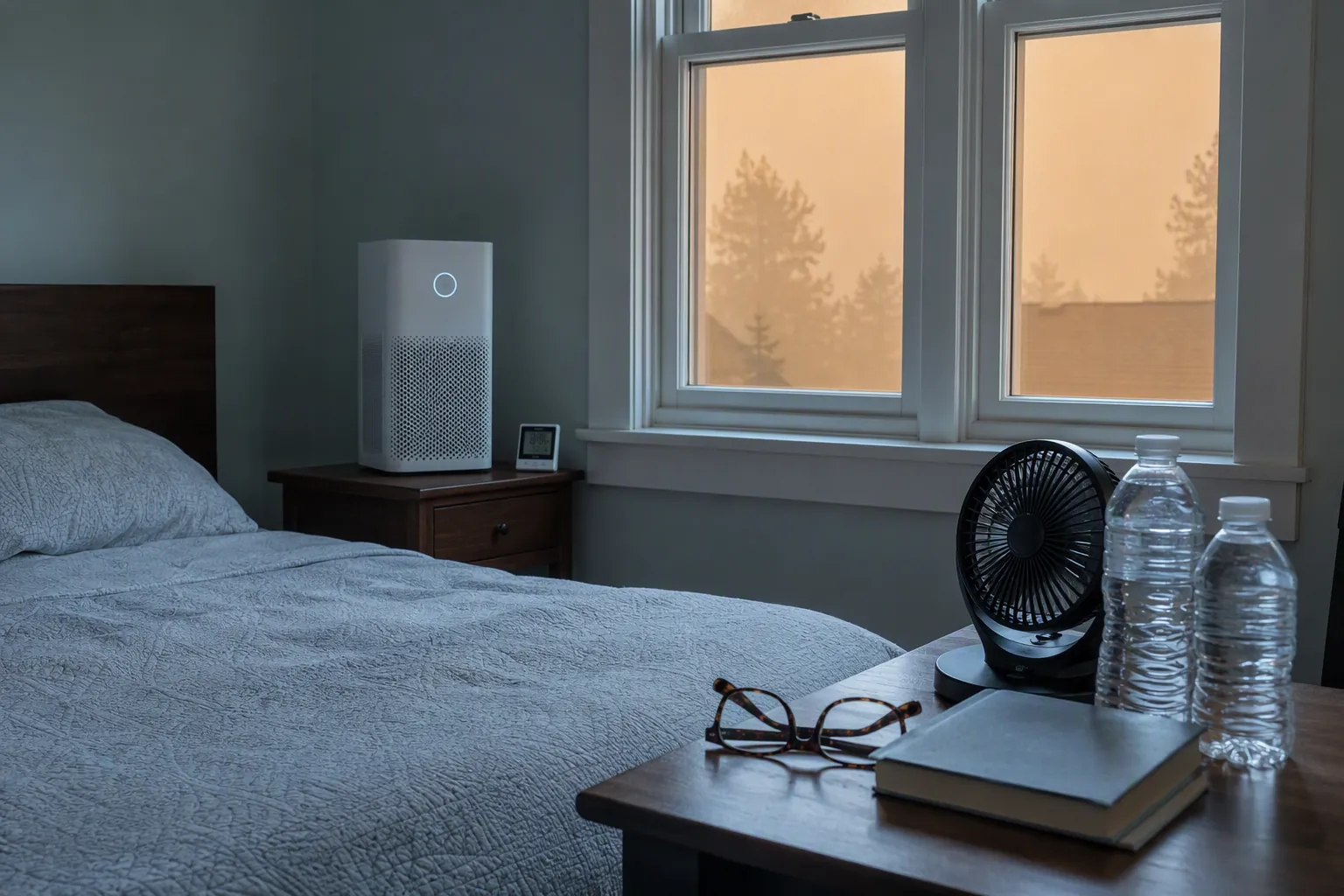
- Choose the room now. Pick the room with the fewest windows and doors, enough space for the older adult’s chair, walker, oxygen or medical equipment if used, water, phone, charger, and caregiver access. A bedroom may work better than a living room if it has fewer openings and a nearby bathroom.
- Make it a clean air room. EPA recommends keeping windows and doors closed and using filtration, including MERV-13 or higher filters where compatible with the HVAC system, to help protect indoor air quality during wildfire smoke.[1]
- Do not pull smoky air inside to cool the room. AirNow’s smoke-readiness guidance says to make sure the clean air room can stay cool without bringing in outdoor air.[2]
- Measure the room, not just the forecast. Put a simple thermometer in the room and make it easy to read. A caregiver on the phone needs a number from the room where the older adult is actually sitting.
- Use air conditioning while it is available and safe to operate. During extreme heat, air-conditioned space is the main protection, and fans alone may not be enough in high-90s temperatures.[3]
- If the AC fails, move through the backup plan immediately. That may mean relocating to the named cool destination, using a generator only if it can be operated safely outdoors and away from openings, or calling for emergency help if relocation is no longer safe. Do not let “we are sheltering” become a reason to sit in rising heat.
The clean-air room should be set up like someone will really sit there for hours: water within reach, charged phone, hearing aids, glasses, medications, a flashlight, a chair that is easy to rise from, and a clear path to the bathroom. If the parent uses a walker, the path into the room matters as much as the air cleaner. A throw rug that is merely annoying on a normal day becomes a fall hazard when the lights go out and everyone is rushing.
This is where home safety and emergency planning meet. A room-by-room fall-risk pass is worth doing before fire season, not because it is tidy, but because evacuation and sheltering both require movement under stress. The room-by-room home safety assessment checklist is a practical place to start if the clean-air room path has cords, rugs, poor lighting, or tight furniture clearances.
The cool destination has to be named
A “cool place” is not a plan. Name the place. Write down the address. Confirm how the older adult will get there if the caregiver is at work, the usual road is closed, rideshare service is overwhelmed, or the older adult cannot climb into a tall vehicle.
- Can the older adult get from the door to the vehicle without stairs, gravel, smoke exposure, or a long walk?
- Does the destination have air conditioning, seating, accessible restrooms, outlets, and space for a walker or wheelchair?
- Will it accept pets, oxygen equipment, a caregiver, or an overnight stay if needed?
- Who confirms it is open during the event?
- What is the backup destination if that site is full, closed, or downwind of smoke?
For some families, the named cool destination is a relative’s house outside the smoke zone. For others, it is a city cooling center, accessible hotel, adult child’s office building, or community shelter. The right answer is the place the older adult can actually reach before heat, smoke, traffic, and mobility limits close the window.
When staying put stops being reasonable
Older adults are at higher risk during extreme heat, and chronic conditions, medications, limited mobility, and living alone can make the margin smaller.[10] NIA’s hot-weather safety guidance tells older adults and caregivers to take heat illness symptoms seriously, including dizziness, headache, confusion, nausea, rapid pulse, fainting, or very high body temperature.[11]
Escalate when the plan is no longer controlling the danger:
- Call 911 or local emergency services for confusion, fainting, severe weakness, trouble breathing, chest pain, signs of heat stroke, or any rapidly worsening condition.
- Call the medical equipment supplier or clinician’s emergency line if oxygen, CPAP, refrigeration, charging, or another device need is failing and there is still time to relocate safely.
- Move to the named cool destination if indoor heat is rising and the route is still safe enough to travel.
- Do not wait for perfect information if the older adult cannot cool down, cannot communicate clearly, or cannot be checked in person.
Medication questions belong with a clinician or pharmacist before the event. Ask how to handle early refills, heat-sensitive medications, fluid restrictions, diuretics, heart conditions, kidney disease, diabetes supplies, oxygen, and any medication that could affect hydration, sweating, alertness, or balance. Do not change dosing because of an article, a neighbor’s advice, or a caregiver’s hunch.
Run a short readiness test before fire season
The test should feel almost embarrassingly practical. Put the go-bag by the door. Ask the older adult to get from their usual chair to the exit with the mobility aid they would use in an emergency. Time how long it takes to put on shoes, grab hearing aids, pick up the medication pouch, and get into the vehicle. If that small rehearsal is hard on a clear day, it will not become easier under smoke and heat.
Then test the sheltering sequence. Close the clean-air room door. Check whether the air cleaner can run where it is placed, whether the phone charges, whether the thermometer can be read, whether the walker fits beside the bed or chair, and whether the bathroom path is clear. If the home still needs basic fall-risk changes, prioritize the ones that affect the evacuation path and shelter room first; a broader aging-in-place checklist by cost and fall risk can help keep that work from becoming scattered.
The plan is ready when five things are true: the bag is packed and liftable, the clean-air room can also stay cool, the cool destination has a name and route, the caregiver knows the decision point, and the older adult has already heard the plan before the day leaving becomes slow or impossible.
References
- Create a Clean Room to Protect Indoor Air Quality During a Wildfire, EPA
- Be Smoke Ready, AirNow
- Extreme Heat Safety, American Red Cross
- Lessons from the January Wildfires: Why Preparedness Matters, LA County Aging & Disabilities
- Create Your Go Bag, CAL FIRE
- Build A Kit, Ready.gov
- Wildfire Smoke and People with Chronic Conditions, CDC
- Older Adults, Ready.gov
- Wildfire Smoke Health Risks for Older Adults, AARP
- Heat and Older Adults (Aged 65+), CDC
- Hot Weather Safety for Older Adults, National Institute on Aging
Related reading
Noticed something outdated or inaccurate on this page? Flag a correction. We review every report against CDC, NIA, and AARP HomeFit guidance before updating a page.
Part of the Fall Prevention section.