
STEADI: intervene
Room-by-Room Heat Wave Safety for Older Adults at Home
Heat is deadliest for older adults inside the home, where an air conditioner may be off, set too low, or too costly to run. This room-by-room cooling plan covers what to set, close, and change in each room with and without AC, plus the checks that confirm the house is actually safe.
Reviewed by Dana Mitchell, OTR/L. Last updated and source-verified: July 31, 2026. This guide is home-safety education, not medical advice; for heat illness warning signs and when to call 911, use the heat warning-sign decision guide.
The phrase “heat wave safety tips for elderly at home” usually turns into the same soft list: drink water, wear loose clothes, stay cool. Fine. But the room may still be 86°F, the blinds may be open on the west side of the house, and the air conditioner may be sitting there like a prop.
That is not a theoretical problem. In Maricopa County’s 2019 heat-death review, 91% of people who died indoors from heat had air conditioners that were off, not set to a protective level, or broken — a finding last verified for this article on July 31, 2026.[1] The dangerous assumption is not “older adults get hot.” The dangerous assumption is “they have AC, so they’re fine.”
National heat-death counts explain why this deserves household-level urgency: CDC data cited by ABC News show heat deaths rising from 1,156 in 2020 to 2,415 in 2023 and 2,394 in 2024, with heat causing about 2,000 deaths per year and official counts likely missing some cases; these figures were last verified for this article on July 31, 2026.[2] But the number that matters at 3 p.m. is smaller: what does the thermometer say in the room where your parent is sitting?

The whole-house rules before you start room by room
Do these checks before the heat wave if possible. During the heat wave, repeat the parts that can fail: thermostat, fan direction and use, curtains, windows, water, and the actual room temperature where the older adult spends time.
- Use a room thermometer, not just the wall thermostat. The thermostat may be in a hallway while the bedroom bakes behind a west-facing window.
- Treat about 80°F indoors as a precaution point for an older adult. The American Geriatrics Society’s hot-weather guidance flags 80°F as a level that deserves caution, especially for older people with health conditions or limited ability to cool down.[4]
- If AC is available, do not assume “lower is always better” or “higher saves enough money.” WHO describes a setup using air conditioning at 81°F with a fan, which can feel about 4°C cooler and cut cooling electricity use by up to 70%; the caregiver’s job is to confirm the actual room still feels and measures safe for that person.[3]
- Do not use a fan as the main cooling plan in severe heat. WHO warns that fans should not be used for cooling when air temperature is above 104°F, and CDC tells older adults not to rely on a fan as the main cooling source when it is really hot outside.[3][5]
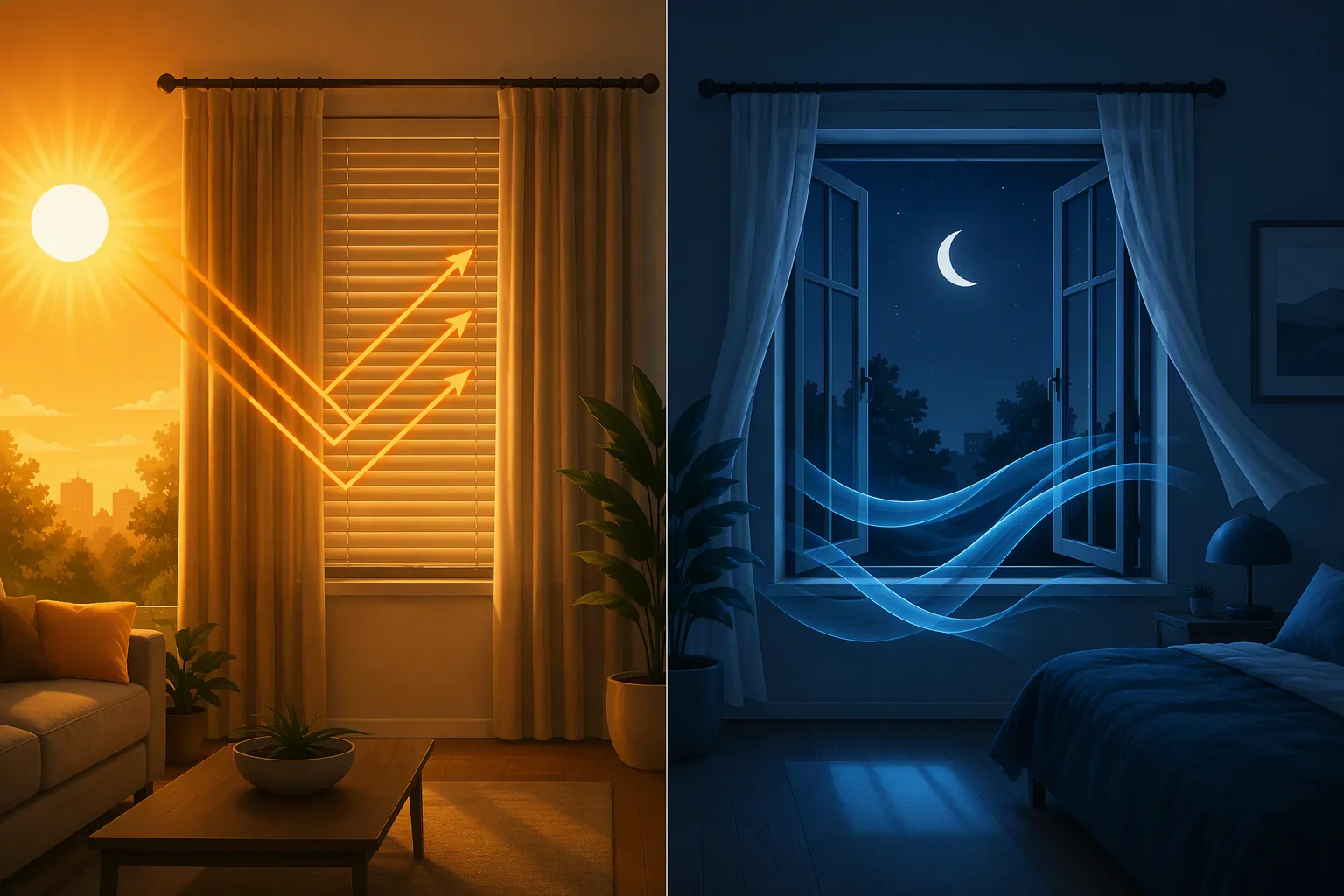
- Close blinds and curtains before the hottest part of the day, especially on sun-facing windows. This is not decoration; it is load reduction.
- Open windows at night only when the outdoor air is cooler than the indoor air. WHO’s rule is simple: night ventilation helps only when outside is cooler than inside.[3]
- Avoid the oven and limit stovetop cooking during the heat wave. The National Institute on Aging advises limiting oven use, keeping shades closed during the hottest part of the day, and opening windows at night when conditions allow.[7]
- Plan medication storage before the house heats up. Insulin, inhalers, EpiPens, and other temperature-sensitive medicines should not be left in a hot room, hot car, sunny kitchen counter, or unventilated entryway. Ask the pharmacist what “too hot” means for each medicine.
- Solve the electric-bill problem before the parent starts turning the AC off. The LIHEAP National Energy Assistance Referral line listed in the AGS tip sheet is 1-866-674-6327, last verified for this article on July 31, 2026.[4]
If AC cost is the reason the house is hot, treat that as a safety barrier, not a budgeting personality trait. For help thinking through LIHEAP, utility discounts, and cooling costs on a fixed income, use CareWise Guide’s guide to helping seniors save electricity during rate hikes.
A fast walkthrough map
Use the table as the first pass. The rest of the article expands the rooms where heat plans most often fail: the bedroom, the daytime sitting area, the kitchen, the bathroom, the medication spot, and the exit plan.
| Area | If the home has AC | If the home has no AC or AC is not usable | Caregiver verifies |
|---|---|---|---|
| Bedroom | Confirm the sleeping room, not just the hallway thermostat, stays cool enough overnight. Use AC plus fan only within safe temperature limits. | Move sleep to the coolest shaded room or cool corner; use night air only when outside is cooler than inside. | Room thermometer reading, blinds closed, safe path to bathroom, water within reach. |
| Living room or daytime refuge | Make one room the main cooled daytime space and keep doors/curtains arranged to protect it. | Pick the lowest, shadiest, best-ventilated area; stop using sunny rooms during peak heat. | Older adult is actually spending peak hours there, not in a hotter favorite chair. |
| Kitchen | Keep AC from fighting oven heat; prepare cold or microwave meals. | Do not cook with oven during peak heat; reduce stovetop use. | No noon baking, no long simmering, no sunny counter storage for medicines. |
| Bathroom | Use cool showers or damp cloths without creating a fall hazard. | Same, but keep the route short and the floor dry. | Grab bars, nonslip surface, towel within reach, no rushing when dizzy. |
| Medication area | Move medicines away from windows, cars, and hot counters. | Use the coolest interior storage spot and pharmacist instructions. | Insulin, inhalers, EpiPens, and other heat-sensitive items have a specific storage plan. |
| Exit plan | Know when to leave if AC fails or cannot keep the sleeping room safe. | Cooling center or air-conditioned destination is part of the plan, not a last-minute debate. | Ride, keys, walker/cane, medications, phone charger, and destination hours are known. |
Bedroom: make the sleeping room pass the thermometer test
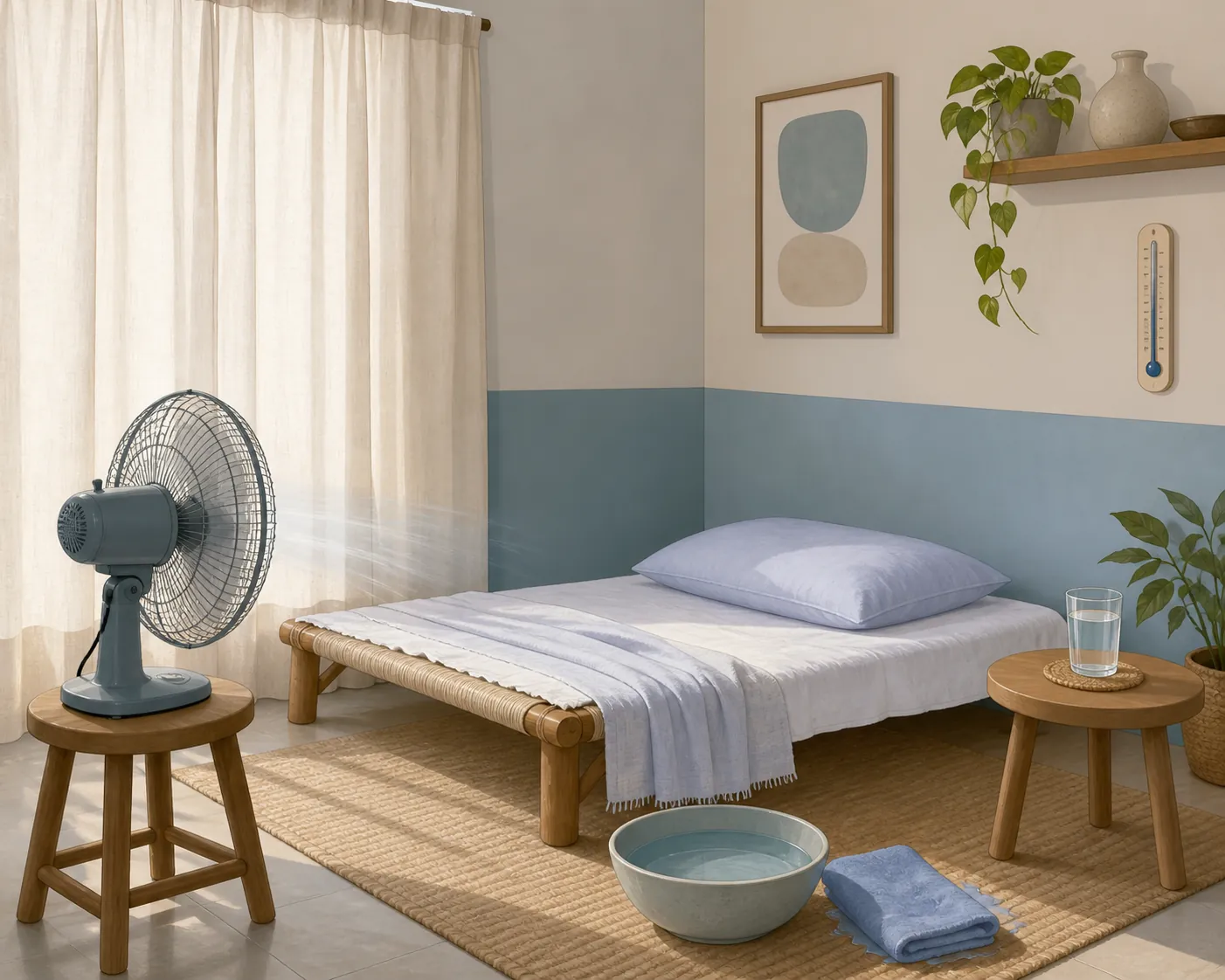
Start where the older adult sleeps, because heat that does not break overnight wears people down. PBS NewsHour, citing Duke heat-health expertise, warns that overnight lows around 75°F can be dangerous because the body loses its chance to recover; the same guidance recommends creating a “cool corner” for sleeping when air conditioning is not available.[6]
With AC, check the bedroom door closed and open. Some systems cool the hallway and leave the bedroom warm. If a fan is used with AC, keep it in the safe-use range: WHO’s 81°F-plus-fan setup is an energy-saving cooling strategy, while the 104°F cutoff is the point where fan reliance becomes dangerous rather than helpful.[3] If the bedroom still sits around or above the precaution range, move the sleeping spot or leave for a cooler place.
Without AC, stop treating the usual bedroom as sacred. Choose the lowest, shadiest room; close curtains before sun hits the window; move the bed, cot, or recliner away from exterior walls that radiate heat; and place water, phone, glasses, cane or walker, and a flashlight within reach. If the coolest sleeping spot changes the route to the bathroom, fix the path before bedtime. For night-lighting and bed-to-bathroom fall prevention, use the power-outage fall-proofing checklist; the same pathway rules matter during heat because dizziness and hurried nighttime trips do not mix.
Living room: protect one daytime refuge
Most homes do not need every room comfortable during a heat wave. They need one reliable daytime refuge where the older adult will actually sit during peak heat. That may not be the favorite chair. If the favorite chair is beside a sunny sliding door, move the chair or choose another room.
In an AC home, this is where you make the electric bill and the safety plan talk to each other. Close unused-room doors if that helps the cooled area hold temperature. Keep blinds closed on sun-facing windows. Use a fan to move cooled air across the sitting area, but do not let the fan become the plan if the AC is off or the room is hot. CDC’s older-adult heat guidance is blunt: stay in air-conditioned buildings, and do not rely on a fan as the main cooling source when it is really hot outside.[5]
In a no-AC home, the living room may be unusable during the hottest hours. Set up the daytime refuge in the coolest room instead: shaded, away from west-facing glass, with a comfortable chair, water, phone, charger, medications if needed, and a clear walking path. If the only tolerable room is upstairs but the upstairs traps heat by late afternoon, that is not a refuge; it is a morning room.
Kitchen: stop adding heat to the house
A heat plan can be ruined by lunch. The oven does not care that the thermostat is set correctly. During a heat wave, plan cold meals, microwave meals, batch-cooked food made before the heat arrives, or delivered meals. The National Institute on Aging specifically advises limiting oven use during hot weather.[7]
Check for habits, not intentions. Some older adults will say they are “just making something small” and then boil pasta, simmer soup, or bake at noon because that is the normal routine. Put easy food at eye level. Move heavy water pitchers where they can be reached without bending or climbing. If the parent uses a stove and gets lightheaded in the afternoon, the solution is not a lecture about hydration; it is changing the meal plan before the hot hours.
Bathroom: cool down without creating a fall
Cool showers, sponge baths, and damp cloths can help, but the bathroom is also where a heat-stressed person can slip. Keep the route short, the floor dry, the towel reachable, and the water temperature comfortable rather than shocking. If the older adult already needs help bathing, do not add a new shower routine without checking whether the bathroom setup can handle it.
A shower chair, grab bars, nonslip surface, and handheld showerhead are not heat gadgets; they are what make cooling routines usable. If this room is already borderline, start with the bathroom modification roadmap before asking someone to shower more often during dangerous heat.
Medication area: move the pills and devices out of the hot zone
Medication storage is part of the room plan because heat does not stop at the skin. Move medicines away from sunny windowsills, hot kitchen counters, bathrooms that steam up, cars, garages, and entry tables that get afternoon sun. For insulin, inhalers, EpiPens, and any medicine with storage limits, ask the pharmacist for the exact temperature range and what to do if the medicine may have overheated.
Hydration advice also belongs here because some medications change the rules. WHO’s heat guidance includes drinking regularly, including about one cup of water per hour and 2–3 liters per day in hot conditions, but CDC cautions that people on fluid restrictions or water pills should ask their doctor how much to drink on hot days.[3][5] That caveat is not fine print. It is the difference between useful advice and unsafe advice.
Entry and exit: decide before the house fails
A cooling center is not a failure of independence. It is the backup cooling system when the house cannot do the job. Before the heat wave, identify the nearest air-conditioned place the older adult can realistically reach: a cooling center, library, community center, senior center, relative’s home, or other local site. Then check the boring pieces: transportation, hours, mobility device, medications, charger, keys, ID, and who will help if the first ride falls through.
For a full no-AC or outage scenario, use the heat wave power-outage guide for seniors. This article is about home configuration; outage planning has its own steps because elevators, medical devices, refrigeration, phones, and lighting can all fail at once.
The twice-daily caregiver check
During a heat wave, a morning check and a late-afternoon or evening check are not excessive. CDC advises checking on older adults at least twice a day during extreme heat and asking whether they have access to water, access to air conditioning, know how to keep cool, and are showing signs of heat stress.[5]
A useful check-in is not “Are you okay?” Many people will say yes because they do not want to be trouble, do not feel the heat the same way, or are trying not to run up the utility bill. Ask and verify:
- What does the room thermometer say where you are sitting?
- What does it say in the bedroom where you will sleep tonight?
- Is the AC on, and is cool air actually coming out?
- Are the blinds and curtains closed on the sunny side?
- Are any windows open while outside air is hotter than inside air?
- Did anyone use the oven or stove during peak heat?
- Is water within reach, and has a doctor given any fluid limits?
- If the house keeps warming up, where are you going, and who is taking you?
If you are preparing 72 hours ahead of a forecast heat dome, pair this room walkthrough with the site’s heat-dome preparation and check-in plan. If your family already uses seasonal room-by-room safety walks, this is the hot-weather version of the same habit; the winter room-by-room home safety guide is a useful template for how to inspect without turning the visit into an argument.
When the home is no longer safe tonight
Leave for an air-conditioned place or cooling center if the sleeping area cannot stay cool enough, if AC is broken or unaffordable to run, if the fan is being used as the main cooling source during severe heat, if the overnight temperature will not drop enough for recovery, or if no one can verify conditions inside the home.
Loose clothing, cool showers, water, and quiet activity all help at the edges. They do not make a hot bedroom safe. The final question is the one a caregiver can answer with a thermometer, a hand at the vent, and a look at the windows: is this house actually cool enough for the older adult to remain here tonight?
References
- The Effects of Heat on Older Adults, Harvard Medicine Magazine.
- As US braces for extreme heat, statistics show around 2,000 people die from heat-related causes each year, ABC News.
- Climate change: heat and health, World Health Organization.
- Tip Sheet: Hot Weather Safety Tips for Older Adults, Health in Aging Foundation, July 2019.
- Heat and Older Adults (Aged 65+), Centers for Disease Control and Prevention.
- How to stay cool and safe in a heat wave, even without air conditioning, PBS NewsHour.
- Hot Weather Safety for Older Adults, National Institute on Aging.
Related reading
Noticed something outdated or inaccurate on this page? Flag a correction. We review every report against CDC, NIA, and AARP HomeFit guidance before updating a page.
Part of the Fall Prevention section.