
Clinical term
Fall-Proof Your Home for Minimally Invasive Bypass Recovery
Last verified 2026-08-02
For a senior coming home after minimally invasive heart bypass, fall prevention is part of recovery planning, not a side chore. The incision may be smaller than a traditional open-chest bypass, and the hospital stay may be shorter, but the first days at home still combine weak legs, new routines, possible dizziness on standing, medication changes, and lifting limits. That is exactly when a parent is most likely to try something ordinary—walking to the bathroom at night, stepping around a pet, reaching for a towel rack—and discover too late that “ordinary” now has different physics.
Use this as a home-safety checklist, not as medical advice. The surgical team’s discharge instructions override any general checklist here, especially for wound care, medications, driving, cardiac rehab, return to work, and activity restrictions. The caregiver’s job before discharge is narrower and very practical: make the route from bed to bathroom boring, lit, clear, and supported.
Why the first weeks at home are a fall-risk window
The American Heart Association frames falls as a real cardiovascular recovery issue, not just a general aging concern. Its consumer guidance says 40% to 60% of adults with cardiovascular disease either have falls or are at risk for them, and more than 60% of adults hospitalized with cardiovascular disease have moderate-to-high fall risk. [1]
Several risks converge after bypass. The AHA scientific statement notes that orthostatic hypotension—blood pressure dropping when a person stands—is present in at least 30% of older adults, and it identifies medication classes linked to falls, including diuretics, beta-blockers, ACE inhibitors or ARBs, sedatives, antidepressants, and opioids. [2] That does not mean any one medicine should be stopped; it means dizziness, timing, bathroom urgency, and night walking deserve to be planned for before the front door opens.
Minimally invasive bypass may shorten some parts of recovery. UF Health’s minimally invasive heart bypass discharge guidance describes a typical hospital stay of about 2 to 3 days, a lifting limit around 10 pounds for the first week, and a return to normal activities in about 2 to 3 weeks. [3] Those are useful ranges, but they are not permission to treat the house like it was before surgery. A person under lifting restrictions should not be catching themselves hard with their arms, hauling a laundry basket, dragging a trash bag, or grabbing unstable furniture to prevent a fall.
The safer assumption is simple: for the first stretch at home, the house has to do more of the work.
Before discharge, walk the bed-to-bathroom route
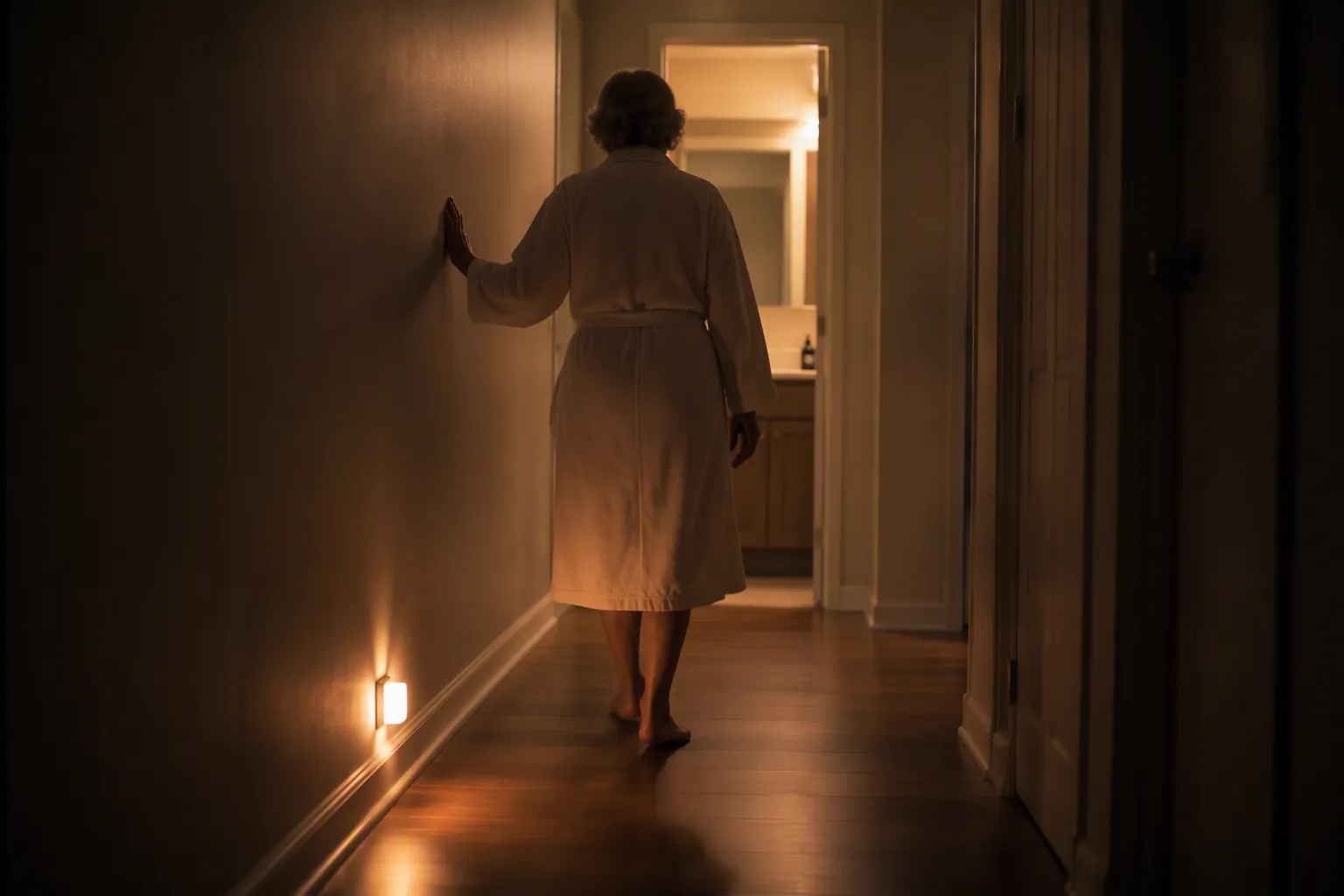
Start where the fall is most predictable: the path from bed to toilet. Not the whole house, not the garage, not the guest room closet. Bed to bathroom. Do it in daylight, then imagine the same trip at 2 a.m. when your parent is sleepy, sore, possibly lightheaded, and trying not to wake anyone.
MedlinePlus advises that someone stay with the patient for the first 1 to 2 weeks after coming home from the hospital, and its home-preparation guidance includes setting up a bed on the first floor when stairs are difficult, using night lights, removing throw rugs and cords, and keeping pets out of walkways. [4] That is the checklist to do before discharge, not after the first close call.

- Set up a first-floor sleeping area if stairs are a barrier, even if your parent dislikes the idea. This can be temporary, but the first nights are not the time to prove independence on a staircase.
- Clear a wide, direct route from bed to bathroom. Remove throw rugs, loose mats, cords, baskets, shoes, plant stands, and low furniture.
- Put night lights along the entire path, not just inside the bathroom. The hallway, doorway threshold, and turn into the bathroom all matter.
- Keep pets out of the route with a closed door, gate, crate, or another plan. A small dog underfoot can be as dangerous as a loose rug.
- Place glasses, phone, water, tissues, remote, charger, and medications where they can be reached without bending, twisting, or walking while carrying too much.
- Put frequently used kitchen and bathroom items at waist-to-shoulder height. Avoid low cabinets and high shelves during the early recovery period.
If you need a broader pass after the bed-to-bathroom route is safe, use the same logic room by room: clear the walking line first, then fix lighting, then remove unstable supports. This site’s room-by-room trip-hazard checklist and night-light planning guide can help if you are doing a fast home sweep under discharge pressure.
Make the bathroom boringly safe
The bathroom is where pride and physics often collide. A parent who is determined not to be “a burden” may try to shower alone, lean on a towel rack, or rush because someone is waiting outside the door. The safer setup removes the need for improvisation.
MedlinePlus is specific about grab bars: they should be secured vertically or horizontally, never diagonally, and towel racks should never be used as grab bars. It also recommends a shower chair with non-skid tips. [4] This is not a decoration issue. A towel bar may hold a towel for years and still fail the first time a recovering adult puts body weight on it.

- Install real grab bars at the toilet and shower or tub area, mounted into appropriate support. Do not count towel racks, sink edges, shower doors, or towel hooks.
- Check that the shower chair has non-skid rubber tips and sits level. A chair that rocks is not ready.
- Ask before discharge whether a raised toilet seat, bath transfer bench, or other bathroom equipment is appropriate for this patient.
- Put soap, shampoo, towels, and clothing within easy reach before the shower starts. Reaching down for a dropped bottle is exactly the kind of movement to avoid.
- Do not plan on unassisted showering until the care team has made the rules clear. If the discharge packet is vague, ask directly: “When can they shower, and should someone be nearby?”
Vancouver Coastal Health notes that a raised toilet seat or bath transfer bench may be needed after cardiac surgery, and that an occupational therapist may assess this before discharge. [5] If no one has talked through bathroom equipment yet, ask. The right time to discover the toilet is too low is not the first night home.
Turn lifting limits into house rules
Recovery instructions often say “do not lift more than…” and families hear that as a rule about exercise. At home, it is also a rule about walking. A person who should not lift or strain should not be walking while carrying laundry, groceries, trash, a pet, a full watering can, or a heavy pitcher. They also should not be the person who lunges for the doorbell, catches a falling object, or steadies themselves on a rolling chair.
The exact limit depends on the operation. MedlinePlus discharge guidance for heart bypass after sternotomy says not to lift anything heavier than 5 to 7 pounds for the first 6 weeks and not to drive for at least 4 to 6 weeks. [6] UF Health’s minimally invasive discharge guidance gives a different early range—about 10 pounds for the first week. [3] Those are not interchangeable instructions. If your parent had a keyhole or small-incision procedure rather than a sternotomy, ask which precautions apply to them.
| Household situation | Recovery rule to set |
|---|---|
| Laundry | Someone else carries baskets, moves loads, and handles stairs. |
| Groceries and deliveries | Leave items at counter height; the recovering senior does not lift bags from the floor. |
| Trash and recycling | Assign it to someone else until lifting and walking restrictions are cleared. |
| Pets | No leash pulling, pet carrying, or stepping over food bowls in walkways. |
| Doorbell or phone | No rushing. Use a chair near the main room, voicemail, smart speaker, or caregiver response. |
| Furniture support | Use stable, approved supports only. No grabbing rolling chairs, towel racks, tray tables, or open doors. |
This may frustrate a parent who wants to show they are still capable. Keep the rule concrete instead of making it about frailty: “Your job is to walk empty-handed until the surgeon clears more.” That preserves dignity better than hovering and scolding after every movement.
Do a medication-and-dizziness check without changing medicines yourself
Medication decisions belong to the prescriber, not the hallway safety checklist. Still, the caregiver can watch the conditions that make a fall more likely: new sleepiness, urgency to urinate after a diuretic, dizziness when standing, or confusion about timing.
Because the AHA identifies several cardiovascular and non-cardiovascular medication classes associated with falls, it is reasonable to ask the discharge nurse, cardiology team, pharmacist, or primary care clinician to review fall risk along with the medication list. [2] Bring the actual bottles if the list at home differs from the hospital list. If heat, dehydration, or blood pressure changes are also concerns, this medication-related fall-risk review can help you organize questions for a clinician.
- Ask which medicines are most likely to cause dizziness, sleepiness, bathroom urgency, or low blood pressure.
- Ask what to do if dizziness happens after standing, after a shower, after meals, or after a dose change.
- Keep a written schedule so the recovering senior is not walking around at night searching for pills.
- Use a stable chair near the bed so the person can sit before standing fully if the care team approves that approach.
For more detail on standing-related lightheadedness as a fall warning, see this guide to dizziness on standing. The key at bypass discharge is not to self-adjust medication; it is to report symptoms early and remove the household hazards that turn a dizzy moment into an injury.
Plan for weeks, not one careful weekend
A minimally invasive procedure can make recovery shorter for some patients, but the risk period does not end the first time your parent walks from the couch to the kitchen. NHLBI says full recovery after CABG often takes 6 to 12 weeks after leaving the hospital, while minimally invasive bypass generally takes less time. [7] The exact timeline is the surgeon’s call.
That means the home setup should stay active past the first few impressive days. Leave the night lights in. Keep the pet gate up. Keep frequently used items at reachable height. Keep the first-floor option available if stairs are still draining or if nighttime bathroom trips are frequent. If the care team starts cardiac rehab or clears more activity, follow that plan; do not turn a home-safety checklist into an exercise prescription.
Daily watch list: when to call
The safest home in the world does not replace clinical follow-up. Columbia Surgery’s recovery guidance recommends daily weigh-ins after heart surgery and says to call the cardiologist for weight gain of more than 2 to 3 pounds in one day or 3 to 5 pounds in one week. It also lists fever over 101°F, dizziness, fainting, and other concerning symptoms as reasons to contact the doctor. [8]
- Weigh at the same time each day, using the same scale if possible.
- Call the cardiology or surgical team for weight gain over the stated daily or weekly ranges.
- Call for fever over 101°F.
- Call for dizziness, fainting, worsening weakness, shortness of breath, confusion, or any symptom the discharge team told you to report.
- Treat a near-fall as useful information, not as an embarrassment. Report it if symptoms were involved, and fix the hazard immediately.
The last task before discharge is not buying every device on the shelf. It is walking the route your parent will actually use, removing what can trip them, adding light where they will be half-awake, and asking the care team what support they need in the bathroom. For a senior recovering from minimally invasive bypass, fall-proofing before discharge is one of the highest-leverage safety jobs a caregiver can do.
References
- Preventing and Managing Falls in Adults with Cardiovascular Disease, American Heart Association
- Preventing and Managing Falls in Adults With Cardiovascular Disease: A Scientific Statement From the American Heart Association, Circulation: Cardiovascular Quality and Outcomes, 2022
- Heart Bypass Surgery - Minimally Invasive - Discharge, UF Health
- Getting your home ready - after the hospital, MedlinePlus
- Your recovery at home after cardiac surgery, Vancouver Coastal Health
- Heart bypass surgery - discharge, MedlinePlus
- CABG Recovery, National Heart, Lung, and Blood Institute
- Recovery From Heart Surgery: Common Concerns, Columbia Surgery
Browse more in the Glossary.