
STEADI: Intervene
How Daylight Saving Time Affects Senior Sleep and Fall Risk
The twice-yearly clock change can temporarily raise an older adult's fall risk through disrupted sleep, mis-timed medication, and darker hours that hide trip hazards. Here's how that risk pathway works, the warning signs worth a doctor's call, and a day-by-day plan for the days before and after the switch.
The first risky moment after a clock change is often ordinary: an older adult wakes by body time, not by the clock on the microwave, and heads toward the bathroom or kitchen while the hallway looks a little different than it did yesterday. Maybe the room is darker than expected. Maybe sleep was shorter or broken. Maybe the morning pills are sitting in the same organizer, but “usual time” and clock time no longer feel like the same thing.

That is the practical answer to how daylight saving time affects seniors’ sleep and health: not usually through one dramatic event, but through a short stack of small changes that arrive at the same time. Sleep may be shorter or more fragmented. Light may land in the wrong part of the day for that person’s routine. Medication timing may become easier to misread. For an older adult who already has balance problems, low vision, neuropathy, nighttime bathroom trips, or several daily medications, that stack is enough to deserve a plan.
The evidence should be read carefully. The studies below do not prove that daylight saving time itself causes falls in seniors. What they do show is more useful for household planning: sleep loss and poor sleep are associated with falls, and the clock change is a predictable time when sleep, light, and medication routines can be disrupted.
The fall-risk pathway starts with sleep
After the spring daylight saving time change, people lose about 40 minutes of sleep on the following Monday, according to a Barnes and Wagner study cited by AARP; some caregiver-facing summaries describe the loss as roughly 40 to 60 minutes, depending on how the finding is reported.[1] One short night does not automatically cause a fall. The concern is what a short or fragmented night does to the person who is already getting up in the dark, using a walker, taking sedating medicine, or trying to remember whether the morning dose has already been taken.
The broader sleep-and-falls research gives that concern some weight. In a nationwide South Korean study of 201,700 adults, Lee and colleagues found that poor sleep quality was associated with about 30% higher odds of any fall.[2] That is an observational association, not a daylight-saving-specific trial, but it fits what caregivers see at home: when sleep is ragged, balance, attention, reaction time, and judgment tend to be less reliable.
Other recent observational studies point in the same direction. In the SWAN cohort, trouble falling asleep was associated with a 30% higher fall risk, and sleeping under 6 hours was associated with about 77% higher odds of falling three or more times.[3] A 2026 BMC Geriatrics study of 10,321 older adults found that sleeping under 7 hours was associated with about 55% higher odds of a past-year fall, independent of health and home hazards measured in that study.[4]
Those numbers are not a reason to frighten a parent with a lecture about the clock. They are a reason to treat the first few days after the change as a fall-risk window, especially for someone who already has near-falls, dizziness, nighttime wandering, new confusion, low vision, or medication complexity.
Three things change at home, even when the clock only moves one hour
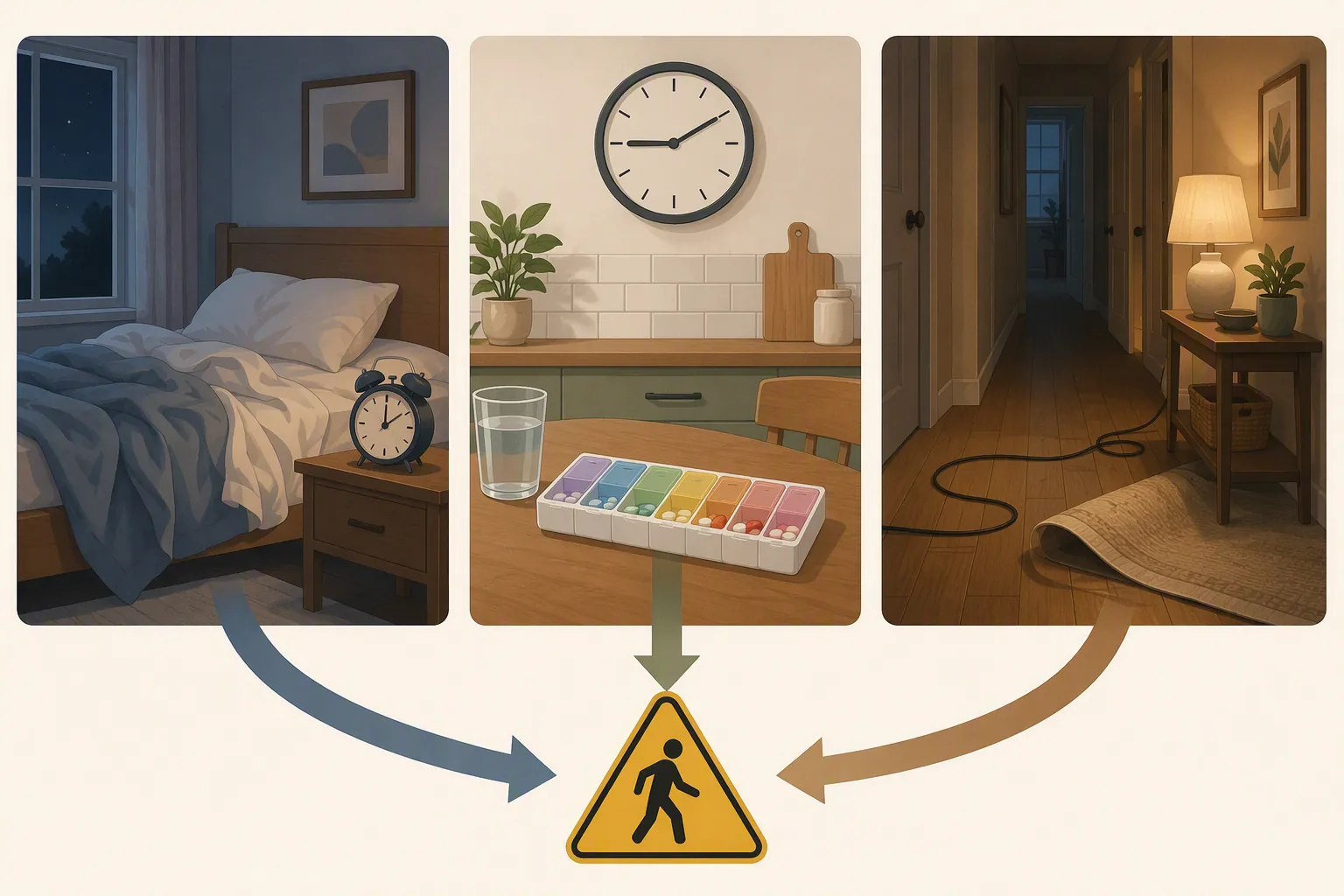
For fall prevention, it helps to keep the risk channels separate. Sleep disruption, medication timing, and light exposure can overlap, but they are not the same problem. Each one calls for a different fix.
| Risk channel | What can happen around the clock change | Pre-change action |
|---|---|---|
| Sleep | Shorter or more fragmented sleep can make balance, attention, and reaction time less dependable. | Shift bedtime and wake time gradually by 15–20 minutes for a few nights before the change. |
| Medication timing | The person may follow “usual time,” the new clock, an old alarm, or a caregiver’s reminder—and those may not match. | Review the medication list, pill organizer, phone reminders, and high-risk timing instructions before the transition. |
| Light and home layout | A hallway, stair edge, rug, cord, or bathroom threshold may be crossed in dimmer or differently timed light. | Move lighting before the change; clear the path to the bathroom, kitchen, and bed. |
Sleep disruption is physical, not just annoying
A tired older adult may not lift a foot quite as high over a threshold. They may stand too fast, forget the cane beside the bed, misjudge the distance to the bathroom door, or reach for a counter that is not where they expected it to be. If they already wake several times a night, the clock change can turn a familiar route into a less familiar one at the exact time when attention is dulled.
There is one useful counterpoint: older adults are not all affected the same way. Circadian rhythm often shifts earlier with age, and a Cleveland Clinic expert cited by AARP notes that spring-forward may be easier for some early-rising older adults than for people whose natural rhythm runs later.[1] That does not remove the need for a plan; it means the plan should match the person. A parent who naturally wakes before dawn may need a lighting and medication check more than a bedtime negotiation.
Medication timing deserves a real check, not a guess
Once-daily medications may often be taken according to the new clock, but that is not a safe rule for every drug. Insulin, Parkinson’s medications, seizure medications, and some heart or thyroid medications may need pharmacist or prescriber guidance before the schedule shifts.[1][5] The same caution applies if the older adult has recently changed doses, started a new medication, had low blood sugar, had dizziness, or uses medicines that must be spaced around meals or other drugs.
The practical problem is rarely the clock alone. It is the mix of old alarms, new clock time, a weekly pill organizer filled on autopilot, and a caregiver saying, “Take it at your usual time,” when “usual” is suddenly unclear. If two people help with medications, the transition needs one shared instruction, not two interpretations.
Light changes expose the weak spots in the house
A throw rug edge that was visible last week may disappear in dim morning light. A cord near the recliner may be obvious at noon and invisible during a half-awake bathroom trip. A stair tread, bathroom threshold, pet bowl, laundry basket, or robot vacuum base can become a hazard when the person is moving by habit instead of careful inspection.
This is where a small home change beats a long reminder. Move the lamp before the time change. Add a night-light before the first dark trip to the bathroom. Clear the route before anyone is sleepy. If the home already needs a broader safety refresh, room-by-room changes can be handled as part of aging-in-place planning; the same logic is covered in our guide to home modifications instead of downsizing.
A 7-day daylight saving safety plan

The household does not need a complicated protocol. It needs a few tasks done before the first risky morning, then a short watch period afterward. Sleep experts commonly recommend gradually shifting bedtime before the clock change and getting morning light after the transition; the American Academy of Sleep Medicine’s Sleep Education guidance and Johns Hopkins Bloomberg School of Public Health both emphasize gradual adjustment and morning sunlight as practical ways to help the body clock adapt.[6][7]
Three days before: start the sleep shift
Move bedtime and wake time by 15 to 20 minutes per night in the direction of the upcoming change. For spring-forward, that usually means a slightly earlier bedtime and wake time. For fall-back, it may mean nudging later or, for some early risers, protecting the usual wake time while avoiding an overly long evening nap.
Do not turn this into a fight over discipline. The goal is not to force perfect sleep. The goal is to avoid having the entire one-hour adjustment land on a single night for someone whose balance and attention are already vulnerable.
- If the older adult naps, keep naps earlier in the day and avoid adding a long late-afternoon nap to compensate.
- If they use a CPAP, hearing aids, glasses, walker, cane, or bedside commode, make sure those items are exactly where they expect them to be.
- If they already have insomnia, sundowning, nighttime wandering, or dementia-related sleep changes, make a simpler plan and watch more closely rather than pushing a rigid schedule.
Two days before: audit medications and reminders
Open the pill organizer and compare it with the medication list. Check the labels, not just memory. Then check every reminder: phone alarms, smart speaker prompts, caregiver texts, paper charts, automatic dispensers, and pharmacy packaging. A reminder that was right last week can become confusing when the clock changes and one caregiver updates the phone while another still talks in “usual time.”
For lower-risk once-daily medications, many people can simply follow the new clock. For insulin, Parkinson’s medications, seizure medications, and some heart or thyroid medications, ask the pharmacist or prescriber before changing timing.[1][5] If medication reminders are handled through apps or smart-home tools, this is also the day to confirm that alarms update correctly; our guide to senior-friendly apps for aging in place covers reminder tools in that broader home-support context.
- Write down the transition-day medication plan in plain language.
- Use one time standard: either the new clock time or the clinician’s specific instruction.
- Tell every helper the same plan, including paid caregivers, spouses, adult children, and neighbors who check in.
- Do not double a dose because the day feels “off.” Call the pharmacist if there is uncertainty.
One day before: fix the route, not the person
Walk the path from bed to bathroom, bed to kitchen, favorite chair to bathroom, and entryway to bedroom. Do it at the time of day when the light will be weakest. Look for the dull little hazards that cause real falls: a curled rug corner, a phone charger cord, shoes beside the bed, a laundry basket in the hall, a pet dish, a loose bath mat, a stair without contrast, or a lamp switch that requires crossing the room in the dark.
The best correction is the one that does not depend on remembering. Put the night-light in place. Move the lamp to the near side of the path. Remove the rug for the week if it will not stay flat. Tape or reroute the cord. Put the walker where the person’s hand naturally reaches when getting out of bed. If clutter comes from devices that move around the floor, including robot vacuums or their bases, treat that as part of the path audit; we discuss that specific issue in our article on robot vacuum hazards for elderly users.
Transition day: use morning light and keep the day boring
On the day after the change, open curtains early or step outside for morning light if it is safe to do so. Morning light helps cue the body clock after the transition.[6][7] If the older adult uses a mobility aid, has icy steps, severe heat, poor air quality, or unstable footing outside, choose a bright indoor spot instead of turning sunlight into a fall hazard.
Keep the rest of the day predictable. Meals, hydration, medication, and movement should be easy to follow. This is not the best morning to rearrange furniture, skip breakfast before errands, or ask a parent with balance problems to rush out the door. If they seem groggy, give them more time to stand, orient, use the bathroom, and gather glasses or hearing aids.
Bad weather can make the light-and-footing problem worse. If the clock change lines up with storms, snow, or power outages, use the same planning approach as any other predictable environmental risk; our severe-weather guide explains how to help an older adult stay safe and steady during severe weather.
The first week after: watch for changes, not perfection
Most households do not need to monitor every minute of sleep. They do need to notice whether the older adult is more unsteady, more confused, more sleepy during the day, or less consistent with medication than usual. A near-fall matters. So does a new bruise, a handprint on the wall where someone caught themselves, a walker left behind at night, or a pill still sitting in the organizer after the dose time has passed.
| What to watch | Why it matters | What to do |
|---|---|---|
| New or worse unsteadiness | Sleep disruption, low blood pressure, illness, medication effects, or poor lighting may be contributing. | Reduce rushing, use mobility aids, improve lighting, and call a clinician if it persists or is sudden. |
| Confusion about medication timing | A missed, duplicated, or mistimed dose can create more risk than the clock change itself. | Pause and call the pharmacist, prescriber, or nurse line before guessing. |
| Near-fall or actual fall | A near-fall is a warning sign, not a harmless almost-event. | Check for injury, report falls to the clinician, and reassess the route where it happened. |
| Several poor nights in a row | Ongoing short sleep may keep attention and balance below baseline. | Return to a stable routine and ask for medical advice if sleep does not settle. |
Heat can also disturb sleep and hydration, so a warm spell around the spring or fall transition deserves extra attention. The pathway is different from daylight saving time, but the result can look similar at home: fatigue, dizziness, slower reactions, and more trips in low light. For that related risk pattern, see three ways heat waves increase fall risk in seniors.
What not to overread
The permanent daylight saving time debate is a separate question from getting one household safely through March or November. If you want the policy-focused version, read our companion article on how permanent DST affects seniors’ sleep and fall risk. Here, the useful fact is simpler: the clock change is scheduled, so the preparation can be scheduled too.
It is also worth avoiding broad claims that every senior will have the same health response. The strongest materials for this article are not sweeping cardiovascular claims; they are the sleep-loss finding around spring-forward, observational sleep-and-falls studies, and practical sleep and medication guidance. That is enough to justify a careful transition plan without pretending the science says more than it does.
When to call a doctor or pharmacist
Call a pharmacist or prescriber before the clock change if the older adult uses insulin, Parkinson’s medication, seizure medication, or heart or thyroid medication with timing instructions, or if you are unsure how a dose should move to the new clock.[1][5] Call promptly after the change if there is a missed or possibly duplicated dose, new dizziness, fainting, repeated low blood sugar, new confusion, a fall, a head hit, worsening sleep disruption, or a clear change from the person’s baseline.
This article is educational guidance, not individualized medical advice. It was source-checked on August 1, 2026, and reviewed for fall-prevention safety by Marisol Vega, RN. Medication changes, new confusion, falls, and persistent sleep problems should be handled with the older adult’s clinician or pharmacist, because the safe answer depends on the person’s diagnoses, medications, and fall history.
References
- 8 Tips to Survive the Spring Daylight Saving Time Change. AARP.
- Association between sleep quality and falls: A nationwide population-based study from South Korea. PMC. 2021.
- Sleep Characteristics and Risk of Falls Among Midlife Women: The Study of Women’s Health Across the Nation. PMC.
- Association between sleep duration and falls among older adults. BMC Geriatrics. 2026.
- How daylight saving time can impact your medication schedule. Physicians Mutual.
- Daylight Saving Time. American Academy of Sleep Medicine Sleep Education.
- 7 Things to Know About Daylight Saving Time. Johns Hopkins Bloomberg School of Public Health. 2023.
Related reading
Noticed something outdated or inaccurate on this page? Flag a correction. We review every report against CDC, NIA, and AARP HomeFit guidance before updating a page.
Part of the Fall Prevention section.