
Clinical term
MS Self-Advocacy: What to Ask to Prevent Falls
Last verified 2026-08-03
A routine neurology visit can move too quickly past the sentence that matters most: “My balance has changed, and I’m worried about falling.” For an older adult with multiple sclerosis, that is not a side note. Cleveland Clinic’s Mellen Center reports that, at a population level, 50% to 70% of people with MS fall within a six-month window, 30% to 50% of those who fall do so repeatedly, and 40% to 50% of MS falls cause injury. Bathroom falls are more likely to injure. Those numbers do not predict what will happen to one person, but they do make fall prevention worth a direct request, not a vague “I’ll be careful.” [1]
The American Academy of Neurology treats fall-risk screening as a quality measure for MS patients of all ages, which gives patients and caregivers a practical opening: this is an expected part of care, not an interruption. Cleveland Clinic also lists fall-prevention components that include patient and family education, physical and occupational therapy, assistive devices, exercise, medication review, calcium and vitamin D consideration, and home safety evaluations. The five asks below are a way to turn those components into something you can say out loud in the room. [1]

Open with the fall risk before the visit gets crowded
Falls are easy to mention too late, after the medication changes, MRI questions, symptom updates, and refill requests. Put the balance concern near the beginning, while there is still time for referrals and instructions.
The older adult can say: “My balance has changed since my last visit. I’m worried about falling, and I want to make a fall-prevention plan today.”
A caregiver can support the same request without taking over: “I want to add what I’ve noticed at home. There have been more near-falls in the hallway and bathroom, and we’d like to ask what services can reduce the risk.”
If memory, attention, or word-finding are affected, bring both perspectives into the room. Cleveland Clinic notes that asking a family member about falls may be more accurate than asking the patient alone when cognition is affected. That is not a reason to dismiss the patient’s account. It is a reason to compare what the person felt, what someone else saw, and what actually happened afterward. [1]
Before the appointment, keep the preparation short enough that it actually happens. Harvard Health recommends bringing every medication and supplement, preparing a question list, taking notes during the visit, and clarifying next steps afterward when accompanying an aging parent to the doctor. For this visit, that means walking in with a current medication bag or list, two or three fall-related questions, and a plan for who will call for referrals if the office does not schedule them before you leave. [2]
| Ask | Exact wording to use |
|---|---|
| Physical therapy referral | “Can you refer me to physical therapy for MS-related balance, gait, strength, and transfer training?” |
| Occupational therapy home safety evaluation | “Can you order an occupational therapy home safety evaluation because my balance has changed and I’m worried about falls at home?” |
| Medication review focused on fall risk | “Can we review all of my prescriptions, over-the-counter medicines, and supplements for dizziness, sedation, urgency, or balance side effects?” |
| Assistive device fitting | “Can PT or OT check whether my cane, walker, or other device is the right type, height, and technique for me now?” |
| Written floor-recovery plan | “Can someone teach and write down what I should do if I end up on the floor, including when to call for help?” |
Ask for physical therapy before the first serious injury
The physical therapy referral is the ask that often gets delayed because the person is still walking, still driving, or still “managing.” That is a low bar. If balance has changed, the useful question is not whether walking is still possible; it is whether the way the person is walking, turning, stepping into the shower, getting up from a chair, or navigating fatigue is still safe enough.
Cleveland Clinic lists motor and sensory impairment, fatigue, fear of falling, bladder dysfunction, cognitive impairment, medication side effects, and assistive-device issues among fall-related factors in MS. Those are exactly the kinds of problems a quick hallway instruction does not solve. [1]
Use specific language: “I’d like a PT referral for fall prevention, not just general exercise. I’m having trouble with balance, turning, and getting up safely when I’m tired.”
If bladder urgency is part of the pattern, say that too. “I’m rushing to the bathroom, especially at night, and that is when I feel least steady.” That gives the clinician a concrete situation to address rather than a general complaint about balance.
A caregiver can add what the person may minimize: “I’ve noticed more furniture-walking in the evening,” or “The near-falls happen most often after appointments, errands, or bathroom trips.” Keep it factual. The point is to help the clinician write the right referral and prioritize the right problems.
Ask for an occupational therapy home safety evaluation, not just “home safety tips”
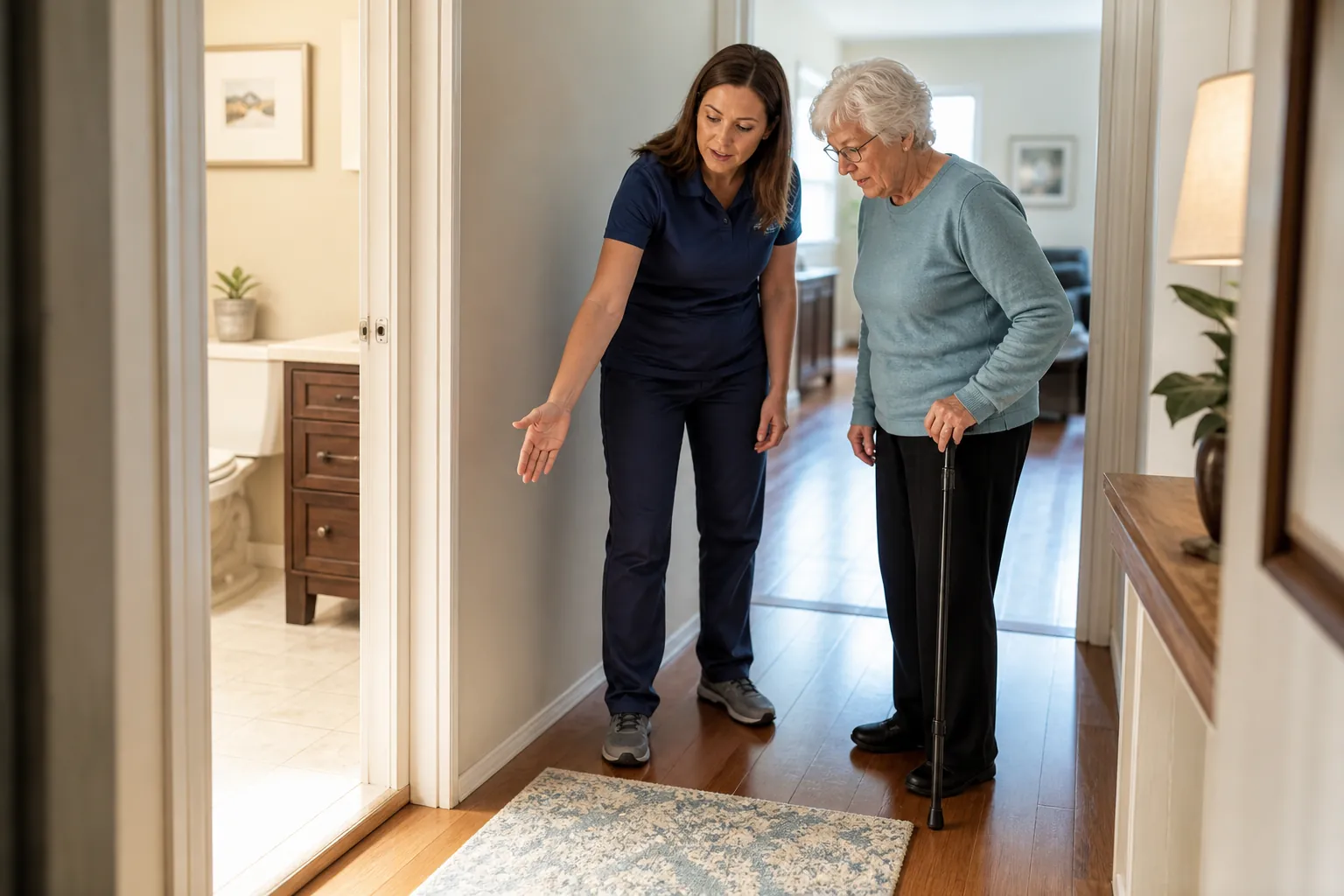
The home is where the advice either works or fails. A neurology note may say “fall precautions,” but the hallway still has a rug edge, the bathroom still has a wet turn, and the bedroom still has a dark path to the toilet.
Ask for the service directly: “Can you order an OT home safety evaluation? I want someone to look at the bathroom, bedroom, stairs, lighting, rugs, and the route I use at night.”
That wording matters because it asks for trained eyes inside the actual environment. An occupational therapist can look at how the person transfers, where fatigue shows up, whether the bathroom setup matches current balance, and which home changes should happen first. For more detail on what this visit can include, see CareWise Guide’s professional home safety assessment guide. As of January 2026, that page notes Medicare coverage considerations for physician-ordered home safety evaluations. This is general information, not medical or insurance advice; coverage rules and plan details can change, so confirm with the clinician, the evaluating provider, and the insurer before relying on coverage.
If the referral will take time, do not wait to fix obvious hazards. Use a room-by-room aging-in-place checklist to look for the basics: loose rugs, poor lighting, blocked walkways, unstable furniture used for support, and nighttime bathroom routes. The bathroom deserves special attention because MS falls there are more likely to injure, and because bathing often combines fatigue, wet surfaces, turning, and privacy. If the shower or tub setup is the weak point, the bathing equipment gap guide can help identify what is missing before someone improvises with a towel bar or a folding chair. [1]
Ask for a medication review that is actually about falling

A medication review can become a refill conversation unless someone names the purpose. Say: “Can we review these specifically for fall risk — dizziness, sedation, slowed thinking, blood pressure effects, bladder urgency, or anything that could affect balance?”
Bring the real list, not the remembered list. That includes prescriptions, over-the-counter sleep aids, pain medicines, bladder medicines, supplements, and anything taken only “once in a while.” Harvard Health’s advice to bring every medication and supplement is especially important here because the fall-risk picture can change when the full list is visible. [2]
Do not stop a medication on your own because you suspect it is affecting balance. The request is for a clinician or pharmacist to weigh benefits, side effects, timing, alternatives, and interactions. If more than one clinician prescribes medications, ask who is responsible for the final review: neurology, primary care, pharmacy, or another specialist.
A useful closing question is: “If we change nothing today, which medicines should we keep watching because they could increase fall risk?” That gives the patient and caregiver something to monitor after the appointment.
Ask for the cane or walker to be fitted and observed
“I already have a cane” does not answer the safety question. The device may be the wrong height, the wrong type, used on the wrong side, left in the car, or skipped inside the house because the person is “only going a few steps.” Cleveland Clinic notes that ill-fitting or inconsistently used assistive devices are associated with falls. [1]
Ask this plainly: “Can PT or OT watch me walk with my device and tell me whether it is still the right one?”
If a caregiver notices the device being abandoned at risky times, name the pattern without scolding: “The cane is used outdoors but not for the bathroom at night,” or “The walker fits through the living room but not easily into the bedroom.” That may point to a device issue, a home layout issue, or both.
Ask for a written floor-recovery plan

A fall-prevention plan also has to answer the 10 p.m. question: if the person ends up on the floor, what happens next? “Be careful getting up” is not a plan. It leaves the older adult to decide, while shaken or injured, whether to crawl, pull on furniture, call a neighbor, use an alert device, or wait.
Ask for instruction and a written version: “Can PT or OT teach me what to do if I fall, write down the steps, and tell me when I should not try to get up?”
The plan should cover more than technique. It should say when to call emergency services, who to call if there is no obvious injury but the person cannot get up, where the phone or alert button will be, and what the caregiver should do if they find the person after a fall. A post-fall checklist can help route the crisis without forcing someone to invent decisions from the floor.
A caregiver’s role is to make the request easier to answer
The caregiver does not need to dominate the visit to be useful. The most helpful support is usually concrete: bring the medication list, write down the fall examples, take notes, and ask who owns the next step before leaving the clinic.
- Before the visit: write down recent falls, near-falls, bathroom scares, nighttime rushing, device problems, and any new fear of falling.
- During the visit: ask for the five services by name, then pause so the older adult can answer first when possible.
- Before leaving: confirm whether referrals were placed, who will call, what number to use if no one calls, and whether a pharmacist or primary care clinician should do the medication review.
- After the visit: put the plan somewhere visible and remove the hazards that do not require waiting for an appointment.
If the clinic note says only “use caution,” follow up with a narrower request: “We need help turning that into referrals. Can you place orders for PT, OT home safety evaluation, and medication review?”
Where to get backup if the next step stalls
If referrals stall, the National MS Society’s MS Navigator program can help people with MS and families look for support and resources. Use the official MS Navigator page for current contact options rather than relying on copied phone numbers or hours from search snippets. [3]
The Multiple Sclerosis Association of America also offers patient support through its helpline and programs; confirm the current contact details directly before sharing them with a family member or adding them to an emergency plan.
If the household is also managing another neurologic condition, the same basic discipline applies: name the diagnosis, name the fall pattern, and ask for services rather than general caution. CareWise Guide has related fall-prevention checklists for Parkinson’s disease and stroke recovery when those are the more relevant care paths.
For MS, leave the appointment with five concrete asks: PT for balance and gait, OT for a home safety evaluation, a medication review focused on fall risk, proper assistive-device fitting, and a written floor-recovery plan. That is the difference between being told to be careful and having a care-team plan someone can actually follow.
References
- Falls, Cleveland Clinic
- Taking an aging parent to the doctor? 10 helpful tips, Harvard Health, February 28, 2022
- MS Navigator, National Multiple Sclerosis Society
Browse more in the Glossary.