
Room checklist
Where to Find Money for an Aging-in-Place Remodel: Grants, Loans, and Assistance Programs (2026)
A practical guide for adult children and older adults on a limited budget, revealing underutilized federal grants, VA benefits, Medicaid waivers, and nonprofit programs that can dramatically reduce out-of-pocket costs for aging-in-place home modifications.
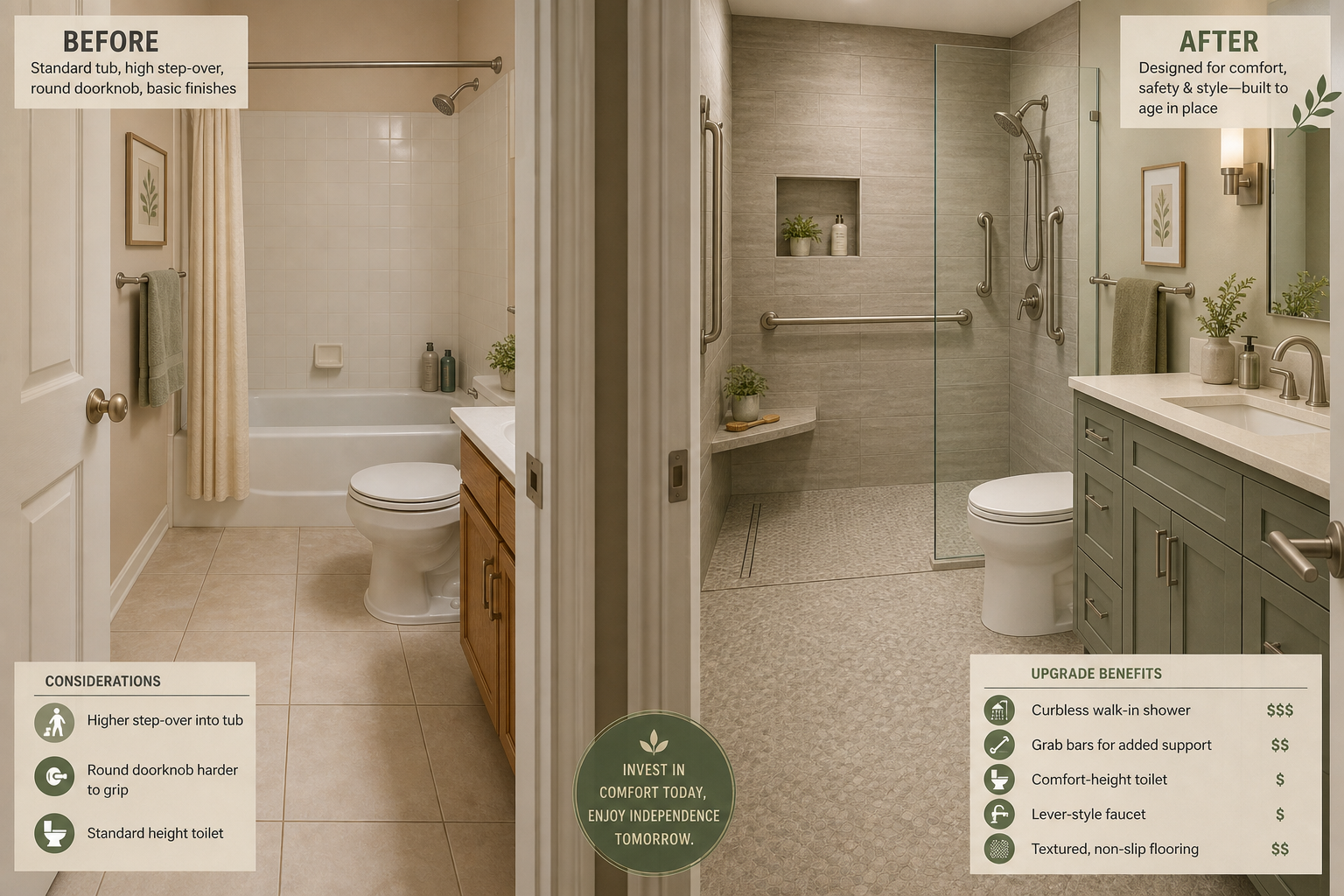
The Hidden Funding Gap: Why Most Families Pay Out of Pocket for Aging-in-Place Modifications
The numbers tell a frustrating story. Over 80% of older adults say they want to remain in their own homes as they age, yet only 18% of adults aged 50 and older have actually made modifications to support that goal, according to a University of Michigan National Poll on Healthy Aging. The gap between desire and action is not driven by a lack of need — nearly 80% of older adults report they would need bathroom modifications like grab bars and walk-in showers — but by a widespread lack of awareness about how to pay for them.
The most comprehensive national data on this subject, from a 2008 HHS ASPE study using Health and Retirement Survey data, found that only about 6% of older adults who added home features reported that insurance or government programs paid any portion of the cost. That same study found that one in four near-elderly and older adults has a mobility limitation combined with an unmodified home barrier — meaning millions of people are at risk for a fall or injury simply because their homes are not set up for their changing needs.
This article is built on a simple premise: the money exists, but it is fragmented across federal agencies, state programs, veterans' benefits, and local nonprofits. Finding it requires a deliberate search strategy, not luck. Below, we walk through every major funding source — from USDA grants for rural seniors to VA benefits for eligible veterans — and give you a step-by-step action plan to start your search today.
If you are looking for a broader overview of all funding types before diving into the search strategy, you can also explore our existing guide on Paying for Aging in Place Home Modifications for a general survey of options.
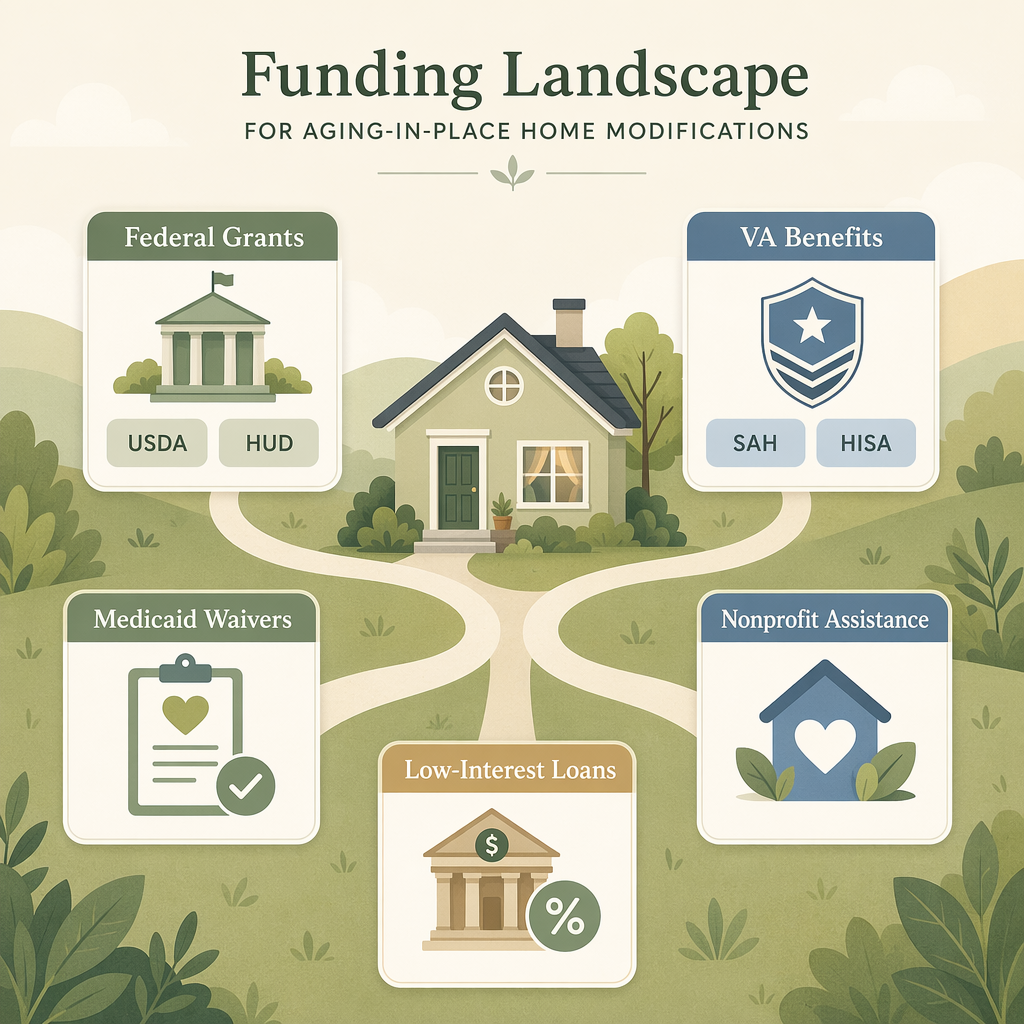
Federal Grant Programs You May Qualify For
Federal grants are the most direct way to reduce out-of-pocket costs because they do not require repayment. The catch is that each program has specific eligibility criteria — age, income, location, and purpose — and many are severely underutilized simply because people do not know they exist.
USDA Section 504 Home Repair Program
The USDA Section 504 program provides grants of up to $10,000 to very-low-income rural homeowners aged 62 and older to repair health and safety hazards. This is one of the most targeted federal grants for aging-in-place modifications, yet it remains largely unknown outside of rural development circles. The grant can be used for projects like installing grab bars, adding ramps, fixing leaky roofs that create fall hazards, and addressing other structural issues that make a home unsafe.
Eligibility is limited to homeowners in rural areas who cannot afford a loan. The program also offers loans of up to $40,000 at a 1% interest rate for those who do not qualify for the grant. A key detail: if the home is sold within three years of receiving a grant, the full amount must be repaid.
HUD Programs: CDBG and HOME
The U.S. Department of Housing and Urban Development (HUD) administers two major programs that can fund home modifications for low- and moderate-income individuals:
- Community Development Block Grant (CDBG): This program provides grants to states and localities, which then use the funds for housing rehabilitation and home repairs for low- and moderate-income residents. Because CDBG funds are distributed locally, the specific programs and application processes vary by city or county.
- HOME Investment Partnerships Program: Similar to CDBG, HOME funds are allocated to states and localities to help low-income homeowners rehabilitate their properties. Some jurisdictions use HOME funds specifically for accessibility modifications.
The challenge with both programs is that they are not direct-to-consumer grants. You must contact your local housing authority or community development office to find out what programs are available and how to apply.
Older Adults Home Modification Grant Program
This federal program, administered through the Administration for Community Living, provides grants to state and local agencies and nonprofit organizations to help low-income older adults modify their homes. Unlike USDA or HUD programs, this grant is specifically targeted at aging-in-place modifications. However, because funds flow through intermediary organizations, availability depends on whether a local agency in your area has received a grant.
| Program | Maximum Amount | Eligibility | Repayment |
|---|---|---|---|
| USDA Section 504 Grant | $10,000 | Rural homeowners 62+, very-low-income | Required if home sold within 3 years |
| USDA Section 504 Loan | $40,000 | Rural homeowners, cannot afford loan | 1% interest, repayment required |
| HUD CDBG | Varies by locality | Low/moderate-income residents | None (grant to locality) |
| HUD HOME | Varies by locality | Low-income homeowners | None (grant to locality) |
| Older Adults Home Modification Grant | Varies by grantee | Low-income older adults | None |
VA Benefits for Eligible Veterans and Surviving Spouses
For veterans and surviving spouses, the Department of Veterans Affairs offers some of the most generous funding available for home modifications. The key is knowing which grant applies to your situation and understanding that the application process requires documentation of the service-connected disability.
Specially Adapted Housing (SAH) Grant
The SAH grant provides up to $109,986 for veterans with specific severe service-connected disabilities to build, purchase, or adapt a home to accommodate their disability. This is the most substantial grant available for home modifications, but eligibility is limited to veterans with qualifying disabilities such as loss of use of both legs, blindness in both eyes, or severe burn injuries. The grant can cover ramps, widened doorways, roll-in showers, and other structural modifications.
Home Improvements and Structural Alterations (HISA) Grant
The HISA grant is more accessible than the SAH grant. It provides up to $6,800 for veterans with service-connected or non-service-connected disabilities to make home modifications that are medically necessary. This includes grab bars, ramps, handrails, bathroom modifications, and doorway widening. Unlike the SAH grant, the HISA grant does not require a specific severe disability — it is based on a physician's determination that the modification is needed for the veteran's care.
Special Housing Adaptation (SHA) Grant
The SHA grant is available to veterans with specific service-connected disabilities that are less severe than those required for the SAH grant. It provides a lower maximum amount but can still cover significant modifications. Eligibility includes conditions like the loss of use of one hand or foot, or certain severe hearing impairments.
| Grant Type | Maximum Amount | Eligibility | Common Uses |
|---|---|---|---|
| SAH | $109,986 | Severe service-connected disabilities | Full home adaptation, ramps, roll-in showers |
| HISA | $6,800 | Service-connected or non-service-connected disabilities | Grab bars, ramps, bathroom mods, door widening |
| SHA | Varies | Specific service-connected disabilities | Home adaptation for less severe conditions |
Medicaid Waivers and State-Specific Programs
Medicaid does not typically cover home modifications as a standard benefit, but many states offer home- and community-based services (HCBS) waivers that can pay for accessibility improvements. The most relevant program is the Money Follows the Person (MFP) demonstration, which helps individuals transition from institutional care (like nursing homes) back into the community. MFP funds can be used for home modifications that make the transition possible — such as installing ramps, grab bars, and roll-in showers.
Because Medicaid is administered at the state level, the availability and scope of these waivers vary dramatically. Some states have robust HCBS programs that cover up to several thousand dollars in modifications, while others offer very limited assistance.
- Contact your local Area Agency on Aging (AAA) to find out what Medicaid waiver programs are available in your state.
- Ask specifically about 'home- and community-based services waivers' and 'Money Follows the Person' — these are the most likely to cover modifications.
- Be prepared to document that the older adult is at risk of institutionalization without the modifications, as this is a common eligibility criterion.
Nonprofit and Community-Based Assistance
When federal and state programs are not an option, nonprofit organizations can fill the gap. These organizations typically provide free or low-cost home repairs and modifications to eligible seniors, often funded through grants and donations.
Rebuilding Together
Rebuilding Together is a national nonprofit with local affiliates across the country. They provide free home repairs and modifications to low-income homeowners, with a focus on health and safety. Their services often include installing grab bars, building ramps, fixing stairs, and addressing other fall hazards. Eligibility is typically based on income, age (often 60+), and homeownership status.
Habitat for Humanity Aging in Place Program
Many local Habitat for Humanity affiliates offer an Aging in Place program that provides home modifications for seniors. Services can include installing grab bars, adding ramps, widening doorways, and making bathrooms more accessible. Unlike the traditional Habitat model, these programs often offer services at low or no cost to eligible homeowners.
Local Faith-Based and Community Organizations
Many local churches, synagogues, and community development organizations run home repair programs for seniors. These are often small-scale and may not be widely advertised. Contacting your local Area Agency on Aging or searching for 'senior home repair [your city]' can uncover these hidden resources.
- Rebuilding Together: Free home repairs for eligible seniors, focused on health and safety.
- Habitat for Humanity: Local affiliates may offer Aging in Place modification programs.
- Local faith-based organizations: Often run small-scale home repair programs for seniors.
- Community development corporations: May offer housing rehabilitation programs for low-income homeowners.
Low-Interest Loan Options When Grants Aren't Available
If grants and nonprofit assistance are not available or do not cover the full cost, low-interest loans can make modifications affordable without depleting savings. The key is to choose a loan product with favorable terms and to understand the repayment obligations.
HUD Title 1 Property Improvement Loans
HUD Title 1 loans are insured by the Federal Housing Administration and can be used for home improvements, including accessibility modifications. For single-family homes, the maximum loan amount is $25,000. These loans do not require equity in the home, making them accessible to homeowners who have not built up significant equity. Interest rates are typically lower than unsecured personal loans.
FHA 203(k) Rehabilitation Loans
The FHA 203(k) loan is a mortgage product that allows homebuyers or current homeowners to finance the purchase or refinance of a home plus the cost of renovations into a single loan. This is particularly useful if the home needs significant modifications — like a full bathroom remodel for accessibility — because the loan amount is based on the projected value of the home after renovations.
Home Equity Loans and Lines of Credit
For homeowners with significant equity, a home equity loan or home equity line of credit (HELOC) can provide funds at relatively low interest rates. The risk is that the loan is secured by the home — if payments are not made, the lender can foreclose. This option is best suited for families who have a clear repayment plan and are confident in their ability to make payments.
| Loan Type | Maximum Amount | Interest Rate | Best For |
|---|---|---|---|
| HUD Title 1 | $25,000 | Below market (FHA-insured) | Homeowners without significant equity |
| FHA 203(k) | Varies by property value | Market rate (FHA-insured) | Major renovations with a single mortgage |
| Home Equity Loan | Up to 80-85% of equity | Fixed, below unsecured | Homeowners with significant equity |
| HELOC | Up to 80-85% of equity | Variable, below unsecured | Ongoing or phased projects |
Tax Deductions for Medically Necessary Home Modifications
While not a direct funding source, the IRS allows taxpayers to deduct the cost of medically necessary home modifications as a medical expense on their federal income tax return. This can significantly reduce the net cost of modifications for families who itemize deductions.
According to IRS Publication 502, qualifying modifications include:
- Installing ramps to enter the home
- Widening doorways to accommodate a wheelchair
- Adding grab bars in bathrooms
- Installing stair lifts or elevator lifts
- Modifying bathrooms for accessibility (roll-in showers, raised toilets)
- Adding handrails or support bars in hallways
The key requirement is that the modification must be primarily for medical care, not for general home improvement. A doctor's recommendation letter is essential documentation. The cost of the modification is deductible as a medical expense, but only to the extent that it does not increase the value of the home. If a modification increases the home's value, only the portion of the cost that exceeds the value increase is deductible.
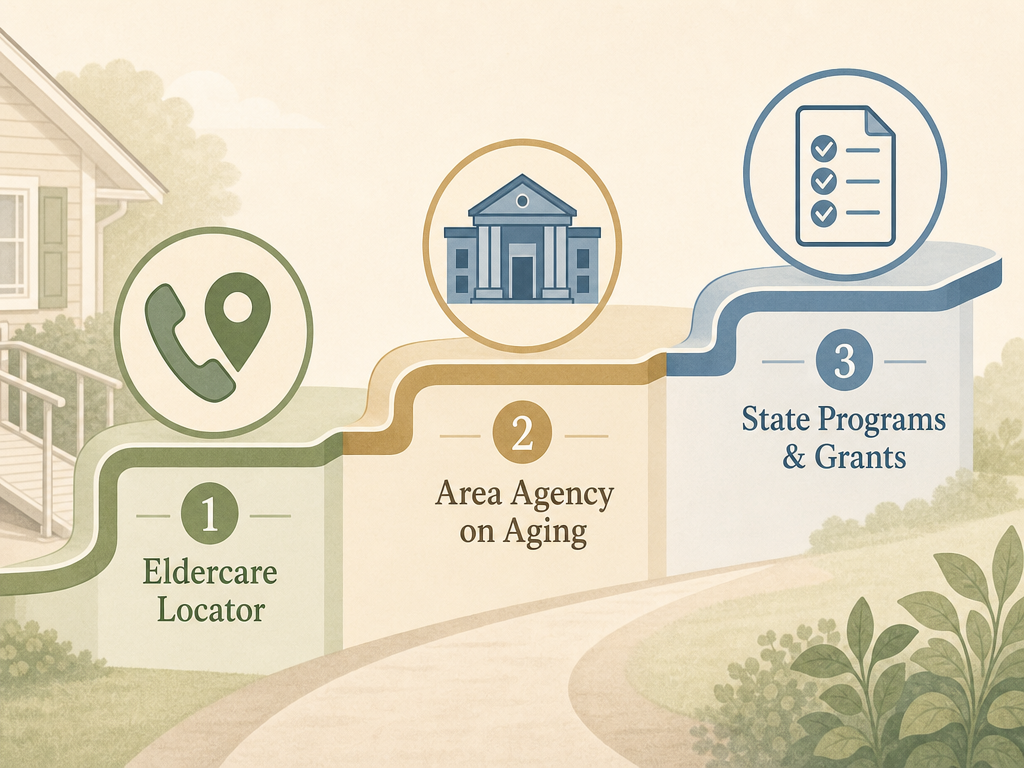
Your Step-by-Step Action Plan: From Search to Application
Finding and securing funding for home modifications requires a systematic approach. Do not expect to find a single application that covers everything. Instead, work through this sequence to identify every program you may qualify for.
Step 1: Start with the Eldercare Locator
The Eldercare Locator, a public service of the Administration for Community Living, connects older adults and their families to local aging resources. Call 1-800-677-1116 or visit their website. They can provide referrals to your local Area Agency on Aging, which is your primary entry point for state and local programs.
Step 2: Contact Your Local Area Agency on Aging (AAA)
Your local AAA is the single most important resource for finding home modification assistance. They can tell you about state-specific programs, Medicaid waiver availability, local nonprofit services, and any direct funding they may offer. Ask specifically about:
- Home- and community-based services (HCBS) waivers
- Money Follows the Person programs
- State-funded home repair or modification programs
- Local nonprofit partners (Rebuilding Together, Habitat for Humanity)
Step 3: Check Federal Programs
Apply for the USDA Section 504 grant if the homeowner is 62+, lives in a rural area, and has very low income. Contact your local HUD office to ask about CDBG and HOME programs in your area. Check the Administration for Community Living website for the Older Adults Home Modification Grant Program.
Step 4: Explore VA Benefits
If the older adult is a veteran or surviving spouse, contact the nearest VA regional office or call 1-800-827-1000. Ask about the SAH, HISA, and SHA grants. Have documentation of the veteran's service-connected disability ready.
Step 5: Consider Loans and Tax Deductions
If grants and assistance do not cover the full cost, explore HUD Title 1 loans or FHA 203(k) loans. Consult a tax professional about deducting the cost of medically necessary modifications under IRS Pub 502.
| Step | Action | Key Resource |
|---|---|---|
| 1 | Call Eldercare Locator | 1-800-677-1116 |
| 2 | Contact Area Agency on Aging | Local AAA office |
| 3 | Apply for federal grants | USDA, HUD, ACL websites |
| 4 | Check VA benefits | VA regional office or 1-800-827-1000 |
| 5 | Explore loans and tax deductions | HUD, IRS Pub 502, tax professional |
For a broader perspective on why home readiness matters and how it connects to the desire to age in place, read our article on The Aging-in-Place Gap: Why 92% of Older Adults Want to Stay Home but Only 10% of Homes Are Ready. And if you are weighing the financial decision between modifying a home and moving to assisted living, our guide on Does an Aging-in-Place Remodel Pay for Itself? provides a detailed cost comparison.
Finally, as you build your funding strategy, consider creating a broader Aging in Place Services Plan that coordinates home modifications with other care services, monitoring technology, and support systems. A comprehensive plan ensures that every dollar spent on modifications works in concert with the rest of your caregiving strategy.
Related reading
- Does an Aging-in-Place Remodel Pay for Itself? The Financial Case for Modifying Your Home vs. Moving to Assisted Living
- The Complete Cost Guide to Aging-in-Place Remodeling: What Every Modification Actually Costs and How to Pay for It
- How to Pay for an Elderly Parent's Bathroom Remodel: VA Grants, Medicaid Waivers, Tax Deductions, and More
Need a professional assessment?
Find a CAPS-credentialed professional or local aging services through our outbound resource list — we never name or rank individual contractors.
Find Local HelpNoticed something outdated or inaccurate on this page? Flag a correction. We review every report against CDC, NIA, and AARP HomeFit guidance before updating a page.