
Room checklist
Aging in Place Remodel Cost vs. Assisted Living: A Complete Decision Guide
This guide helps adult children and older adults compare the full cost of aging-in-place remodeling ($3,000–$60,000+) against the annual cost of assisted living ($64,200+), and walks through federal grants, VA benefits, Medicaid waivers, and tax deductions that can make home modifications far more affordable than relocating.
Why Cost Awareness Is the First Step in Aging-in-Place Planning
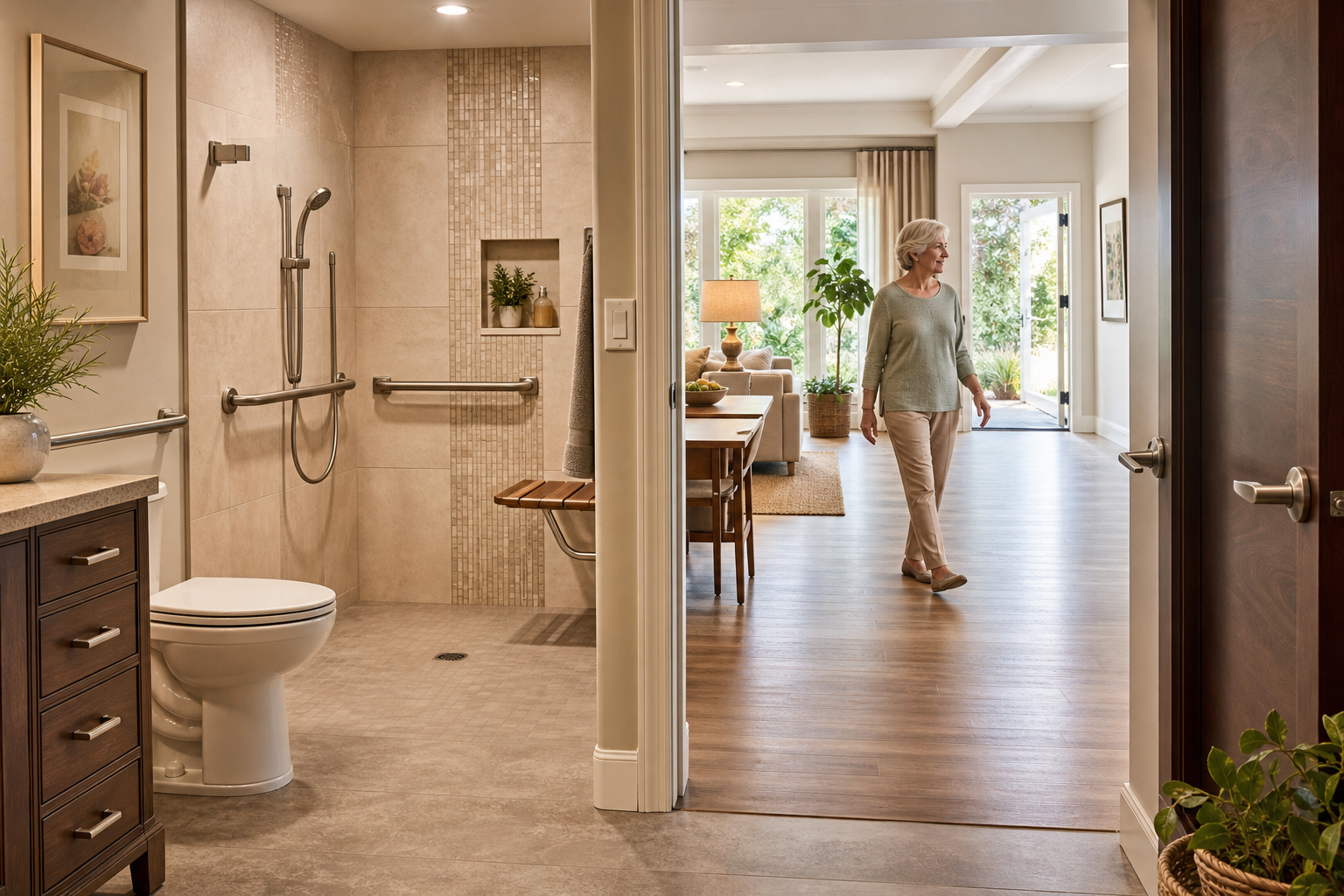
The desire to remain at home as we age is nearly universal. Surveys consistently find that roughly 90% of older adults prefer living in their own homes to moving into an assisted living facility. Yet the built environment is not on their side: an estimated 10% of U.S. homes meet basic criteria for aging readiness — a no-step entry, a first-floor bedroom and bathroom, and at least one accessible bathroom feature. That gap between preference and reality is where the financial stakes come into focus.
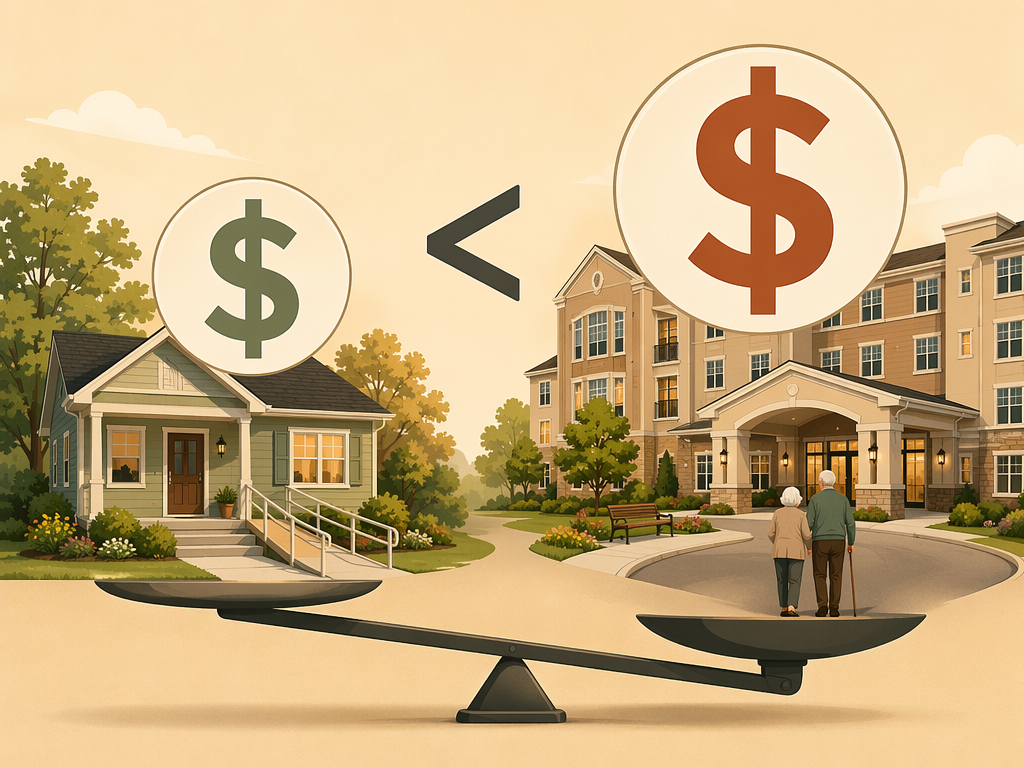
The national median cost of assisted living is approximately $64,200 per year, or about $5,350 per month. For many families, that figure is the default comparison point when evaluating whether to modify a home or relocate. But the comparison is rarely made explicit. Most caregivers and older adults approach home modifications as an expense to be minimized rather than an investment to be weighed against the recurring cost of facility care.
This guide reframes the question. Instead of asking "Can we afford to remodel?" it asks "Can we afford not to?" By laying out the full cost landscape of aging-in-place remodeling — from a few hundred dollars for grab bars to $60,000 or more for a comprehensive retrofit — and comparing it directly to the cost of assisted living, the decision becomes clearer. When federal grants, VA benefits, Medicaid waivers, and tax deductions are factored in, the financial argument for modifying a home grows stronger still.
What Aging-in-Place Remodeling Actually Costs: Room-by-Room Ranges
Home modification costs span a wide range because the scope of work varies enormously — from a single grab bar installation to a full-home structural retrofit. The table below summarizes typical cost ranges for the most common modifications, drawn from multiple industry sources. These are national averages; actual costs will vary by region, contractor rates, and the specific condition of the home.
| Modification | Typical Cost Range | Notes |
|---|---|---|
| Grab bars (per bar, installed) | $150 – $400 | Must be anchored to wall blocking rated for 250–300 lbs. Most common aging-in-place project (93% of remodelers). |
| Curbless (barrier-free) shower | $8,000 – $18,000 | Eliminates step-over hazard. Second most common project (83% of remodelers). |
| Stair lift (straight rail) | $2,500 – $18,000 | Cost depends on stair length, rail type, and features. Curved rails cost more. |
| Ramp installation | $1,500 – $12,000 | Must meet 1:12 slope ratio. Modular ramps are less expensive than custom-built. |
| Door widening (per doorway) | $700 – $2,000 | Minimum 32-inch clear width requires a 36-inch door. Often done in combination with other work. |
| Vertical platform lift | $9,000 – $20,000 | Alternative to stair lift for wheelchair users. Requires electrical work. |
| Smart home upgrades (lighting, locks, thermostats) | $200 – $2,500 | Includes voice-activated controls, motion-sensor lighting, and smart door locks. |
| Full home aging-in-place remodel | $15,000 – $60,000+ | Comprehensive retrofit covering bathroom, kitchen, entry, and hallway modifications. |
The bathroom remains the highest-priority and highest-risk area. According to the National Center for Injury Prevention and Control, bathrooms account for 35.7% of fall injuries among older adults. This is why curbless showers and grab bars top the list of most-requested modifications. The NAHB's Q1 2023 survey of professional remodelers found that 93% had installed grab bars and 83% had built curbless showers as part of aging-in-place projects.
For a deeper breakdown of bathroom-specific costs and phased approaches, see our Bathroom Remodel for Elderly Safety: A Phased Cost Guide.
The Financial Comparison: Remodeling vs. One Year of Assisted Living
The most powerful argument for investing in home modifications emerges when you place the costs side by side with the cost of assisted living. Even a comprehensive $50,000 full-home remodel is less than a single year of facility care at the national median of $64,200. And unlike rent, the value of a home modification is not consumed — it remains in the property and can improve resale value.
| Scenario | One-Time Cost | Annual Recurring Cost | Breakeven vs. Assisted Living |
|---|---|---|---|
| Minimal modifications (grab bars, shower bench, lever handles) | $300 – $3,000 | $0 (one-time) | Less than 1 month of assisted living |
| Moderate modifications (curbless shower, widened doorways, lighting) | $8,000 – $20,000 | $0 (one-time) | 1.5 – 4 months of assisted living |
| Comprehensive retrofit (full bathroom, kitchen, entry, stair lift) | $15,000 – $60,000 | $0 (one-time) | 3 – 11 months of assisted living |
| Assisted living (national median) | N/A | $64,200 | N/A — ongoing cost |
This comparison does not account for the fact that home modifications are a one-time investment while assisted living is an ongoing annual expense. A $50,000 remodel that keeps someone at home for five years costs $10,000 per year in amortized terms — versus $64,200 per year for facility care. The savings over five years exceed $270,000.
There is also the question of fall-related costs. The Financial Case for Fall-Proofing a Senior's Home examines how a single fall requiring hospitalization can cost $30,000 to $50,000 or more — wiping out the cost of most home modifications in a single event. When prevention is cheaper than the incident, the financial logic becomes even harder to ignore.
Federal and State Funding Programs That Can Offset Costs
For many families, the gap between "we need modifications" and "we can afford modifications" is bridged by federal, state, and nonprofit funding programs. These programs are underutilized — partly because eligibility rules vary, and partly because caregivers simply do not know they exist. The table below summarizes the major programs, their maximum awards, and who qualifies.
| Program | Maximum Award | Eligibility Summary | Best For |
|---|---|---|---|
| USDA Section 504 Grant | Up to $10,000 (grant); up to $40,000 (loan) | Low-income homeowners age 62+ in rural areas; grant forgivable if property remains primary residence for 3 years | Rural seniors needing essential safety repairs (ramps, grab bars, roof, plumbing) |
| VA HISA Grant (Home Improvements and Structural Alterations) | Up to $6,800+ (varies by disability rating) | Veterans with service-connected or non-service-connected disabilities; can be used in rentals or family homes | Veterans needing bathroom modifications, ramps, or doorway widening |
| VA SAH Grant (Specially Adapted Housing) | Up to $117,000+ (varies by disability) | Veterans with severe service-connected disabilities (e.g., loss of limbs, vision impairment) | Major structural modifications for wheelchair access and independent living |
| HUD Title 1 Property Improvement Loan | Up to $25,000 (unsecured); up to $60,000 (secured) | Homeowners with equity; no age or income restriction | Larger projects where other grants are insufficient |
| HUD 203(k) Rehabilitation Mortgage | Included in mortgage amount | Homebuyers or homeowners refinancing; combines purchase/refi with renovation costs | Major renovations including accessibility improvements during purchase or refinance |
| Medicaid Money Follows the Person (MFP) | Varies by state; covers reasonable modification costs | Medicaid beneficiaries transitioning from nursing homes or institutions back to community living | Seniors moving from facility care back to a modified home |
Each program has specific application windows, documentation requirements, and funding caps that vary by state and fiscal year. The USDA Section 504 grant, for example, is available only to homeowners in rural areas who meet income limits — but for those who qualify, the $10,000 grant can cover the full cost of a ramp, grab bars, and a raised toilet. The VA HISA grant is particularly valuable because it can be used in a veteran's own home, a family member's home, or even a rental property, and it covers both service-connected and non-service-connected disabilities.
For a comprehensive walkthrough of all available grants, loans, and insurance options — including state-specific programs and application tips — see our How to Pay for Aging-in-Place Remodeling: A Guide to Grants, Loans, Insurance, and Financial Assistance in 2026.
Nonprofit Programs and Tax Deductions for Home Modifications
Beyond federal programs, several national nonprofit organizations provide free or low-cost home modifications for seniors. These programs are typically income-qualified and may have waiting lists, but they can cover significant portions of a modification project.
- Rebuilding Together: A national nonprofit that provides free home repairs and modifications to low-income homeowners, with a focus on health and safety. Local affiliates prioritize seniors and veterans. Typical projects include grab bar installation, ramp construction, and bathroom safety modifications.
- Habitat for Humanity Aging in Place Program: Many local Habitat affiliates offer home modification services — not just new construction — for seniors who need accessibility improvements. Services vary by location but often include ramp building, bathroom modifications, and exterior repairs.
- Local Area Agency on Aging (AAA): The AAA network provides referrals to local programs and, in some areas, direct funding for home modifications. Some AAAs administer state-funded grant programs specifically for home safety improvements. Contact your local AAA as a first step in any funding search.
Tax deductions offer another avenue for cost recovery. Under IRS Publication 502, medical expenses that exceed 7.5% of adjusted gross income can be deducted — and this includes home modifications that are medically necessary. A physician's letter documenting that the modification is needed for medical care (e.g., a ramp for a person who uses a wheelchair, grab bars to prevent falls for someone with balance impairment) is essential. The deduction covers the full cost of the modification, including labor, materials, and any structural changes, but not the increase in home value.
How to Find and Apply for Assistance: A Step-by-Step Approach
Navigating the funding landscape can feel overwhelming, but the process breaks down into a manageable sequence of steps. The key is to start early — before a crisis forces a rushed decision — and to work through each step systematically.
- Contact your local Area Agency on Aging. This is the single most important first step. The AAA network provides free, personalized referrals to local programs, contractors, and funding sources. Many AAAs maintain lists of vetted CAPS-certified contractors and can connect you with state-specific grant programs.
- Check your state housing finance agency. State-level programs often supplement federal grants. Some states offer low-interest loans or deferred-payment loans for accessibility modifications. Search for "[your state] housing finance agency home modification" to find programs.
- Determine veteran status. If the older adult is a veteran or the surviving spouse of a veteran, apply for the VA HISA grant first. The application requires a VA physician's prescription for the modifications and an itemized cost estimate from a contractor. The VA processes HISA grants through regional offices.
- Assess rural eligibility. If the home is in a rural area (check the USDA eligibility map), apply for the USDA Section 504 grant. The application requires income documentation, proof of age (62+), and a property inspection. The grant is forgivable after three years of occupancy.
- Gather medical documentation. For any program — and for the IRS medical expense deduction — obtain a letter from the older adult's physician stating that the modifications are medically necessary. This letter is the single most important document for both funding applications and tax purposes.
- Obtain multiple itemized contractor quotes. Most funding programs require at least two or three quotes. Work with CAPS-certified contractors when possible, as they are trained in aging-in-place design and building codes. The quotes should itemize materials, labor, and any structural work separately.
- Apply for programs in order of likelihood. Start with grants (free money) before loans. Apply to the VA HISA or USDA Section 504 first, then consider HUD Title 1 loans if a gap remains. Nonprofit programs like Rebuilding Together can fill remaining needs.
The National Institute on Aging recommends planning for home modifications before care is needed. Proactive planning gives you time to research funding, compare contractors, and phase the work to match your budget. Reactive modifications — done after a fall or hospital discharge — are almost always more expensive and more stressful.
Decision Framework: When to Invest in Modifications vs. When to Relocate
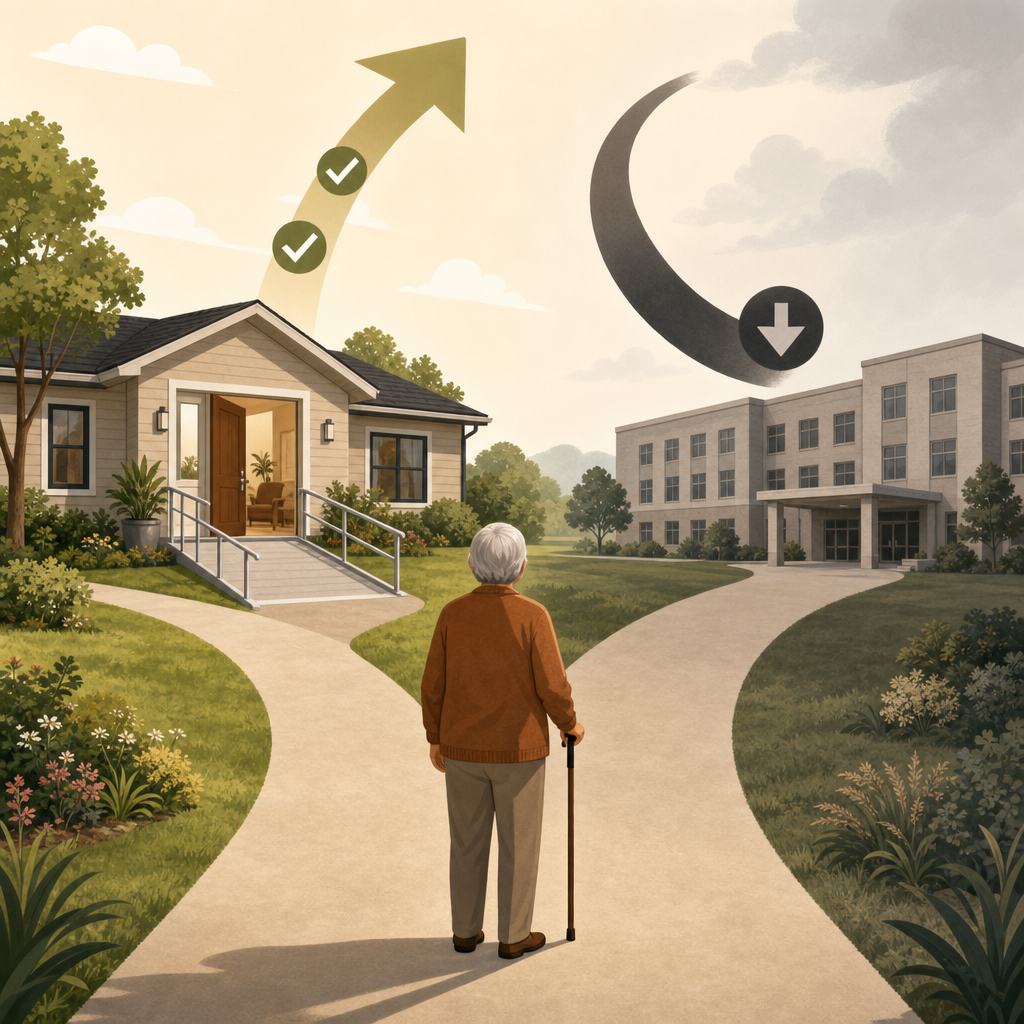
Not every home is a good candidate for aging-in-place modifications. A multi-story home with a narrow layout, no first-floor bathroom, and structural limitations may require modifications so extensive that the cost approaches or exceeds the value of the home. In those cases, relocating to a more suitable home — or to an assisted living facility — may be the more practical choice.
The decision framework below helps families weigh the key factors. No single factor is decisive; the framework is designed to surface trade-offs that might otherwise be overlooked in an emotional decision.
| Factor | Favors Modifications | Favors Relocation |
|---|---|---|
| Home layout | Single-story or first-floor bedroom/bathroom already exist (78% have main-floor bedrooms, 88% have main-floor bathrooms) | Multi-story with no first-floor bathroom; narrow hallways and doorways that cannot be widened |
| Estimated modification cost | Under $30,000 (less than 6 months of assisted living) | Over $60,000 (approaches or exceeds one year of assisted living) |
| Available funding | Qualifies for USDA Section 504, VA HISA, or Medicaid MFP | No grant eligibility; would require full out-of-pocket or high-interest loan |
| Care trajectory | Stable or slowly progressive condition; modifications will serve needs for 5+ years | Rapidly progressive condition (e.g., late-stage dementia, ALS) where care needs will soon exceed what home modifications can address |
| Caregiver proximity | Family caregiver lives nearby or can move in; home has space for a caregiver | Long-distance caregiving with no local support; home is isolated from services |
| Community and social ties | Strong neighborhood connections, proximity to medical care, and access to transportation | Isolated location; limited access to healthcare, groceries, or social activities |
| Home equity and resale | Modifications will add value or at least not reduce it; universal design features appeal to broad buyer pool | Home is in declining market; modifications may not recoup cost at resale |
For families facing this decision, the Aging in Place vs. Assisted Living: A Family Decision Framework for 2026 provides a more comprehensive comparison, including emotional, social, and medical considerations beyond the financial analysis covered here.
Related reading
Need a professional assessment?
Find a CAPS-credentialed professional or local aging services through our outbound resource list — we never name or rank individual contractors.
Find Local HelpNoticed something outdated or inaccurate on this page? Flag a correction. We review every report against CDC, NIA, and AARP HomeFit guidance before updating a page.