Only 10% of Homes Are Ready for Aging in Place — Here's How to Check Yours
Reviewed: 2026-06-30
Only 10% of Homes Are Ready for Aging in Place — Here's How to Check Yours
A startling Census Bureau finding shows just 10% of U.S. homes have the basic features needed for safe aging. This article provides a room-by-room assessment framework to determine if a parent's home is ready and what to do if it is not.
By Editorial Team
A house can feel perfectly familiar and still be poorly prepared for aging in place. That is the uncomfortable part. The towel rack that has quietly become a handhold, the hallway rug that has curled at one corner, the lamp switch that sticks unless you press it just right—none of these looks dramatic during a family visit. They become dramatic when someone is tired, wet, carrying laundry, or trying to reach the bathroom at 2 a.m.
The Census Bureau’s most useful finding on this subject is also its most blunt: among 115 million U.S. homes studied, only 10% had all three basic features it used to define an “aging-ready” home—a step-free entryway, a first-floor bedroom and full bathroom, and at least one bathroom accessibility feature.[1] That does not mean every other home is dangerous today. It does mean most homes are asking older bodies to keep adapting to spaces that were not built with later life in mind.
The gap matters because the wish to stay home is not rare or sentimental noise. In a Pew Research Center survey published in February 2026, 60% of older adults living at home said they would prefer to stay there with a caregiver rather than move elsewhere, but only 37% thought that outcome was likely.[2] A separate 2026 report from Choice Mutual found that 85% of seniors planning to stay in their current homes did not believe they would need significant modifications.[3] Commercial survey data should not carry the whole argument by itself, but it lines up with what many families see: confidence in the idea of home, much less attention to the actual house.
Start at the Door, Not the Doctor’s Chart
Health matters, of course. So do money, family support, transportation, medication management, and whether the older adult wants help in the first place. But a home readiness check starts with a simpler question: if mobility changed next month, would the house still work?
Walk the route a person actually uses. Come in through the usual entrance, not the front door no one opens. Notice whether there is a step, a loose threshold, a narrow landing, or a storm door that requires backing up while pulling. If someone used a cane, walker, or wheelchair temporarily after a hospitalization, that entry would become the first test of independence.
The Census Bureau’s definition is intentionally basic. A home is not “aging-ready” because it has a favorite recliner, a loyal neighbor, or a bedroom that could theoretically be moved someday. The baseline is physical: step-free entry, a first-floor place to sleep and bathe, and at least one accessible bathroom feature.[1] A house missing one of those features may still be workable, but the missing feature needs a plan rather than a shrug.
Area to Check
What You Are Looking For
Why It Matters
Entry
A step-free route or a realistic plan for a ramp or alternate entrance
A single step can become a barrier after surgery, injury, or mobility decline
Main floor
A bedroom and full bathroom usable without stairs
Stairs turn ordinary routines into repeated risk points
Bathroom
Grab bars, safer bathing access, non-slip surfaces, and room to move
Wet surfaces and transfers make small balance losses more consequential
Lighting
Bright, reachable lighting from bed to bathroom and on stairs
Poor visibility makes familiar pathways less forgiving
Paths
No throw rugs, cords, clutter, or tight turns where mobility aids would pass
Fall hazards often sit in the exact places people use most
The Bathroom Deserves the Longest Look
If the family has energy for only one room this week, choose the bathroom. It combines water, hard surfaces, tight turning space, privacy, and awkward transfers. That is why vague reassurance—“she’s careful,” “he holds the sink,” “they’ve always used that tub”—does not settle anything.
Falls are already common enough without giving the bathroom extra chances. CDC data show that falls are the leading cause of injury among adults 65 and older; more than 14 million older adults, about 1 in 4, fall each year, and roughly 37% of those falls result in an injury requiring treatment.[4] The point is not to panic over every tile floor. It is to stop treating balance as a permanent trait.
Look first at how someone gets in and out of the tub or shower. A high tub wall requires standing on one leg, shifting weight, and stepping over a barrier while the surface may be wet. If the person is already holding a towel rack, glass door frame, sink edge, or sliding shower door for support, that is not a quirky habit. It is an improvised safety system, and it is usually weaker than the person depending on it.
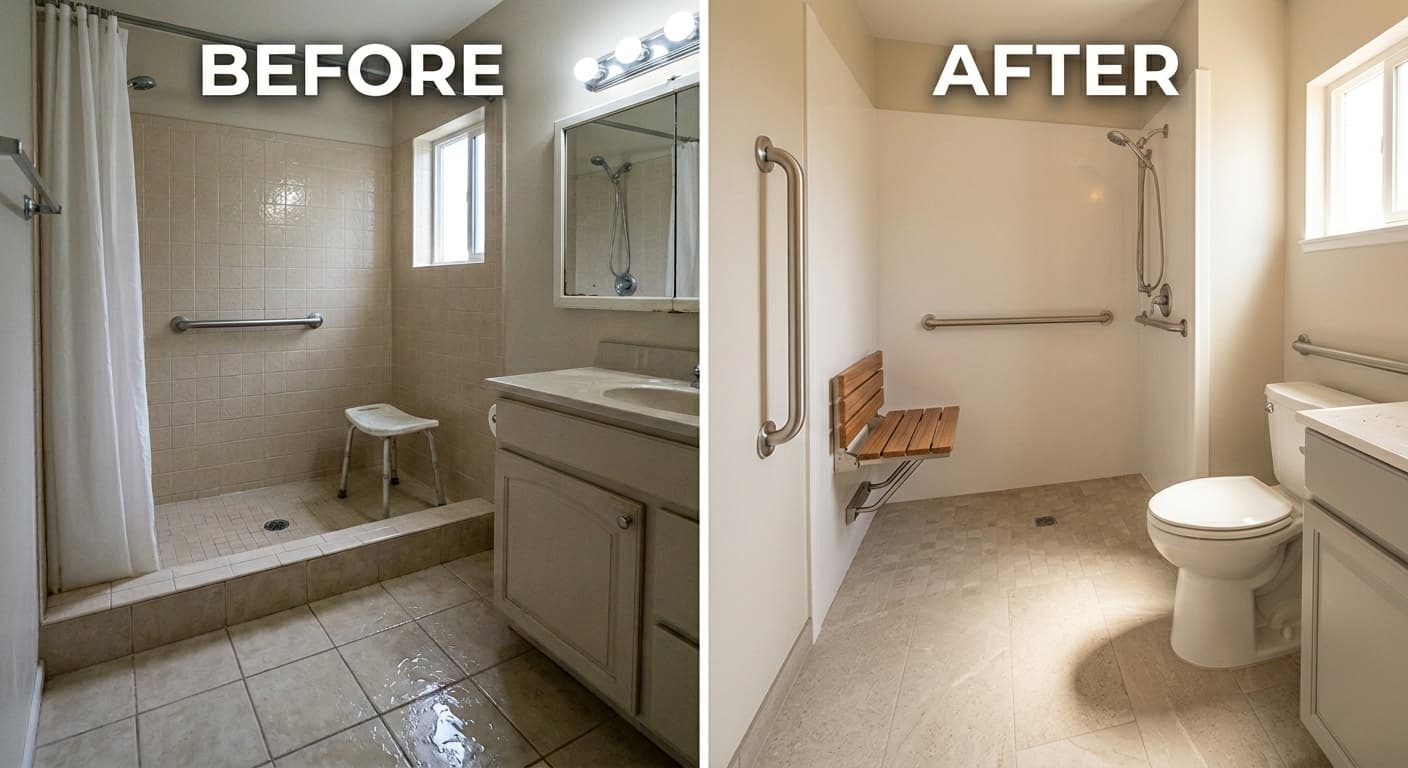
Grab bars are a good example of a modest change that does real work. A 2021 study discussed by Wirecutter found that people using grab bars were 76% more likely to recover their balance than people without them.[5] That finding does not make every bathroom safe by itself, and it does not mean a suction-cup bar is equivalent to a properly installed one. It does explain why a correctly mounted bar beside the toilet and in the bathing area belongs near the top of the list.
Occupational therapist Cheryl Hall put the bathroom problem plainly in Wirecutter’s aging-in-place guidance: it is “the most risky place” because “you’re naked and wet.” The same article quotes occupational therapist Matt Haase recommending that people start modifications “as soon as you’re in what you consider your forever home,” rather than waiting for a crisis.[5] That advice is easy to postpone because a grab bar feels like an admission. It is better understood as permission to keep using the room without negotiating with every surface.
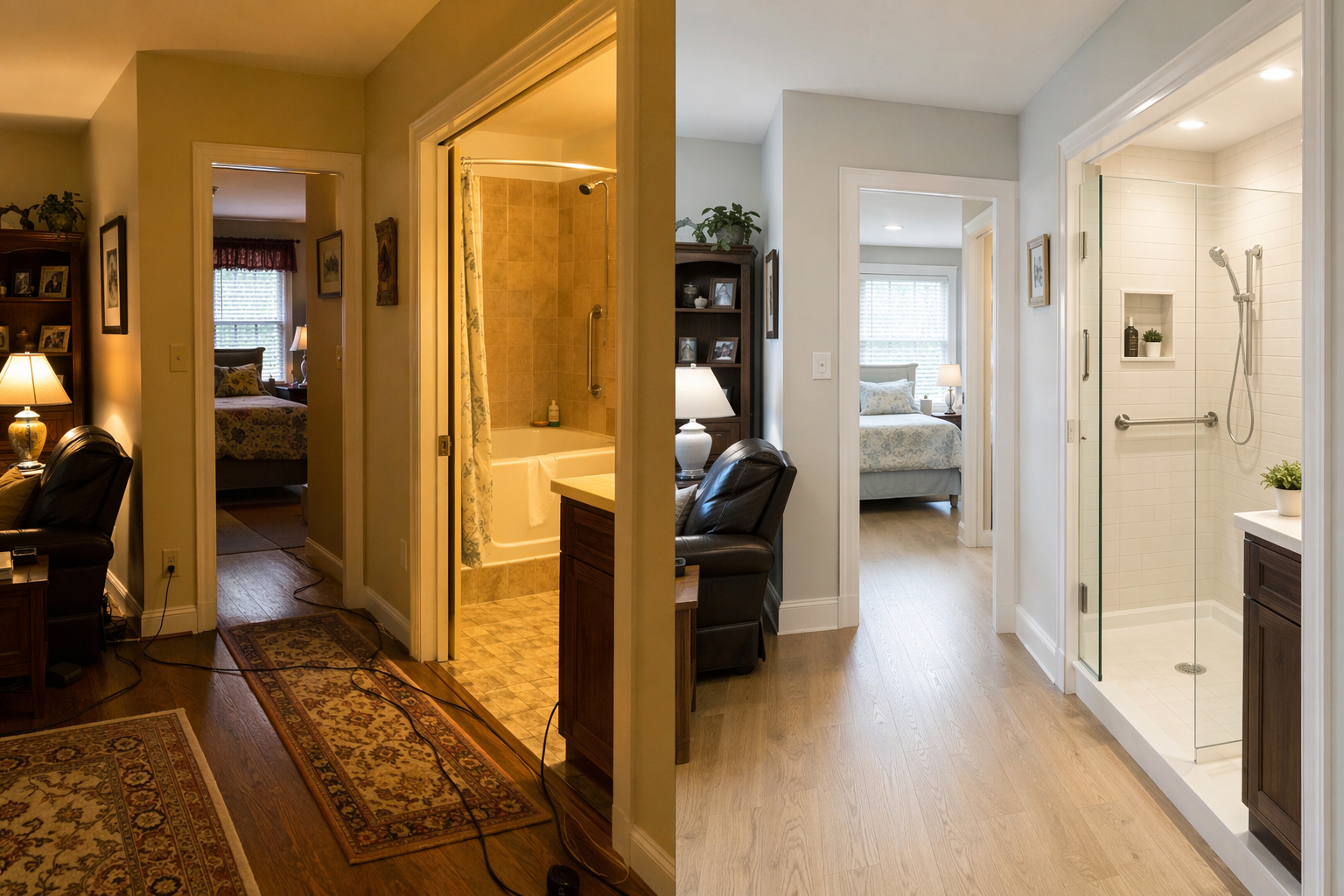
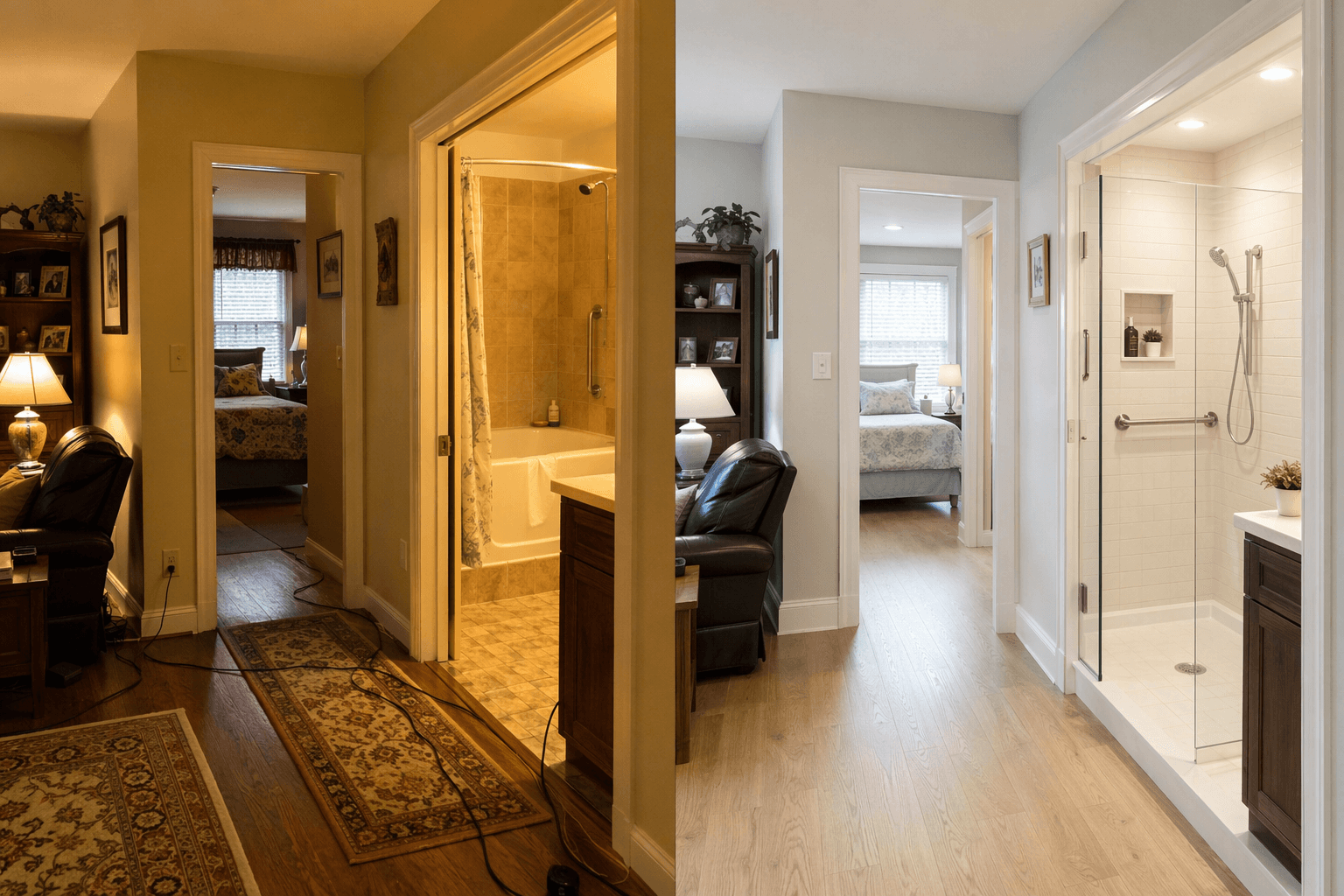
For a bathroom check, separate the urgent from the expensive. A family may not be ready to replace a tub with a curbless shower. They can still remove loose bath mats, add non-slip strips or flooring, install well-anchored grab bars, improve lighting, place commonly used items within reach, and consider a shower chair or hand-held showerhead. Those are not cosmetic upgrades. They reduce the number of moments when someone has to balance, twist, reach, and hope.
Lighting, Rugs, Cords, and the Small Hazards Everyone Stops Seeing
The most familiar rooms can be the least honestly inspected. People step over the same cord for years. They know which lamp flickers. They know the rug by the kitchen sink bunches up, so they lift their foot a little higher. Familiarity is not protection; sometimes it is just practice at avoiding a problem that should be removed.
Do one walkthrough during the day and one after dark. Start from the bed and go to the bathroom, kitchen, and main exit. Can the person turn on a light before getting up? Is the switch easy to reach, or does it require crossing the room? Are stair treads visible? Are there shadows at thresholds? Are nightlights bright enough to show the floor, not just glow politely from an outlet?
Then look down. Throw rugs, curled mats, extension cords, pet bowls, shoe piles, low baskets, and decorative tables often sit in travel lanes. Mail stacked on a bench may not look like clutter until a walker needs that turning radius. A narrow hallway may be fine for a steady adult and miserable for someone using a mobility aid while carrying a glass of water.
Remove throw rugs or secure only those that cannot slide, curl, or bunch.
Move cords out of walking paths instead of taping over a bad route.
Add nightlights from bed to bathroom and brighter lighting on stairs.
Clear the route a walker would use, even if no walker is used today.
Check that handrails are steady, graspable, and present where stairs are actually used.
These fixes can feel too ordinary to count. That is their advantage. They do not require a contractor, a family meeting, or a decision about selling the house. They simply stop making daily movement harder than it needs to be.
Sort Modifications by Consequence, Not by Ambition
Families often stall because the imagined project is too large: widen every doorway, redo the bathroom, add a ramp, replace the flooring, maybe build a first-floor suite. Some homes will eventually need serious changes. But the first pass should sort modifications by what happens if nothing changes.
Priority
Typical Changes
How to Think About Them
Critical
Bathroom grab bars, stair handrails, adequate night lighting, removal of rugs and tripping hazards
Do these early because they address common, repeated risks and are often relatively simple
Essential
Zero-step entry, first-floor bedroom and full bathroom, wider doorways
Document these clearly because they determine whether the home can still function after mobility changes
Forward-looking
Curbless shower, stair lift, home elevator, smart safety technology
Plan these when the home, budget, and likely care needs justify a larger investment
Door width belongs in the second category for most families. A doorway that works today may not work for a walker or wheelchair, and a tight bathroom doorway can make caregiving harder. Home-safety guidance commonly uses 32 inches as a minimum clear width and 36 inches as preferable. If the current doorway is narrower, that does not mean demolition starts tomorrow. It means the limitation should be written down before a discharge planner, spouse, or adult child has to solve it under pressure.
Stairs need the same honesty. A second-floor bedroom is not automatically disqualifying, but the family should know where sleeping would happen if stairs became unsafe for a month. Is there a room on the first floor that could realistically become a bedroom? Is there a full bathroom on that level? Would furniture have to be moved, or would privacy and heating become problems? These are practical questions, not betrayals of the home.
The regional Census figures are a useful reminder that housing stock is not the same everywhere. In the 2020 analysis, 6% of homes in the Mid-Atlantic met all three aging-ready criteria, compared with 14% in the West South Central region.[1] The national 10% figure is a baseline, not a verdict on a particular address. Older housing, split-level layouts, local building patterns, and climate all shape what a family finds when it starts measuring the house instead of assuming it.
What to Do During a Room-by-Room Check
A useful home check is slow enough to notice details and restrained enough not to turn into a family trial. The older adult should be part of it whenever possible. The goal is not to point at everything wrong with the house. The goal is to find the places where the house is quietly demanding extra strength, balance, vision, or flexibility.
Walk the normal path from the usual entrance to the kitchen, bathroom, bedroom, laundry area, and mailbox.
Repeat the bed-to-bathroom route after dark with the lights as they are normally used.
Watch for furniture, rugs, cords, thresholds, and tight turns that would interfere with a cane, walker, or caregiver.
Test support points by asking what someone grabs now when standing, bathing, climbing stairs, or getting off the toilet.
Write down barriers that cannot be fixed immediately, especially stairs, entry steps, narrow bathroom doors, and lack of a first-floor full bath.
If the conversation keeps getting stuck—“we’ll deal with that later,” “Dad won’t allow it,” “Mom says she’s fine”—it may help to separate the emotional delay from the physical checklist. Families caught in that pattern may want to read The Home Safety Gap: Why Families Delay Action and How to Start. Avoidance is common, but it should not get to rename itself as planning.
When a Self-Check Is Not Enough
A family walkthrough is a good beginning, especially for visible hazards. It is less reliable when the older adult has had a fall, a recent hospitalization, a new diagnosis, worsening vision, dizziness, weakness, or trouble transferring. At that point, the question is not only what the house looks like. It is how this person moves through this house.
An occupational therapist can evaluate the fit between a person’s abilities and the home environment. That may include bathing, toileting, stairs, transfers, lighting, furniture height, and the safest way to arrange daily routines. For readers comparing self-checks with professional help, Professional Home Safety Assessments for Older Adults: What Medicare Now Covers explains what Medicare now covers and what to expect from an assessment.
A Certified Aging-in-Place Specialist, often called a CAPS professional, is more focused on home design and remodeling. That can be useful when the self-check reveals larger barriers: a bathroom that needs reconstruction, an entry that may need a ramp, doorways that may need widening, or a floor plan that cannot support first-floor living without changes.
At the end of the first check, do not try to solve the whole future. Sort what you found into three piles: fix now, price and plan, and ask a professional. Loose rugs, poor night lighting, unstable handholds, missing grab bars, cluttered paths, and weak stair railings should not wait for a full remodel. Entry barriers, no first-floor bathing option, narrow doorways, and unsafe stairs should be documented clearly, because those are the problems that become urgent after a fall, surgery, or sudden decline.
The house does not have to become clinical to become safer. It does have to stop relying on luck, muscle memory, and furniture that was never meant to hold a person’s weight. Aging in place is not just a preference; it is a physical arrangement. The sooner a family looks at the actual rooms, the more choices it has before a crisis makes the decisions smaller and harsher.

Comments
Join the discussion with an anonymous comment.