Aging in Place Remodel: What to Prioritize and What to Defer — A Staged Roadmap
bathroomstructural~$50,000+ for whole-home retrofit; under $500 for Tier 1Reviewed: 2026-06-20
Aging in Place Remodel: What to Prioritize and What to Defer — A Staged Roadmap
Most families can't afford a complete $50,000 retrofit all at once. This guide provides a four-tier, dollar-bounded staging framework that shows you exactly which high-impact, low-cost modifications to tackle first — and which structural projects to defer — so you can address 80% of fall risk for under $2,000 while planning bigger work.
Estimated cost range: $50,000+ for whole-home retrofit; under $500 for Tier 1
Potential funding: VA grants, Medicaid waivers, USDA Rural Development programs
Cost ranges are estimates. Verify eligibility directly with each program.
By Editorial Team
Why a Staged Approach Beats an All-at-Once Remodel
The numbers are stark: only 10% of U.S. homes are considered "aging ready" according to U.S. Census Bureau data cited in a 2025 systematic review, yet 88% of adults aged 50 to 80 believe it is important to remain in their homes. The gap between desire and reality is not a lack of will — it is a lack of a practical, affordable plan. When families hear that a whole-home aging-in-place retrofit can exceed $50,000, many freeze. They do nothing because they believe they cannot do everything.
That assumption is wrong. A staged approach — tackling high-impact, low-cost modifications first and deferring structural work to later phases — allows families to address the vast majority of fall risk for a fraction of the cost of a full renovation. Industry data confirms the trend: 76% of home remodelers reported increased requests for aging-in-place features between 2020 and 2023, and in 2023, 93% of remodelers added a grab bar to a bathroom, making it the single most requested feature. Families are already thinking in phases; they just need a framework to execute it.
The evidence supports this phased logic. A 2025 systematic review of 20 studies found that 13 studies (65%) confirmed the effectiveness of home modifications in reducing falls, with bathroom modifications (grab bars, non-slip flooring) and stair railings showing the strongest impact. One randomized controlled trial (Stark et al., 2017) demonstrated a 39% reduction in falls in the intervention group. Notably, the review also found that combining home modifications with exercise programs produced the greatest fall-reduction outcomes — meaning the first tier of low-cost safety upgrades can be paired with a simple balance routine for outsized benefit.
A staged approach means you can start with the grab bar and lever handle today, and plan the curbless shower for next year.
Tier 1: Immediate Safety Upgrades — Under $500
Tier 1 is the most important tier in this entire framework. These are modifications you can complete this weekend, with a trip to the hardware store and a few hours of work. They address the most common fall scenarios — the bathroom, the bedroom at night, and cluttered pathways — for less than $500 total.
Grab bars ($15–$80 for standard models; $100–$400 installed): The single most impactful modification. A study cited by Forbes Health found that people who had a grab bar in their shower were 75% more likely to keep their balance while stepping from a slippery shower to a dry floor. Install one next to the toilet and one inside the shower or tub.
Raised toilet seat ($27–$85): Reduces the distance of the sit-to-stand transfer, which is one of the most common moments for a fall. The NAHB CAPS checklist recommends a toilet height of 17–19 inches.
Night lights and pathway lighting ($10–$50): After age 50, people require 50% more light to see clearly. Plug-in night lights in the bathroom, hallway, and bedroom create a lit path to the toilet at night.
Lever-style door handles ($75–$400 per door): Require less grip strength and can be operated with an elbow or forearm. Install on the bathroom and bedroom doors first.
Non-slip bath mats and treads ($15–$40): Place a non-slip mat outside the shower or tub and adhesive treads inside the tub. The bathroom accounts for 35.7% of fall injuries in older adults, according to the National Center for Injury Prevention & Control.
Clear-pathway decluttering ($0): Remove throw rugs, trailing cords, and furniture that narrows walkways to less than 36 inches. This costs nothing and eliminates a major tripping hazard.
The "80% of fall risk for under $2,000" claim that frames this article is built on this logic. The 2025 systematic review confirms that grab bars and stair railings are the most impactful single interventions. Tier 1 covers grab bars, lighting, and pathway clearing — the three interventions that address the highest-frequency fall scenarios. Tier 2 adds stair handrails and improved lighting. Together, Tiers 1 and 2 cost well under $2,000 and cover the environmental factors involved in the vast majority of home falls.
Tier 2: Short-Term Investments — $500 to $5,000
Tier 2 modifications should be planned within the first year. They build on Tier 1 by addressing lighting quality, flooring traction, and stair safety — the next layer of fall risk. These projects are still relatively affordable and can often be completed without a general contractor.
Tier 2 modifications: cost ranges and rationale. All figures are national averages from NerdWallet, Forbes, and HomeAdvisor (2023–2026).
Modification
Cost Range
Why It Matters
Improved lighting throughout
$100–$500
After age 50, you need 50% more light. Flat recessed pot lights can lose 50–70% of output by the time light reaches a countertop. Add task lighting and brighter bulbs.
Non-slip flooring in bathrooms and kitchen
$3–$14 per sq ft
Slip-resistant flooring (engineered wood, LVT, cork, rubber) reduces fall risk in the two highest-risk rooms. Avoid high-gloss tile.
Handrails on both sides of stairways
$150–$600
The NAHB CAPS checklist recommends handrails on both sides of every stairway. This is a low-cost, high-impact intervention for multi-level homes.
Shower bench or transfer bench
$50–$300
Allows the user to sit while bathing, reducing the risk of a standing fall. A transfer bench straddles the tub wall so the user sits and swings legs over.
Widen doorways to 32–34 inches
$600–$2,000
The NAHB recommends 36-inch minimum doorways for wheelchair access. Even widening to 32–34 inches improves walker and wheelchair clearance.
A key principle in Tier 2 is to choose finishes and fixtures that will work for future mobility levels, not just the present. If you are replacing flooring, choose slip-resistant material now even if the user is still steady on their feet. If you are painting, consider high color contrast between walls and trim — the Spruce recommends a difference of 30–40 Light Reflectance Value (LRV) points between door trim and surrounding wall color to aid depth perception.
Tier 3: Medium-Term Structural Work — $5,000 to $15,000
Tier 3 projects require more planning, a contractor, and a larger budget. These should be deferred until the family has completed Tiers 1 and 2 and has a clearer picture of the older adult's mobility trajectory. A person who uses a walker today may need a wheelchair in two years — and that changes which Tier 3 projects make sense.
Tier 3 modifications: cost ranges and decision triggers. Cost data from NerdWallet, Forbes, and Budget Dumpster (2023–2026).
Modification
Cost Range
When to Consider
Walk-in shower conversion
$1,500–$12,000
When stepping over a tub wall becomes difficult or dangerous. Prefab units are under $1,000; custom tile work runs higher.
Straight stair lift
$2,000–$10,000
When the user can no longer safely climb stairs. Straight stair lifts are far less expensive than curved models ($10,000+).
Comfort-height raised toilet (17–19 inches)
$150–$500
If a raised toilet seat is no longer sufficient and a permanent solution is needed. The NAHB CAPS checklist recommends this height.
Entry ramp
$1,100–$3,600
When steps at the entry become a barrier. A ramp with a gentle slope (1:12 ratio) is preferred over a single-step threshold.
A common mistake families make is jumping to Tier 3 before completing Tiers 1 and 2. A stair lift is expensive and unnecessary if the user can safely navigate the main floor with grab bars and improved lighting. The 2025 systematic review found that the most impactful interventions are bathroom modifications and stair railings — both of which are covered in Tiers 1 and 2. Defer structural work until you have addressed the basics.
Tier 4: Long-Term Major Renovations — $15,000+
Tier 4 covers the most expensive and invasive modifications. These projects are not urgent for most families and should be timed with other home renovation needs or major life transitions — a kitchen that was already due for replacement, a bathroom that needs a full gut, or a move to a single-story living arrangement.
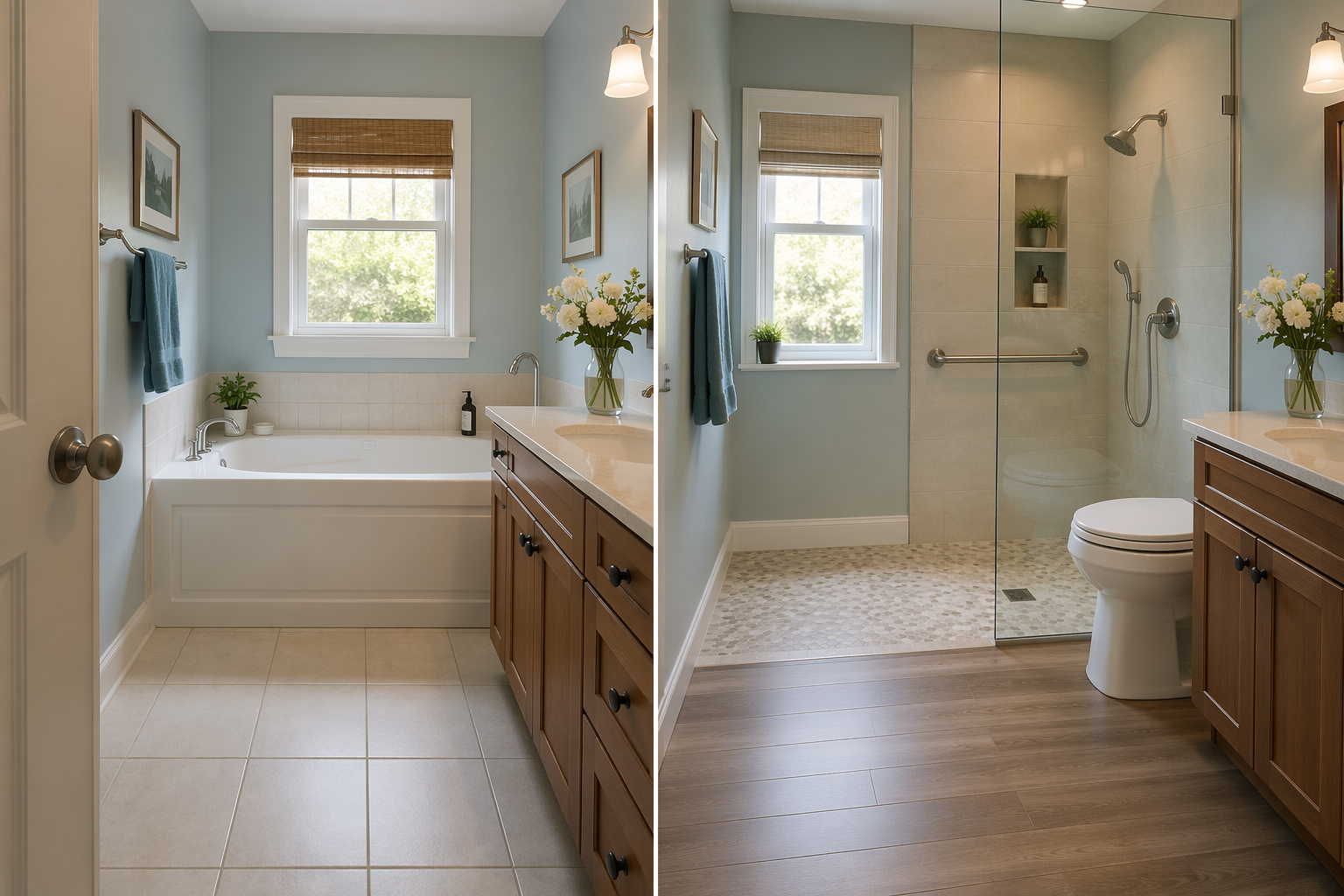
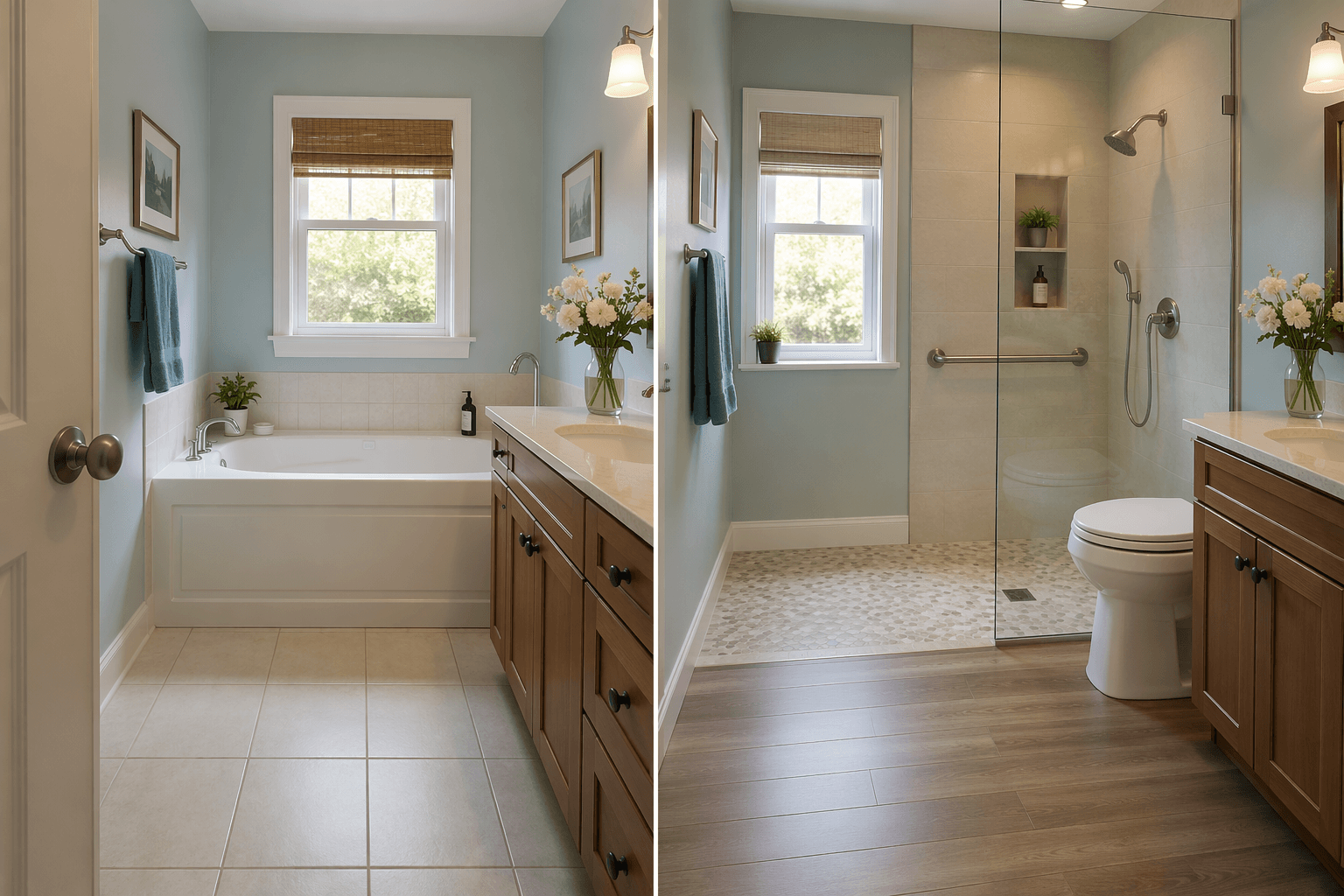
Full bathroom remodel with curbless shower ($20,000–$25,000): A curbless (zero-threshold) shower eliminates the step-over hazard entirely. This is the gold standard for accessibility but requires significant structural work to slope the floor to a linear drain.
Kitchen renovation ($8,000–$50,000): Accessible kitchen modifications include pull-out shelves, lowered countertops, touch-activated faucets, and appliances with front-mounted controls. The wide range reflects the difference between a minor refresh and a full custom remodel.
Home elevator ($20,000–$50,000): A residential elevator is the most expensive single modification. It is rarely necessary if the main living areas (bedroom, bathroom, kitchen) are on one level. Consider a stair lift first.
In-law suite or main-floor bedroom addition ($30,000–$100,000+): Only 78% of adults aged 50–80 have a main-floor bedroom, according to the 2022 National Poll on Healthy Aging. Adding one is a major structural project that should be planned years in advance.
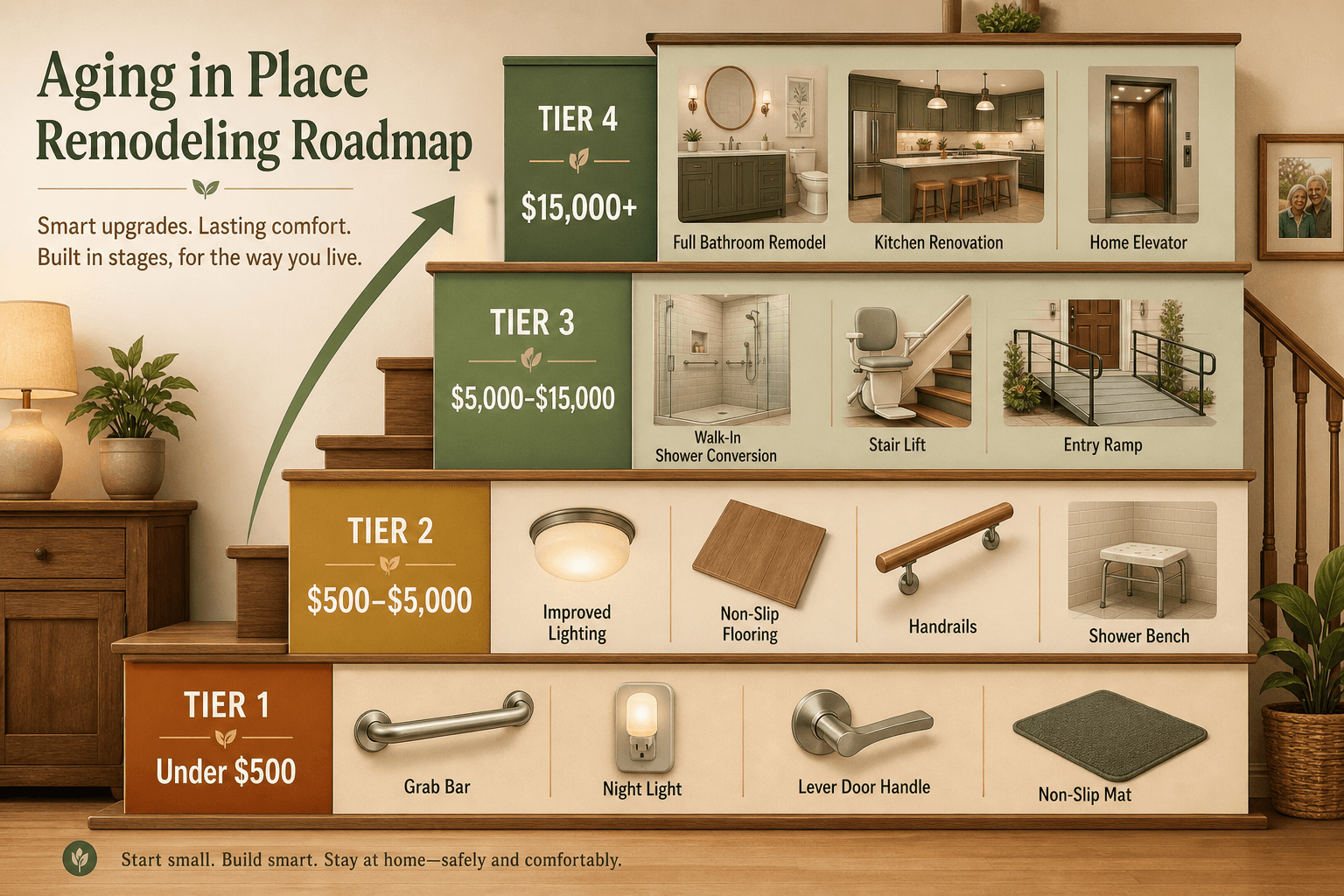
The four-tier staging framework: start at the bottom and work your way up. Most families never need to reach Tier 4.
Decision Framework: What to Do Now vs. What to Defer
The right starting tier depends on three factors: the older adult's current mobility, whether a fall has already occurred, and the home's existing conditions. The table below maps common scenarios to the appropriate starting tier.
Decision framework for choosing your starting tier based on the older adult's current situation.
Scenario
Start With
Defer
Parent just had a fall, no walker yet
Tier 1 (immediate safety upgrades)
Tiers 3 and 4 until mobility needs are clearer
Parent uses a walker, no falls yet
Tiers 1 and 2 (lighting, flooring, handrails)
Tier 3 stair lift unless stairs are already a barrier
Parent uses a wheelchair
Tier 3 entry ramp and widened doorways
Tier 4 full bathroom remodel unless current bathroom is unusable
No current mobility issues, planning ahead
Tier 1 grab bars and lever handles (proactive installation)
All structural work until mobility changes
Parent has dementia and is at risk of wandering
Tier 1 grab bars + Memory Care safety planning
Structural work that may confuse or agitate
CAPS specialist Eve Hill, quoted in Forbes Health, warns that rushed jobs "fail to give choices or a sense of control." A staged approach avoids this by letting families make decisions incrementally, with full information about the older adult's evolving needs. If you are in crisis mode after a fall, start with our 30-Minute Family Safety Walkthrough to identify immediate hazards, then return to this tiered framework for the longer-term plan.
How to Plan for Future Needs Without Overbuilding
One of the smartest strategies in a staged remodel is to make decisions today that preserve future options. You do not need to install a grab bar in every room right now, but you should install blocking in the walls so that grab bars can be added later without tearing out tile. You do not need a 36-inch doorway today, but if you are replacing a door, choose the wider frame now.
Install blocking in walls during any current renovation: Add 2x6 blocking between studs around the tub, shower, and toilet. This allows grab bars rated for 250–300 pounds (per NAHB CAPS recommendations) to be installed later without opening walls.
Choose lever handles and wider doorways even if not immediately needed: The incremental cost of a lever handle over a round knob is negligible. The cost to widen a doorway after the fact is $600–$2,000. Do it now if you are already renovating.
Select slip-resistant flooring that works for all mobility levels: Engineered wood, luxury vinyl tile (LVT), cork, and rubber are slip-resistant and wheelchair-friendly. Avoid high-gloss tile and thick-pile carpet.
Plan for a main-floor bathroom and bedroom: Only 34% of adults aged 50–80 say their home "definitely" has the features needed to age in place. If your home lacks a main-floor bathroom, prioritize that in Tier 3 or 4 planning.
Working with a CAPS Specialist on Staging
A Certified Aging-in-Place Specialist (CAPS) is a professional trained by the National Association of Home Builders (NAHB) to design and modify homes for aging-in-place. Unlike a general contractor, a CAPS specialist understands the full range of accessibility solutions and can help families plan a phased remodel that avoids wasted work.
Comprehensive assessment: A CAPS specialist evaluates the home's current conditions and the older adult's mobility, strength, and anticipated needs. They identify which modifications are urgent and which can wait.
Phased planning: They create a staged plan that sequences work so that early phases do not interfere with later ones. For example, they ensure that electrical rough-ins for future lighting are installed during Tier 2, even if the fixtures are not added until Tier 3.
Contractor coordination: CAPS specialists can work with your general contractor to install blocking, rough-ins, and wider door frames during early phases, saving thousands in future demolition costs.
Funding guidance: Many CAPS professionals are familiar with funding sources such as VA grants, Medicaid waivers, and USDA Rural Development programs. They can help you align your staged plan with available funding. See our Funding Sources Guide for more details.
Not every family needs a CAPS specialist. If you are only completing Tier 1 modifications, a trip to the hardware store and a drill are sufficient. But if you are planning Tier 3 or Tier 4 work, or if you want to ensure that your Tier 2 flooring and lighting choices support future Tier 3 modifications, a CAPS consultation is a worthwhile investment. For a detailed comparison of when to hire a CAPS versus an occupational therapist versus a general contractor, read our guide: CAPS vs. OT vs. General Contractor: Who to Hire First.
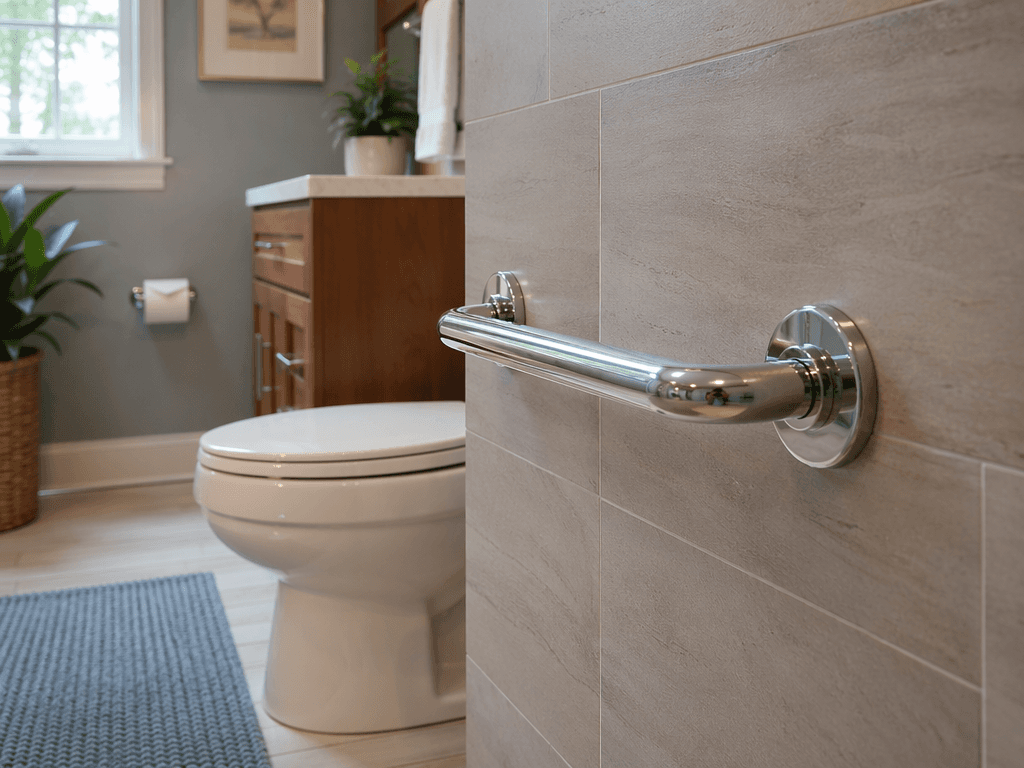
A grab bar and lever handle installed in a bathroom that looks like a normal, attractive home — not a clinical setting.
The staged remodeling framework is not about doing less — it is about doing the right things in the right order. By starting with Tier 1's under-$500 safety upgrades and working upward only as needed, families can make meaningful progress toward a safer home without the paralysis of a $50,000 price tag. The evidence is clear: home modifications reduce falls, improve independence, and, when combined with exercise, produce the greatest outcomes. The question is not whether to modify the home — it is where to start. Now you have a roadmap.

Comments
Join the discussion with an anonymous comment.