
Room checklist
How to Get Help from Habitat for Humanity's Aging in Place Program
A practical guide for family caregivers on qualifying for and applying to Habitat for Humanity's Aging in Place program, including eligibility criteria, the decentralized affiliate application process, and essential fallback programs when Habitat is not available.
Habitat for Humanity’s Aging in Place help can be free or low-cost, and it can be exactly the kind of practical help that keeps an older homeowner safer at home: a ramp, grab bars, stair railings, bathroom changes, roof or porch repairs, and sometimes referrals for food, transportation, or other support. The first thing to know, though, is that there is not one national application for “Habitat for Humanity aging in place.” Habitat works through a large network of more than 1,100 local affiliates, and each affiliate decides what it can offer, who qualifies locally, when applications open, and how many homes it can take on at a time.[1]
So the useful question is not simply, “Does Habitat have this program?” It is: “Does my parent’s local Habitat affiliate offer Aging in Place, critical home repair, or a similar senior repair program right now, and can my parent get into the next intake?”
That distinction matters because demand is not a side issue. Habitat says more than 19 million older Americans live in homes that are unsafe, in disrepair, or not equipped for their needs.[2] Local affiliates are trying to meet that need with limited grant dollars, staff, contractors, volunteers, and intake capacity. Families should move quickly, but also build a backup plan from the beginning.
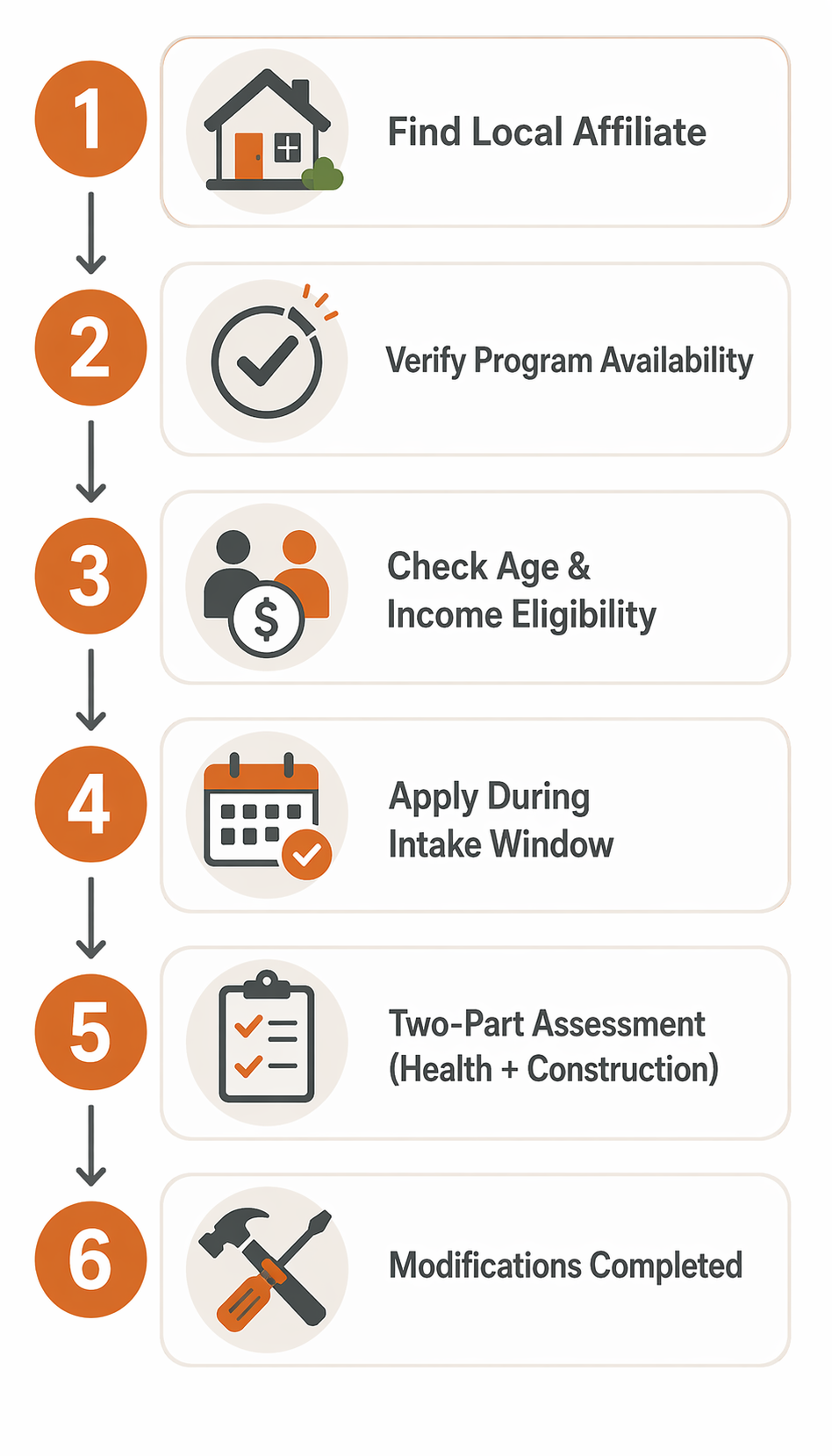
Start with the local affiliate, not the national page
The national Habitat page is useful for understanding the program model. It is not enough to tell you whether your parent can get a ramp this spring, whether their income is under the local limit, or whether the waiting list is closed. The working path is local.
- Find the Habitat affiliate that serves your parent’s home address.
- Look for “Aging in Place,” “critical home repair,” “home preservation,” “senior repair,” or “accessibility modifications.”
- Confirm that the program is active now, not simply described from a past grant cycle.
- Ask whether applications are open, whether there is a waitlist, and whether the next intake has a specific call-in date.
- Ask for the age, income, ownership, occupancy, and repair-scope rules in writing if possible.
If the affiliate does not use the exact words “Aging in Place,” do not stop there. Some affiliates serve older adults through a critical home repair program rather than a separately branded Aging in Place page. The name matters less than the actual service: safety repairs and accessibility changes for an older homeowner.
Is your parent likely to qualify?
Most Habitat Aging in Place and senior repair programs are meant for lower-income older homeowners who live in the home needing repairs. The details vary enough that no family should assume eligibility from a national description alone.
| Eligibility point | What to verify locally |
|---|---|
| Age | Many programs use an age threshold in the early- to mid-60s, often 62, but the local affiliate sets the rule. |
| Income | Limits are usually based on local HUD Area Median Income guidelines. Ask for the exact household-size table for the current program year. |
| Homeownership | The older adult generally must own the home. |
| Occupancy | The older adult generally must live in the home as their primary residence. |
| Location | The home must be in the service area of that affiliate or grant program. |
| Repair scope | The requested work must fit the affiliate’s current funding rules, construction capacity, and safety priorities. |
| Application timing | Some affiliates use rolling intake; others open a limited number of slots on a specific date. |
Income is the part families most often underestimate. “Low income” is not a feeling or a national dollar amount. It is usually tied to the local Area Median Income, often abbreviated AMI, and the limit changes by county and household size. For example, Habitat for Humanity of Greater Memphis listed a 2025 Aging in Place income limit of $31,900 for a one-person household in Shelby County, along with a small $19 recording fee.[3] That number should not be used for another county. It is useful because it shows how specific the local rules can be.
The same is true for repair scope. Habitat for Humanity of Summit County describes a HUD-funded Aging in Place program with 18 eligible modification types, and it also notes program-specific requirements such as sweat equity.[4] That does not mean every Habitat Aging in Place program has the same list or the same participation rule. It means your phone call has to get past the phrase “home modifications” and into the local program’s actual allowed work.
Documents to gather before you call
You may not need every document for the first phone call, but having them ready prevents a small delay from turning into a missed intake window. If your parent is private about money or embarrassed about the home’s condition, explain that the goal is not to judge them. The program has to document eligibility because the funding requires it.
- Proof of age, such as a driver’s license, state ID, passport, or birth certificate.
- Proof of homeownership, such as a deed, property tax statement, mortgage statement, or other locally accepted document.
- Proof that the home is the primary residence, such as utility bills, tax records, or ID showing the address.
- Recent income documentation for everyone in the household, including Social Security, pension, wages, disability income, retirement distributions, or other benefits.
- Homeowners insurance information if available.
- Photos of the problem areas, especially entrances, steps, bathrooms, flooring hazards, roof leaks, porch damage, and places where falls have happened or almost happened.
- A short list of daily-living problems: trouble bathing, entering the home, using the toilet, carrying laundry, reaching the kitchen, getting mail, or moving safely between rooms.
What to ask when you reach the affiliate
A good call is short, respectful, and specific. The person answering may be juggling a full repair caseload. Your goal is to find out whether there is a real path to apply, not to tell the whole family history on the first call.
- “Do you currently offer Aging in Place, senior repair, accessibility modification, or critical home repair services for older homeowners?”
- “What ZIP codes or cities are covered?”
- “What is the minimum age for the homeowner?”
- “What income limit applies for a household of one, two, or however many people live in the home?”
- “Does the homeowner have to be current on property taxes, mortgage payments, or homeowners insurance?”
- “Are applications open now? If not, when is the next intake?”
- “Do slots fill by phone, online form, mailed application, lottery, waitlist, or staff review?”
- “What repairs or modifications are not covered?”
- “Is there any homeowner cost, fee, repayment agreement, lien, or forgivable loan?”
- “If we are not eligible or the list is full, who else should we call locally?”
Ask about timing very plainly. Some affiliates have competitive application openings. Memphis, for example, tells applicants that available Aging in Place slots fill quickly.[3] In high-demand areas, being “eligible” may only mean your parent can try to apply when the window opens. It does not guarantee selection.
This is where families need a calendar, not just hope. If the affiliate says applications open at a particular time, write down the date, the exact method, the documents required before submission, and whether the older homeowner must personally speak with staff or sign forms. If your parent has hearing loss, memory trouble, limited English, or anxiety about official calls, ask whether an adult child can help with the call while the homeowner gives permission.
What happens after an application gets through
Once an application is accepted for review, expect verification before construction. Staff may confirm income, ownership, occupancy, the condition of the home, and whether the requested work fits the grant or program rules. Being accepted for review is not always the same as being approved for a completed project.
Habitat’s Aging in Place work is often strongest when it uses the Housing Plus approach: the home is not treated as a stand-alone construction site. A health or human-services assessment looks at how the person actually lives day to day, while a construction assessment looks at what the home needs. That can change the work order in useful ways. A family may call asking for a ramp, but the assessment may also identify unsafe bathroom transfers, missing handrails, poor lighting, or a need for community supports such as meals, transportation, grocery help, or Area Agency on Aging services.[1]
That pairing matters because a repair does not solve every aging-in-place problem by itself. A new grab bar helps more when someone has the strength, routine, and support to bathe safely. A ramp helps more when the person also has transportation access and can get to medical appointments. For a broader look at the non-construction side of staying home, see Aging in Place Services: The Complete Guide to Home Support Options.
The evidence behind this model is promising, but it should be used carefully. Habitat reports that the CAPABLE model, developed at Johns Hopkins and implemented across five Habitat affiliates, showed 75% of participants improved in self-care, an average savings of $22,120 per participant over 24 months, a 15% increase in confidence about not falling, a 30% reduction in depressive symptoms, and a 49% improvement in activities-of-daily-living limitations.[5] Those figures support the idea that assessment plus home modification can matter. They should not be read as a guaranteed savings amount for one household.
What Habitat may install or repair
Common Aging in Place work can include grab bars, raised or ADA-compliant toilets, walk-in shower changes, lever door handles, improved lighting, non-slip flooring, widened doorways, wheelchair ramps, porch repairs, handrails, roof work, siding, exterior paint, clearer address numbers, and mailbox adjustments. The actual list depends on the affiliate and the funding source.
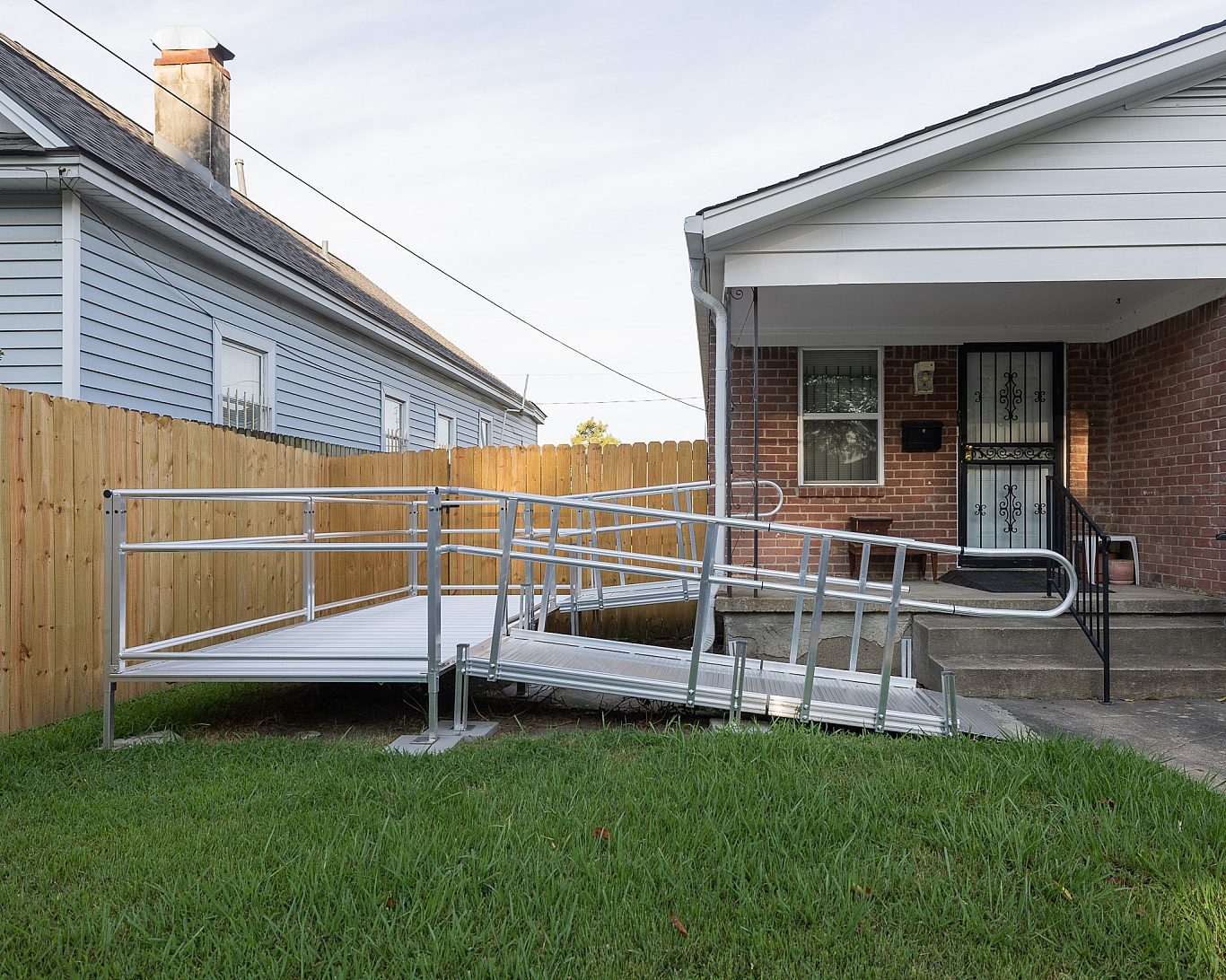
Do not spend all your energy making a perfect wish list before you know the local scope. A repair program may cover a ramp but not a full bathroom remodel. Another may prioritize roofs, porches, and trip hazards because those are the grant’s allowable health-and-safety repairs. If you need a deeper room-by-room sense of what might be possible, use What Habitat for Humanity Aging in Place Modifications Install: A Room-by-Room Guide as a planning companion, then compare it against your affiliate’s actual rules.
What it may cost
Many Habitat Aging in Place repairs are free to the homeowner because they are supported by grants, donations, or public funding. Some affiliates, however, use other cost structures. A program may charge a small administrative or recording fee, as Memphis does with its $19 recording fee, or it may use a forgivable loan model in which a portion is forgiven each year the homeowner continues to live in the home.[3]
Before your parent signs anything, ask what will be recorded against the property, whether there is a lien, what happens if the homeowner moves, sells, dies, or enters long-term care, and whether heirs could face repayment. A forgivable loan may still be a very good deal, but families should understand it before a crisis forces a decision.
If the first answer is no, keep moving
“No” can mean several different things: the affiliate does not offer senior repair, the home is outside the service area, income is too high, the requested repair is outside the grant scope, the waitlist is closed, or the program has already filled its slots. Ask which kind of no you received. That tells you where to go next.
Capacity limits are real. In coverage of Tacoma/Pierce County Habitat, a repair coordinator said she could work 80 hours a week and still not reach every eligible homeowner.[6] That is not a reason to give up on Habitat. It is a reason not to make Habitat the only plan.
| Fallback option | When it may help |
|---|---|
| Rebuilding Together Safe at Home | For free safety modifications such as grab bars, handrails, and ramps where a local Rebuilding Together affiliate serves the area. |
| USDA Section 504 Home Repair Program | For very-low-income homeowners age 62+ in eligible rural areas who need health-and-safety repairs. |
| Medicaid HCBS waivers | For people who qualify for Medicaid long-term services and supports and need home modifications tied to documented functional need. |
| Area Agency on Aging and local grants | For smaller local grants or referrals, often for older adults age 60+ with income limits. |
| City, county, or HUD-supported repair programs | For locally funded home repair, accessibility, weatherization, or lead-safety programs that may operate outside Habitat. |
Rebuilding Together’s Safe at Home work focuses on free home safety modifications for older adults, people with disabilities, and low-income families; the organization reports that 76% of households it serves include someone age 65 or older.[7] Like Habitat, it is local-network based, so availability depends on whether there is an active affiliate serving your parent’s address.
USDA Section 504 is worth checking if your parent lives in a rural area. The program offers grants of up to $10,000 for very-low-income homeowners age 62 or older to remove health and safety hazards, and loans of up to $40,000 at a 1% fixed interest rate for eligible homeowners.[8] Rural eligibility and income rules are specific, so use the property address when checking.
Medicaid Home- and Community-Based Services waivers can sometimes pay for home modifications, but the rules are state-specific and usually require documentation that the modification is medically or functionally necessary. The dollar limits vary by state and waiver. This route is usually slower than a simple contractor job, but for a parent who already needs long-term services and supports, it can be important.
For a wider funding search, use How to Pay for an Aging-in-Place Remodel: Grants, Loans, and Funding Sources and Where to Find Money for an Aging-in-Place Remodel: Grants, Loans, and Assistance Programs (2026). If you are not sure whether the home itself is still a good aging-in-place setting, start with The Aging in Place Readiness Audit: A 5-Point Assessment for Family Caregivers.
Use a two-track plan
Track one is Habitat. Find the affiliate, confirm the program name, verify age and income rules, ask about intake timing, gather documents, and be ready for an in-home assessment if the application moves forward. If Housing Plus or CAPABLE-style assessment is available, take it seriously; it may uncover supports that matter as much as the repair.
Track two is every other realistic funding or service route. Call the Area Agency on Aging, check Rebuilding Together, screen for USDA Section 504 if the home is rural, ask about Medicaid waiver coverage if your parent is Medicaid-eligible, and look for city or county repair programs. If your parent’s needs are beyond what grab bars, ramps, repairs, and community services can safely support, use When Aging in Place Is No Longer Safe: A Five-Domain Framework before putting more money and effort into the house.
Habitat can be one of the best low-cost paths to critical aging-in-place repairs, especially when the local affiliate combines construction with a real look at daily-living needs. Treat it as a local opportunity to investigate quickly, not as a guaranteed national benefit or the only door worth knocking on.
References
- Aging in Place, Habitat for Humanity
- Aging in Place impact, Habitat for Humanity
- Aging in Place Program, Habitat for Humanity of Greater Memphis
- Aging in Place, Habitat for Humanity of Summit County
- CAPABLE model, Habitat for Humanity
- Habitat for Humanity sees success with aging-in-place program, HousingWire
- Safe at Home, Rebuilding Together
- Single Family Housing Repair Loans & Grants, USDA Rural Development
Related reading
Need a professional assessment?
Find a CAPS-credentialed professional or local aging services through our outbound resource list — we never name or rank individual contractors.
Find Local HelpNoticed something outdated or inaccurate on this page? Flag a correction. We review every report against CDC, NIA, and AARP HomeFit guidance before updating a page.