Aging in Place Services: A Complete Guide to Home Care, Community Programs, and Funding
This guide helps family caregivers and older adults understand the full range of aging-in-place services — from home health care and personal care to innovative community models like PACE, CAPABLE, and Village programs — with clear cost breakdowns and funding pathways to build an actionable care plan.
Cost ranges are estimates. Verify eligibility directly with each program.
By Editorial Team
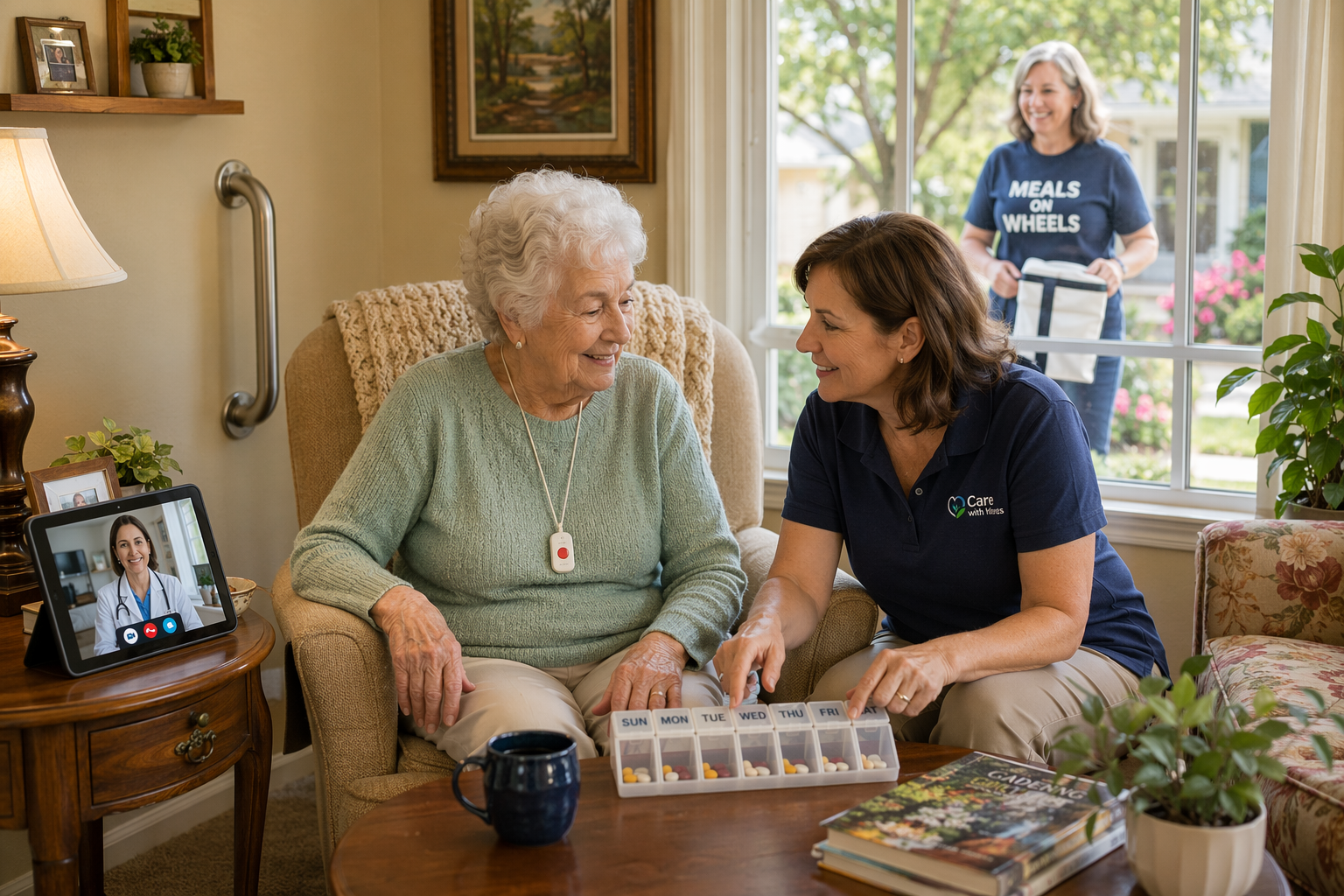
Aging in place is supported by a coordinated ecosystem of services, technology, and human care — not just one solution.
Why Aging in Place Requires More Than a Wish
The desire to grow older at home is nearly universal. Surveys consistently find that more than 90% of older adults prefer to remain in their own homes rather than move to assisted living or a nursing facility. Yet the gap between that wish and the reality of safe, sustainable aging in place is wide. According to industry data, only about 10% of U.S. homes are considered "aging-ready" — equipped with the basic structural features and safety modifications that allow an older adult to live independently without elevated fall risk or daily struggle.
This gap is not simply about grab bars and wider doorways. It is about a coordinated ecosystem of services — home health care, personal assistance, meal delivery, transportation, emergency response, adult day programs, and care coordination — that must work together to keep someone safe, healthy, and socially connected at home. No single service can do it alone. The families who succeed are the ones who learn to layer multiple services into a single, coherent care plan that matches their parent's functional needs and financial reality.
The Full Spectrum of Aging-in-Place Services
Understanding the landscape of available services is the first step. The table below organizes the major service categories, what they include, who typically provides them, and how they are paid for. This framework will help you identify which services your parent currently needs and which ones may become necessary as their condition evolves.
Major categories of aging-in-place services, their scope, and typical funding sources.
Rides to medical appointments, grocery stores, social activities
Volunteer driver programs, public transit paratransit, ride-share services
Donations; Medicaid non-emergency medical transport; grants
Emergency Response Systems
Medical alert pendants, fall detection, two-way voice communication, GPS trackers
PERS providers (product-neutral category)
Private pay; some Medicaid waivers; Medicare Advantage (limited)
Respite Care
Short-term relief for family caregivers — in-home or at an adult day center or facility
Home care agencies, adult day centers, residential facilities
Private pay; Medicaid HCBS waivers; VA caregiver support; National Family Caregiver Support Program
Adult Day Care
Supervised daytime programs with social activities, meals, and some health services
Adult day centers
Private pay ($60–$130/day); Medicaid HCBS waivers; VA benefits
Care Coordination
Assessment, care plan development, provider referrals, ongoing monitoring
Geriatric care managers, Area Agencies on Aging, PACE programs
Private pay; some Medicaid HCBS waivers; sliding-scale fees
A critical distinction to understand is the difference between skilled care and custodial care. Skilled care — nursing, physical therapy, occupational therapy — requires a licensed professional and is ordered by a physician. Medicare covers this type of care, but only for a limited time and only if the person is homebound and receiving services from a Medicare-certified home health agency. Custodial care — help with bathing, dressing, eating, and other activities of daily living (ADLs) — is not covered by Medicare. This is the most common type of care families need, and it is almost always paid for out of pocket, through Medicaid (for those who qualify), or through long-term care insurance.
Innovative Community-Based Models: PACE, CAPABLE, and Village Programs
Beyond the standard service categories, three innovative models have emerged that many families — and even many healthcare professionals — do not know about. Each takes a fundamentally different approach to supporting aging in place, and each has a strong track record of improving outcomes while reducing costs. Understanding these models could open up options you did not know existed.
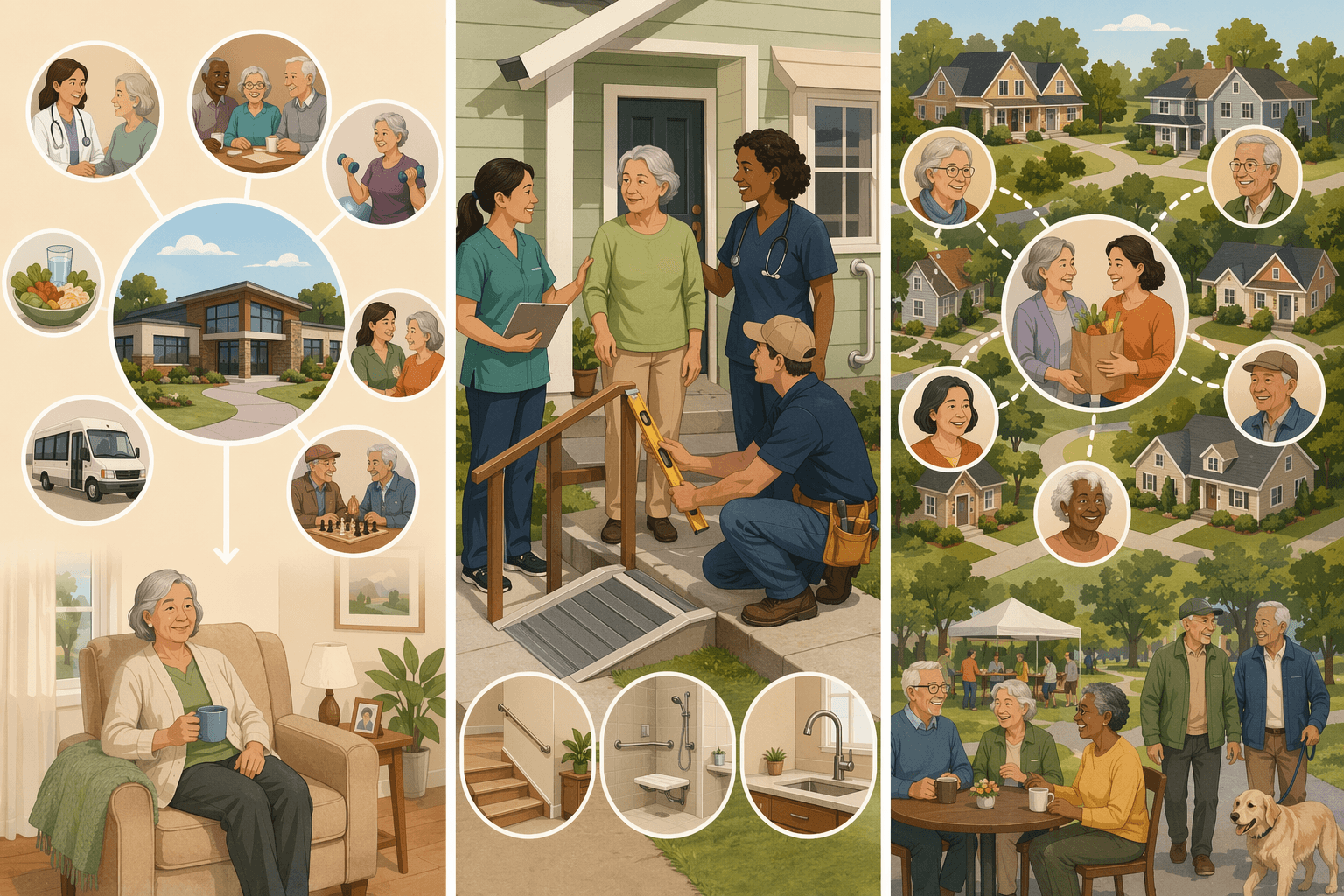
Three proven community-based models that help older adults age safely at home: PACE (all-inclusive managed care), CAPABLE (short-term home-based intervention), and Village (member-governed support networks).
PACE: All-Inclusive Care for Those Who Need Nursing Home Level of Care
The Program of All-Inclusive Care for the Elderly (PACE) is one of the most comprehensive models available. It is designed for older adults who meet their state's criteria for nursing home care but want to remain living at home. PACE provides all Medicare and Medicaid-covered services — plus many that are not typically covered — through a single, coordinated provider network.
Eligibility requirements are straightforward: the participant must be at least 55 years old, live in a PACE service area, meet the state's nursing home level-of-care criteria, and be able to live safely in the community with PACE support. As of the most recent data, there are 194 PACE programs serving approximately 94,500 participants across 33 states and the District of Columbia.
The scope of services is unusually broad. PACE covers primary and specialty medical care, dental care, prescription drugs, adult day care, transportation to and from the center, meals, home care, hospital care, and nursing home care when needed. For participants who are dual-eligible (qualify for both Medicare and Medicaid), all services are provided at no out-of-pocket cost. For those with Medicare only, the cost is the Medicare Part D premium. For those without either, the average cost is $4,000 to $5,000 per month.
CAPABLE: Short-Term, High-Impact Home Intervention
The Community Aging in Place — Advancing Better Living for Elders (CAPABLE) program takes a very different approach. It is a short-term, person-directed intervention that lasts only 4 to 5 months, yet it produces measurable improvements in function, safety, and healthcare utilization.
CAPABLE brings together three professionals: an occupational therapist (6 visits), a registered nurse (4 visits), and a handy worker who makes minor home modifications and repairs. The participant sets their own functional goals — things like being able to bathe safely, get in and out of bed without help, or cook a meal. The team works together to address the medical, functional, and environmental barriers to achieving those goals.
The results are striking. Research conducted over more than a decade shows that CAPABLE reduces hospitalizations and nursing home days, improves medication management, strength, balance, mobility, and nutrition. It also reduces depressive symptoms and health disparities. The program costs approximately $3,000 per participant and yields more than $30,000 in medical cost savings — a return on investment of more than 6 to 1. Among low-income older adults on Medicare or Medicaid, 75% showed improvement in self-care ability over the 5-month program period.
Village Model: Grassroots, Member-Governed Support Networks
The Village model is a grassroots approach that started in Boston's Beacon Hill neighborhood in 2001 and has since grown to more than 200 operating villages across the United States, with another 150 or more in development. Villages are member-governed, typically nonprofit organizations that charge annual dues — not per-service fees — ranging from as little as $10 to as much as $900 per year, depending on the community and whether the member receives a subsidy.
What do villages provide? They offer non-professional services directly — transportation, housekeeping, companionship, light home maintenance — and they maintain a vetted network of community service providers who offer discounted rates to members. The model is consumer-driven and person-centered. Members decide what services they need and when. The village coordinates the logistics.
The Village model is particularly well-suited for older adults who are still relatively independent but need occasional support and want to maintain social connection. It can delay or prevent the need for institutional care by addressing the small gaps that, left unaddressed, can lead to a crisis. The annual dues model also makes it more predictable and affordable than paying hourly for services.
How to Layer Services Into a Coordinated Care Plan
Knowing what services exist is not the same as knowing how to combine them. The most common mistake families make is treating each service as a standalone decision — hiring a home care aide without considering transportation needs, or installing grab bars without addressing medication management. A coordinated care plan layers services so they reinforce each other.
The table below maps common care scenarios to recommended service combinations. Use it as a starting point, then adjust based on your parent's specific functional limitations, medical conditions, and preferences.
Sample care scenarios with recommended service combinations and estimated costs. Actual costs vary by location, level of care, and funding source.
Care Scenario
Functional Needs
Recommended Service Combination
Estimated Monthly Cost Range
Post-fall recovery (hip fracture)
Skilled PT/OT, temporary help with bathing and dressing, home safety modifications
Home health (PT/OT) + personal care aide (4–6 hours/day) + home safety assessment + grab bar installation
$2,500–$5,000 (first 2–3 months, then decreasing)
Early-stage dementia (living alone)
Medication reminders, meal preparation, safety monitoring, social engagement
PERS with fall detection + Meals on Wheels + adult day center (2–3 days/week) + medication management service
Help with bathing, dressing, toileting; respite for family caregiver; social connection
Personal care aide (3–4 hours/day) + respite care (8–16 hours/week) + adult day center (2 days/week) + Village membership
$2,000–$4,500
Veteran with service-connected disability
Home modifications, personal care, transportation, caregiver support
VA Aid and Attendance + SAH/SHA grant for modifications + home health aide (VA-covered) + VA respite care
$0–$1,500 (with full VA benefits)
What Aging-in-Place Services Really Cost
Cost is the single biggest barrier to aging in place for most families. The numbers can be daunting, but understanding them clearly is the first step toward finding a workable solution. The table below presents current cost data for the major service categories, drawn from multiple industry sources.
Current cost ranges for major aging-in-place services and facility-based alternatives. All figures are national estimates and should be verified locally.
Service or Setting
Typical Cost Range
Source Notes
Personal care (home health aide, custodial)
$1,500–$4,000 per month
Choice Mutual; varies by hours of care and location
Home modifications (full scope)
$3,000–$100,000 total
Choice Mutual; varies from grab bars ($100–$400 each) to full bathroom conversion ($9,000–$40,000)
PACE (out-of-pocket, no Medicare/Medicaid)
$4,000–$5,000 per month
NCOA; $0 for dual-eligible participants
Assisted living (national median, 2025)
$65,028 per year ($5,419 per month)
Senior Housing News; up 4.4% from 2024
Memory care (national median, 2025)
$80,280 per year ($6,690 per month)
Senior Housing News; up 3.7% from 2024
Adult day care
$60–$130 per day
NIA; varies by program and location
CAPABLE program
~$3,000 total (one-time, 4–5 months)
CAPABLE National Center; yields 6:1+ ROI
To put these costs in perspective, the median household income for adults aged 65 and older in the United States was $56,680 in 2024. That means the median older adult household earns less than the annual cost of assisted living ($65,028) and significantly less than memory care ($80,280). Even aging in place with a moderate level of personal care ($1,500–$4,000 per month) can consume 32% to 85% of that income.
This affordability gap is not a future problem — it is here now. A study by NORC and NIC projects that by 2033, nearly 75% of middle-income older adults will not be able to afford assisted living without selling their home. And even among those with home equity, 40% will still be unable to afford it. Fewer than 15% of adults aged 75 and older can afford the combined cost of housing and long-term care, according to a 2023 analysis by the National Low Income Housing Coalition.
Funding Sources: Medicare, Medicaid, VA, and Beyond
Most families do not rely on a single funding source. Instead, they combine multiple sources to create a workable financial plan. Understanding what each source covers — and, just as importantly, what it does not cover — is essential.
Major funding sources for aging-in-place services, their coverage scope, and key eligibility criteria.
Funding Source
What It Covers
What It Does NOT Cover
Key Eligibility Criteria
Medicare (Original)
Short-term skilled home health (PT, OT, nursing, speech therapy) for homebound individuals; DME (walkers, hospital beds, some PERS); hospice
Custodial personal care (bathing, dressing, toileting) alone; 24/7 care; meal delivery; homemaker services
Must be homebound; need skilled care ordered by physician; Medicare-certified agency
Medicaid HCBS Waivers
Personal care, home modifications, adult day care, respite, case management, transportation (varies by state)
Services not specified in the state's waiver plan; institutional care (nursing home) is a separate benefit
Income and asset limits (vary by state); functional need for nursing home level of care; waiver slot availability
VA Aid and Attendance
Personal care, home health aide, assisted living, nursing home (for qualifying veterans and surviving spouses)
Services not related to the service-connected disability (for some grant programs); home modifications beyond grant limits
Veteran or surviving spouse; need for aid and attendance (requires help with ADLs or is bedridden); meet income thresholds
VA SAH/SHA Grants
Home modifications for service-connected disabilities: SAH up to $126,526 (FY2026); SHA up to $25,350; TRA up to $50,961
Non-service-connected disabilities (limited to HISA grant: $6,800 service-related, $2,000 non-service)
Service-connected disability rating; ownership of home; use of grant within specified timeframes
Long-Term Care Insurance
Personal care, home health aide, adult day care, assisted living, nursing home (depending on policy)
Pre-existing conditions during waiting period; services not specified in the policy; unlimited care (policies have daily/monthly maximums and benefit periods)
Must purchase policy before needing care; medical underwriting; varies significantly by policy
Older Americans Act (via AAAs)
Meal services (Meals on Wheels, congregate meals), transportation, caregiver support, legal assistance, health promotion
Intensive personal care; 24/7 care; medical services
Age 60+ (some programs have no income limit); priority to those with greatest economic or social need
Nonprofit Programs (Rebuilding Together, Habitat for Humanity)
Home safety modifications, minor repairs, accessibility improvements (grab bars, ramps, bathroom modifications)
Major structural renovations; ongoing personal care; medical equipment
Income eligibility (varies by affiliate); homeowner status; age or disability criteria
A few critical patterns emerge from this table. First, Medicare is not a long-term solution for aging in place. It covers skilled home health only for a limited period and only when the person is homebound. Once the skilled need ends, so does Medicare coverage. Second, Medicaid HCBS waivers are the primary long-term funding source for low-income seniors, but they are state-specific, have waiting lists in many states, and require the participant to meet nursing home level-of-care criteria. Third, VA benefits are substantial but underutilized. Many veterans and surviving spouses do not know they qualify for Aid and Attendance or home modification grants.
Where to Start: Your First Steps to Building a Plan
The information in this guide is comprehensive, but it can also feel overwhelming. The key is to take it one step at a time. Below is a practical starting path that any family caregiver can follow, regardless of whether they are in crisis mode or planning ahead.
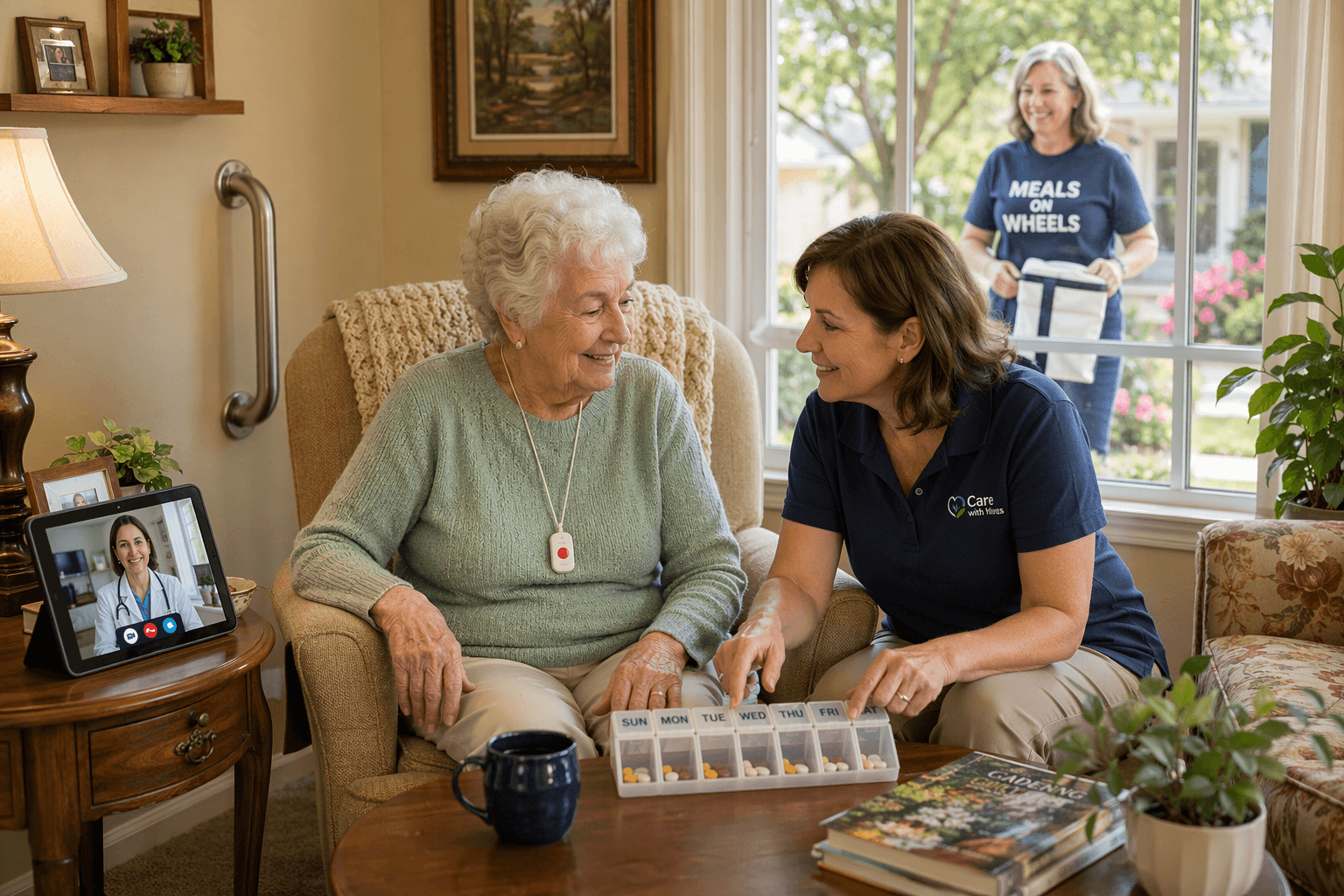
A coordinated care plan layers services from multiple sources — family, professional, and community — around the older adult at home.
Call the Eldercare Locator at 800-677-1116. This national, federally funded service connects you to your local Area Agency on Aging (AAA). The AAA is the single most useful resource for understanding what services are available in your parent's community, what they cost, and how to access them. They can also help with benefits screening for Medicaid, VA, and other programs.
Request a functional assessment. Before you can build a care plan, you need to know exactly what your parent can and cannot do independently. An occupational therapist or a geriatric care manager can conduct a formal assessment of ADLs (bathing, dressing, toileting, transferring, eating) and IADLs (medication management, meal preparation, transportation, housekeeping). This assessment becomes the foundation for every service decision.
Explore PACE and CAPABLE eligibility. If your parent is 55+ and meets nursing home level-of-care criteria, check whether a PACE program operates in their area. If they have at least one functional limitation and no memory disorder, check whether CAPABLE is available. These two programs offer the highest value per dollar of any aging-in-place service.
Request a home safety assessment. An occupational therapist or a CAPS-certified contractor can evaluate the home for fall hazards and recommend modifications. Many AAAs offer free or low-cost home safety assessments. The assessment should cover every room — bathroom, bedroom, kitchen, stairs, entryways — and identify both immediate fixes (grab bars, non-slip mats) and longer-term projects (ramp installation, bathroom conversion).
Check VA benefits for veterans and surviving spouses. If your parent is a veteran or the surviving spouse of a veteran, contact the VA or a Veterans Service Officer (VSO) to check eligibility for Aid and Attendance, SAH/SHA home modification grants, and respite care. These benefits are often underclaimed — do not assume your parent does not qualify without checking.
Build your service combination and cost estimate. Using the tables in this guide as a starting point, list the services your parent needs, estimate the monthly cost, and identify which funding sources can cover each service. Most families will combine Medicare (for short-term skilled needs), Medicaid or VA (for ongoing personal care), and private pay (for gaps). Long-term care insurance, if available, can fill additional gaps.
Revisit the plan regularly. Aging in place is not a one-time decision. As your parent's functional needs change — after a hospitalization, a fall, or a progression of dementia — the care plan must evolve. Set a reminder to review the plan every 3 to 6 months, or after any significant health event.
Aging in place is not about doing everything yourself. It is about knowing what exists, how to access it, and how to combine services into a plan that works for your parent and your family. The ecosystem is complex, but it is navigable — one step at a time.


Comments
Join the discussion with an anonymous comment.