
Room checklist
How to Fund a Senior Bathroom Remodel: A Step-by-Step Hierarchy of Grants, VA Benefits, and Tax Breaks
Many families assume Medicare pays for bathroom modifications, but it generally does not. This guide provides a clear, prioritized path through VA grants, Medicaid waivers, federal programs, nonprofit assistance, and tax deductions to help you fund a safer bathroom.
The Financial Shock: Why Most Families Assume Medicare Will Pay
You have just watched your mother struggle to step over the bathtub wall for the third time this week. Or maybe you got the call — a fall, a trip to the ER, a hip that will never be the same. The bathroom, that small room she uses a dozen times a day, has become a hazard zone. Your first thought is practical: we need to fix this. Your second thought, the one that brings a wave of relief, is that Medicare will help cover the cost.
That relief is almost always premature. The hard truth is that Original Medicare explicitly does not pay for home modifications, including bathroom remodels. This misconception leads families down a costly path of delays, out-of-pocket spending, and missed opportunities for financial assistance. The good news is that a real funding path exists — but it requires knowing which doors to knock on and in what order.
A full bathroom remodel for aging in place typically runs between $6,600 and $28,000 nationally, with an average cost of about $11,200. For a family already stretched by caregiving responsibilities, that figure can feel insurmountable. But a combination of VA grants, Medicaid waivers, federal programs, nonprofit assistance, and medical tax deductions can cover a substantial portion — if you follow the right hierarchy.
What Original Medicare Actually Covers (and What It Doesn't)
Before you explore other funding sources, you need a clear picture of what Original Medicare (Part B) will and will not pay for. This sets realistic expectations and prevents wasted effort.
Original Medicare covers two things relevant to a bathroom remodel:
- An occupational therapist's home evaluation. Medicare Part B covers 80% of the cost of an OT evaluation to assess fall risks and recommend modifications. This is a critical first step — the OT's written recommendation becomes the medical justification you will need for nearly every funding source on this list.
- Durable medical equipment (DME) when medically prescribed. Items like grab bars, raised toilet seats, and shower chairs may be covered as DME if a physician prescribes them. However, Medicare pays for the equipment itself, not the installation or any structural work required to mount it.
What Medicare does not cover: construction, demolition, plumbing, electrical work, tiling, flooring replacement, doorway widening, walk-in tub installation, or any permanent structural change. If it requires a contractor and a permit, Medicare will not pay for it.
Medicare Advantage Plans: A State-by-State Wild Card
Medicare Advantage (Part C) plans operate differently from Original Medicare. In 2019 and 2020, the Centers for Medicare & Medicaid Services expanded the list of supplemental benefits that Advantage plans could offer to include home modifications for beneficiaries with chronic conditions. This means some plans now cover bathroom safety modifications — but it is far from universal.
Coverage varies by:
- State and county — not all regions offer plans with these expanded benefits.
- Carrier — some insurers have embraced the flexibility; others have not.
- Plan tier — higher-premium plans are more likely to include home modification benefits.
- Chronic condition requirement — the beneficiary typically must have a qualifying chronic illness, not just general age-related mobility decline.
Medicaid HCBS Waivers: The Best Bet for Low-Income Seniors
For seniors who meet income and asset limits, Medicaid Home and Community-Based Services (HCBS) waivers are often the most generous funding source for bathroom modifications. Over 30 states offer HCBS waivers that specifically cover what Medicaid calls 'Environmental Accessibility Adaptations' — structural changes that allow a beneficiary to remain safely at home rather than enter a nursing facility.
What these waivers typically cover:
- Grab bar installation (including reinforcement of wall studs)
- Roll-in or curbless shower construction
- Walk-in tub installation
- Widening of doorways for wheelchair or walker access
- Non-slip flooring replacement
- Lever-style faucet and door handle installation
The catch is that each state runs its own waiver program with its own eligibility criteria, covered modifications, and funding caps. Some states have robust programs with annual limits of $10,000–$25,000 per beneficiary; others have narrow programs that cover only basic grab bars and ramps.
VA Benefits: The Most Generous Option for Eligible Veterans and Survivors
If the older adult in your care is a veteran or the surviving spouse of a veteran, this is the first door you should knock on. The Department of Veterans Affairs offers several grant programs that can cover a significant portion — or even the entirety — of a bathroom remodel.
| Grant Program | Maximum Amount (2026) | Best For | Key Eligibility |
|---|---|---|---|
| Specially Adapted Housing (SAH) | $117,014 | Major structural changes for veterans with specific service-connected disabilities | Must have qualifying service-connected disability (e.g., loss of use of legs, severe burn injuries) |
| Special Home Adaptation (SHA) | $23,438 | Modifications for veterans with specific service-connected vision or mobility impairments | Must have qualifying service-connected disability affecting vision or mobility |
| Home Improvements and Structural Alterations (HISA) | $6,800 (service-connected) / $2,000 (non-service-connected) | Medically necessary modifications for any enrolled veteran | Physician prescription required; covers grab bars, ramps, roll-in showers |
The SAH grant is the most generous option, providing up to $117,014 for veterans with qualifying service-connected disabilities. This can fund a complete bathroom renovation, including structural changes like curbless showers, widened doorways, and reinforced walls for grab bars. The HISA grant is more accessible — it covers medically necessary modifications for any enrolled veteran, regardless of whether the condition is service-connected, though the funding cap is lower.
Federal Grants and Loans: USDA, HUD, and Other Programs
For seniors who do not qualify for VA benefits but have very low incomes, two federal programs can help fund bathroom modifications.
| Program | Maximum Assistance | Eligibility | Use for Bathroom Modifications |
|---|---|---|---|
| USDA Section 504 Home Repair Program | Grant up to $10,000; loan up to $20,000 | Very-low-income homeowners age 62+ in rural areas | Covers grab bars, ramps, roll-in showers, non-slip flooring, and other safety modifications |
| HUD Title 1 Home Improvement Loan | Up to $25,000 (single-family) | Homeowners with equity; no age or income limit | Can fund any permanent improvement, including bathroom remodels |
The USDA Section 504 program is particularly valuable for seniors in rural areas. The grant portion — up to $10,000 — does not need to be repaid, making it one of the few sources of free money for non-veterans. The loan portion can be used for more extensive work. Eligibility is based on very-low-income thresholds that vary by county, so check the USDA Rural Development website for your area.
Nonprofit Assistance and Community Programs
Several national and local nonprofit organizations provide no-cost or low-cost bathroom safety modifications for seniors and veterans. These programs are often overlooked but can be a lifeline for families who do not qualify for VA benefits or Medicaid.
- Rebuilding Together — The Safe at Home program provides free safety modifications including grab bars, handrails, non-slip flooring, and lighting upgrades for low-income seniors. They operate through local affiliates in most states.
- Habitat for Humanity — Many local Habitat affiliates offer an Aging in Place program that can install grab bars, ramps, and other modifications at reduced or no cost for qualifying homeowners.
- Heroes at Home — Provides home modifications for wounded veterans, including bathroom accessibility improvements.
- Local Area Agencies on Aging (AAA) — Your local AAA can connect you with community-based programs that offer free or low-cost home safety assessments and modifications.
Nonprofit programs typically have limited funding and long waiting lists. Apply early and be prepared to provide documentation of income and medical need.
Medical Tax Deductions: Making the IRS Help Pay for Your Remodel
Even after exhausting grants and assistance programs, you may still face out-of-pocket costs. Medical tax deductions can reduce the net cost of your bathroom remodel by allowing you to deduct qualifying expenses from your taxable income.
The IRS allows you to deduct medical expenses that exceed 7.5% of your adjusted gross income (AGI). Medically prescribed home modifications qualify as medical expenses if they are:
- Prescribed in writing by a physician as medically necessary for the taxpayer, spouse, or dependent.
- Permanent improvements that do not increase the value of the home (or the deductible amount is limited to the cost of the improvement minus any increase in property value).
Commonly deductible bathroom modifications include:
- Grab bars and handrails (including wall reinforcement)
- Walk-in tubs or roll-in showers
- Widened doorways for wheelchair access
- Non-slip flooring
- Lever-style faucets and door handles
- Raised toilet seats and comfort-height toilets
Your Funding Decision Flowchart: Which Path to Pursue First
The key to maximizing financial assistance is pursuing funding sources in the right order. Here is the hierarchy you should follow, based on eligibility:
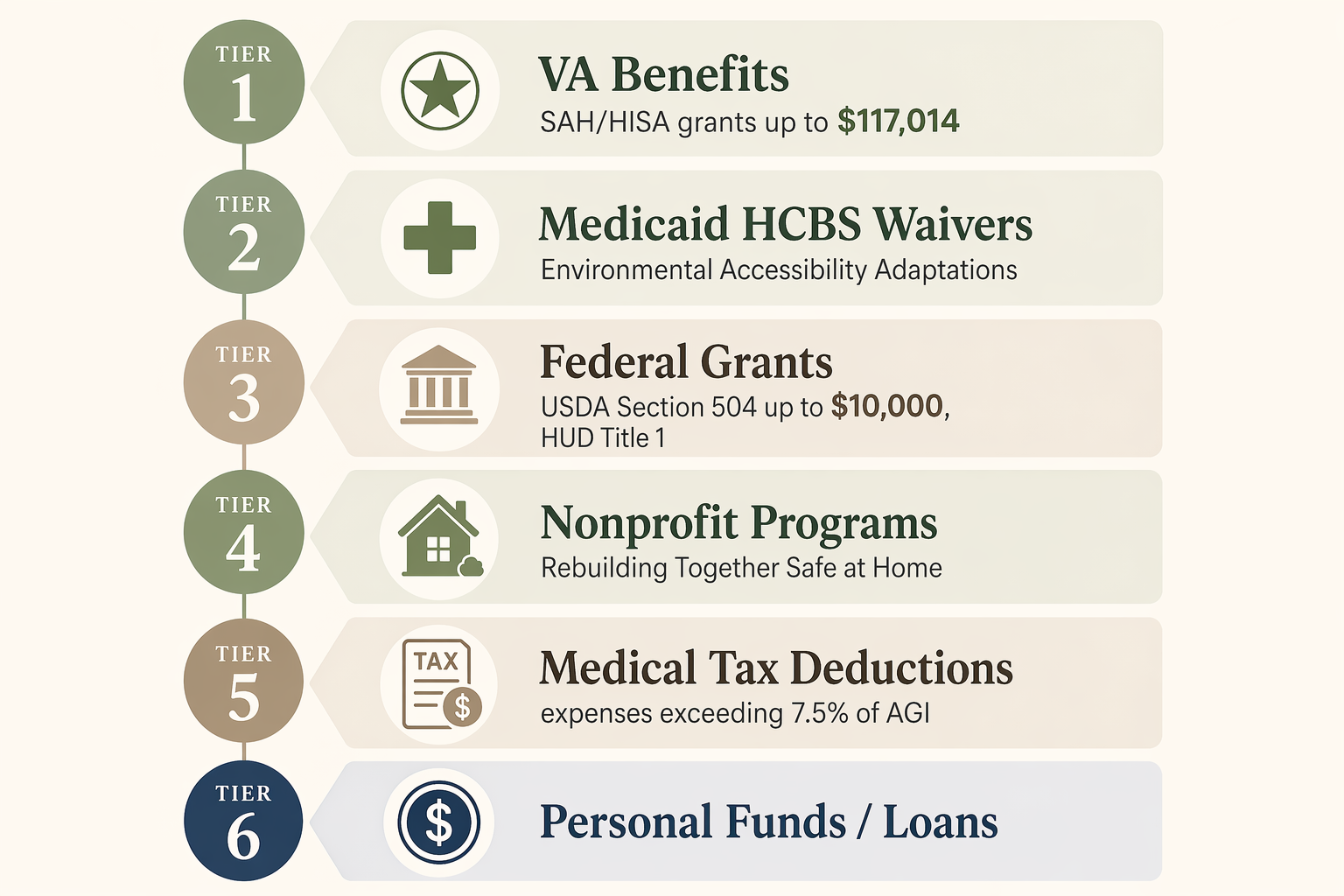
- Is the senior a veteran or surviving spouse? Start with VA benefits (SAH, SHA, or HISA grants). This is the most generous option available.
- Does the senior meet income and asset limits for Medicaid? Apply for your state's HCBS waiver. Over 30 states offer Environmental Accessibility Adaptations.
- Is the senior a very-low-income homeowner in a rural area? Apply for the USDA Section 504 grant (up to $10,000).
- Does the senior have a Medicare Advantage plan? Call the plan to ask about home modification benefits for chronically ill beneficiaries.
- Contact local nonprofit programs (Rebuilding Together, Habitat for Humanity) for free or low-cost modifications.
- For remaining costs, work with a CAPS-certified contractor to get itemized bids and a physician's prescription to qualify for medical tax deductions.
This hierarchy ensures you pursue the most generous funding sources first. Many families make the mistake of starting with personal savings or loans, only to discover later that they qualified for a VA grant or Medicaid waiver that would have covered the entire project.
Call Scripts and Documentation Checklist: Your Toolkit for Success
Applying for funding requires persistence and organization. Use these call scripts and documentation checklist to streamline the process.
Call Script for VA Benefits
"Hello, I am calling about the Specially Adapted Housing grant and the HISA grant. My [father/mother/spouse] is a veteran and we need bathroom modifications for safety. Can you tell me: (1) what documentation is required to apply, (2) whether a physician's prescription is needed, and (3) what the current grant amounts are for 2026?"
Call Script for Medicaid HCBS Waiver
"Hello, I am calling about the Home and Community-Based Services waiver program. My [mother/father] is a [state] resident and needs bathroom modifications to avoid moving to a nursing home. Can you tell me: (1) whether your state's HCBS waiver covers Environmental Accessibility Adaptations, (2) what the income and asset limits are, and (3) what documentation is required to apply?"
Call Script for Nonprofit Programs
"Hello, I am calling about your Safe at Home / Aging in Place program. My [parent] is a senior on a fixed income and we need bathroom safety modifications. Can you tell me: (1) whether you serve our county, (2) what the income eligibility requirements are, (3) what types of modifications you cover, and (4) how long the waiting list is?"
Documentation Checklist
Before you call any funding source, gather these documents. Having them ready will speed up every application.
- Physician's prescription or letter of medical necessity stating the specific modifications needed and why they are medically necessary.
- Occupational therapy home evaluation report (covered by Medicare Part B).
- Itemized contractor bids from at least two qualified contractors (preferably CAPS-certified).
- Proof of income (tax returns, Social Security statements, pension statements).
- Proof of assets (bank statements, investment accounts).
- Proof of age (birth certificate or driver's license).
- Proof of veteran status (DD-214 discharge papers) if applying for VA benefits.
- Proof of homeownership (deed, property tax statement).
- Photos of the current bathroom showing the hazards that need to be addressed.
For a broader overview of all funding sources before diving into the specific hierarchy, see our companion guide: How to Pay for a Senior Bathroom Remodel: Grants, Loans, and Assistance Programs in 2026. And if you are still deciding between modifying the home or moving to assisted living, read Does an Aging-in-Place Remodel Pay for Itself? for a financial comparison.
Related reading
Need a professional assessment?
Find a CAPS-credentialed professional or local aging services through our outbound resource list — we never name or rank individual contractors.
Find Local HelpNoticed something outdated or inaccurate on this page? Flag a correction. We review every report against CDC, NIA, and AARP HomeFit guidance before updating a page.