
Room checklist
Why 40% of Repeat Fallers Still Have No Bathroom Modifications — and What to Do About It
Nearly 40% of Medicare beneficiaries who have fallen repeatedly still have no bathroom safety modifications. This article examines the research behind the adoption gap, the evidence for effective modifications, and the psychological and practical barriers that keep families from acting after a first fall.
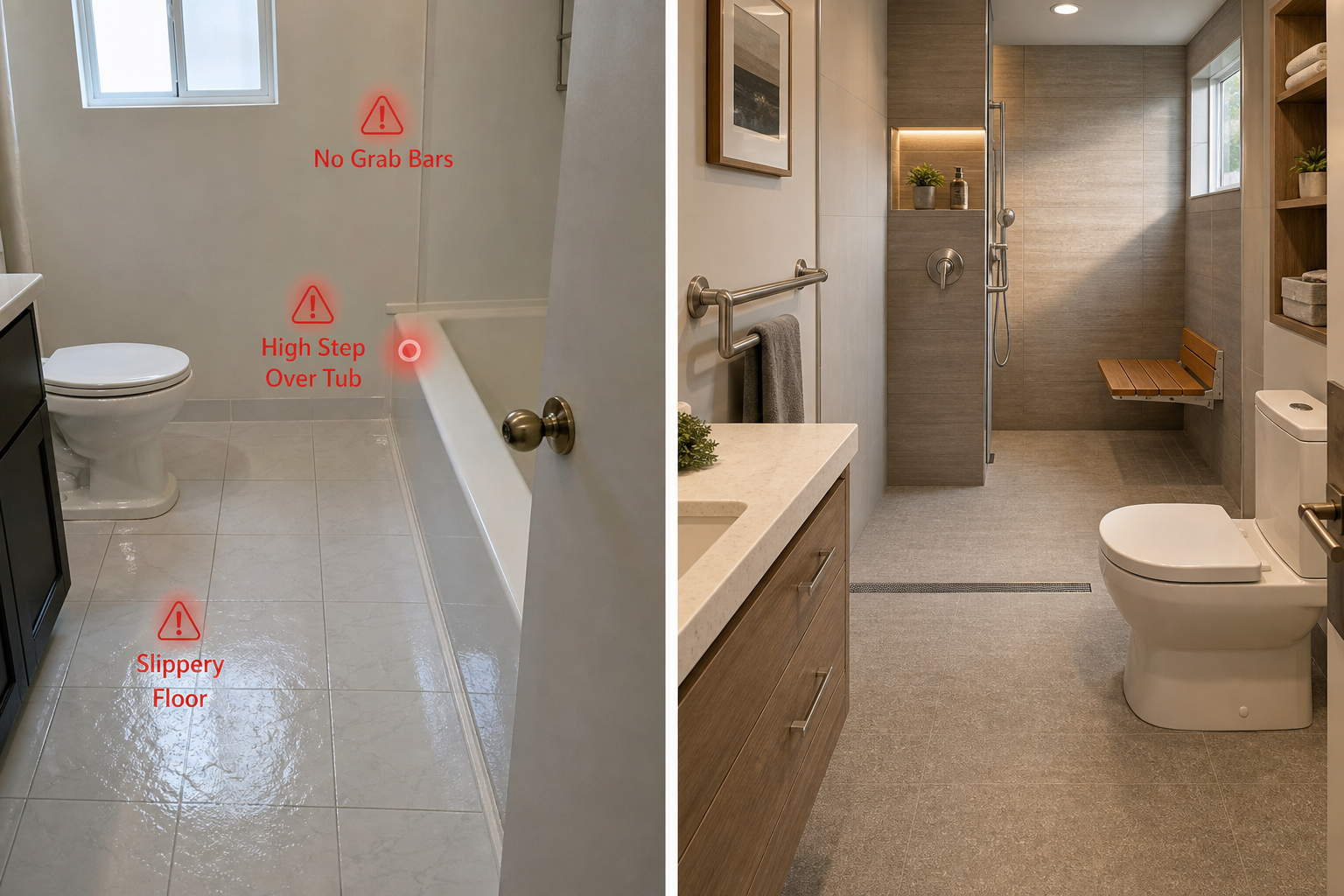
The 40% Problem: Why Repeat Fallers Still Lack Bathroom Modifications
A first fall is often a warning shot. Yet for millions of older adults, that warning does not lead to action. According to a 2022 study by Ng et al. published in Health and Social Care in the Community, approximately 40.2% of Medicare beneficiaries who had experienced repeated falls had no bathroom modifications at all. Extrapolated to the national population, this represents roughly 1.9 million older adults who have fallen more than once and still live with unmodified bathrooms — the most hazardous room in the home.
The study, which analyzed data from the 2016 Medicare Current Beneficiary Survey, included 2,404 community-dwelling adults aged 65 and older who had experienced at least one fall. Among them, 50.1% had fallen repeatedly (two or more falls). Of those repeat fallers, only about 60% had made any bathroom safety changes. The remaining 40% — nearly two million people — had not installed a single grab bar, non-slip mat, raised toilet seat, or other basic modification.
How Common Are Bathroom Falls? The Data Behind the Risk
To understand why the 40% figure matters, it helps to look at the broader fall landscape. The CDC reports that more than one in four older adults (age 65+) falls each year. Those falls result in approximately 3 million emergency department visits and about 1 million hospitalizations annually. The total healthcare cost of non-fatal older adult falls reached $80 billion in 2020, up from $50 billion in 2015, according to data cited by the National Council on Aging (NCOA). Medicare covers 67% of these costs.
The bathroom is a disproportionate contributor to this crisis. While the exact number of bathroom-specific fall-related ER visits is difficult to pin down from national surveillance data alone, one commonly cited figure — approximately 235,000 ER visits per year among older adults due to bathroom injuries — comes from a CDC analysis. The combination of wet, hard surfaces, the need to transition between standing and sitting, and the lack of stable handholds makes the bathroom uniquely dangerous.
What the Research Says About Modifications That Work
The evidence that specific bathroom modifications reduce fall risk is strong. The most compelling single study comes from Levine et al. (2021), published in Human Factors. Researchers had 63 adults complete a hazardous bathtub exit task with an unpredictable external balance perturbation. Of the participants, 32 were provided a grab bar and 31 were not. The results were striking: participants with a grab bar were 75.8% more likely to recover their balance during the task. In every case where a participant successfully grasped the grab bar, balance recovery was achieved.
Beyond grab bars, other evidence-supported modifications include curbless (zero-threshold) showers that eliminate the step-over hazard, non-slip flooring materials, and comfort-height toilets (17–19 inches versus the standard 15 inches) that reduce the difficulty of sit-to-stand transfers. For a deeper dive into the clinical evidence for each of these modifications, see our evidence-based review of bathroom modifications.
Who Gets Modifications — and Who Doesn't: Racial and Ethnic Disparities
The Ng et al. study also revealed stark disparities in who has bathroom modifications. After controlling for demographic and health factors, the researchers found that non-Hispanic Black beneficiaries had 62% lower odds (OR = 0.38) of having bathroom modifications compared to non-Hispanic White beneficiaries. Hispanic beneficiaries had 36% lower odds (OR = 0.64). These disparities persisted even when accounting for income, education, and health status.
| Population Group | Odds Ratio (OR) | Interpretation |
|---|---|---|
| Non-Hispanic White | 1.00 (reference) | Baseline odds of having bathroom modifications |
| Non-Hispanic Black | 0.38 (p < 0.001) | 62% lower odds of having modifications |
| Hispanic | 0.64 (p = 0.039) | 36% lower odds of having modifications |
Several factors likely contribute to these disparities. Financial barriers are one obvious candidate: home modifications require upfront cash that may not be available to families with fewer resources. Housing stock differences also play a role — older homes in lower-income neighborhoods may have bathrooms that are structurally harder to modify. Access to information about modification options and funding sources may be uneven. Cultural factors, including differing norms around accepting help or modifying a home, may also influence decisions.
For families facing financial barriers, our guide to elder care assistance programs covers federal, state, and local benefits — including Medicaid waivers, VA grants, and nonprofit programs — that may help offset the cost of bathroom modifications.
The Fear-of-Falling Cycle: Why a First Fall Doesn't Always Lead to Action
Even when the evidence is clear and the cost is manageable, many families still do not act. The reason is often psychological. The CDC notes that many people who fall become afraid of falling. This fear can paradoxically increase fall risk: older adults reduce their activity to avoid falling, which leads to muscle weakness and balance deterioration, which in turn makes falls more likely. Falling once doubles the risk of falling again.
Beyond the fear-of-falling cycle, older adults may resist bathroom modifications for several reasons:
- Loss of independence: Accepting a grab bar or shower chair can feel like admitting you can no longer care for yourself. For many older adults, the bathroom is one of the last private spaces where they manage their own care.
- Aesthetic concerns: Standard grab bars and safety equipment are often associated with an institutional, hospital-like appearance. Many older adults do not want their home to look like a medical facility.
- Denial or minimization:
- Cost concerns: Even a modest modification like grab bar installation can feel like an unnecessary expense, especially for older adults on fixed incomes who are already managing healthcare costs.
For adult children, the challenge is often how to start the conversation. If your parent has dementia, resistance to bathing and bathroom changes can be especially intense. Our guide on bathing a parent with dementia offers strategies for addressing resistance in a way that respects your parent's dignity.
A Practical Decision Framework for Families After a First Fall
If your parent has fallen — even once — the time to act is now. Waiting for a second fall is waiting for a hospitalization. Here is a practical framework to move from concern to action.
Step 1: Assess the Bathroom for Hazards
Walk through the bathroom with a critical eye. Key hazards to look for:
- No grab bars near the toilet or in the shower/tub area
- A bathtub with a high step-over threshold (typically 12–18 inches)
- Slippery floor surfaces, especially when wet
- A standard-height toilet (15 inches) that requires significant effort to stand from
- Poor lighting, especially between the bedroom and bathroom at night
- Throw rugs or bath mats that can slide or catch a foot
Step 2: Have the Conversation
Frame the conversation around safety and independence, not decline. Emphasize that modifications are what make it possible to stay at home longer — not a sign that staying at home is no longer possible. If your parent is resistant, focus on the highest-impact, least-invasive change first: a single grab bar in the shower or tub area.
Step 3: Decide on the Right Level of Intervention
Not every bathroom needs a full renovation. The right approach depends on your parent's current mobility, fall history, and the bathroom's existing layout. Here is a quick guide to the three main paths:
| Approach | Best For | Examples |
|---|---|---|
| DIY grab bar installation | Good upper-body strength; simple tub/shower layout; no structural changes needed | Single grab bar near tub entry; non-slip mat; raised toilet seat |
| CAPS-certified contractor | Multiple modifications needed; structural changes (e.g., curbless shower); complex layouts | Grab bars installed into blocking; walk-in shower; widened doorway |
| Occupational therapist evaluation first | Significant mobility limitations; recent hospitalization; multiple falls; dementia | Full functional assessment; personalized modification plan; ADL training |
Step 4: Prioritize the Highest-Impact Modifications First
If budget is a constraint, start with the modification that has the strongest evidence: a grab bar in the shower or tub area. The Levine et al. study showed that even a single grab bar, when properly installed and used, dramatically improves the ability to recover from a loss of balance during bathtub exit. A non-slip bath mat and a raised toilet seat are low-cost additions that also provide meaningful risk reduction.
When to Call a CAPS-Certified Contractor vs. an Occupational Therapist
Many families are unsure whether to start with a contractor or a therapist. The distinction matters because these two professionals serve different roles, and the right starting point depends on your parent's needs.
| Professional | Primary Role | When to Start Here |
|---|---|---|
| CAPS-certified contractor | Structural renovations, code-compliant installation, project management | You already know what modifications are needed; the project involves structural changes (e.g., curbless shower, doorway widening); you need a reliable installer |
| Occupational therapist (OT) | Functional assessment, personalized modification recommendations, ADL training | You are unsure what modifications are needed; your parent has complex mobility or cognitive challenges; a recent hospitalization or surgery has changed their functional status |
| Both (OT first, then CAPS contractor) | OT assesses and recommends; contractor installs | Your parent has significant mobility limitations; you want a professional assessment before spending money on renovations; the project is large enough to warrant both |
An occupational therapist can identify needs that a contractor would not catch — for example, that your parent would benefit from a specific grab bar placement based on their height, reach, and dominant hand, or that a transfer bench would be more appropriate than a full shower modification. A CAPS-certified contractor, on the other hand, ensures that modifications are installed to code, with proper structural support, and that the finished product is safe and durable.
For a broader view of how bathroom modifications fit into a whole-home fall prevention strategy, see our guide to home modifications that prevent falls, which covers prioritization across all rooms of the home.

Related reading
Need a professional assessment?
Find a CAPS-credentialed professional or local aging services through our outbound resource list — we never name or rank individual contractors.
Find Local HelpNoticed something outdated or inaccurate on this page? Flag a correction. We review every report against CDC, NIA, and AARP HomeFit guidance before updating a page.