
Room checklist
Your Parent's Home Isn't Safe — But You're Calling the Wrong Person First
Most families call a contractor the moment they realize a parent's home is unsafe. But the right first call is often a Certified Aging-in-Place Specialist (CAPS) — an assessor and coordinator who fills the gap between spotting a hazard and getting it fixed. This article explains what a CAPS does, when to hire one, and how to find the right professional for your family.
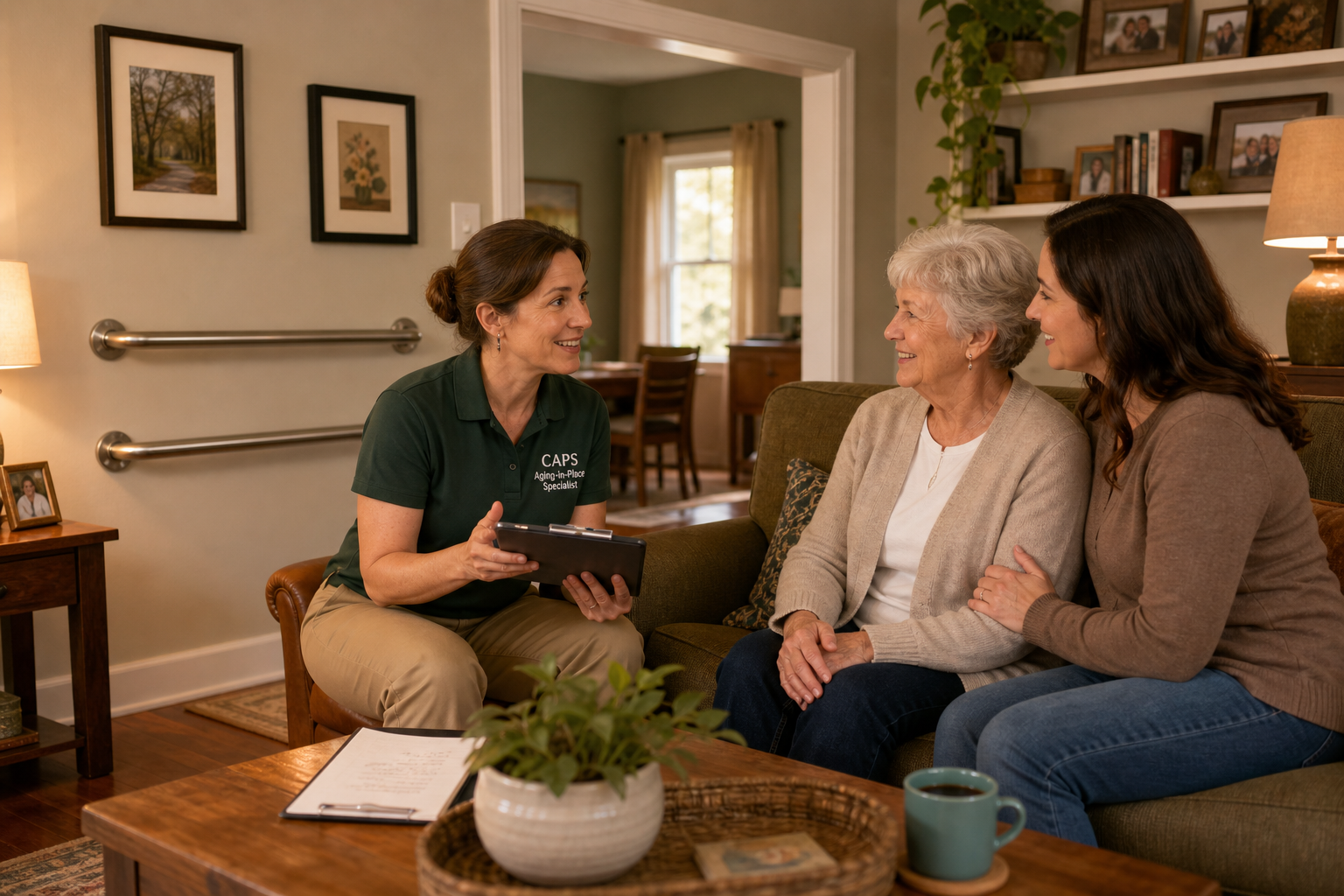
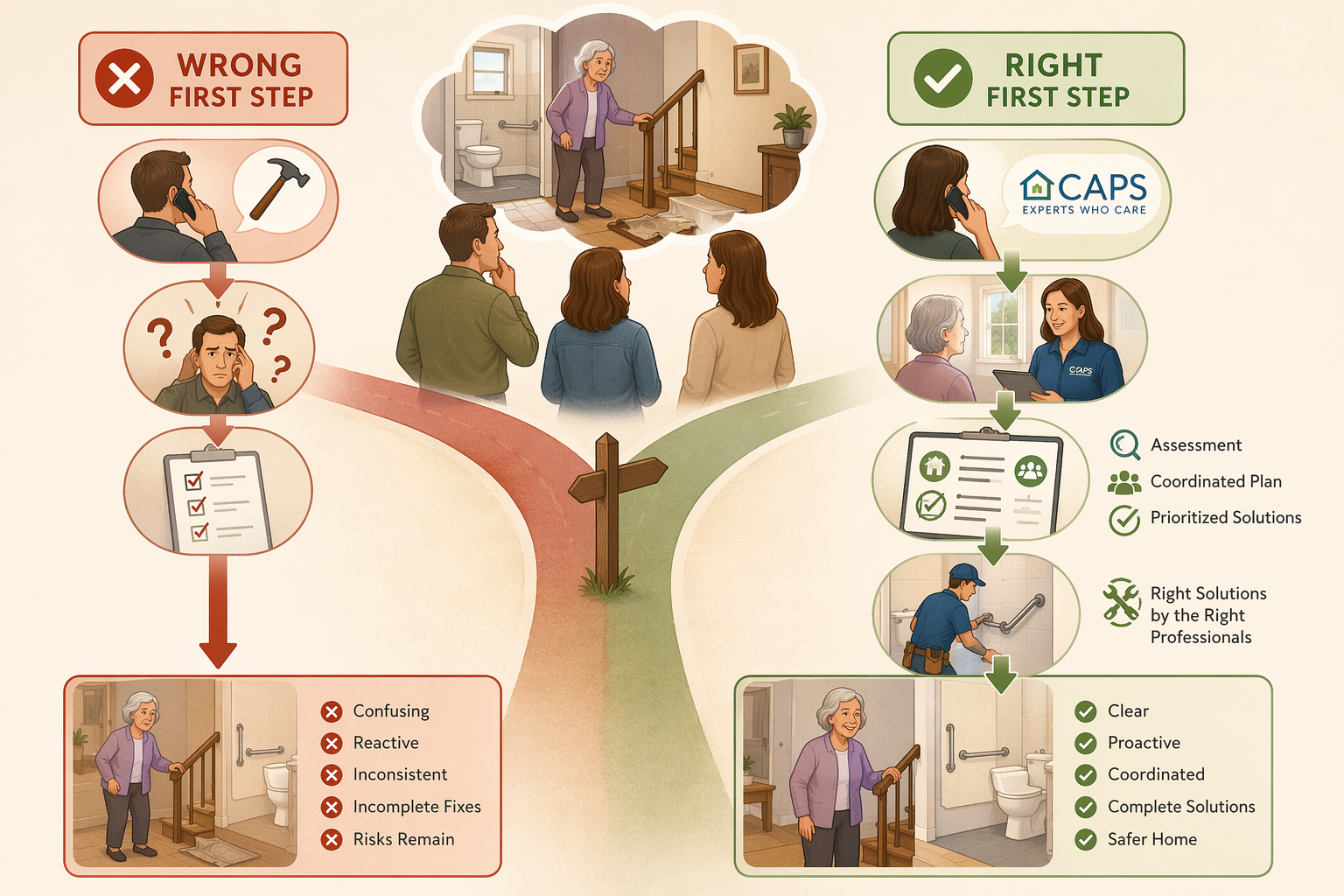
The Moment You Realize the House Isn't Safe — and the Wrong First Call
It happens in a single, unsettling moment. You walk into your parent's home and see the clutter on the stairs, the dim hallway, the bathroom with no grab bars. Or maybe you've just helped them up from a fall, and your hands are still shaking. The instinct is immediate and practical: call a contractor. Get someone in here to fix things.
That instinct is understandable, but it's almost always the wrong first move. A general contractor is trained to build and renovate — not to assess a home comprehensively for aging-in-place needs. Calling one before you have a plan is like hiring a carpenter before you have blueprints. You'll likely end up with expensive work that misses the real problems.
The professional you actually need first is a Certified Aging-in-Place Specialist (CAPS). Most families have never heard of this role, which is precisely the problem. A CAPS fills the critical gap between recognizing a hazard and getting it fixed — and skipping this step is one of the most common and costly mistakes families make.
What a Certified Aging-in-Place Specialist Actually Does
A CAPS is not a builder. The credential, jointly developed by AARP and the National Association of Home Builders (NAHB), trains professionals to assess homes, plan modifications, coordinate contractors, and verify that the work is done correctly. CAPS professionals come from varied backgrounds — construction, occupational therapy, nursing, interior design, and real estate — and complete three NAHB courses covering design concepts, construction solutions, and client communication.
The process typically follows four steps:
- Home assessment and safety evaluation. The CAPS walks through every room, identifying hazards, measuring doorways, checking lighting, and evaluating the home's structural capacity for modifications. This is far more thorough than what a contractor would do during a free estimate.
- Modification planning with cost estimates. Based on the assessment, the CAPS creates a prioritized plan — what needs to happen immediately, what can wait, and what each modification will cost. This plan becomes the blueprint for any contractor work.
- Contractor coordination and quote management. If the CAPS doesn't do the work themselves, they help you find qualified contractors, review bids, and ensure the quotes match the plan. This step alone can save families thousands of dollars and months of frustration.
- Follow-up walkthrough. After the work is done, the CAPS returns to verify that every modification was installed correctly and actually meets the family's needs.
Amy Roberts, a CAPS professional quoted in Care.com, estimates that less than 4% of homes in the U.S. housing market are aging-in-place ready. That means 96% of homes need some level of modification — and most families don't know where to start.
What It Costs to Hire a CAPS Specialist
Cost is often the first question families ask, and the answer depends on the scope of work. The table below summarizes typical costs based on data from AgingInPlaceDirectory and other industry sources.
| Service or Modification | Typical Cost Range | Notes |
|---|---|---|
| Home safety assessment (full report with visuals) | $300 – $1,000 | Includes room-by-room evaluation and prioritized plan |
| Hourly consultation | $75 – $200/hr | For families who want guidance without a full assessment |
| Grab bars (installed) | $100 – $300 each | One of the most cost-effective safety upgrades |
| Wheelchair ramp | $1,500 – $5,000 | Cost varies by length, materials, and site conditions |
| Stairlift | $3,000 – $5,000 | Straight stairlifts; curved models cost more |
| Walk-in tub | $5,000 – $15,000 | Includes installation; prices vary by features |
| Major kitchen or bathroom renovation | $10,000 – $50,000+ | Full remodel with accessibility features |
These figures are directional ranges, not hard averages. A CAPS assessment in a high-cost metro area will run closer to $1,000, while the same service in a rural area might be $400. The key point: the assessment cost is a fraction of what you'd spend on unnecessary or poorly planned renovations.
For a deeper look at how these costs compare to the long-term expense of assisted living — and why families consistently underestimate the total price of aging in place — see our guide on the hidden costs of aging in place in 2026.
Room-by-Room: What a CAPS Might Recommend
A CAPS assessment doesn't just produce a list of problems — it produces a prioritized, room-by-room plan. Based on expert input from CAPS professionals, here are the specific modifications you can expect to see recommended.
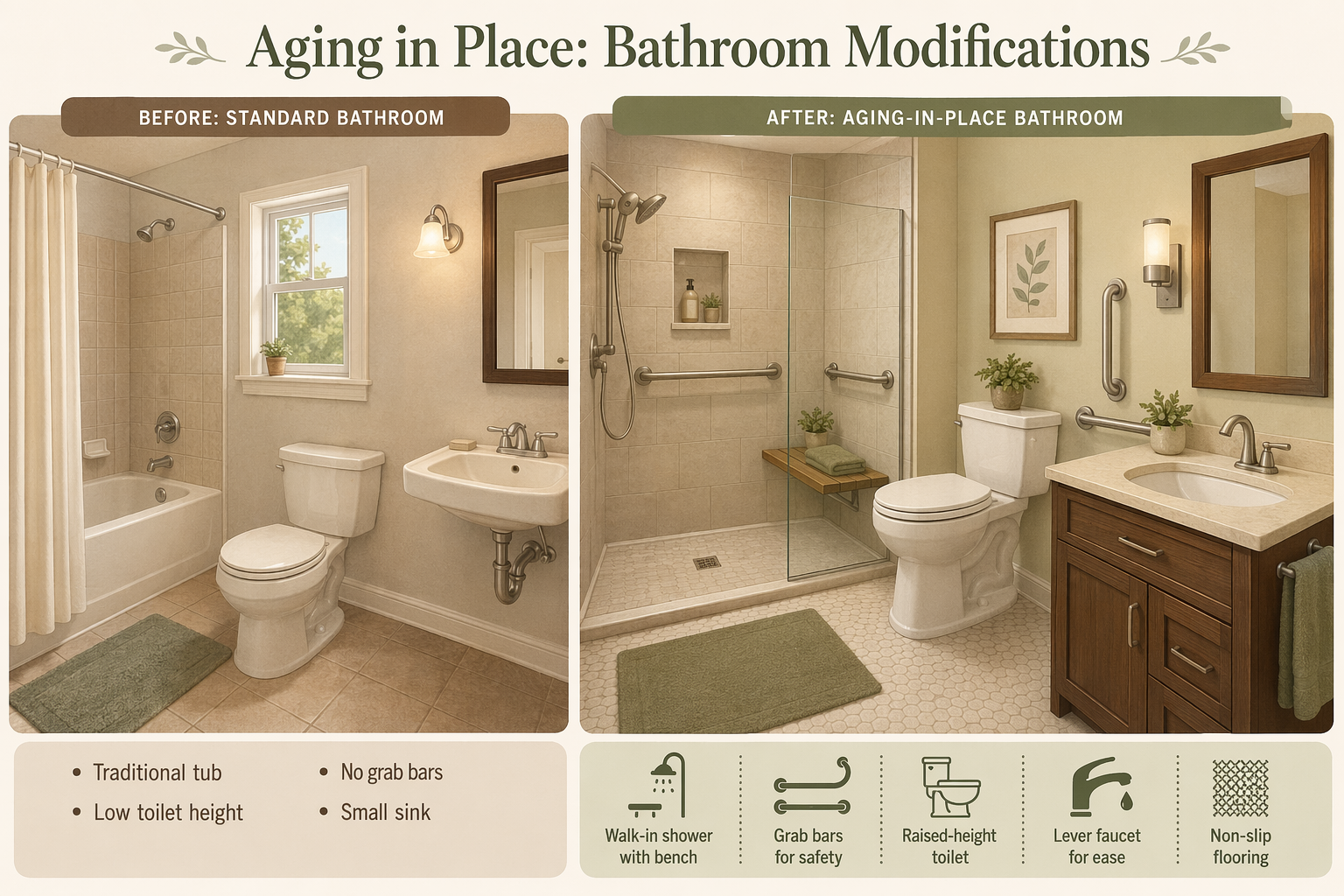
Bathroom
- Raised toilet (17–19 inches high) to reduce the effort of sitting and standing.
- Grab bars near the toilet and in the shower or tub area — not just towel bars that look like grab bars.
- Shower bench or transfer bench with a hand-held spray nozzle.
- Lever-style faucet handles instead of twist knobs.
- Non-slip flooring and a curbless or low-threshold shower entry.
Kitchen
- Microwave placed on the countertop rather than above the stove, eliminating the need to reach overhead.
- Stove with front-mounted temperature controls so the user doesn't have to reach across burners.
- Pull-out shelves and drawers in lower cabinets to reduce bending.
- Lever-style handles on cabinets and appliances.
Entryways and Doorways
- Doorways widened to at least 32 inches to accommodate walkers and wheelchairs.
- Zero-step or ramp entry at the main entrance.
- Lever-style door handles instead of round knobs.
Stairs and Hallways
- High-contrast stair treads so each step is visually distinct.
- Carpeting on stairs for traction and reduced impact in a fall.
- Soft, even lighting in hallways — no dark spots or harsh shadows.
- Handrails on both sides of the staircase, extending the full length.
For a complete, room-by-room priority guide organized by urgency — especially useful if you're planning modifications after a recent fall — see our aging-in-place remodel priority guide.
Four Signs It's Time to Call a CAPS Specialist
Not every family needs a CAPS assessment immediately. But these four situations are clear triggers that it's time to make the call.
- A mobility aid has entered the home. The moment a cane, walker, or wheelchair becomes part of daily life, the home's layout needs to be evaluated. Doorways that were fine for walking may be too narrow. Bathroom layouts that worked before may become dangerous. A CAPS can identify the specific changes needed to accommodate the new mobility device.
- There has been a recent fall or near-fall. A fall is the single strongest predictor of future falls. Even a near-miss — a stumble, a grab for the wall — means the environment is not safe. A CAPS assessment after a fall can identify the specific hazard and prevent a more serious injury.
- You're planning any home renovation. If you're already going to remodel a bathroom, kitchen, or entryway, this is the ideal time to incorporate aging-in-place features. Adding grab bars, widening a doorway, or installing a curbless shower costs far less during a renovation than as a separate project later.
- A dementia or Alzheimer's diagnosis has been made. Cognitive decline changes the safety equation entirely. Wandering, confusion, and impaired judgment create risks that standard home modifications don't address. A CAPS with dementia-specific experience can recommend modifications like secure door alarms, simplified layouts, and visual cues that support safe navigation.
How a CAPS Differs From Other Professionals You Might Call
Families often confuse the CAPS role with other professionals. The table below clarifies who does what, so you can make the right first call.
| Professional | Primary Focus | When to Call |
|---|---|---|
| CAPS (Certified Aging-in-Place Specialist) | The home environment — assessing, planning, and coordinating modifications | When you need a comprehensive safety assessment and a prioritized modification plan before any construction begins |
| General Contractor | Building and renovation — executing construction work | After you have a CAPS plan and need someone to install grab bars, widen doorways, or remodel rooms |
| Occupational Therapist (OT) | The person's functional abilities — clinical assessment of mobility, strength, and daily living skills | When you need a clinical evaluation of what the older adult can and cannot do safely |
| Home Care Provider | Personal care — bathing, dressing, meal preparation, medication reminders | When the older adult needs hands-on help with daily tasks, not structural changes to the home |
The key distinction: a CAPS focuses on the place, not the person. An OT assesses the individual's physical abilities; a CAPS assesses whether the home environment supports those abilities. Both are valuable, and they often work together. But if you're looking at a cluttered staircase and wondering whether to call a contractor, an OT, or a home care agency, the answer is almost always: start with a CAPS.
For a quick reference on how CAPS fits alongside other common caregiving acronyms, see our caregiver's cheat sheet for POA, CAPS, and PERS.
How to Find a CAPS Specialist and What to Ask Before Hiring
The NAHB member directory is the most reliable way to find CAPS-certified professionals. Not all CAPS professionals are listed in the directory, but it's the best starting point. You can also search for local remodeling companies that advertise CAPS certification on their websites.
Once you have a few candidates, ask these questions before hiring:
- How many aging-in-place assessments have you completed? Experience matters. A CAPS who has done 50 assessments will spot problems a newer professional might miss.
- Can you provide references from similar projects? Ask for references from families whose situation was similar to yours — same home type, same mobility challenges, same budget.
- Do you coordinate with contractors, or do you work with a specific team? Some CAPS professionals also do the installation work. Others only assess and plan. Know which model you're getting.
- What does your assessment report include? A thorough report should include room-by-room findings, prioritized recommendations, estimated costs, and — ideally — photos or diagrams of the proposed changes.
- What is your fee structure? Is the assessment a flat fee or hourly? Does the fee include a written report? Are follow-up visits included?
A note on availability: there is no national registry of CAPS professionals beyond the NAHB directory. Families in areas without NAHB-member contractors may have difficulty locating a CAPS. In that case, consider working with an occupational therapist who specializes in home safety assessments, or ask a local remodeling company if they have staff with CAPS training.
If any of the four signs apply to your family, the right first step is clear: start with an assessment, not a renovation. A CAPS specialist will give you a roadmap that saves money, reduces stress, and — most importantly — keeps your parent safe in the place they want to be.
Related reading
- CAPS vs. Other Aging-in-Place Certifications: Which Credential Should You Trust for Your Parent’s Home Modifications?
- 10 Signs Your Parent's Home Needs a CAPS Assessment — Before a Fall Forces the Decision
- Aging in Place Specialist vs. Occupational Therapist: Who Should You Call for Home Modifications?
Need a professional assessment?
Find a CAPS-credentialed professional or local aging services through our outbound resource list — we never name or rank individual contractors.
Find Local HelpNoticed something outdated or inaccurate on this page? Flag a correction. We review every report against CDC, NIA, and AARP HomeFit guidance before updating a page.