
Glossary entry
POA, CAPS, and PERS: A Caregiver's Cheat Sheet for the Three Acronyms That Determine Where Your Parent Lives, Who Makes Medical Decisions, and How They Stay Safe
The Crisis That Starts Everything
Your mother took a hard fall in the kitchen three days ago. The hospital discharged her this morning with a list of medications, a referral for physical therapy, and a vague instruction to "make sure the home is safe." You are standing in her living room, staring at a throw rug that suddenly looks like a hazard, wondering who has the legal right to talk to her doctor, whether the bathroom doorway is wide enough for a walker, and what happens if she falls again tonight and cannot reach the phone.
This scenario plays out in thousands of households every week. According to the University of Michigan's National Poll on Healthy Aging, 88% of adults aged 50 and older want to remain in their homes for as long as possible. Yet the same research shows that less than 4% of U.S. homes are actually ready for aging in place. The gap between preference and reality is where family caregivers get stuck — not because they lack willingness, but because they face three separate, unfamiliar decisions in rapid succession, each with its own acronym and its own expert.
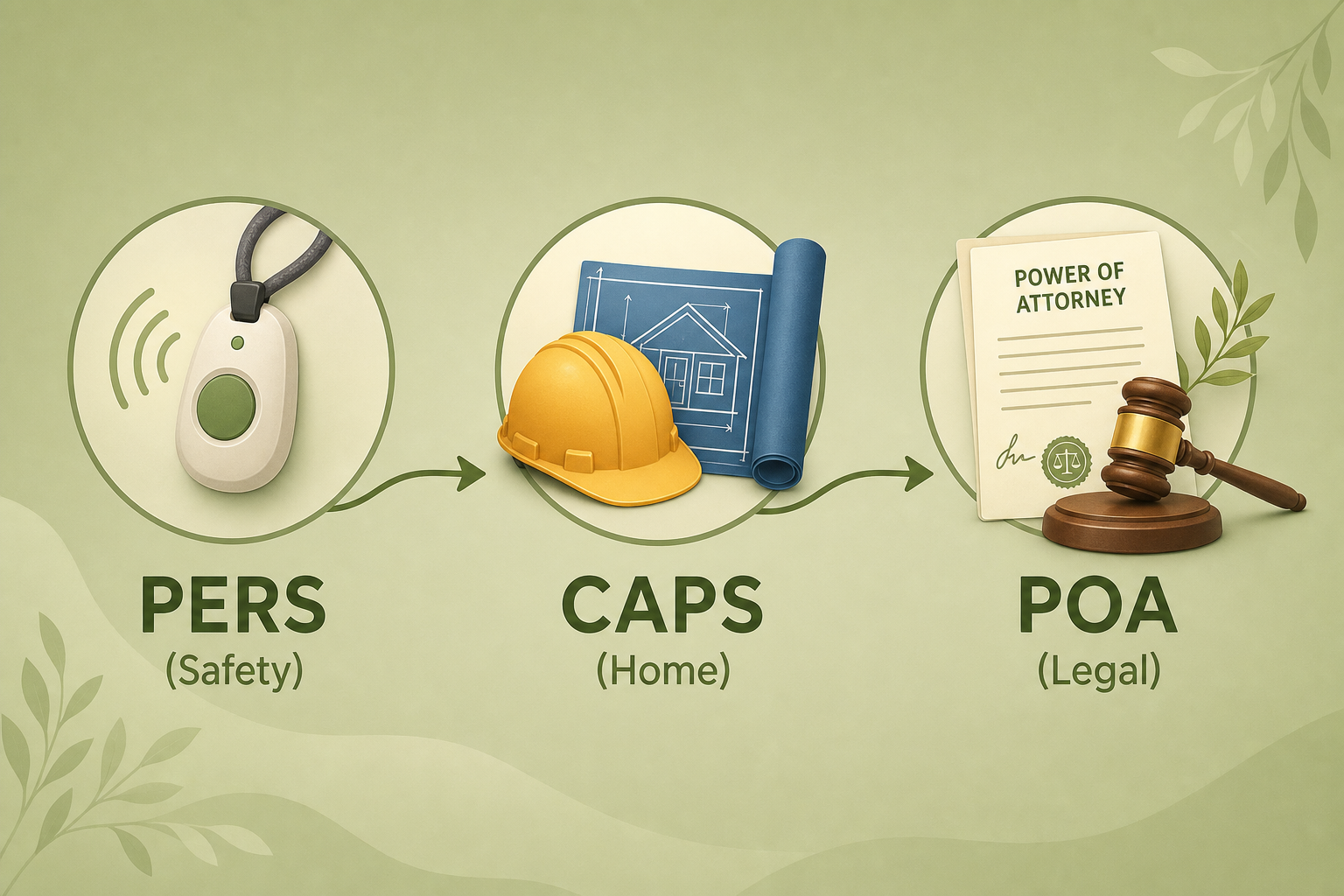
Those three acronyms are POA, CAPS, and PERS. They represent the sequential, interconnected decisions that determine where your parent lives, who makes medical decisions, and how they stay safe. Here is how they fit together.
Step 1: POA — Legal Authority Before Anything Else
Before you can hire a contractor, buy a medical alert device, or even discuss your parent's care plan with their physician, you need the legal authority to act on their behalf. That authority comes from a power of attorney (POA) — a legal document in which your parent (the principal) names someone they trust (the agent) to make decisions for them.
The critical distinction is durability. A durable power of attorney remains in effect even if your parent becomes incapacitated — after a stroke, during advanced dementia, or while unconscious. A non-durable POA ends the moment the principal loses capacity, which is exactly when you need it most. As the National Council on Aging explains, a durable POA helps eliminate the time and expense of court-appointed guardianship, a process that can take months and cost thousands of dollars in legal fees.
There are two primary types you will need to consider:
- A medical POA (also called a healthcare proxy) allows the agent to decide what medical care the principal receives, choose doctors, and determine where the principal lives — including whether they can remain at home or need to move to a facility.
- A financial POA allows the agent to access bank accounts, pay bills, file taxes, manage property, and apply for public benefits such as Medicaid or VA aid.
The cost to have an attorney draft a durable POA typically ranges from $200 to $600, depending on your location and whether you are creating both medical and financial documents. Some states offer standardized forms that can be filled out without an attorney, but given the stakes, an elder law attorney's review is money well spent. As of 2022, 29 states have enacted versions of the Uniform Power of Attorney Act (UPOAA), which standardizes POA rules across state lines — important if your parent lives in a different state than you do.
For a deeper breakdown of each POA type and the legal capacity window, see our Power of Attorney for Elderly Parents guide. The key takeaway here: POA is the prerequisite. Without it, you cannot execute the next two steps effectively.
Step 2: CAPS — Making the Home Safe After Discharge
Once legal authority is in place, the next question is whether the home itself is safe. Most family caregivers conduct a mental walk-through and spot obvious hazards — loose rugs, poor lighting, a cluttered hallway. But a thorough home safety assessment requires trained eyes that know what to look for and how to prioritize modifications.
That is where a Certified Aging-in-Place Specialist (CAPS) comes in. This credential is awarded by the National Association of Home Builders (NAHB) and requires completing a three-course curriculum covering marketing and communication (CAPS I), design concepts for livable homes (CAPS II), and technical details and solutions for aging in place (CAPS III). A CAPS professional is trained to assess a home's accessibility, recommend modifications, obtain renovation quotes, and oversee the work.
A personalized home evaluation from a CAPS typically costs approximately $500 and includes a full written report of recommended modifications. The most common changes fall into a few categories:
| Modification | Purpose | Typical Cost Range |
|---|---|---|
| Grab bars (bathroom, shower, toilet) | Provide stable support for transfers and balance | $50–$200 per bar (installed) |
| Raised toilet seat or comfort-height toilet | Reduce squat depth for easier sit-to-stand | $40–$150 (seat); $200–$600 (toilet) |
| 32-inch+ doorways (widened) | Allow walker and wheelchair passage | $500–$2,000 per doorway |
| No-step entry (ramp or zero-threshold) | Eliminate step hazard at exterior doors | $1,000–$5,000 (ramp) |
| Lever-style door handles | Replace twist knobs for easier operation | $15–$50 per handle |
| Front-mounted stove controls | Prevent reaching over hot burners | $50–$200 (retrofit kit) |
For a detailed walk-through of one of the most common and cost-effective modifications, see our Grab Bars Installation Guide. The CAPS evaluation will identify which of these modifications your parent's home needs most urgently.
Step 3: PERS — The Daily Safety Net
Legal authority is in place. The home has been assessed and modified. Now the question becomes: what happens the next time your parent falls, has a medical emergency, or simply needs help getting up from the floor? A personal emergency response system (PERS) — often called a medical alert system — provides that daily safety net.
A PERS device typically consists of a wearable button (pendant, wristband, or clip) and a base unit connected to a monitoring center. When the user presses the button, they are connected to a trained operator who can dispatch emergency services, call a family member, or simply talk the user through the situation. Modern systems with automatic fall detection can trigger an alert even if the user cannot press the button — critical after a stroke, seizure, or severe fall that leaves the person unconscious or unable to move.
Monthly costs for PERS services typically range from $20 to $50 per month, with some providers charging an initial equipment fee. The two main form factors are:
- Home-based systems: A base station connects to your landline or cellular network, and the wearable pendant works only within range of the base (typically 300–600 feet). Best for seniors who spend most of their time at home.
- Mobile systems: The wearable device contains its own cellular connection and GPS, allowing the user to summon help from anywhere — the backyard, the grocery store, or a doctor's appointment. Best for active seniors who leave the house regularly.
For a complete breakdown of how PERS works, what features to evaluate, and whether Medicare or Medicaid covers the cost, see our PERS definition and coverage guide and our Medicare coverage FAQ for medical alert systems. The important point here is that PERS is the final layer — it does not replace home modifications or legal planning, but it provides the ongoing safety monitoring that makes aging in place sustainable.
The POA → CAPS → PERS Decision Tree
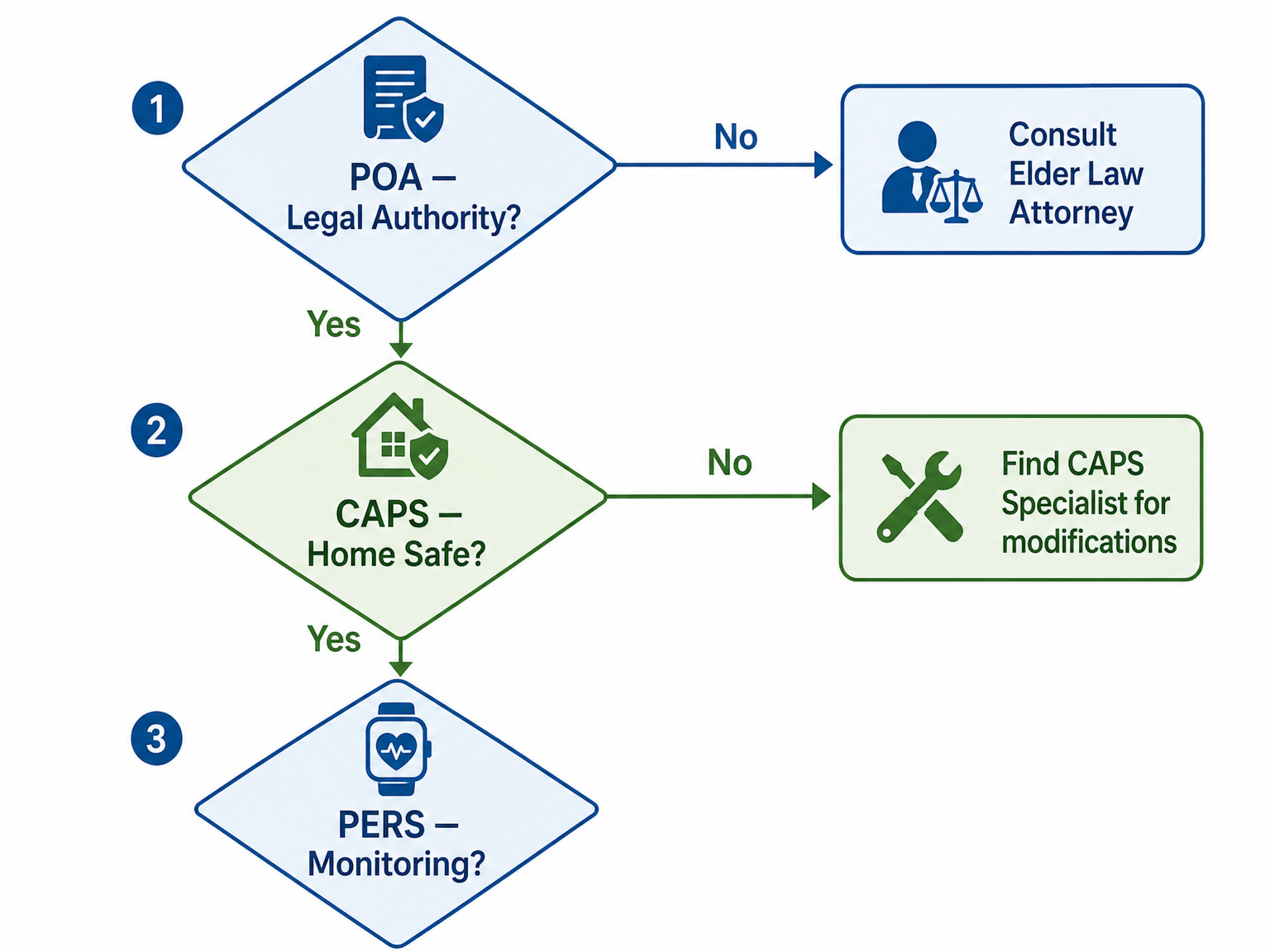
The three steps are not optional checkboxes you can tackle in any order. They form a logical sequence:
- Do you have a durable POA (medical and financial) in place? If no, consult an elder law attorney immediately. If yes, proceed to step 2.
- Has the home been assessed for safety by a CAPS-certified professional? If no, schedule a home evaluation (approximately $500). If yes, proceed to step 3.
- Does your parent need a PERS device for ongoing fall and emergency monitoring? If yes, compare home-based vs. mobile systems and check Medicare/Medicaid coverage options.
This sequence matters because each step enables the next. Without a POA, you cannot legally authorize a CAPS evaluation or sign a PERS service contract on your parent's behalf if they are unable to do so themselves. Without a CAPS assessment, you may install grab bars in the wrong location or miss a critical hazard that a PERS device cannot compensate for. And without a PERS device, a single fall in a modified home can still result in hours of lying on the floor waiting for help.
Cost Comparison at a Glance
Budgeting for the full pathway helps avoid the shock of unexpected expenses. Here is how the three steps compare financially:
| Step | Typical One-Time Cost | Typical Ongoing Cost | Who to Contact |
|---|---|---|---|
| POA (legal authority) | $200–$600 (attorney setup) | None | Elder law attorney |
| CAPS (home evaluation) | ~$500 (evaluation fee) | Modification costs vary widely | NAHB CAPS directory |
| PERS (monitoring device) | $0–$150 (equipment fee) | $20–$50/month | PERS provider |
The total first-year investment — including attorney fees, a CAPS evaluation, modest modifications (grab bars, raised toilet seat, lever handles), and a year of PERS service — typically falls between $1,500 and $3,500. That is a fraction of the cost of a single month in a skilled nursing facility, which the National Institute on Aging notes can exceed $8,000 per month depending on location and level of care.
Your First 30 Days After Discharge: A Checklist
The days immediately following a hospital discharge are chaotic. Use this checklist to stay on track without becoming overwhelmed:
- Week 1: Confirm or establish a durable POA. If your parent does not have one, call an elder law attorney today. If they already have one, locate the document and confirm it is durable (not springing or limited). Make copies for all relevant parties.
- Week 1: Schedule a follow-up with your parent's primary care provider within 7 days of discharge. Bring the discharge summary and a list of all new medications.
- Week 2: Contact a CAPS-certified professional for a home evaluation. Use the NAHB's CAPS directory to find specialists in your area. Expect the evaluation to take 1–2 hours and cost approximately $500.
- Week 2: Prioritize the most urgent modifications identified in the CAPS report — typically bathroom grab bars, a raised toilet seat, and improved lighting in hallways and stairs.
- Week 3: Research PERS providers. Compare home-based vs. mobile systems, automatic fall detection, battery life, and monthly costs. Check whether your parent's Medicare Advantage plan or Medicaid waiver covers any portion of the cost.
- Week 3: Order and set up the PERS device. Test it with your parent to ensure they understand how to use it and are comfortable wearing it.
- Week 4: Revisit the CAPS report and schedule any remaining modifications. Review the PERS usage logs (if available) to confirm the system is being used correctly. Touch base with your parent's primary care provider about medication adjustments and fall risk.
If your parent's health crisis involved dementia or memory loss, the urgency of the POA step increases significantly. See our guide to understanding wandering in dementia for additional safety planning considerations specific to cognitive decline.
Browse more in the Glossary.