
Room checklist
Bathroom Remodel for Elderly: The Complete Room-by-Room Modification Guide with Costs, Priorities, and Mistakes to Avoid
A comprehensive, evidence-based guide for family caregivers and older adults planning a bathroom renovation for aging in place. Covers every modification, its cost, priority level, and installation considerations — with a focus on technical specifications and universal design that avoids an institutional look.
The Fall Risk Reality in the Bathroom
The bathroom is the most dangerous room in the house for an older adult — not because of chemicals or sharp objects, but because of the combination of water, hard surfaces, and the complex movements required to use a toilet, enter a shower, or step out of a tub. The data is sobering: the CDC reports that approximately 235,000 Americans over age 65 visit emergency rooms each year due to bathroom-related falls and injuries. To put that in perspective, that is roughly 640 people every single day.
Nationally, about 3 million emergency department visits each year are due to older adult falls across all settings, and roughly 1 million of those result in hospitalization. Falls are the leading cause of traumatic brain injuries and account for 83% of hip fracture deaths among older adults. The bathroom concentrates this risk because it demands three things that become harder with age: balance on wet surfaces, lower-body strength to lower and raise the body, and clear vision in often-dim lighting.
The three primary fall triggers in a bathroom are:
- Wet surfaces — Slippery tile, wet shower floors, and puddled water on the floor create low-friction zones where a loss of balance happens in a fraction of a second.
- Awkward movements — Stepping over a tub wall, lowering onto a low toilet, and pivoting in a cramped shower stall all require coordinated strength and balance that decline with age.
- Poor visibility — Inadequate lighting makes it harder to see edges, wet spots, and obstacles, especially for older eyes that need significantly more light to perceive depth and contrast.
Understanding these three triggers is the foundation for every modification decision that follows. A well-designed bathroom for aging in place systematically removes each trigger through targeted changes — not through a single expensive renovation, but through a prioritized sequence of interventions that address the highest-risk problems first.
Core Modifications Ranked by Priority with Technical Specs and Cost Ranges
Not all bathroom modifications are created equal. Some address immediate fall risks for under $600, while others are long-term investments that improve daily function and resale value. The priority ranking below is based on the severity of the fall trigger each modification addresses, not on cost or convenience.
1. Grab Bars — The Single Most Effective Safety Addition
Grab bars are the foundation of bathroom safety because they directly address the "awkward movements" trigger. A person transferring from a toilet to a standing position, or stepping out of a shower onto a wet floor, needs a stable handhold rated for their full body weight. Standard towel bars are not designed for this — they are typically anchored into drywall with small screws and can pull out under load.
The technical requirements for effective grab bars are specific:
- Load rating: Must support at least 250 pounds of force when properly installed.
- Mounting: Must be anchored into wall studs or use heavy-duty toggle bolts designed for the application. Surface-mounting into tile alone is not sufficient.
- Diameter: 1.25 to 1.5 inches, which allows a secure grip for hands that may have reduced strength or arthritis.
- Placement: Horizontal bars beside the toilet (for sit-to-stand support) and inside the shower or tub area (for entry and exit). Vertical bars at the shower entrance can help with balance during the step-over motion.
Cost for installing three to four grab bars, including professional installation, typically ranges from $200 to $600. This is the highest-return investment in bathroom safety you can make.
2. Non-Slip Flooring — Addressing the Wet Surface Trigger
The floor is the largest surface in the bathroom and the one most directly involved in falls. Standard glossy ceramic or porcelain tile, while easy to clean, becomes dangerously slippery when wet. The key specification to look for is the Dynamic Coefficient of Friction (DCOF), which measures how much traction a tile provides when wet.
Industry standards recommend:
- Bathroom floors: DCOF of 0.42 or higher. This is the minimum for general bathroom areas where the floor may get splashed but is not continuously wet.
- Shower floors: DCOF of 0.60 or higher. Shower floors are constantly wet and require significantly more traction.
Matte textured porcelain, natural stone with a honed finish, and slip-resistant vinyl sheet flooring are all good options. Avoid polished marble, high-gloss ceramic, and any tile with a smooth glazed surface — these typically have DCOF values well below 0.42 when wet.
Professional installation of non-slip flooring in a standard bathroom runs $6,400 to $11,000, depending on the material and the complexity of the layout. This is a significant investment, but it addresses the most persistent fall trigger in the room.
3. Comfort-Height Toilet — Reducing the Awkward Movement Risk
Standard toilets have a seat height of approximately 14 to 15 inches. For an older adult with reduced quadriceps strength, hip arthritis, or balance issues, lowering onto and rising from this height requires significant effort and creates a moment of instability. A comfort-height toilet — also called an ADA-height toilet — has a seat height of 17 to 19 inches, which is closer to the height of a standard chair.
The difference of three to four inches reduces the knee flexion angle and the amount of lower-body strength needed to stand up. For someone who has already had a fall or who reports difficulty getting up from low surfaces, this is a straightforward and relatively low-cost intervention.
Cost ranges from $300 for a basic model to $1,200 for a comfort-height toilet with additional features such as a built-in bidet or heated seat. Installation is typically a few hundred dollars more if plumbing modifications are needed.
4. Curbless Shower or Walk-In Tub — Eliminating the Step-Over Hazard
Stepping over a 5- to 6-inch tub wall is one of the most dangerous movements an older adult makes in a bathroom. It requires lifting one leg high while balancing on the other, often on a wet or slippery surface. A curbless shower — also called a zero-threshold or roll-in shower — eliminates this step-over entirely by having the shower floor flush with the bathroom floor.
A curbless shower conversion typically costs $3,000 to $15,000, depending on whether it involves a full tear-out or a more limited modification. The wide range reflects differences in plumbing relocation, subfloor slope adjustment, and the quality of finishes selected.
A walk-in tub is an alternative for those who prefer soaking baths. These have a low step-in threshold (typically 3 to 7 inches) and a door that seals before the tub fills. Costs range from $2,000 for a basic model to $20,000 for a luxury unit with jets, heated surfaces, and therapeutic features. The trade-off is that the user must sit and wait for the tub to drain before exiting, which can be a concern in an emergency.
5. Layered Lighting — Addressing the Poor Visibility Trigger
Vision changes with age are well documented: a 60-year-old needs roughly three times as much light as a 20-year-old to see clearly, and a person over 80 needs even more. The bathroom is often the most poorly lit room in the house, with a single overhead fixture that creates shadows and glare.
Lighting recommendations for aging-in-place bathrooms include:
- Light output: At least 646 lumens for general bathroom lighting for those 60 and older, and 968 lumens for those 80 and older. Many standard bathroom fixtures deliver only 400 to 500 lumens.
- Layered approach: Combine overhead ambient light, task lighting at the vanity (sconces on either side of the mirror, not just above it), and accent lighting to eliminate shadows.
- Dimmers: Allow adjustment for nighttime use, reducing glare for middle-of-the-night bathroom trips.
- Nightlights: Low-level path lighting along the baseboard or near the toilet helps orient someone who wakes up disoriented.
Lighting upgrades are relatively inexpensive compared to structural modifications — expect $200 to $800 for new fixtures and dimmers, plus installation if rewiring is needed.
| Modification | Fall Trigger Addressed | Cost Range | Priority |
|---|---|---|---|
| Grab bars (3-4 bars, installed) | Awkward movements | $200 - $600 | Highest |
| Non-slip flooring (DCOF ≥0.42 / ≥0.60) | Wet surfaces | $6,400 - $11,000 | High |
| Comfort-height toilet (17-19 inches) | Awkward movements | $300 - $1,200 | High |
| Curbless shower conversion | Awkward movements + wet surfaces | $3,000 - $15,000 | Medium |
| Walk-in tub | Awkward movements | $2,000 - $20,000 | Medium |
| Layered lighting (646-968 lumens) | Poor visibility | $200 - $800 | Medium |
Three Categories of Bathroom Remodeling Mistakes to Avoid
Even well-intentioned bathroom modifications can fail — or create new hazards — if the wrong materials are chosen, installation is done improperly, or design decisions prioritize appearance over function. The mistakes fall into three categories.
Floor and Material Mistakes
- Choosing glossy tile with a low DCOF. Polished ceramic and marble tiles are beautiful but dangerous when wet. Always check the manufacturer's DCOF rating before purchasing. If the rating is not listed, assume it is below 0.42.
- Ignoring transition strips between flooring types. A raised edge where tile meets vinyl or where the bathroom floor meets the hallway floor creates a tripping hazard. Use flush transition strips or plan the flooring to be continuous through the doorway.
- Using large-format tile in a small shower. Large tiles require a steeper slope for proper drainage, which can create an uneven surface that is difficult to stand on. Smaller tiles (2x2 inches or smaller) conform better to the shower pan slope.
Installation Mistakes
- Grab bars not anchored into studs. This is the most common and most dangerous installation error. A grab bar mounted only into tile or drywall will fail under load. If studs are not in the ideal location, install blocking between studs before the tile goes up, or use a heavy-duty anchoring system rated for the application.
- Improper shower curb height for a curbless design. A true curbless shower requires the subfloor to be sloped toward the drain, which may involve cutting floor joists or building up the surrounding floor. Contractors who are not experienced with accessible design may create a shower that looks curbless but has a hidden lip that still requires a step-over.
- Inadequate waterproofing behind tile. A curbless shower, by design, has water flowing across a larger area of the floor. If the waterproofing membrane is not properly installed, water can seep into the subfloor and cause structural damage over time.
Design Mistakes
- Poor lighting placement. A single overhead light creates shadows on the face at the vanity and leaves the shower area dark. Sconces on either side of the mirror provide even facial lighting, and a dedicated light in the shower area is essential.
- Using towel bars as grab bars. Towel bars are not load-rated and will pull out of the wall if used for support. This is one of the most common makeshift solutions that leads to falls.
- Doorways narrower than 32 inches. If a walker or wheelchair is needed now or in the future, a standard 24- or 28-inch bathroom door will not accommodate it. Widening the doorway to at least 32 inches (36 inches is preferred) is much easier to do during a renovation than as a separate project later.
Universal Design Doesn’t Have to Look Medical
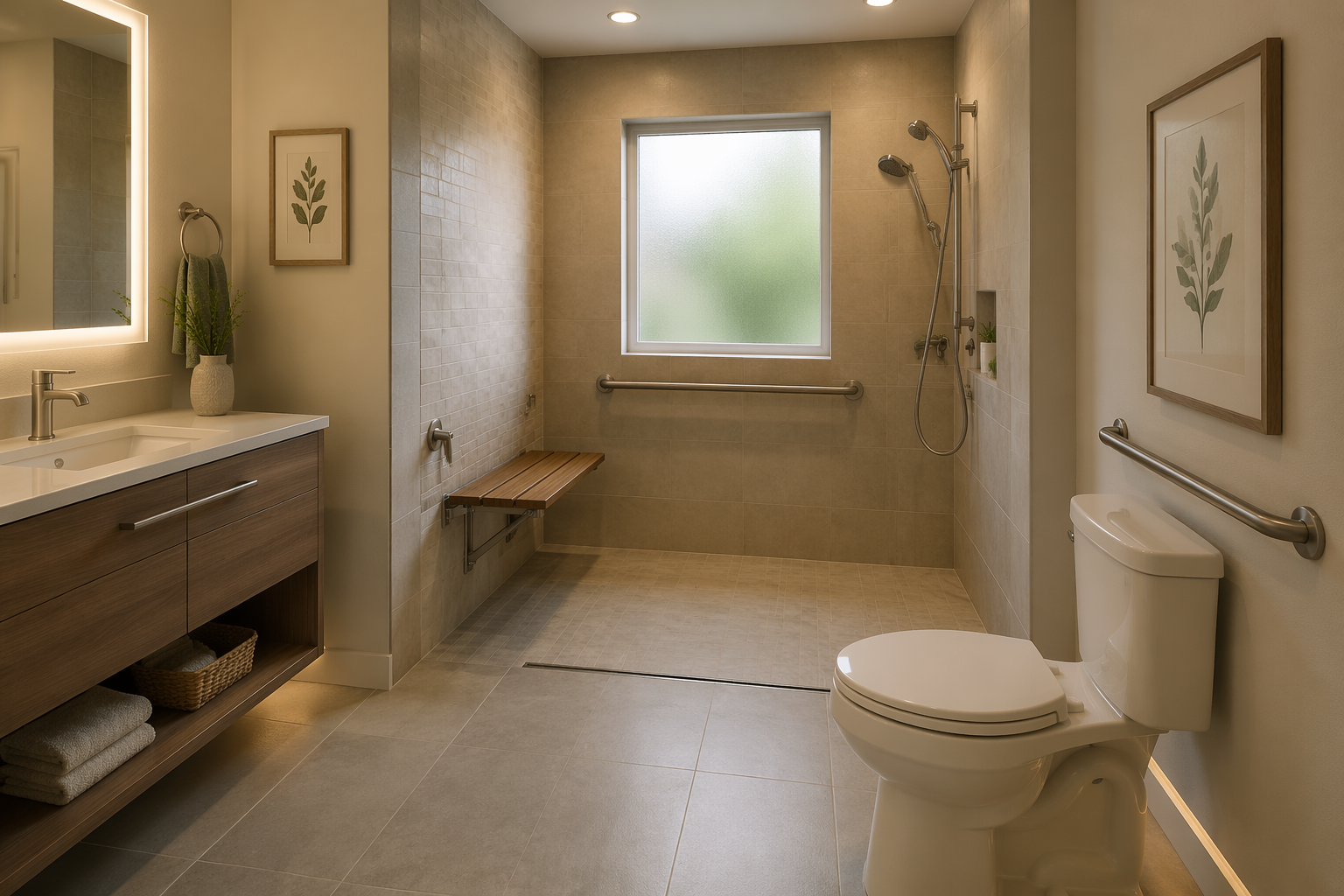
One of the most common objections to bathroom modifications is aesthetic: "I don't want my bathroom to look like a hospital." This concern is valid, but it is based on an outdated assumption that safety features must be institutional. Modern universal design has moved well beyond the white metal grab rail and plastic transfer bench.
The key shift is that major manufacturers now produce decorative grab bars that are rated for the same loads as standard bars. Delta, Moen, and Kohler all offer grab bars in brushed nickel, matte black, oil-rubbed bronze, and other residential finishes. These bars look like upscale towel bars or robe hooks — they blend into the design rather than announcing themselves as medical equipment.
Similarly, a curbless shower with a linear drain, a fold-down teak bench, and a handheld showerhead on a slide bar creates a spa-like aesthetic that any homeowner would want. Matte textured tile in warm gray or beige provides slip resistance without the institutional look of white linoleum. A comfort-height toilet with a sleek one-piece design is indistinguishable from a standard modern toilet to the casual observer.
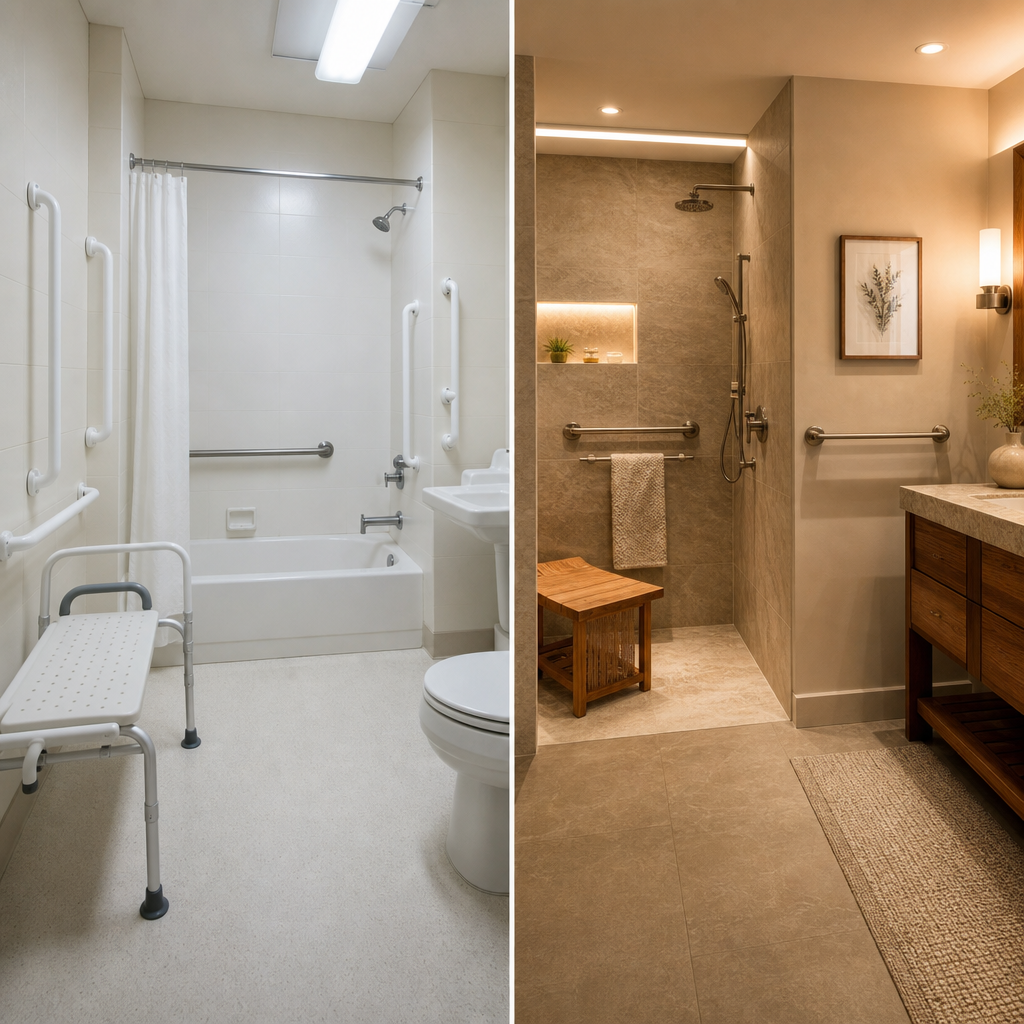
The design principles that make a bathroom safe for an 80-year-old also make it more comfortable for everyone: better lighting, easier-to-clean surfaces, more spacious layouts, and fixtures that require less effort to use. A well-designed aging-in-place bathroom does not look like a concession to age — it looks like a thoughtfully designed space that happens to work better for people of all abilities.
Phased Approach Decision Framework
Not every modification needs to happen at once. The right approach depends on the current level of risk, the budget available, and whether the bathroom is being renovated for immediate needs or as a long-term preparation. The framework below organizes modifications by the urgency of the fall trigger they address.
| Phase | Modifications | Fall Trigger Addressed | Typical Cost |
|---|---|---|---|
| Immediate safety (this week) | Grab bars beside toilet and in shower; non-slip bath mat; nightlight | Awkward movements + wet surfaces + poor visibility | $200 - $700 |
| Short-term upgrades (1-3 months) | Comfort-height toilet; lever-handled faucet; handheld showerhead; improved vanity lighting | Awkward movements + poor visibility | $500 - $2,000 |
| Medium-term renovation (6-12 months) | Non-slip flooring (DCOF ≥0.42); curbless shower conversion or walk-in tub; widened doorway | Wet surfaces + awkward movements | $10,000 - $26,000 |
| Long-term full remodel (1-3 years) | Complete bathroom redesign with universal design principles; heated floors; integrated lighting system; all fixtures at accessible heights | All three triggers | $6,600 - $28,000 |
The immediate safety phase addresses the highest-risk scenarios with minimal investment. Grab bars and a nightlight can be installed in a single afternoon. The short-term phase focuses on fixtures that reduce the effort and risk of daily movements. The medium-term renovation tackles the structural changes — flooring and shower access — that require professional contractors but provide the greatest long-term safety improvement. The long-term full remodel is for those who want a comprehensive universal design bathroom that will serve them for decades.
A key consideration: if you are planning a full bathroom renovation within the next two years, it may be more cost-effective to skip the short-term upgrades and go directly to the medium-term phase. Installing a comfort-height toilet now and then replacing it again during a full remodel doubles the cost of the fixture and the labor.
When to Hire a CAPS-Certified Contractor
A Certified Aging-in-Place Specialist (CAPS) is a contractor who has completed training through the National Association of Home Builders on designing and modifying homes for older adults and people with disabilities. While any licensed contractor can install grab bars or replace a toilet, a CAPS-certified professional brings specific knowledge that matters for complex modifications.
Consider hiring a CAPS-certified contractor when your project involves:
- Structural modifications: Curbless shower installation requires understanding of subfloor slope, waterproofing, and load-bearing walls. A CAPS contractor will know how to achieve the required slope without compromising the floor structure.
- Doorway widening: Widening a bathroom doorway to 32 or 36 inches may involve moving or removing a load-bearing wall. A CAPS contractor can assess whether the wall is structural and plan the modification accordingly.
- Multi-modification coordination: If you are doing a full bathroom remodel with grab bars, non-slip flooring, a curbless shower, and lighting upgrades, a CAPS contractor will ensure all the modifications work together — for example, that grab bar blocking is installed before the tile goes up.
- Future-proofing: A CAPS contractor is trained to anticipate future needs — such as reinforcing walls for future grab bar installation even if bars are not installed immediately, or planning electrical rough-ins for lighting that will be added later.
For simpler projects — installing a comfort-height toilet, adding grab bars where studs are easily accessible, or replacing a faucet — a licensed general contractor or a skilled handyman with experience in accessible design may be sufficient. The key is to verify that anyone installing grab bars understands the load-rating requirements and will anchor them into studs or use approved blocking.
Cost Summary Table and Funding Sources
The following table provides a consolidated view of all major bathroom modifications with their national average cost ranges. These figures are based on 2026 data from multiple sources and will vary by geographic region, contractor rates, and material choices.
| Modification | Low-End Cost | High-End Cost | National Average |
|---|---|---|---|
| Grab bars (3-4 bars, installed) | $200 | $600 | $400 |
| Non-slip flooring (DCOF ≥0.42, installed) | $6,400 | $11,000 | $8,700 |
| Comfort-height toilet (installed) | $300 | $1,200 | $600 |
| Curbless shower conversion | $3,000 | $15,000 | $5,000 |
| Walk-in tub (installed) | $2,000 | $20,000 | $10,000 |
| Lever-handled faucet (installed) | $150 | $330 | $240 |
| Full bathroom remodel (comprehensive) | $6,600 | $28,000 | $11,200 |
Funding these modifications is often the biggest barrier for families. The good news is that several programs and strategies can help offset the cost:
- VA Specially Adapted Housing (SAH) grants: For qualifying veterans with service-connected disabilities, the maximum SAH grant for fiscal year 2026 is $126,526. These grants can be used to modify a home, including bathroom renovations, to meet disability needs. A separate Special Home Adaptation (SHA) grant of up to $25,350 is available for veterans with less severe qualifying conditions.
- Medicaid HCBS waivers: Many states offer Home and Community-Based Services (HCBS) waivers that fund "environmental accessibility adaptations" — including bathroom modifications — for low-income seniors who qualify for Medicaid. Coverage varies significantly by state.
- USDA Section 504 grants: Very-low-income seniors aged 62 and older may qualify for grants of up to $10,000 for home repairs and modifications, including bathroom safety improvements. These are available through the USDA Rural Development program.
- Medical expense tax deduction: Home modifications made for medical reasons — such as installing grab bars for a person with a diagnosed fall risk — may be deductible as medical expenses if they exceed 7.5% of your adjusted gross income. The modification must be deemed medically necessary by a physician.
- Medicare: Original Medicare (Part B) does not typically pay for home modifications, but it does cover an occupational therapist home assessment that can identify needed modifications. Some Medicare Advantage plans (Part C) have begun offering supplemental benefits that cover home modifications following CMS rule changes in 2019 and 2020. Coverage varies by plan and carrier.
- Nonprofit programs: Organizations like Rebuilding Together offer Safe at Home and Heroes at Home programs that provide free home modifications for low-income seniors and veterans. Habitat for Humanity also has aging-in-place programs in some locations.
A bathroom renovation that enables an older adult to remain safely at home for five additional years can offset $240,000 to $480,000 in assisted living facility costs, based on national averages of $4,000 to $8,000 per month. While cost should not be the primary driver of safety decisions, the financial case for investing in a well-designed aging-in-place bathroom is compelling.
Related reading
Need a professional assessment?
Find a CAPS-credentialed professional or local aging services through our outbound resource list — we never name or rank individual contractors.
Find Local HelpNoticed something outdated or inaccurate on this page? Flag a correction. We review every report against CDC, NIA, and AARP HomeFit guidance before updating a page.