
Room checklist
What Does a CAPS Certified Aging-in-Place Contractor Do — and How to Find One
A CAPS (Certified Aging-in-Place Specialist) credential from NAHB identifies contractors trained in universal design, whole-home safety assessment, and phased modification planning — skills that go beyond what a general contractor typically brings to elder-specific renovation work. This guide explains what a CAPS professional actually does, how their process differs from a standard contractor, what modifications they handle, and how family caregivers can find, vet, and fund one.
Why the Contractor You Choose for Aging-in-Place Work Matters More Than You Might Expect
Hiring someone to widen a doorway or install grab bars sounds straightforward. It isn't — at least not when the goal is keeping an older adult safely at home for years to come. Aging-in-place modifications require a contractor to think beyond what the building code requires today and anticipate what a person's home will need to support as their mobility and cognition change. That is a fundamentally different skill set from standard residential renovation work.
The gap between supply and need is significant. According to Amy Roberts, a senior real estate specialist and Certified Aging-in-Place Specialist quoted by Care.com, fewer than 4% of homes in the U.S. housing market are currently aging-in-place ready. Most homes — even recently built ones — were designed without meaningful consideration for the mobility changes that come with aging.
This guide is the upstream resource for families who are about to start that process. It explains what the CAPS credential actually means, what a CAPS professional does differently from a general contractor, how to find one, what to expect to pay, and how to access funding. Before engaging any contractor, it's worth starting with a room-by-room home fall prevention checklist to identify the most urgent hazards — that assessment will sharpen your conversations with any professional you bring in.
What CAPS Stands For and Who Issues the Credential
CAPS stands for Certified Aging-in-Place Specialist. The credential is issued by the National Association of Home Builders (NAHB) and is designed for contractors, remodelers, builders, designers, and allied professionals who work on housing modifications for older adults and people with disabilities.
Earning the credential requires completing three courses:
- CAPS I: Marketing and Communicating with Aging-in-Place Clients — covers how to assess client needs, communicate effectively with older adults and their families, and position aging-in-place services.
- CAPS II: Design Concepts and Methods for Livable Homes — covers universal design principles, whole-home safety assessment, and solutions for mobility challenges and cognitive impairments.
- CAPS III: Details and Solutions for Livable Homes — covers implementation specifics, phased construction planning, budget integration, and coordination with allied professionals.
For contractors and remodelers, NAHB also requires proof of liability insurance, workers' compensation insurance, a valid business license, and a signed code of ethics pledge. Credential holders must complete four hours of continuing education annually to maintain the designation. If a credential lapses for more than three years, the holder must retake CAPS III before reinstatement.
CAPS is not the only aging-in-place credential in the field. Others include the Senior Home Safety Specialist (SHSS) from Age Safe America, the Universal Design Certified Professional (UDCP) from NARI, the Certified Environmental Access Consultant (CEAC), the Environmental and Childhood Health Modification (ECHM) from USC, and the Home Accessibility Specialist (HAS). Each has a different scope and audience. This guide focuses on CAPS because it is the most widely recognized credential for licensed contractors and remodelers pursuing structural home modification work.
What a CAPS Contractor Actually Does: The Step-by-Step Process
A CAPS professional's engagement typically follows a structured workflow that distinguishes it from a standard contractor estimate. The process is designed to produce a plan that serves the client's current needs and anticipates future ones — not just a list of repairs to execute today.
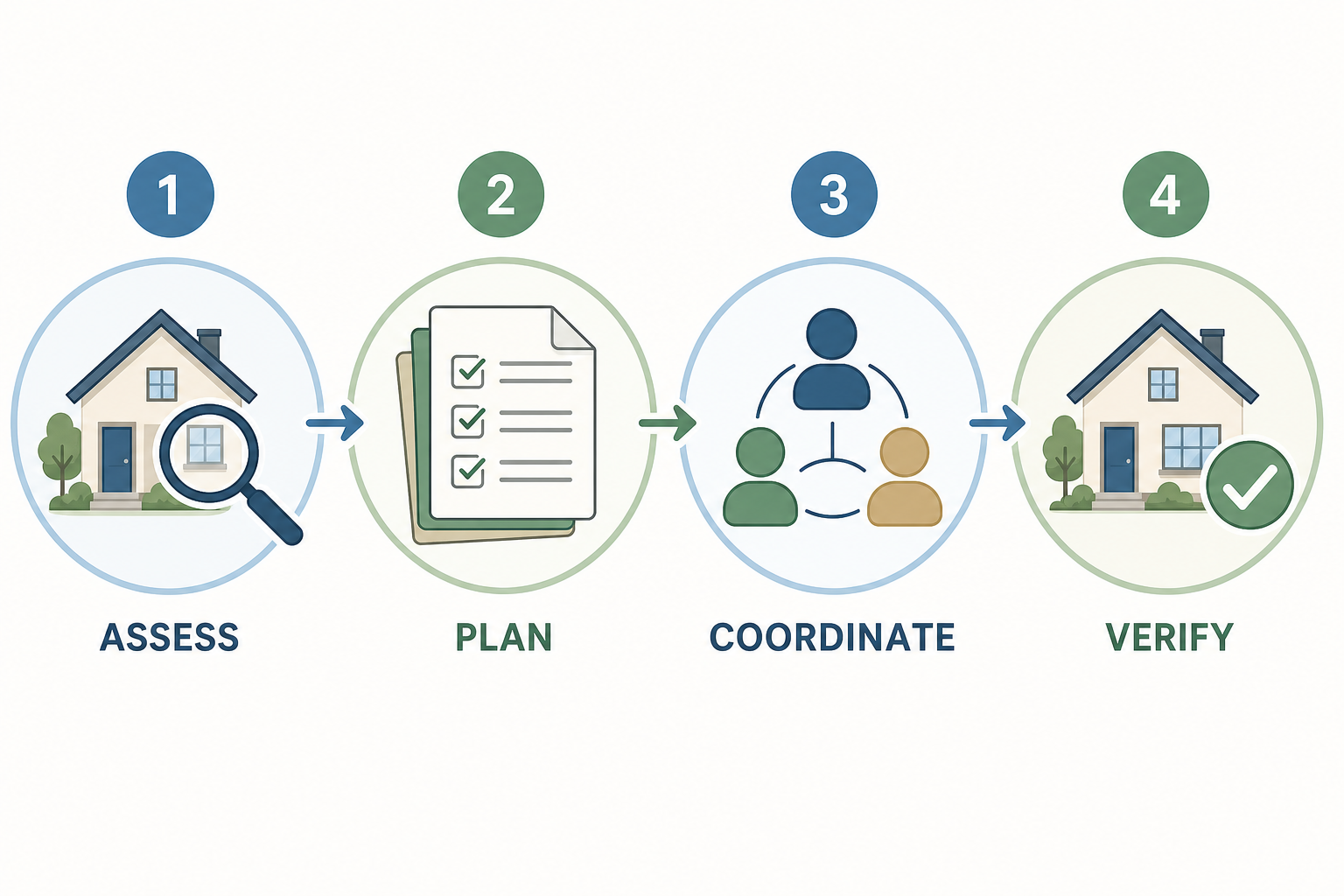
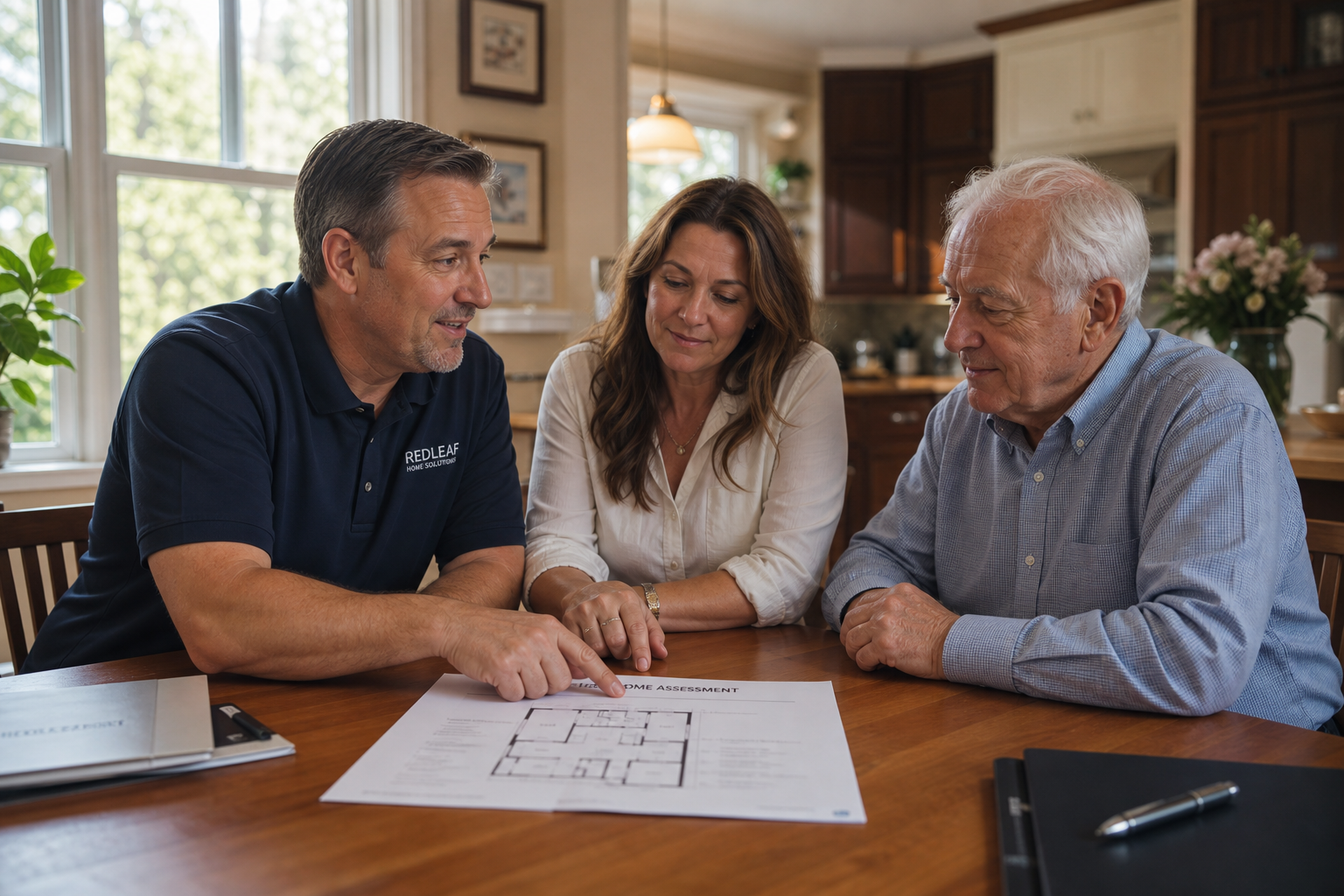
- Whole-home safety assessment. The CAPS professional walks through the entire home — not just the rooms that prompted the call — to identify existing hazards, accessibility gaps, and features that will become problematic as mobility changes. This assessment typically produces a written report.
- Prioritized, phased modification plan. Rather than presenting a single large project estimate, a CAPS professional sequences modifications by urgency, budget, and anticipated functional change over time. The goal is a plan the family can act on incrementally.
- Trade coordination. When modifications require specialized tradespeople — a structural engineer, plumber, electrician, or interior designer — the CAPS professional obtains quotes and coordinates the work. This is particularly important for complex modifications like curbless shower conversions or doorway widening that cross multiple trades.
- Post-completion walk-through. After modifications are complete, the CAPS professional reviews the finished work with the homeowner and family to confirm that the modifications function as intended and address any follow-up questions.
"I recommend looking at what remodeling you can do now, in six months and in the next year. We lay out a plan that, over time, will get the house fitted for you." — Valerie Jurik-Henry, CAPS professional, Right at Home
That phased planning philosophy is central to what separates a CAPS engagement from a one-time contractor estimate. The home is being prepared for a trajectory, not a single moment.
CAPS Professional vs. General Contractor: Key Differences
A licensed general contractor can install grab bars, build a ramp, or widen a doorway. The question is whether they know which modifications are actually needed, in what order, and whether the result will serve the person living in the home five years from now — not just pass inspection today.
| Dimension | CAPS Professional | General Contractor |
|---|---|---|
| Training focus | Universal design, elder-specific mobility and cognitive needs, whole-home safety assessment | Construction methods, building codes, project management |
| Assessment approach | Full-home walkthrough producing a written safety and modification report | Site visit focused on the specific project being quoted |
| Planning horizon | Phased modification plan across current and anticipated future needs | Single project estimate for work requested |
| Trade coordination | Obtains quotes from and coordinates engineers, plumbers, electricians, designers as needed | Manages subcontractors for a defined project scope |
| OT collaboration | Trained to work alongside occupational therapists and incorporate clinical assessments | Typically no formal relationship with OT practices |
| Occupied-home experience | Accustomed to working in homes where older adults continue to live during modifications | Variable; depends on individual contractor experience |
| Design judgment | Evaluates whether a modification is appropriate for the client's specific functional needs | Executes the modifications as specified by the client |
In practice, the best outcome is often a CAPS professional directing or collaborating with a general contractor — the CAPS credential provides the elder-specific design judgment; the general contractor provides the construction execution. Neither role replaces the other.
Common Room-by-Room Modifications CAPS Contractors Handle
CAPS professionals work across the entire home, not just high-priority rooms. Here is a practical overview of the modifications most commonly assessed and planned in each area.
Bathroom
The bathroom is typically the first priority. Common modifications include curbless (roll-in) shower conversion, raised toilet seat or comfort-height toilet, grab bars at the toilet and shower, hand-held showerhead, and a fold-down shower bench. For detailed product options, installation considerations, and cost tiers specific to the bathroom, see the guide on bathroom modifications to prevent falls for aging in place.
Bedroom
Ground-floor bedroom placement eliminates stair risk entirely and is often the highest-impact single change for someone with significant mobility limitations. Bed height adjustment — ensuring the person can sit and stand without strain — is a lower-cost modification that makes a meaningful daily difference.
Kitchen
Kitchen modifications focus on reducing reach distances and improving maneuverability. Relocating a countertop microwave to a lower position, replacing overhead-mounted controls with front-facing oven and range controls, and ensuring a minimum five-foot turning radius for wheelchair users are the most commonly recommended changes.
Entryways and Exterior Access
Zero-step entry is the standard goal — eliminating the threshold step that creates a tripping hazard and blocks wheeled mobility aids. This may involve a ramp, a graded approach, or a small platform lift depending on the home's structure. Interior doorways typically need to be at least 32 inches wide (36 inches is preferred) to accommodate a walker or wheelchair.
Hallways and Lighting
Continuous soft lighting along hallways — particularly between the bedroom and bathroom — significantly reduces nighttime fall risk. Motion-activated nightlights are a low-cost starting point; hardwired lighting upgrades provide a more reliable long-term solution.
Stairs and Door Hardware
For homes where stairs cannot be avoided, high-contrast tread edges and carpeting for traction are foundational safety improvements. Stair lifts are a more significant equipment installation — for full cost and funding detail, see the guide on stair lift cost and funding options for aging in place. Throughout the home, replacing round doorknobs with lever handles is a simple, low-cost modification that makes a meaningful difference for anyone with reduced grip strength or arthritis.
How to Find a CAPS Contractor
The most direct path is the NAHB professional designations directory at nahb.org. Search for "CAPS" under professional designations and filter by your location. The directory is searchable by specialty type, which can help narrow results to contractors with relevant project experience. Because NAHB's directory URL structure can change, navigate from the main nahb.org site rather than bookmarking a deeply nested URL.
Secondary paths that often surface contractors with strong local track records:
- Area Agency on Aging (AAA): Your local AAA may maintain a referral list of vetted contractors with aging-in-place experience. Contact information for your local AAA is available through the Eldercare Locator at eldercare.acl.gov.
- Occupational therapist referrals: OTs who specialize in home modification assessments frequently work with CAPS contractors and can refer families to professionals they have collaborated with on comparable projects.
- Local home builders associations: Many regional chapters of NAHB maintain their own member directories and can identify CAPS-credentialed members in your area.
Questions to Ask Before Hiring — and Red Flags to Watch For
Holding a CAPS credential is a meaningful signal, but it doesn't replace due diligence. Use these questions to vet any contractor before signing an agreement.
Questions to Ask
- Can you provide current proof of liability insurance and workers' compensation coverage?
- Is your CAPS credential current? When was it last renewed?
- How many aging-in-place projects have you completed in the past two years? Can you describe a project comparable to what we're planning?
- Have you worked with an occupational therapist on previous projects? Are you open to incorporating an OT assessment into the planning process?
- Are you comfortable working in an occupied home — one where the older adult will continue living during modifications?
- Are you familiar with local funding programs — VA grants, Medicaid waivers, or Area Agency on Aging programs — and can you help document modifications for those applications?
- Can you provide references from two or three clients whose aging-in-place projects are similar in scope to ours?
Red Flags
- Cannot or will not provide proof of current insurance and licensing before the first meeting.
- Has no references from elder-specific or accessibility-focused projects.
- Resists a phased planning approach — insists on a single large project estimate without discussing future needs.
- Pressures you to sign a contract or pay a deposit before completing a full home assessment.
- Cannot explain how their modifications will address the specific functional limitations of the person who will live in the home.
What Home Modifications Cost: Realistic Ranges for Planning
Cost ranges vary by region, contractor experience, and project complexity. The figures below are general estimates drawn from aging-in-place specialist sources and are intended to help families enter contractor conversations with realistic expectations — not as fixed benchmarks.
| Service or Modification | Estimated Cost Range | Notes |
|---|---|---|
| Home safety assessment | $300–$1,000 | A personalized evaluation with a full written report typically runs around $500, according to CAPS Gina Knight of Kastle Keeper, quoted by Care.com. |
| Hourly consultation | $75–$200/hr | Varies by specialist experience and market. |
| Grab bars (installed) | $100–$300 | Per bar, installed. See the grab bars installation guide for full detail. |
| Wheelchair ramp | $1,500–$5,000 | Varies by length, material, and site conditions. |
| Stair lift | $3,000–$5,000 | See the stair lift cost and funding guide for full detail on types and funding options. |
| Walk-in tub | $5,000–$15,000 | Includes installation; varies significantly by product tier. |
| Full bathroom accessibility remodel | $10,000–$50,000+ | Curbless shower, raised toilet, widened doorway, and related work. |
| Full kitchen accessibility remodel | $10,000–$50,000+ | Countertop reconfiguration, appliance relocation, turning radius work. |
For grab bar installation specifics, see the complete guide on grab bars for bathroom safety. For stair lift cost detail and funding options, see the stair lift cost and funding guide.
Funding Pathways for Home Modifications in 2026
Several funding programs can offset modification costs, and in many cases they can be combined. Eligibility requirements vary by program, location, and individual circumstance. The overview below is intended to orient families toward the right starting points — not to confirm eligibility, which requires direct contact with each program.
| Program | Who It Serves | What It Covers | Key Requirement |
|---|---|---|---|
| VA Home Improvements and Structural Alterations (HISA) Grant | Veterans and service members | Medically necessary modifications; available for both service-connected and non-service-connected conditions | VA healthcare enrollment; medical necessity documentation |
| VA Specially Adapted Housing (SAH) Grant | Veterans with specific service-connected disabilities | Major structural changes to build or modify a home for independent living | Service-connected disability meeting specific criteria |
| VA Special Housing Adaptation (SHA) Grant | Veterans with qualifying mobility or vision impairments | Modifications to an existing home or a family member's home | Service-connected disability meeting specific criteria |
| Medicaid Home and Community-Based Services (HCBS) Waivers | Medicaid-enrolled individuals | Home modifications that support health, safety, or independence; scope varies by state | Prior authorization required; OT assessment often required |
| USDA Section 504 Home Repair Program | Very-low-income homeowners in rural areas | Repairs and accessibility-related modifications | Income at or below 50% of area median income; owner-occupied home |
| Area Agency on Aging and local nonprofits | Older adults, income-eligible households | Minor modifications: grab bars, lighting, small ramps | Eligibility varies by program and location |
Funding sources can often be stacked. A family might use a local nonprofit minor-repair grant to cover grab bars and lighting, a Medicaid HCBS waiver to fund a bathroom modification, and personal savings or a home equity line for larger structural work. A CAPS professional familiar with local programs can help identify which combination applies to your situation.
When to Pair a CAPS Contractor with an Occupational Therapist
CAPS contractors and occupational therapists (OTs) play complementary but distinct roles. An OT assesses a person's functional capacity — what they can and cannot do safely, what limitations are likely to progress, and what clinical needs should drive modification decisions. A CAPS contractor translates those clinical findings into structural changes. The two roles are not interchangeable, and neither replaces the other.
In practice, the OT-CAPS partnership works best when the OT is engaged first in situations where functional limitations are complex, changing rapidly, or difficult to assess without clinical training. The OT's written assessment then informs the CAPS contractor's modification plan, ensuring that the structural work addresses the person's actual functional needs rather than a family's best guess about what those needs are.
When a CAPS contractor's own whole-home assessment is a sufficient starting point — typically when functional limitations are stable and well-understood — you may not need a separate OT evaluation before beginning the modification planning process. The CAPS professional can identify when an OT referral would add value and can often help facilitate that connection.
The formal workflow between OTs and CAPS contractors is not standardized across the industry — how referrals are made and how the two professionals collaborate varies by location, care setting, and individual practice. Treat the OT-CAPS partnership as a best-practice model to pursue when the situation warrants it, not a required sequence that every family must follow.
Related reading
- Funding Sources for Home Modifications: A Complete Guide to VA, Medicaid, Grants, and More
- Hidden Disparities in Bathroom Safety: Why Non-Hispanic Black and Hispanic Seniors Are Far Less Likely to Have Bathroom Modifications — and What Caregivers Can Do
- How Much Does a CAPS Specialist Cost? A Family Budget Guide for Home Modifications
Need a professional assessment?
Find a CAPS-credentialed professional or local aging services through our outbound resource list — we never name or rank individual contractors.
Find Local HelpNoticed something outdated or inaccurate on this page? Flag a correction. We review every report against CDC, NIA, and AARP HomeFit guidance before updating a page.