
Room checklist
Bathroom Remodel for Elderly with Dementia: Safety Without Disorientation
For older adults with Alzheimer's or cognitive decline, a standard bathroom remodel can increase confusion and fall risk. This guide explains how to modify a bathroom for safety while preserving the familiar environment that supports memory, routine, and calm.
Why Standard Bathroom Remodels Can Disorient Someone with Dementia
When a family caregiver decides it is time to remodel the bathroom for an aging parent, the instinct is often to tear everything out and start fresh: new tile, new fixtures, a new layout. For an older adult with Alzheimer's disease or another form of dementia, that approach can backfire. A bathroom that looks completely different — where the toilet has moved to a different wall, the floor pattern has changed, and the familiar vanity mirror is gone — can erase the spatial memory the person relies on to navigate the room safely.
Someone with cognitive decline uses environmental cues — the position of the toilet, the color of the floor, the location of the towel rack — as a mental map. When those cues disappear overnight, the result is often confusion, agitation, and a dramatically increased risk of falling. A person who could previously find the toilet independently may begin wandering into the shower or trying to sit on the floor. The very renovations intended to prevent falls can create new hazards.
This does not mean you should skip safety upgrades. It means the approach must be fundamentally different: preserve as much of the existing layout and visual character as possible, introduce changes gradually, and prioritize modifications that are invisible to routine — they make the room safer without making it feel different.
The Evidence: Modifications Must Be Gradual and Preserve Familiar Layouts
A growing body of research supports the idea that home modifications for cognitively impaired older adults must take a fundamentally different approach than modifications for physically frail but cognitively intact individuals. A 2025 systematic review by Cha, published in PMC, analyzed 20 studies on home modifications for aging in place and found that 13 (65%) confirmed the effectiveness of modifications in fall prevention, functional independence, and cost savings. Critically, the review concluded that for cognitively impaired older adults, home modifications that maintain familiar environments while enhancing safety are essential.
The most striking evidence comes from a study by Yeni et al. (2022), which examined nurse-led home modifications for dementia patients. The intervention eliminated falls entirely in modified homes, with a p-value of 0.000 — a result so statistically significant it is essentially impossible to attribute to chance. Bathroom modifications were the most common and most effective intervention type across all studies in the review.
For cognitively impaired older adults, home modifications that maintain familiar environments while enhancing safety are essential. — Cha (2025), A Systematic Review of Home Modifications for Aging in Place
For readers who want a broader look at the research supporting home modifications for aging in place, our evidence-based overview of aging-in-place home modifications covers the full range of studies, including cost savings and independence outcomes.
High-Impact, Low-Disruption Changes: Grab Bars, Flooring, and Lighting
The most effective modifications for someone with dementia are those that add safety without altering the room's essential character. These changes should feel invisible to the person using the bathroom — the room looks and feels the same, but it is measurably safer.
Grab Bars: Placement Over Quantity
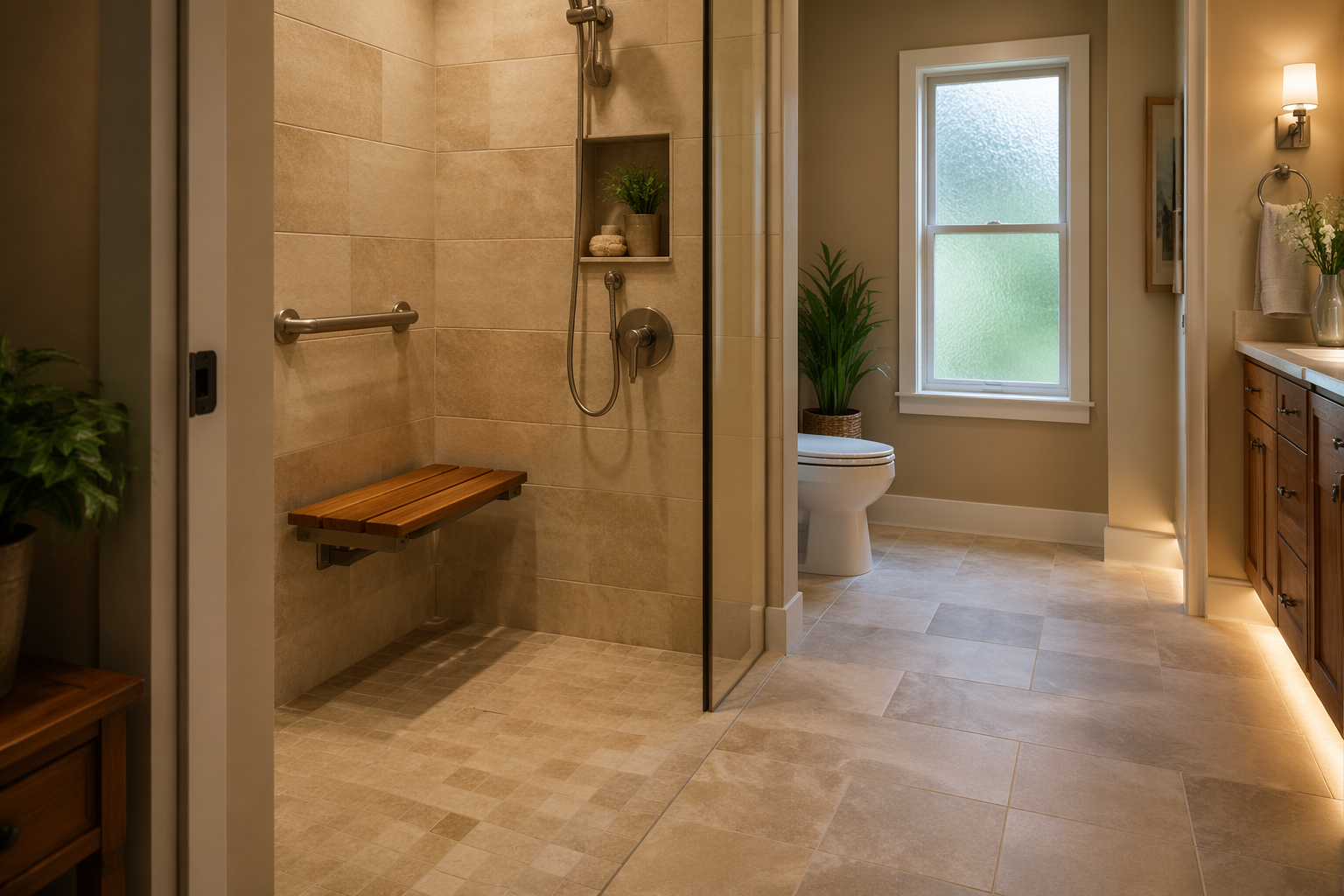
Grab bars are the single most important safety addition, but for someone with dementia, where you place them matters as much as how many you install. The goal is to place bars where they are needed without making the bathroom look like a hospital room. A recommended minimum of five locations includes: at the shower entry (a vertical bar at 33–36 inches), inside the shower (a horizontal bar), near the shower controls, beside the toilet (a 36-inch horizontal bar), and near the vanity. Each bar must be anchored into wall studs and support at least 250 pounds.
For a detailed walkthrough of how to install grab bars yourself, see our step-by-step grab bar installation guide for family caregivers.
Non-Slip Flooring: Same Look, Safer Surface
Replacing the bathroom floor is one of the most disruptive changes you can make, but it is also one of the most important for fall prevention. The solution is to choose a flooring material with a Dynamic Coefficient of Friction (DCOF) of 0.60 or higher — a standard that indicates adequate slip resistance for wet areas — while matching the color and tone of the existing floor as closely as possible. If the original floor was a warm beige stone tile, choose a non-slip tile in the same color family. The person with dementia should not notice the difference.
Lighting: Warm and Motion-Activated
Poor visibility is a major fall trigger, but harsh, cool-toned lighting can increase agitation in someone with dementia. The recommendation is warm-toned LED lights in the 2700K to 3000K range, paired with motion-activated night lights that illuminate the path to the toilet during nighttime bathroom trips. A motion-activated nightlight strip along the baseboard provides orientation without startling the person awake.
Related reading
Need a professional assessment?
Find a CAPS-credentialed professional or local aging services through our outbound resource list — we never name or rank individual contractors.
Find Local HelpNoticed something outdated or inaccurate on this page? Flag a correction. We review every report against CDC, NIA, and AARP HomeFit guidance before updating a page.