
Room checklist
The Evidence for Aging-in-Place Home Modifications: What Research Says About Fall Prevention, Independence, and Cost Savings
A 2025 systematic review of 20 studies found that 65% confirm home modifications are effective for fall prevention, functional independence, and cost savings. This article translates the research evidence into a practical decision-making resource for families considering modifications.
Why This Evidence Review Matters for Your Decision
When a family begins discussing whether to install grab bars, widen a doorway, or build a ramp, the conversation usually starts with cost and inconvenience. Rarely does it start with the research. That is a problem, because the evidence base for home modifications is stronger than most people realize — and knowing what the data actually says can transform a difficult financial decision into a confident investment.
In 2025, a systematic review following PRISMA 2020 guidelines examined 20 studies from 10 countries, spanning 2010 to 2024. The finding: 65% of the studies confirmed that home modifications are effective for fall prevention, functional independence, and cost savings. This article translates that research into a practical framework for families who want to know whether modifications are worth the investment — and what the evidence actually supports.
The Scale of the Problem: How Many Older Adults Face Unmodified Home Barriers?
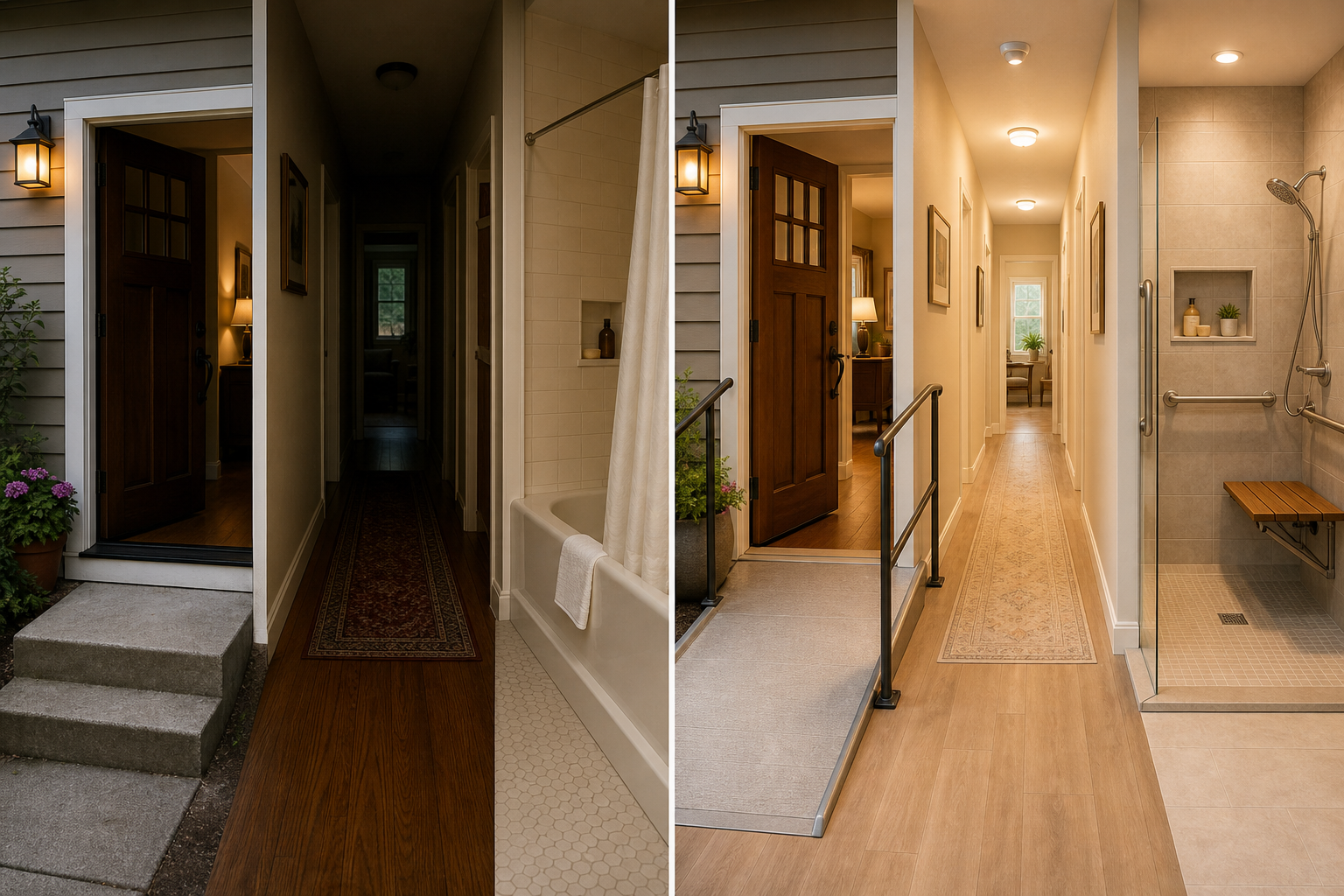
Before examining what modifications can achieve, it helps to understand the gap between need and current home conditions. According to a 2008 HHS/ASPE report analyzing the 2006 Health and Retirement Study (HRS) Home Modification Module (n=1,512, ages 52+), one in four near-elderly and older adults has a mobility limitation combined with an unmodified home barrier — specifically in the entry, bathroom, or toilet area. That is roughly 25% of the aging population living in homes that do not match their functional needs.
Nationally, only 10% of U.S. homes are considered "aging ready" — meaning they have a step-free entry, a first-floor bedroom and bathroom, and at least one bathroom accessibility feature. The remaining 90% of homes were not designed with aging in mind. When you pair this with the fact that one-third of adults 65 and older experience a fall each year — and two-thirds of those falls happen at home — the scale of the mismatch becomes clear.
What the Research Measures: A Multidimensional Impact Framework
One reason home modification research can feel fragmented is that the outcomes are not all about falls. The 2025 systematic review organizes evidence across five distinct dimensions, each of which tells a different part of the story. Understanding this framework helps families evaluate modifications holistically rather than asking only "Will this prevent a fall?"
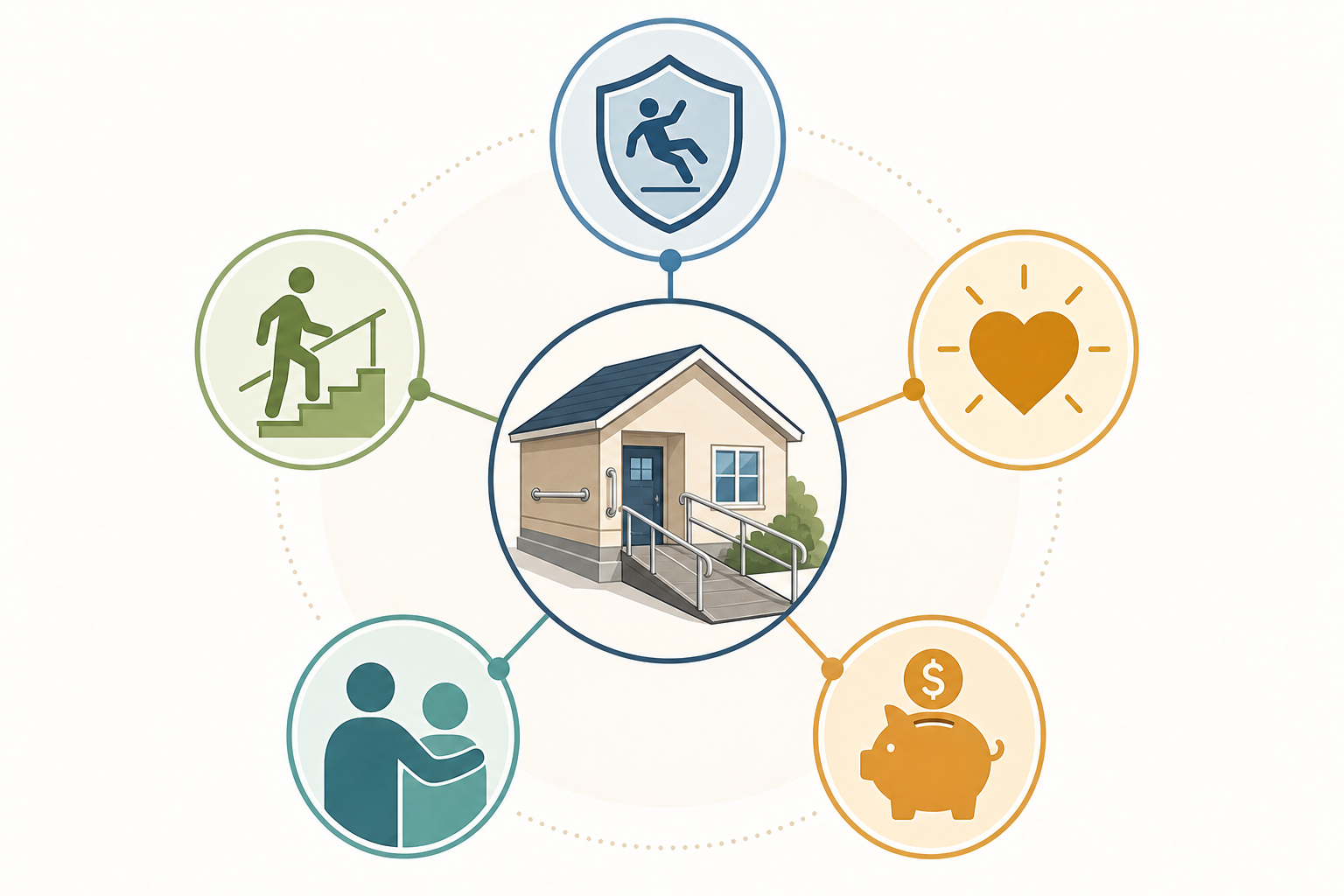
- Fall prevention: The most studied outcome. Modifications reduce both the frequency and severity of falls, particularly for high-risk groups.
- ADL independence: Whether modifications help older adults perform activities of daily living — bathing, toileting, transferring — with less assistance.
- Quality of life: Subjective measures of wellbeing, confidence, and perceived safety at home.
- Caregiver burden: The reduction in hours and emotional strain on family and paid caregivers.
- Cost-effectiveness: Whether the investment in modifications produces measurable savings in healthcare and long-term care costs.
Measuring across multiple dimensions matters because a modification that does not prevent a fall may still reduce care hours or improve quality of life. A single-dimension view — falls only — underestimates the total value of the intervention.
Key Research Findings: Fall Prevention
Fall prevention is where the evidence is strongest. Two studies from the 2025 review stand out for their size and rigor.
The Stark et al. 2017 randomized controlled trial (n=300) is one of the most frequently cited studies in the field. It found that the intervention group — which received home modifications including grab bars, shower seats, and improved lighting — experienced a 39% reduction in falls compared to the control group. This is not a small effect. A 39% reduction means that for every three falls the control group experienced, the modification group experienced fewer than two.
The Hollinghurst et al. 2022 study (n=657,536 older adults in Wales, UK) took a population-level approach. Researchers analyzed the impact of home adaptations — primarily grab bars, handrails, and ramps — on emergency admissions across an entire healthcare system. They found that adaptations reduced fall-related emergency admissions by 3% per quarter (OR=0.97, p<0.001). A 3% quarterly reduction compounds over time, meaning the cumulative effect over several years is substantial — and the study covered over half a million people, making the finding highly reliable.
Key Research Findings: Independence, Caregiver Burden, and Cost-Effectiveness
Beyond falls, the research shows that modifications have a measurable impact on how much help a person needs — and how much that help costs.
The Carnemolla et al. 2019 study (n=157) tracked weekly care hours before and after home modifications. The results were striking: total weekly care hours decreased by 42% after modifications. Informal care (provided by family members) dropped 46%, while formal paid care dropped 16%. For a family caregiver spending 20 hours per week helping a parent with bathing, toileting, and transfers, a 46% reduction means roughly 9 fewer hours per week — time that can be redirected to work, rest, or simply being a daughter or son rather than a nurse.
The cost-effectiveness data comes from Wilson et al. 2017, a modeling study conducted in New Zealand. Researchers calculated that home modifications cost NZD 5,480 per quality-adjusted life year (QALY) gained. To put that in context, healthcare interventions are generally considered cost-effective below NZD 50,000 per QALY in New Zealand — meaning modifications are roughly ten times more efficient than the threshold. The study also found that modifications were most cost-saving for adults aged 75 and older who had experienced a prior fall, which is precisely the population most families are worried about.
| Study | Sample Size | Key Finding | Dimension Measured |
|---|---|---|---|
| Stark et al. 2017 (RCT) | n=300 | 39% reduction in falls | Fall prevention |
| Hollinghurst et al. 2022 | n=657,536 | 3% reduction per quarter in fall-related emergency admissions | Fall prevention |
| Carnemolla et al. 2019 | n=157 | 42% reduction in weekly care hours (informal -46%, formal -16%) | Caregiver burden / Independence |
| Wilson et al. 2017 (modeling) | N/A (modeling) | NZD 5,480 per QALY gained; most cost-saving for 75+ with prior falls | Cost-effectiveness |
What the Research Doesn't Yet Tell Us: Limitations and Gaps
No evidence review is complete without acknowledging what is not yet known. The 2025 systematic review identifies several important gaps that families should keep in mind.
- Smart home technology: The review found limited evidence on the effectiveness of smart home devices — motion sensors, automated lighting, voice-activated controls — compared to traditional structural modifications. This is a rapidly evolving area, but the research has not yet caught up to the market.
- Long-term sustainability: Most studies tracked outcomes for 12 to 24 months. We have less data on whether modifications remain effective after five or ten years, or whether they need to be upgraded as a person's condition progresses.
- Diverse populations: Study populations in the review were predominantly from high-income countries (U.S., UK, Australia, New Zealand, Sweden). Less is known about modification effectiveness in rural settings, multi-generational households, or communities with different housing stock.
- Cost-effectiveness outside high-risk groups: The strongest cost-effectiveness data applies to adults 75+ with a prior fall history. For younger, healthier older adults, the return on investment is less well documented.
From Evidence to Action: What These Findings Mean for Your Home
The research points to a clear conclusion: home modifications work, and they work best when targeted at the most common problem areas. The 2025 review notes that 50% of homes in one Swedish study lacked grab bars in hygiene areas — a finding that mirrors U.S. data showing that grab bars are the single most common modification added by remodelers. In 2023, 93% of remodelers added a grab bar to a bathroom, according to industry data.
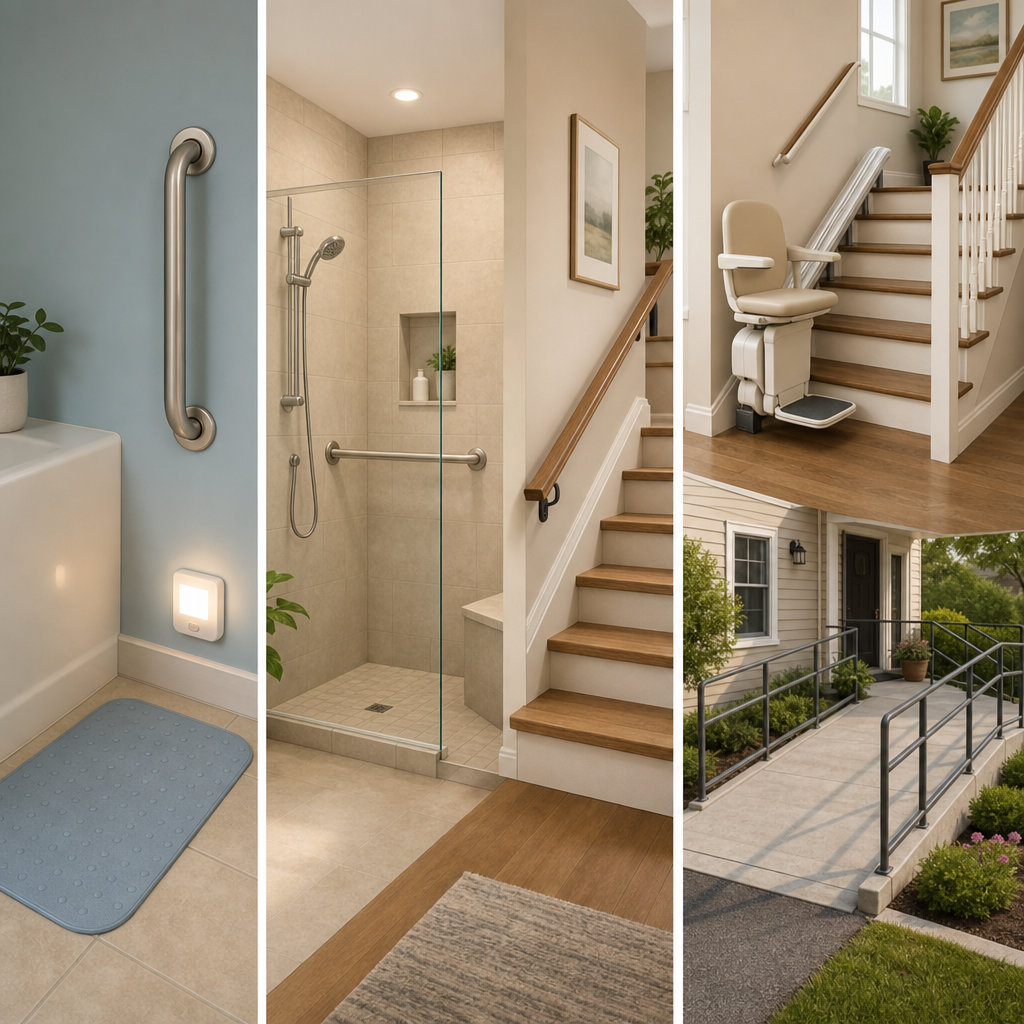
The most common and evidence-backed modifications fall into three cost tiers:
| Tier | Cost Range | Examples | Evidence Strength |
|---|---|---|---|
| Low-cost upgrades | $25 – $500 | Grab bars ($20–$150 each), lever door handles, improved lighting, non-slip mats | Strong — grab bars are the most studied single modification |
| Mid-range projects | $1,000 – $10,000 | Walk-in shower conversion ($6,000–$12,000), stair lift ($2,500–$8,000), modular ramp ($395–$6,000) | Strong — stair lifts and ramps have population-level data (Hollinghurst 2022) |
| High-cost structural changes | $10,000 – $50,000+ | Door widening ($600–$2,000 per doorway), full bathroom remodel, residential elevator | Moderate — less RCT data, but supported by modeling studies (Wilson 2017) |
For families starting the process, the evidence supports beginning with the bathroom — the room where most falls occur and where modifications have the strongest track record. A walk-in shower with a grab bar and shower seat, combined with improved lighting, addresses the three most common environmental fall risks in a single project.
For more detailed guidance on specific modifications, see our decision guide on stair lifts vs. alternatives and our guide to portable vs. permanent entryway ramps. For a room-by-room safety checklist, visit our stair safety guide.
Funding the Evidence: How to Pay for Modifications
The research makes a strong case that modifications are cost-effective, but the upfront cost remains a barrier for many families. The 2008 HRS data found that 77% of modifications were self-funded — only 6% were covered by insurance or government programs. That pattern has not changed dramatically in the years since.
However, several funding sources exist for those who qualify:
| Funding Source | Maximum Amount (FY 2026) | Eligibility | Notes |
|---|---|---|---|
| VA Specially Adapted Housing (SAH) Grant | $126,526 | Veterans with specific service-connected disabilities | Can be used for structural modifications, ramps, and bathroom renovations |
| VA Special Home Adaptation (SHA) Grant | $25,350 | Veterans with certain service-connected disabilities | For less extensive modifications than SAH |
| USDA Rural Housing Repair Grant | Up to $10,000 | Homeowners age 62+ in rural areas | Must be used to remove health and safety hazards; loans up to $40,000 at 1% interest also available |
| Medicare Advantage (some plans) | Varies by plan | Chronically ill enrollees | Some plans cover home accessibility improvements; coverage is plan-specific and not guaranteed |
For most families, the reality is that modifications will be paid out of pocket. The national average cost for aging-in-place remodeling is $3,000 to $15,000, according to 2024 industry data. When measured against the potential savings in care hours (42% reduction per the Carnemolla study) and fall-related medical costs, the investment often pays for itself within one to two years — particularly for households where a fall would trigger a move to assisted living.
For a detailed breakdown of costs by modification type, see our FAQ on home modification costs. For an explanation of why Medicare typically does not cover these modifications, read our guide to the Medicare DME prevention paradox.
Related reading
Need a professional assessment?
Find a CAPS-credentialed professional or local aging services through our outbound resource list — we never name or rank individual contractors.
Find Local HelpNoticed something outdated or inaccurate on this page? Flag a correction. We review every report against CDC, NIA, and AARP HomeFit guidance before updating a page.