
Room checklist
Portable vs. Permanent Entryway Ramps: A Decision Guide for Families Aging in Place
This guide helps family caregivers decide between a portable ramp and a permanent ramp by evaluating the senior's mobility trajectory, rise height, property constraints, and duration of need. It covers safety trade-offs, costs, installation timelines, and real-world case examples.
Choosing between a portable ramp and a permanent ramp for your parent's home can feel like a high-stakes decision, especially when you are balancing safety concerns, budget constraints, and the emotional weight of the moment. The wrong choice can mean wasted money, a fall risk, or a barrier that keeps your parent from leaving the house. The right choice restores independence and peace of mind.
This guide is built around four decision factors: the height of the entryway steps (rise height), the trajectory of your parent's mobility (temporary recovery vs. progressive decline), whether they self-propel a wheelchair or are pushed, and the property constraints (rental rules, HOA covenants, available space). We will walk through each factor, then apply them to real-world entryway scenarios.
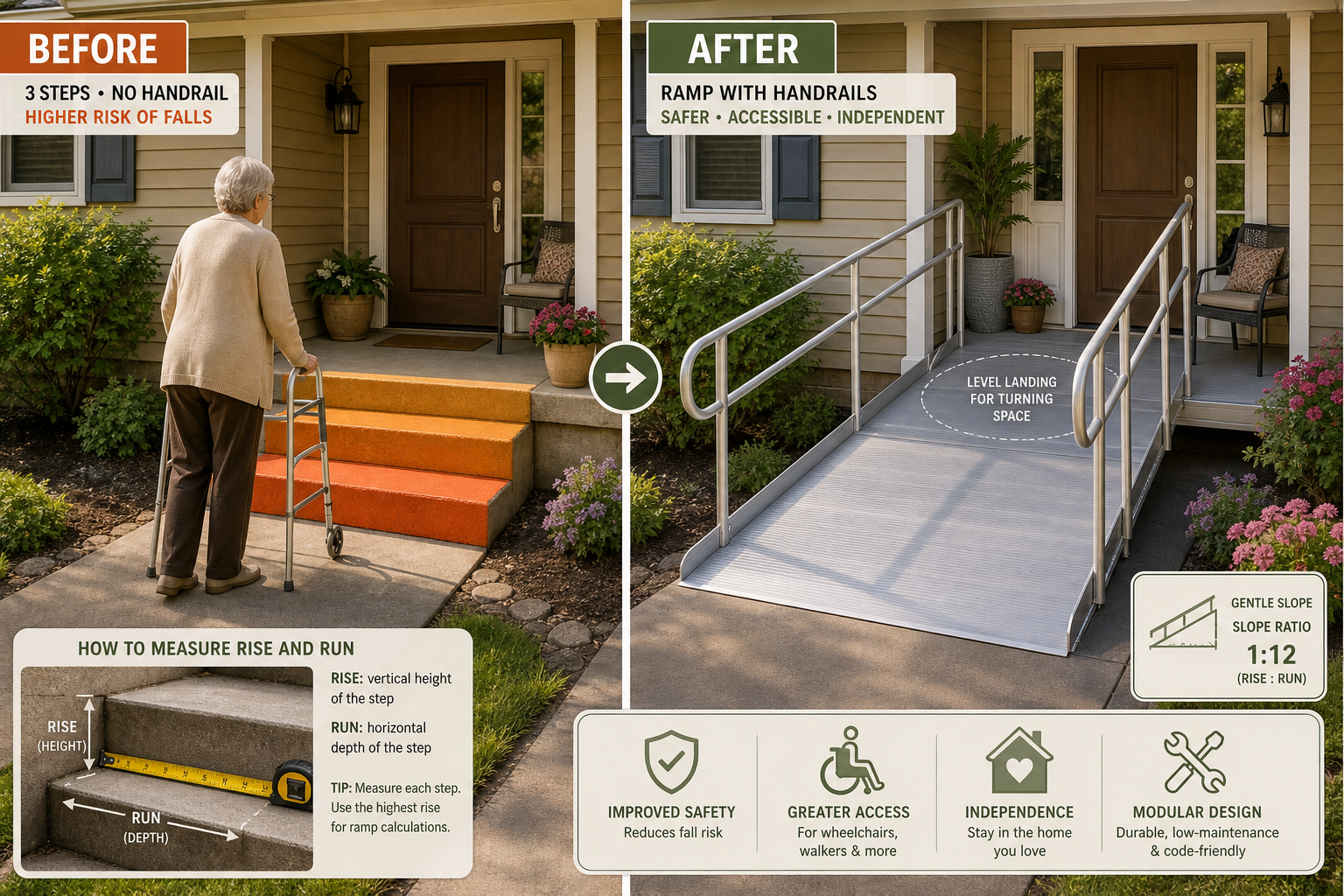
Quick Assessment: Three Questions to Determine Your Ramp Type
Before you research products or call a contractor, answer these three questions. They will immediately narrow your options.
1. What is the rise height of your entryway?
Measure from the ground to the top of the threshold. A standard step is roughly 7 inches tall. A 3-step stoop is about 21 inches. This measurement is critical because portable ramps have a hard limit: most models max out at 10 to 12 feet in length, which corresponds to a rise of about 21 inches when using a 1:12 slope. If your rise is higher than that, you are looking at a permanent or modular ramp.
2. What is the mobility trajectory?
Is your parent recovering from a hip replacement and expected to regain full mobility in 8–12 weeks? Or have they been diagnosed with a progressive condition like Parkinson's disease, post-stroke mobility impairment, or multiple sclerosis? A temporary need points toward a portable ramp. A progressive or permanent condition points toward a permanent or modular ramp. The evidence supports this: a 2019 study by Carnemolla et al. found that home modifications, including ramp installation, reduced weekly care hours by 42% and informal care by 46% — savings that compound over years of daily use.
3. What are your property constraints?
Are you renting? Does the home have an HOA? Is there enough space in the front yard to accommodate a 21-foot ramp run? Portable ramps require no permanent alteration to the property and can be removed when you move. Permanent ramps require a building permit in most jurisdictions and may need HOA approval. If you are renting, a portable ramp is often the only option unless the landlord agrees to a permanent modification.
- Rise height ≤ 21 inches (3 steps) and temporary need → portable ramp
- Rise height > 21 inches or progressive condition → permanent or modular ramp
- Renting or HOA restrictions → portable ramp (or modular if removable)
- User self-propels a manual wheelchair → permanent ramp with handrails and 36"+ width
Portable Ramps: Best for Temporary Needs and Low-Step Entries
Portable ramps are the quickest, cheapest way to solve a low-step entry problem. They are designed for 1 to 3 steps, post-surgery recovery, rental homes, or travel. They cost between $50 and $500, weigh between 50 and 90 pounds, and can be set up in under an hour with no tools. Most are made of aluminum and fold into a compact shape for storage or transport.
However, portable ramps come with significant limitations that many families discover only after purchase.
| Feature | Portable Ramp | Why It Matters |
|---|---|---|
| Max length | 10–12 feet | Limits use to ~21" rise (3 steps max) |
| Handrails | Not available on most models | No support for balance-impaired users |
| Weight | 50–90 lbs | Difficult for one person to carry and position |
| Slope at max length | Often steeper than 1:12 | Harder to push a wheelchair up |
| Edge protection | Rarely included | Risk of wheelchair wheel slipping off |
| Cost | $50–$500 | Low upfront cost, but may need replacement |
The slope issue is equally important. The ADA recommends a 1:12 slope (1 inch of rise per 12 inches of ramp length). For a 21-inch rise, that requires a 21-foot ramp. A 10-foot portable ramp covering the same rise creates a slope of roughly 1:5.7 — nearly twice as steep. This is manageable for someone who walks with a cane but can be impossible for someone pushing a manual wheelchair or using a walker.
Permanent and Modular Ramps: Built for Progressive Conditions and Daily Use
Permanent and modular ramps are the right choice for entryways with 3 or more steps, progressive mobility conditions, and daily use. They cost between $1,000 and $10,000, but they include the safety features that portable ramps lack: handrails on both sides, level landings at the top and bottom, edge protection, and a clear width of at least 36 inches.
Modular aluminum ramps deserve special attention because they offer a middle ground that many families overlook. They are built to permanent-grade specifications — handrails, landings, 1:12 slope, 36-inch width — but they can be disassembled and moved if the user relocates. This is a critical advantage for families who are renting or who may move to a different home in the next few years.
| Feature | Permanent (Wood/Concrete) | Modular Aluminum |
|---|---|---|
| Cost | $3,000–$10,000 | $1,500–$6,000 |
| Installation time | 3–7 days (professional) | 1 day (two people or pro) |
| Handrails | Yes, required for rises >6" | Yes, included |
| Landings | Yes, required every 30' | Yes, included |
| Relocatable | No | Yes — can be disassembled |
| Permit required | Almost always | Usually, but varies by locality |
For families dealing with a progressive condition like Parkinson's or post-stroke mobility impairment, the investment in a permanent or modular ramp pays for itself over time. The 2019 Carnemolla study found that home modifications reduced formal care hours by 16% and informal care by 46%. A properly built ramp can also reduce fall-related emergency admissions: a 2025 systematic review by Cha et al. found that home modifications reduced fall-related emergency admissions by 3% per quarter (OR=0.97, p<0.001) in a UK cohort of 657,536 older adults.
If you decide on a permanent ramp, consider working with a CAPS-certified contractor who specializes in aging-in-place modifications. They understand slope requirements, landing dimensions, and how to integrate the ramp with your existing entryway.
Real-World Case Examples: Matching Ramp Type to Your Entryway
The following scenarios show how the decision framework works in practice. Find the one that matches your situation.
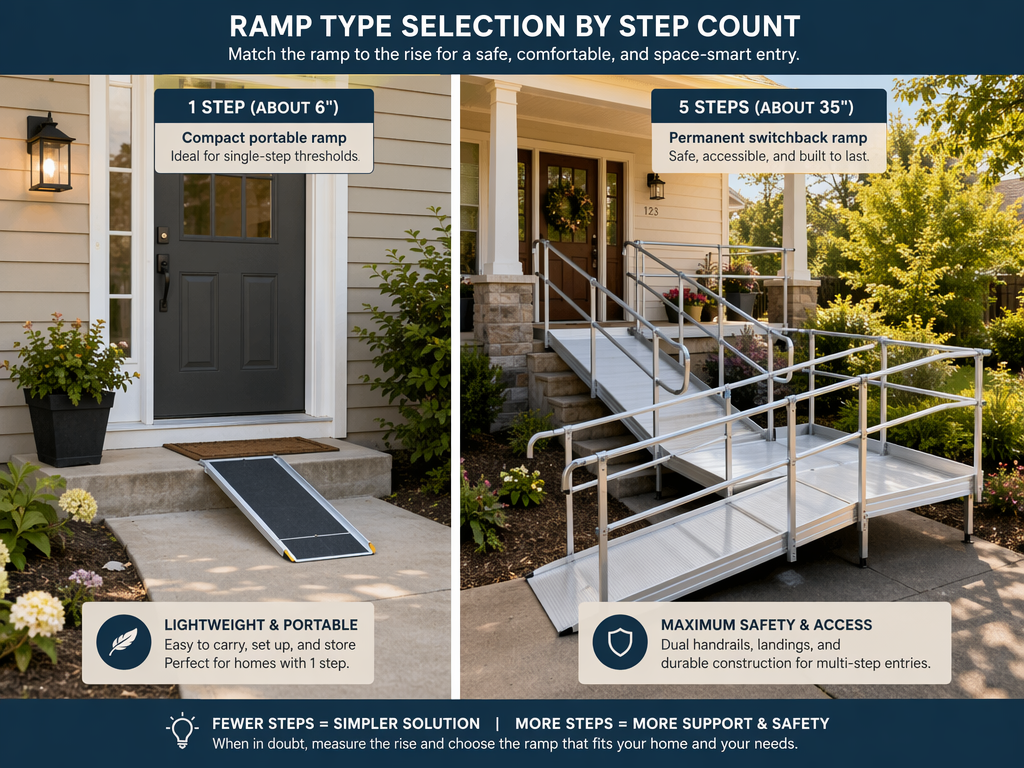
Scenario A: Single-Step Threshold (Rise: 1/2 to 7 inches)
A single step or a high threshold is the simplest case. A threshold ramp — a small, low-cost ramp that sits directly on the step — is often sufficient. These cost $30–$150 and require no tools. They are ideal for a senior who uses a walker or cane and just needs to clear that one lip. If the rise is under 1/2 inch, a beveled threshold reducer may be all that is needed.
Scenario B: 3-Step Porch (Rise: ~21 inches)
This is the most common decision point. A 3-step porch is right at the edge of what a portable ramp can handle. If your parent is recovering from surgery and expected to improve within 3 months, a 10-foot portable ramp ($150–$400) is a reasonable short-term solution. If they have a progressive condition or you are unsure about the trajectory, choose a modular aluminum ramp. The extra cost ($1,500–$3,000) buys handrails, a proper slope, and the ability to keep the ramp for years.
Scenario C: 5-Step Stoop (Rise: ~35 inches)
A 5-step stoop requires a ramp run of at least 35 feet at a 1:12 slope. This is well beyond the capacity of any portable ramp. You need a permanent or modular ramp, and you will likely need a switchback design (a ramp that turns 180 degrees at a landing) to fit the run into a typical front yard. Expect to pay $4,000–$10,000. A CAPS-certified contractor can design a switchback that meets ADA standards and fits your property.
Scenario D: Multi-Level Entry (Rise: 40+ inches or multiple landings)
For a multi-level entry with a very high rise or tight space constraints, a ramp may not be feasible. In these cases, a stair lift is often a better alternative. Stair lifts require no exterior footprint, cost $3,000–$8,000, and can be installed in a day. They are not a direct replacement for a ramp — they do not accommodate a wheelchair — but they solve the entry problem for someone who can transfer to a seat.
Safety Comparison: Handrails, Edge Protection, and Slip Resistance
Safety is not a feature you can compromise on when a fall can mean a hip fracture, a hospital stay, and a permanent loss of independence. The safety gap between portable and permanent ramps is wide, and it is important to understand it before you decide.
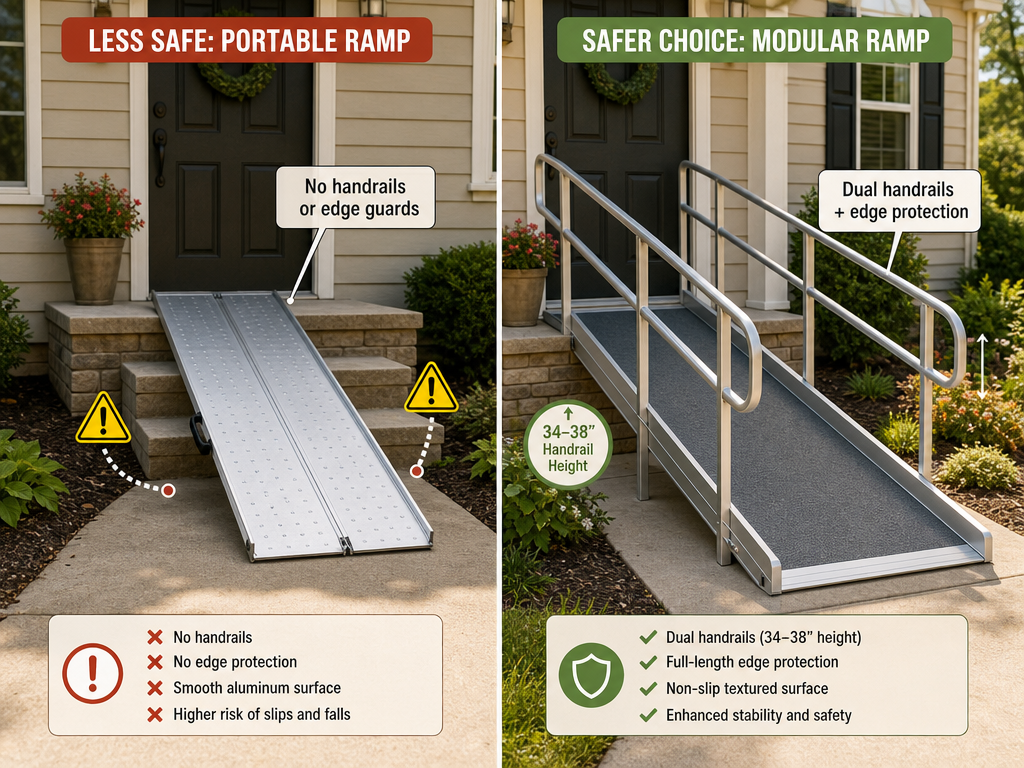
| Safety Feature | Portable Ramp | Permanent/Modular Ramp |
|---|---|---|
| Handrails | Not available on most models | Required for rises >6" (ADA) |
| Edge protection (curb) | Rarely included | Required (4" minimum per ADA) |
| Slip-resistant surface | Some models have traction coating | Standard on aluminum and wood |
| Level landing at door | Not included | Required (5'x5' minimum) |
| Stability in wind/weather | Can shift or move | Permanently anchored |
Slip resistance is another concern. Portable ramps are often made of smooth aluminum that becomes slippery when wet. Some models include a traction coating, but it wears down over time. Permanent ramps — whether aluminum, wood, or concrete — can be fitted with slip-resistant surfaces that meet ADA standards. For homes in regions with rain, snow, or ice, this is a critical consideration.
Installation Timeline: From One Hour to One Week
Time matters when your parent is already struggling to get in and out of the house. Here is what you can expect for each ramp type.
| Ramp Type | Installation Time | Tools Required | Who Can Install |
|---|---|---|---|
| Portable ramp | 1 hour | None | You or a family member |
| Modular aluminum kit | 1 day | Basic tools (drill, wrench) | Two people or a contractor |
| Custom permanent (wood/concrete) | 3–7 days | Full construction tools | Licensed contractor |
If you are in a crisis situation — your parent just came home from the hospital and cannot manage the steps — a portable ramp can be ordered online and installed the same day. It is not a perfect long-term solution, but it buys you time to plan a permanent modification. If you are planning ahead, a modular aluminum kit can be installed over a weekend, and a custom permanent ramp can be scheduled with a contractor who specializes in aging-in-place modifications.
Making the Final Decision: A Summary Checklist
Use this checklist to confirm your decision before you purchase or build. If you answer "yes" to more questions in one column, that ramp type is likely the better fit.
- Rise height is 21 inches or less (3 steps max)
- Need is temporary (post-surgery recovery, short-term rehab)
- You are renting or cannot make permanent alterations
- User walks independently with a cane or walker (does not self-propel a wheelchair)
- Budget is under $500
If most of the above are true, a portable ramp is a reasonable choice.
- Rise height is over 21 inches (4+ steps)
- Condition is progressive (Parkinson's, MS, post-stroke, dementia)
- You own the home and plan to stay for 2+ years
- User self-propels a manual wheelchair or has significant balance impairment
- Budget allows $1,500–$10,000
If most of the above are true, invest in a permanent or modular ramp.
Once you have made your decision, explore these related resources on the site:
- If cost is a concern, see our complete guide to funding sources for home modifications for information on VA grants, Medicaid waivers, and other programs.
- If a ramp is not feasible due to space or rise height, read our stair lift decision guide for alternatives.
- If your parent is resistant to the idea of a ramp, our guide on overcoming stigma around stair safety changes offers practical conversation strategies.
- If your parent uses a wheelchair, our manual vs. power wheelchair guide can help you choose the right device for their needs.
Related reading
Need a professional assessment?
Find a CAPS-credentialed professional or local aging services through our outbound resource list — we never name or rank individual contractors.
Find Local HelpNoticed something outdated or inaccurate on this page? Flag a correction. We review every report against CDC, NIA, and AARP HomeFit guidance before updating a page.