
Room checklist
Walk-In Tub vs. Curbless Shower: Why the Evidence Favors a Zero-Threshold Shower for Most Older Adults
Walk-in tubs are heavily marketed to seniors, but the safety evidence strongly favors curbless showers for most older adults. This article compares both options across safety, cost, usability, and long-term value — helping family caregivers make an informed, evidence-based decision for their parent's bathroom remodel.
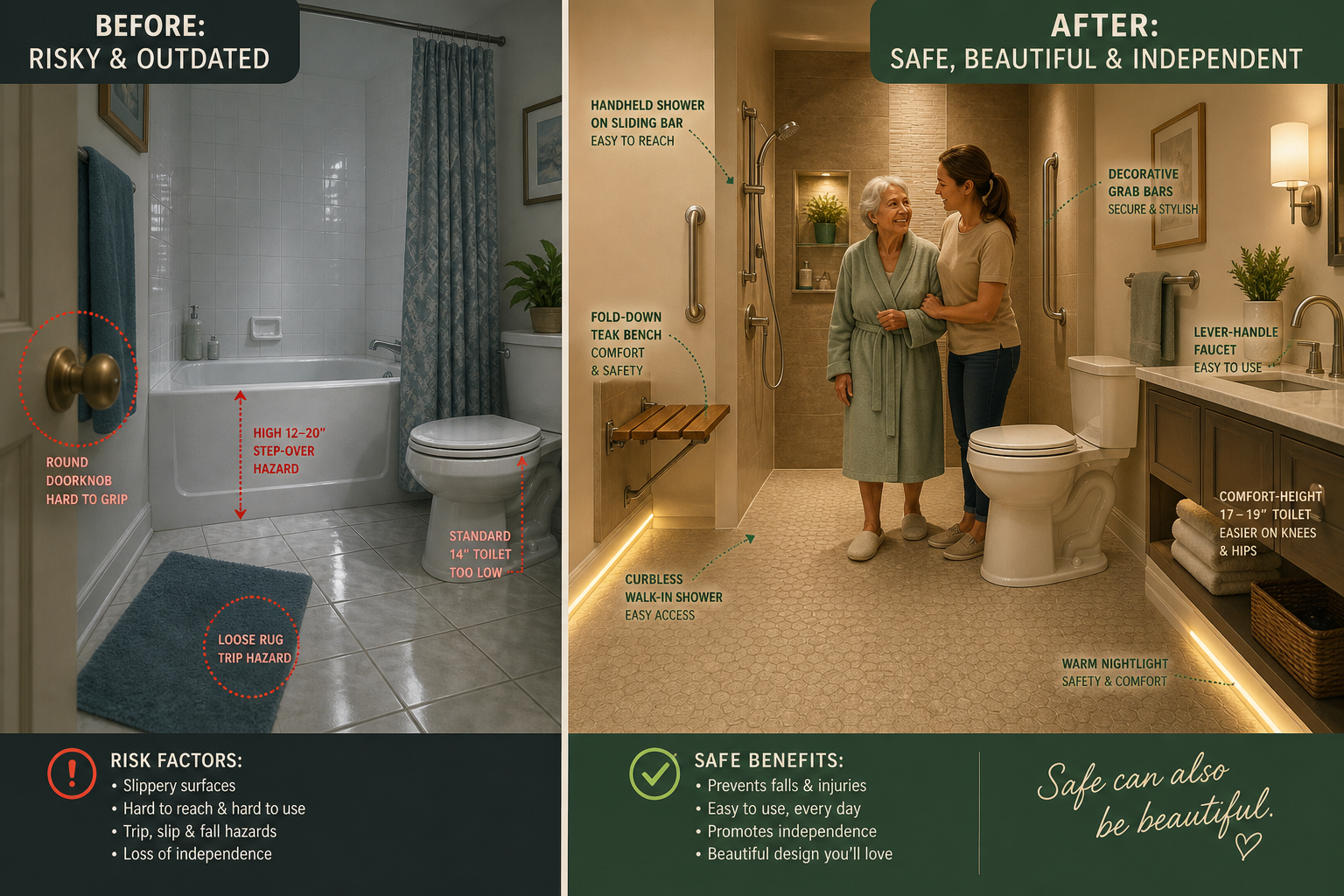
Why This Decision Matters: The Bathtub Is the Highest Fall-Risk Fixture in the Home
If you are reading this, you have likely already confronted the reality that your parent's bathroom is no longer safe. You are not overreacting. According to the CDC, over 14 million older adults — roughly one in four — report falling each year, and falls are the leading cause of injury-related death among adults 65 and older. The age-adjusted fall death rate rose 21% between 2018 and 2024, from 64.7 to 78.4 per 100,000 people.
The bathroom is the epicenter of this crisis. Buildwithinspiration, citing CDC data, reports that approximately 235,000 Americans over 65 visit emergency rooms every year due to bathroom-related falls and injuries. The combination of wet surfaces, hard fixtures, and the need to step over a high tub wall creates a perfect storm for a catastrophic injury.
This article is not a neutral product comparison. It is an evidence-based argument: for the vast majority of older adults, a curbless (zero-threshold) shower is the clinically safer and more future-proof choice than a walk-in tub. The marketing for walk-in tubs is aggressive and emotionally persuasive — but the safety data tells a different story.
Walk-In Tub: The Marketing vs. The Reality
Walk-in tub manufacturers promise a spa-like experience: warm hydrotherapy, a lower step-in than a standard tub, and the ability to bathe independently. For a family caregiver watching a parent struggle with balance, these promises are deeply appealing. But the reality is more complicated — and more dangerous.
The Claimed Benefits
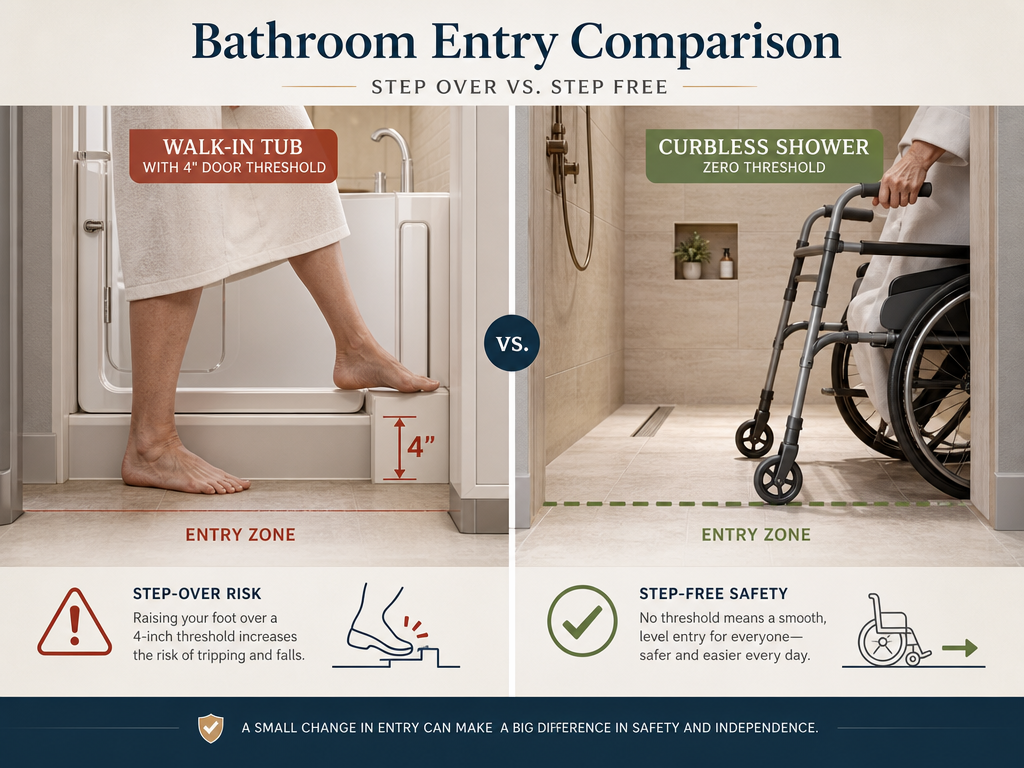
- Lower step-in height: Walk-in tubs typically have a door threshold of 3 to 6 inches, compared to the 12 to 20 inches of a standard bathtub. This is a genuine improvement for someone who cannot lift their leg high enough to clear a traditional tub wall.
- Hydrotherapy: Many models include jets for warm water massage, which can provide genuine relief for arthritis and muscle stiffness.
- Soaking: For older adults who have always enjoyed a bath, the ability to soak is a quality-of-life consideration.
The Safety Risks That Marketing Doesn't Mention
The 3- to 6-inch door threshold is lower than a standard tub, but it is not zero. For someone using a walker or who has significant balance issues, any step-over is a fall risk. The user must step over the threshold to enter, sit down on a low seat, wait for the door to seal, and then wait for the tub to fill — a process that can take several minutes. During that time, the user is sitting in a cold, empty tub with no way to exit quickly.
The slow drain time is a critical safety issue. After bathing, the user must sit in the tub while the water drains completely before the door can be opened. This can take 60 to 90 seconds or longer. If the user needs to exit urgently — due to a medical event, a sudden drop in blood pressure, or simply feeling trapped — they cannot. They are locked in until the water level drops below the door threshold.
CAPS-certified specialist Jamie Gold, quoted in an AARP article, recommends curbless showers for aging in place, calling them "something less to trip on for someone who might have balance, fatigue or issues." She recommends them regardless of age. The AARP article notes that walk-in tubs can cost as little as $2,000 for a standard model or more than $20,000 for a luxury one — a significant investment for a fixture that introduces new risks.
Curbless Shower: Zero Threshold, Maximum Safety
A curbless (zero-threshold) shower is exactly what it sounds like: a shower with no step-up or step-over at the entry. The floor of the shower is level with the bathroom floor, with a slight slope toward a linear drain to manage water flow. This single design choice eliminates the primary fall risk that makes bathtubs dangerous.
Why It's Safer
- Zero threshold: No step-over hazard. A walker or wheelchair can roll directly into the shower. This is not just a convenience — it is a critical safety feature for anyone with balance issues, leg weakness, or a history of falls.
- Immediate exit: Unlike a walk-in tub, there is no door to seal, no water to drain, and no wait time. The user can step out or be assisted out at any moment. This is essential for someone who may experience a sudden drop in blood pressure, dizziness, or confusion.
- Built-in bench compatibility: A curbless shower can accommodate a permanent or fold-down bench, allowing the user to sit while bathing. This reduces the risk of falling while standing and makes it easier for a caregiver to assist.
- Grab bar integration: Grab bars can be installed at multiple heights and locations within the shower, providing support during entry, exit, and bathing. The AARP article notes that decorative grab bars from major manufacturers are rated for 250+ pounds.
- Future-proof: If your parent's mobility declines further — if they begin using a wheelchair or require full caregiver assistance — a curbless shower requires no adaptive transition. It is already accessible.
The Trade-Offs
A curbless shower is not a perfect solution for everyone. The primary drawback is the loss of a soaking tub. If your parent values bathing as a therapeutic or relaxation ritual, a curbless shower cannot replicate that experience. Additionally, a curbless shower requires a linear drain and a properly sloped floor, which may necessitate a wider bathroom or more extensive structural work. Buildwithinspiration reports that curbless shower conversions typically cost $3,000 to $15,000, while AARP estimates $6,000 to $10,000.
What the Evidence Says: Systematic Reviews and Fall Data
The decision between a walk-in tub and a curbless shower should not be based on marketing claims or anecdotal reports. It should be based on evidence. A 2025 systematic review published in PMC (National Institutes of Health) analyzed 20 studies following PRISMA 2020 guidelines and found that 13 of 20 studies (65%) confirmed the effectiveness of home modifications in fall prevention, functional independence, and cost savings.
The review highlighted a landmark study by Stark et al. (2017), which found that home modifications — including grab bars, slip-resistant flooring, lighting improvements, and shower conversions — reduced falls by 39% in the intervention group compared to the control group. Critically, bathroom modifications were identified as the most impactful category of intervention. All 20 studies in the review included bathroom safety enhancements, and 100% included mobility and accessibility improvements such as threshold removal and doorway widening.
This evidence directly supports the case for curbless showers. A zero-threshold shower is, in effect, a threshold removal — one of the interventions proven to reduce falls. A walk-in tub, by contrast, introduces a new threshold (the door) and a new hazard (water entrapment) that the evidence base does not support.
Walk-In Tub vs. Curbless Shower: Head-to-Head Comparison
The following table summarizes the key differences across the dimensions that matter most for an older adult's safety, independence, and long-term quality of life.
| Dimension | Walk-In Tub | Curbless Shower |
|---|---|---|
| Entry safety | 3-6 inch door threshold remains a trip/fall hazard | Zero threshold — walker or wheelchair rolls in at floor level |
| Fall risk during use | Moderate to high — user must sit on low seat, wait for fill, and cannot exit quickly | Low — user can sit on bench, stand, or exit at any time |
| Emergency egress | Poor — user is trapped until water drains below door threshold (60-90+ seconds) | Excellent — immediate exit with no barriers |
| Wheelchair accessibility | Not accessible — requires transfer from wheelchair to tub seat | Fully accessible — wheelchair rolls directly into shower |
| Caregiver assistance ease | Difficult — caregiver must reach over tub wall, assist with transfer, and wait for drain | Easy — caregiver can stand beside user, assist with bench transfer, and exit immediately |
| Hydrotherapy / soaking | Yes — warm water jets and full-body soaking available | No — shower-only; no soaking capability |
| Cost range (2026) | $2,000 – $20,000+ (AARP) | $3,000 – $15,000 (buildwithinspiration); $6,000 – $10,000 (AARP) |
| Long-term adaptability | Poor — does not accommodate future wheelchair use or declining mobility | Excellent — already accessible; no adaptive transition needed |
Decision Framework: Which Option Fits Your Parent's Situation?
The evidence strongly favors curbless showers, but every family's situation is different. Use the following framework to assess which option aligns with your parent's current and anticipated needs.
When a Curbless Shower Is the Clear Winner
- Your parent uses a walker or wheelchair now, or is likely to need one within the next 2-3 years.
- Your parent has a history of falls, balance issues, or leg weakness.
- A caregiver will be assisting with bathing — a curbless shower makes this dramatically easier and safer.
- Your parent does not strongly value soaking in a tub and is comfortable with shower-only bathing.
- You have the bathroom space to accommodate a linear drain and a slightly wider shower area.
When a Walk-In Tub Might Still Be Appropriate
- Your parent has a specific medical need for hydrotherapy (e.g., for arthritis or chronic pain) and a doctor has recommended warm water therapy.
- Your parent is currently mobile (no walker or wheelchair), has no history of falls, and strongly prefers bathing over showering.
- Bathroom space is extremely limited and cannot accommodate a curbless shower with a linear drain.
- Your parent has a caregiver who will be present during every bath and can assist with entry, exit, and emergency egress.
Even in these scenarios, a walk-in tub should be viewed as a transitional solution, not a permanent one. If your parent's mobility declines — and it likely will — the walk-in tub will become a barrier rather than an aid.
Verdict: Why Curbless Showers Are the Safer Choice for Most Families
The evidence is clear: for the vast majority of older adults, a curbless shower is the clinically safer and more future-proof choice. The walk-in tub industry has done an effective job marketing a product that sounds safe but introduces new hazards — a door threshold that remains a fall risk, a slow drain that traps users in hot water, and a design that makes emergency egress difficult or impossible.
The CDC reports that over 14 million older adults fall each year, and falls are the leading cause of injury-related death in this population. The PMC 2025 systematic review found that home modifications — including threshold removal, grab bars, and slip-resistant flooring — reduce falls by 39%. A curbless shower is a direct application of this evidence. A walk-in tub is not.
If your parent values soaking and has no mobility concerns, a walk-in tub may still be a reasonable choice — but only with the understanding that it is a short-term solution. For everyone else, the verdict is straightforward: choose the curbless shower. It is safer, more accessible, and will serve your parent well as their needs evolve.
For a broader perspective on how to prioritize bathroom modifications alongside other home safety upgrades, see our room-by-room prioritization guide for aging-in-place modifications. And if you are still in the early stages of planning, our bathroom remodel crisis guide for family caregivers can help you move from shock to action.
Related reading
Need a professional assessment?
Find a CAPS-credentialed professional or local aging services through our outbound resource list — we never name or rank individual contractors.
Find Local HelpNoticed something outdated or inaccurate on this page? Flag a correction. We review every report against CDC, NIA, and AARP HomeFit guidance before updating a page.