
Room checklist
CAPS Specialist vs. General Contractor vs. Occupational Therapist: Who Should You Hire for Home Modifications?
Many families don't know which professional to call first after a parent's decline. This guide compares CAPS specialists, general contractors, and occupational therapists so you can choose the right expert for your situation.
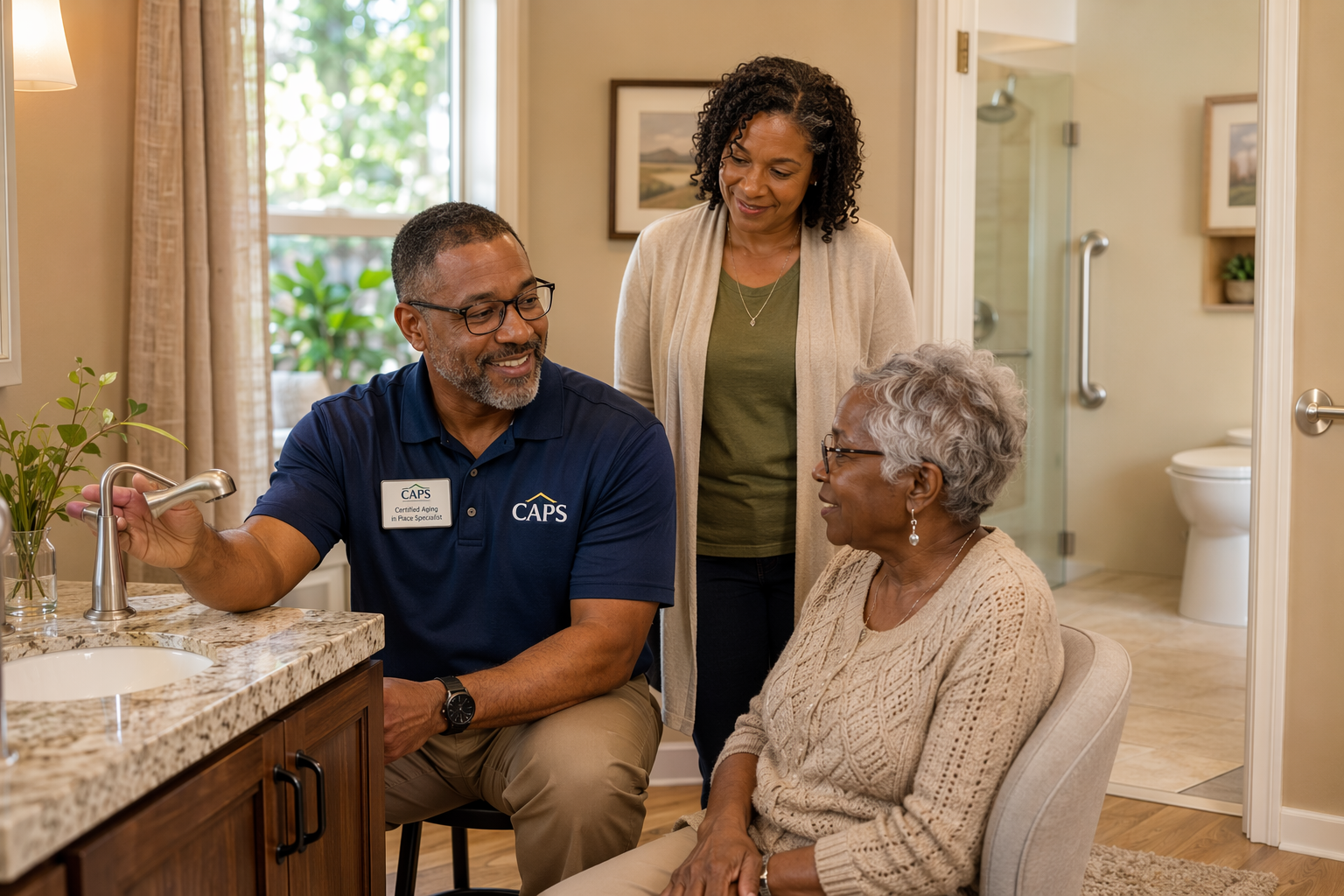
Why Choosing the Right Professional Matters
After a parent's fall or a new diagnosis that limits mobility, most families do the same thing: they call a general contractor. It makes sense on the surface — you need grab bars installed, a ramp built, or a bathroom remodeled. But that instinct often leads to wasted money, unsafe modifications, and a second round of work that costs more than hiring the right person the first time.
The core problem is that three different types of professionals can help with home modifications, and they are not interchangeable. A Certified Aging-in-Place Specialist (CAPS), an occupational therapist (OT), and a general contractor each bring a distinct skill set, focus, and engagement model. Choosing the wrong one first is not just inefficient — it can result in grab bars that cannot support a person's weight, doorways that are still too narrow for a walker, or modifications that address the wrong problem entirely.
This guide provides a structured comparison of the three roles and a decision framework that answers the question families most often get wrong: should I start with a person-focused assessment or a home-focused assessment?
Role Definitions: CAPS, General Contractor, and Occupational Therapist
Before comparing them, it helps to understand what each professional actually does. The boundaries between these roles are not always obvious to families, and some professionals hold multiple credentials.
Certified Aging-in-Place Specialist (CAPS)
A CAPS is a construction-forward professional trained specifically in home modifications for aging in place. The credential is offered by the National Association of Home Builders (NAHB) in cooperation with AARP and requires completing three courses: CAPS I (Marketing and Communicating with the Aging in Place Client), CAPS II (Design Concepts and Methods for Livable Homes and Aging in Place), and CAPS III (Details and Solutions for Livable Homes and Aging in Place). Course topics include design principles, product selection for occupied homes, common installation errors, and budgeting phased construction.
Most CAPS professionals come from construction backgrounds — they are remodelers, contractors, or architects who added the credential. But the program has no prerequisites; healthcare professionals including occupational therapists, physical therapists, nurses, and social workers also pursue the certification. This means a CAPS might be a contractor who understands universal design, or an OT who understands construction — and the distinction matters when you hire one.
Occupational Therapist (OT)
An occupational therapist is a licensed clinical professional who evaluates a person's functional abilities within their environment. When it comes to home modifications, an OT conducts a comprehensive home assessment focused on the individual's specific needs — how they move, transfer, bathe, cook, and navigate their daily routines. The OT identifies the gap between what the person can do and what the home demands of them, then recommends modifications to close that gap.
OTs do not typically perform construction work. Their output is a set of recommendations — often with specific measurements, placement guidance, and functional rationale — that a contractor or CAPS then executes. Medicare Part B covers OT home evaluations, which makes this a more accessible starting point for many families than they realize.
General Contractor
A general contractor manages construction and renovation projects. Their expertise lies in structural changes, building codes, material selection, and coordinating subcontractors. A good general contractor is essential for large-scale renovations — adding a first-floor bedroom, widening doorways, or building an addition.
The critical gap: general contractors are not trained in aging-in-place design unless they have pursued that specialization independently. A contractor without CAPS or similar training may install grab bars into drywall without proper blocking, place them at standard heights rather than the user's functional height, or miss the load-path requirements that make a grab bar safe for a person who needs it to bear their full weight during a fall.
Comparison at a Glance: Training, Focus, and When to Hire
The table below summarizes the key differences across the three roles, plus a row for other aging-in-place certifications you may encounter.
| Dimension | CAPS | Occupational Therapist | General Contractor | Other Certifications (SHSS, ECHM, UDCP) |
|---|---|---|---|---|
| Training background | NAHB three-course program (CAPS I–III); no prerequisites; many come from construction or healthcare | Master's or doctoral degree in occupational therapy; state licensure; clinical training in functional assessment | Varies by state; typically trade experience or construction management degree; no aging-in-place requirement | Varies: SHSS (Age Safe America) focuses on home safety evaluations; ECHM (USC) is academic; UDCP (NARI) is design-focused |
| Primary focus | Home structure and design for safety, accessibility, and future-proofing | Person's functional abilities within the home environment | Structural integrity, building codes, aesthetics, project management | Ranges from fall prevention (SHSS) to universal design (UDCP) to academic home modification (ECHM) |
| Typical engagement | Home assessment, modification plan, cost estimates, contractor coordination, project oversight | Clinical home evaluation, written recommendations with specific measurements and rationale | Bid, construction, subcontractor management, permit acquisition | SHSS: $150–$400 per evaluation; ECHM/UDCP: typically consulting or design roles |
| Cost model | Assessment fee (approx. $500 for a full report per CAPS Gina Knight); project costs vary by scope | Covered by Medicare Part B for home evaluations; private pay for additional consulting | Hourly or project-based bid; no specialized assessment fee structure | SHSS assessments $150–$400; others vary by professional |
| Best scenario to hire | You know the home needs structural changes and want them done safely with aging-in-place expertise | You are unsure what modifications are needed; the person's functional abilities are changing or unclear | You have a clear, large-scale renovation plan (addition, full remodel) and need construction execution | You want a focused fall-prevention assessment (SHSS) or universal design consultation (UDCP) |
For detailed cost data on specific modifications — grab bars, stair lifts, walk-in showers, door widening — see the Aging in Place Home Modifications Cost Guide. For funding options, see the complete guide to grants, loans, and assistance programs.
When Roles Overlap: The Ideal Collaborative Approach
The best outcomes for complex situations come from a team, not a single professional. The ideal sequence is: an OT assessment first, followed by a CAPS-coordinated modification plan, with a general contractor executing the construction under the CAPS's specifications.
Here is how each role communicates with the others in this model:
- The OT produces a functional assessment with specific recommendations: 'Grab bar at 34 inches on the right side of the toilet, 42 inches long, with a 1.5-inch diameter, installed into blocking that spans three studs.'
- The CAPS translates those recommendations into a construction plan, identifies any structural conflicts (load-bearing walls, plumbing locations), and coordinates with the general contractor.
- The general contractor executes the plan, with the CAPS inspecting key milestones — blocking installation, grab bar placement, shower threshold height — before the walls are closed.
This layered approach prevents the most common and costly mistake: installing a modification that meets code but does not meet the user's needs. A grab bar at the standard 33–36 inches is useless if the person needs it at 30 inches because of their height and transfer pattern. A contractor who follows the ADA standard without the OT's input will produce a code-compliant but functionally inadequate result.
Decision Framework: Start with the Right Question
The decision framework is simple to state but requires honest self-assessment to apply correctly:
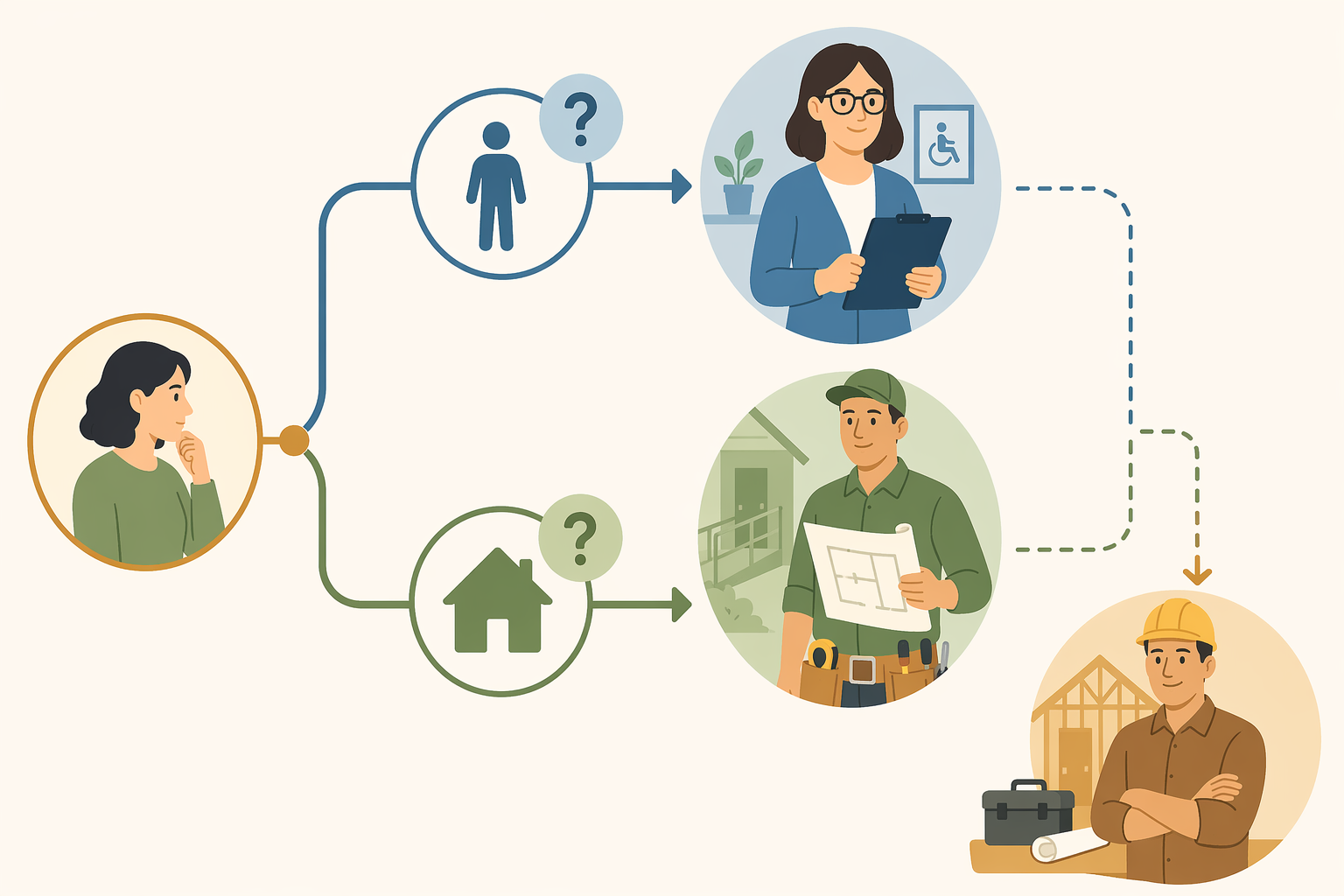
Ask yourself which of these two questions best describes your situation:
- "I'm not sure what my parent can still do safely, and I don't know what modifications would actually help." → Start with an OT.
- "I know exactly what needs to change — the bathroom is too narrow, the tub is a hazard, and the doorways need widening — but I need someone who can design and install it safely for aging in place." → Start with a CAPS.
If you are unsure which question applies, use the 11 Red-Flag Signs self-assessment tool to identify specific hazards and functional challenges room by room. The results will clarify whether your primary concern is the person's changing abilities or the home's structural barriers.
Quick Self-Checklist
- Has your parent had a fall or near-fall in the past 6 months? → Consider an OT assessment first.
- Is their mobility changing — using a cane now where they did not six months ago? → OT first.
- Do you already know the specific modifications needed (grab bars, ramp, stair lift)? → CAPS first.
- Are you planning a major renovation (new bathroom, addition, full-floor remodel)? → CAPS for design, general contractor for execution.
- Is your parent resisting modifications or unsure what would help? → OT first; the clinical recommendation often carries more weight with the older adult.
How to Find Each Professional and What to Ask Before Hiring
Finding the right professional requires more than a Google search. Each type requires a different vetting approach.
Finding a CAPS
The NAHB maintains a national directory of CAPS designees. You can also ask primary care doctors, senior centers, or local home health agencies for recommendations. When interviewing a CAPS, ask:
- "What training do you have in load path and blocking for grab bars?" — A CAPS should be able to explain how they ensure a grab bar can support 250–300 pounds of dynamic load.
- "Do you have liability insurance and workers' compensation insurance?" — Required for NAHB credential renewal.
- "Can you provide references from aging-in-place projects specifically, not just general remodeling?"
- "Do you collaborate with occupational therapists?" — A CAPS who regularly works with OTs is more likely to produce person-centered designs.
For a full list of vetting questions, see 10 Questions Every Caregiver Should Ask Before Hiring a CAPS Specialist.
Finding an Occupational Therapist
Ask your parent's primary care physician for a referral to an OT who does home evaluations. Medicare Part B covers these evaluations when ordered by a physician. When interviewing an OT, ask:
- "Do you have experience with home modification recommendations specifically, not just rehabilitation?" — Some OTs focus on clinical rehab and may not have deep home modification expertise.
- "Will you provide a written report with specific measurements and placement guidance that a contractor can follow?"
- "Do you have experience working with CAPS or contractors on the implementation side?"
Finding a General Contractor for Aging-in-Place Work
If you already have a modification plan from an OT or CAPS and need construction execution, look for a contractor who has completed aging-in-place projects. Ask:
- "Have you worked on aging-in-place or accessibility projects before? Can you show me examples?"
- "Are you familiar with blocking requirements for grab bars and handrails?" — A contractor who says 'we just screw them into the studs' may not understand the load requirements.
- "Will you work from an OT's or CAPS's specifications, or do you prefer to design the layout yourself?" — The right answer depends on whether you have a plan already.
Real-World Case: After a Parent's Fall
Maria, 52, got the call every adult child dreads: her 78-year-old father had fallen getting out of the shower. He was not seriously injured, but the emergency room doctor said the next fall might be different. Maria's first instinct was to call a contractor to install grab bars and a shower seat.
Instead, a friend who had been through this with her own parents suggested an occupational therapist first. Maria's father's physician referred him for an OT home evaluation, which Medicare Part B covered. The OT spent 90 minutes watching Maria's father move through his daily routine — getting out of bed, walking to the bathroom, stepping into the shower, sitting on the toilet, making coffee.
The OT's findings surprised Maria:
- The fall happened because the bathroom doorway was 28 inches wide — too narrow for her father's walker — and he had to turn sideways to enter, losing his balance.
- The grab bars Maria planned to install at 36 inches (standard height) would have been useless — her father needed them at 30 inches because of his height and the way he transferred from his walker to the toilet.
- The shower threshold was 6 inches high — a tripping hazard that a grab bar alone would not solve.
The OT provided a written report with specific recommendations: widen the bathroom doorway to 34 inches, install a curbless shower with a linear drain, place grab bars at 30 inches on the toilet wall and 34 inches in the shower, and add a handheld showerhead on a slide bar.
Maria then hired a CAPS to translate those recommendations into a construction plan. The CAPS identified that the wall where the grab bars needed to go had no blocking — a standard contractor would have installed them into drywall anchors, which would fail under load. The CAPS coordinated with a general contractor to open the wall, install blocking, widen the doorway, and modify the shower base. Total project cost: $8,500. The bathroom remodel that Maria initially envisioned (grab bars and a shower seat, no doorway widening, no threshold removal) would have cost $2,000 and left her father at risk for another fall.
Key Takeaways and Next Steps
The decision between a CAPS, an OT, and a general contractor is not about which professional is 'better' — it is about matching the professional's expertise to the primary question your family needs answered.
- If the question is about the person's function — what they can do, what they struggle with, what modifications would actually help — start with an occupational therapist. Medicare Part B covers the evaluation.
- If the question is about the home's structure — how to install modifications safely, what design choices support aging in place, how to future-proof — start with a CAPS.
- If you already have a clear plan from an OT or CAPS and need construction execution, hire a general contractor who has aging-in-place experience.
- For complex situations, the ideal team is OT + CAPS + contractor, in that order. The investment in the assessment phase pays for itself by preventing costly and unsafe modifications.
Start with the 11 Red-Flag Signs self-assessment to identify specific hazards. Then use the decision framework above to determine which professional to call first. For funding, review the grants, loans, and assistance programs guide to understand what financial support is available before you begin.
The research on home modifications is clear: properly designed and installed modifications reduce fall risk, support independence, and are cost-effective compared to the alternatives. The evidence-based case for home modifications article summarizes the data on falls reduction, independence outcomes, and cost savings. But evidence only translates into results when the right professional applies it to the right situation. Do not guess — assess first, then hire accordingly.
Related reading
Need a professional assessment?
Find a CAPS-credentialed professional or local aging services through our outbound resource list — we never name or rank individual contractors.
Find Local HelpNoticed something outdated or inaccurate on this page? Flag a correction. We review every report against CDC, NIA, and AARP HomeFit guidance before updating a page.