
Room checklist
How to Pay for Aging-in-Place Remodeling: A Guide to Grants, Loans, Insurance, and Financial Assistance in 2026
Many families don't know about the funding sources available to help pay for aging-in-place home modifications. This guide covers federal grants, VA benefits, state programs, insurance coverage, and tax strategies to help you afford the changes that keep a loved one safe at home.
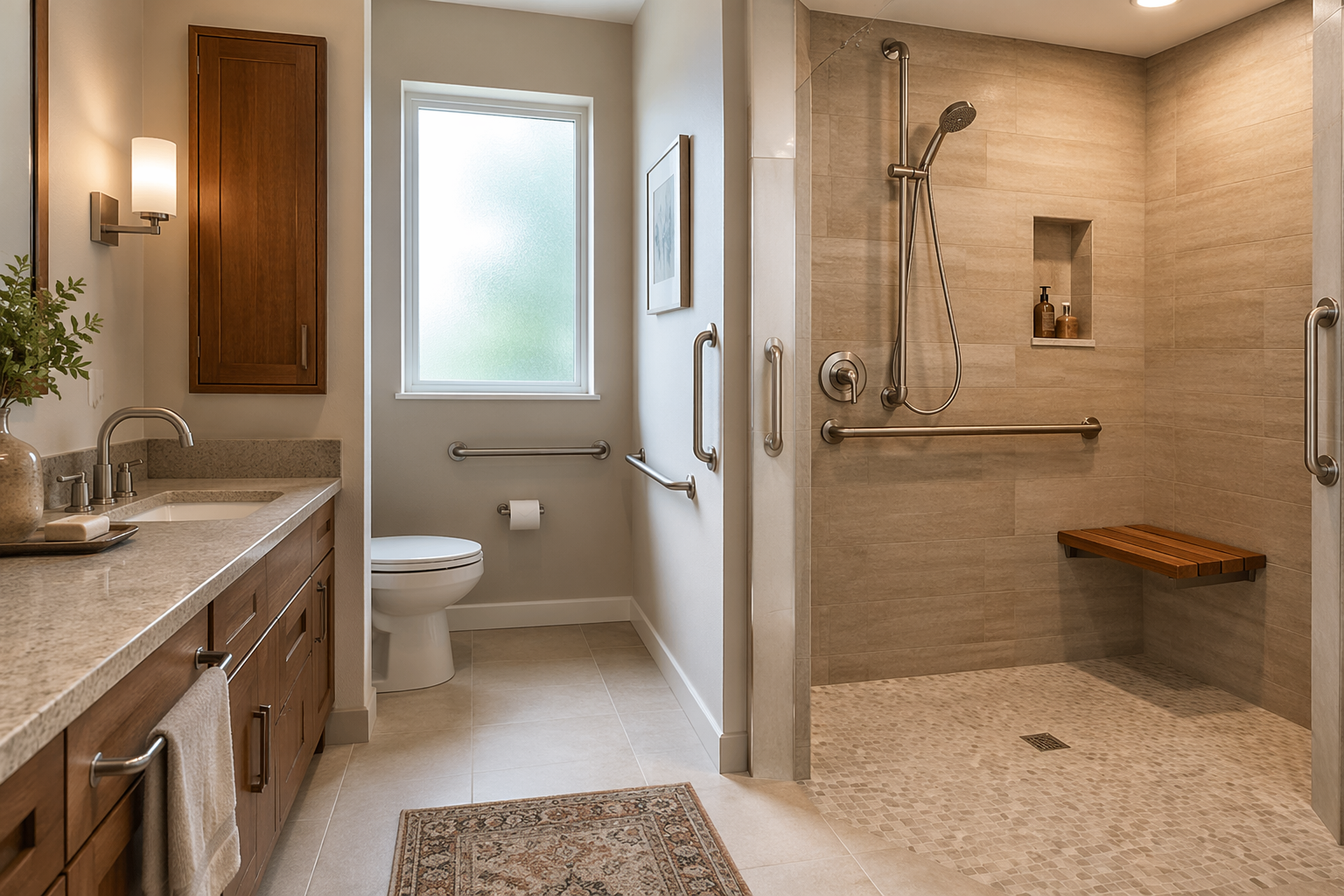
Introduction: The Cost Barrier and Why Funding Matters
The desire to age in place is nearly universal. According to a U.S. News and World Report survey cited by Carex, 93% of adults aged 55 and older view aging in place as an important goal. Yet the reality of making a home safe and accessible often collides with a hard financial question: how do we pay for this?
The answer, for most families, has been to pay out of pocket. Data from the 2019 American Housing Survey shows that 77% of home modifications were self-funded. This is a staggering figure, especially when you consider that only an estimated 10% of U.S. homes are considered "aging-ready" — meaning they have a step-free entryway, a first-floor bedroom and bathroom, and at least one bathroom accessibility feature. The gap between what people want and what their homes can provide is vast, and the primary reason is cost.
But self-funding is not the only option. A range of federal grants, VA benefits, state programs, insurance provisions, and tax strategies exist to help offset the expense. The problem is that these programs are chronically underutilized, often because families simply do not know they exist or how to navigate the application process.
The core thesis of this article is simple: many families are leaving money on the table. Whether it is a USDA grant for a rural homeowner, a VA benefit for a veteran with a service-connected disability, or a tax deduction for a medically necessary stair lift, the funding is available — but it requires knowing where to look and how to apply. This guide is designed to be that roadmap.
Self-Funding Options: Home Equity, HELOCs, Reverse Mortgages, and Personal Loans
For many families, self-funding remains the most straightforward path, even if it is not the cheapest. The advantage is control: no grant applications to fill out, no eligibility criteria to meet, and no restrictions on which contractor you hire. The disadvantage is that you are using your own capital or taking on debt that must be repaid.
Here are the most common self-funding mechanisms, along with their key trade-offs.
| Option | How It Works | Best For | Key Trade-Off |
|---|---|---|---|
| Home Equity Loan | Lump-sum loan secured by home equity; fixed rate and term. | One-time, large projects like a full bathroom remodel. | Requires sufficient equity; monthly payments start immediately. |
| HELOC (Home Equity Line of Credit) | Revolving credit line secured by home equity; variable rate. | Multiple smaller projects over time, or unpredictable costs. | Variable interest rates can rise; temptation to overspend. |
| Reverse Mortgage (HECM) | Loan against home equity for homeowners 62+; no monthly payments required. | Older homeowners with significant equity who want to preserve cash flow. | Reduces inheritance; fees can be high; must maintain home and pay taxes/insurance. |
| Personal Loan | Unsecured loan based on creditworthiness; fixed rate and term. | Smaller projects ($5,000–$15,000) when home equity is not an option. | Higher interest rates than secured loans; shorter repayment terms. |
A home equity loan or HELOC can be an excellent choice if you have substantial equity and a stable income to cover payments. A reverse mortgage, formally known as a Home Equity Conversion Mortgage (HECM), is a more specialized tool. It allows homeowners aged 62 and older to convert part of their home equity into cash without making monthly mortgage payments. This can free up significant cash flow for modifications, but it reduces the equity available to heirs and comes with upfront costs.
For smaller projects — like installing grab bars, improving lighting, or adding lever-style door handles — a personal loan or even a 0% APR credit card promotion may be the simplest route. The key is to match the financing vehicle to the size and urgency of the project.
Federal Programs: USDA Section 504 Grants and Loans
One of the most powerful yet least-known funding sources for aging-in-place modifications is the USDA Section 504 Home Repair program. This program is specifically designed to help very-low-income homeowners in rural areas repair, improve, or modernize their homes — and it is particularly generous for seniors.
The program offers two types of assistance that can be combined:
| Assistance Type | Maximum Amount | Key Terms |
|---|---|---|
| Loan | $40,000 | 1% fixed interest rate; 20-year term; must be unable to obtain credit elsewhere. |
| Grant | $10,000 | For homeowners aged 62+; lifetime limit; must be used to remove health and safety hazards. |
| Combined (Loan + Grant) | $50,000 | Available in presidentially declared disaster areas; otherwise capped at $40,000 loan + $10,000 grant. |
To qualify, applicants must own and occupy the home, have a household income that does not exceed the very-low-income limit for their county, and be unable to obtain affordable credit elsewhere. For the grant portion specifically, the applicant must be age 62 or older. The 1% interest rate on the loan portion is extraordinarily favorable — far below any commercial loan rate available in 2026.
It is important to note that the grant has a lifetime limit of $10,000 and must be repaid if the property is sold within three years. The loan, however, is a standard amortizing loan at the 1% rate, making it one of the most affordable borrowing options available for home repairs.
Federal Programs: FHA Title 1 Loans and CDBG
Beyond the USDA program, two other federal mechanisms can help fund home modifications: FHA Title 1 loans and Community Development Block Grants (CDBG).
FHA Title 1 Loans
FHA Title 1 loans are a lesser-known but valuable option for homeowners who may not have significant equity in their homes. These loans are insured by the Federal Housing Administration and can be used for a wide range of home improvements, including aging-in-place modifications.
| Loan Feature | Detail |
|---|---|
| Maximum Loan Amount (Single-Family) | $25,000 |
| Collateral Required | No collateral required for loans under $7,500; a lien on the property is required for loans over $7,500. |
| Interest Rate | Market-based, but typically lower than unsecured personal loans. |
| Eligibility | Must own the home; no minimum equity requirement. |
The no-collateral feature for loans under $7,500 makes this an attractive option for smaller projects like installing a ramp, adding grab bars, or improving lighting. For larger projects up to $25,000, the loan is secured by a lien on the property, but the lack of an equity requirement means homeowners who have not built up substantial equity can still access financing.
Community Development Block Grants (CDBG)
CDBG is a federal program administered by the U.S. Department of Housing and Urban Development (HUD) that provides grants to state and local governments. These funds can be used for a wide range of community development activities, including home repair and modification programs for low-income homeowners.
Unlike the USDA or FHA programs, CDBG is not a direct-to-consumer program. You cannot apply for a CDBG grant yourself. Instead, you must find a local program in your city or county that uses CDBG funds to provide home repair assistance. The best way to find these programs is to contact your local housing authority, city planning department, or Area Agency on Aging.
Veterans Benefits: SAH and HISA Grants
For veterans and their families, the Department of Veterans Affairs (VA) offers two primary grant programs that can significantly offset the cost of home modifications. These are among the most generous funding sources available, but they are also among the most underutilized.
Specially Adapted Housing (SAH) Grant
The SAH grant is designed for veterans with service-connected disabilities that affect mobility. It provides up to $81,080 (as of 2026) to help build, purchase, or modify a home to accommodate the disability. This is a substantial sum that can cover major structural changes like widening doorways, installing ramps, modifying bathrooms, or even building an entirely new accessible home.
There is also a Temporary Residence Adaptation (TRA) program under the SAH umbrella, which provides up to $35,593 for veterans who are living temporarily in a family member's home and need to make it accessible.
Home Improvements and Structural Alterations (HISA) Grant
The HISA grant is a separate program with a different purpose. While the SAH grant focuses on major structural adaptation, the HISA grant covers more targeted home modifications that are medically necessary for the veteran's treatment or daily functioning.
| Grant Type | Maximum Amount (Service-Connected) | Maximum Amount (Non-Service-Connected) | Typical Uses |
|---|---|---|---|
| SAH 2101a | $81,080 | N/A | Major structural changes, ramps, widened doorways, accessible bathrooms. |
| HISA | $6,800 | $2,000 | Grab bars, handrails, ramps, bathroom modifications, lighting improvements. |
A critical distinction: the HISA grant is available for both service-connected and non-service-connected disabilities, though the maximum amount differs. This means a veteran whose mobility limitations are not related to their military service may still qualify for up to $2,000 in home modification assistance.
State and Local Programs: Medicaid HCBS Waivers and Area Agencies on Aging
Federal programs are not the only game in town. Every state has its own set of programs designed to help low-income seniors and individuals with disabilities remain in their homes. The most significant of these is the Medicaid Home and Community-Based Services (HCBS) waiver program.
Medicaid HCBS Waivers
Medicaid HCBS waivers allow states to use Medicaid funds to provide home and community-based services — including home modifications — to individuals who would otherwise require institutional care. This is a powerful tool, but its availability and scope vary dramatically by state.
In some states, HCBS waivers can cover the full cost of bathroom modifications, ramps, and other structural changes. In others, the program may only cover equipment or minor modifications. The key is to find out what your state offers.
- Contact your state's Medicaid office and ask about HCBS waiver programs that cover home modifications.
- Ask specifically about "1915(c) waivers" — these are the most common type of HCBS waiver and often include home modification benefits.
- Be prepared to provide documentation of medical necessity from a physician or occupational therapist.
- Note that waiting lists for HCBS waivers can be long in many states — apply as early as possible.
Area Agencies on Aging (AAA)
Your local Area Agency on Aging is one of the most valuable resources you may not know about. These agencies are funded through the Older Americans Act and serve as information and referral hubs for seniors and their families. They can help you navigate the maze of state and local programs, including home modification assistance.
Many AAAs maintain lists of local grant programs, low-interest loan funds, and charitable organizations that provide home modification assistance. Some even have their own small grant programs. A single phone call to your local AAA can save hours of research.
Insurance Coverage: When DME and Home Modifications Are Covered
Many families assume that Medicare or their private insurance will cover home modifications. The reality is more nuanced, and understanding the distinction between durable medical equipment (DME) and structural modifications is critical.
| Item | Medicare Part B Coverage | Private Insurance Coverage | Notes |
|---|---|---|---|
| Ramps (modular) | May cover as DME if medically necessary | Often covered as DME | Covers the equipment only; labor and installation typically not covered. |
| Lift chairs | May cover if meets DME criteria | Often covered | Must be prescribed by a physician; Medicare covers only the lift mechanism, not the chair. |
| Hospital beds | Covered as DME | Often covered | Requires a physician's prescription. |
| Grab bars | Not covered | Rarely covered | Considered a home modification, not DME. |
| Bathroom remodel | Not covered | Not covered | Structural modifications are almost never covered by health insurance. |
| Stair lifts | Not covered | Not covered | Considered a home improvement, not medical equipment. |
The key takeaway: if it is a piece of equipment that can be taken with you when you move, it may be covered as DME. If it is a structural change to the home — like installing grab bars, widening doorways, or remodeling a bathroom — it is almost never covered by standard health insurance or Medicare.
Tax Strategies: Medical Expense Deductions for Qualifying Modifications
While not a direct funding source, the federal tax code offers a significant incentive for medically necessary home modifications: the medical expense deduction. If you itemize your deductions, you may be able to deduct the cost of qualifying modifications as a medical expense.
The general rule is that you can deduct medical expenses that exceed 7.5% of your adjusted gross income (AGI). For a family with an AGI of $60,000, that means expenses over $4,500 are deductible. A $10,000 bathroom modification could therefore generate a $5,500 deduction.
Qualifying vs. Non-Qualifying Modifications
The IRS distinguishes between modifications that are medically necessary and those that are general home improvements. Only the former are deductible.
- Qualifying: Grab bars, ramps, stair lifts, widening doorways for wheelchair access, roll-in showers, handrails, and other modifications that are prescribed by a physician to accommodate a specific medical condition.
- Non-qualifying: General home improvements that add value to the home, such as a new kitchen, new flooring, or a bathroom remodel that is not specifically designed for accessibility.
- Partial deduction: If a modification adds value to the home (e.g., a ramp that could be used by future buyers), the deduction may be limited to the difference between the cost of the modification and the increase in the home's value.
To claim the deduction, you will need a written recommendation from a physician stating that the modification is medically necessary. Keep all receipts, contracts, and invoices. The IRS may require documentation that the modification was specifically designed to accommodate a medical condition, not simply a general home improvement.
How to Find a CAPS-Certified Contractor Who Knows Funding Pathways
Navigating the funding landscape is complex, and not every contractor understands the programs available. This is where a CAPS (Certified Aging-in-Place Specialist) contractor can make a significant difference.
CAPS certification is awarded by the National Association of Home Builders (NAHB) to contractors who have completed training on aging-in-place design and construction. While the certification does not guarantee that a contractor knows every funding program, CAPS-certified professionals are more likely to be familiar with the financial assistance landscape because they work in this niche every day.
When interviewing potential contractors, ask these questions to gauge their familiarity with funding pathways:
- "Have you worked with clients who used VA grants or USDA Section 504 funding?" — A contractor who has navigated these programs before will know the documentation requirements and timelines.
- "Do you have experience with Medicaid HCBS waiver-funded projects?" — Some states require contractors to be pre-approved for waiver-funded work.
- "Can you provide a detailed cost breakdown that separates equipment from labor?" — This is essential for DME insurance claims and for tax deduction documentation.
- "Are you familiar with the documentation requirements for medical expense tax deductions?" — A knowledgeable contractor can provide the detailed invoices and medical necessity letters you will need.
For a complete guide on how to find, vet, and hire a CAPS-certified contractor, including the specific questions to ask before signing a contract, see our guide to vetting CAPS-certified contractors. This is the logical next step after you have identified your funding sources.
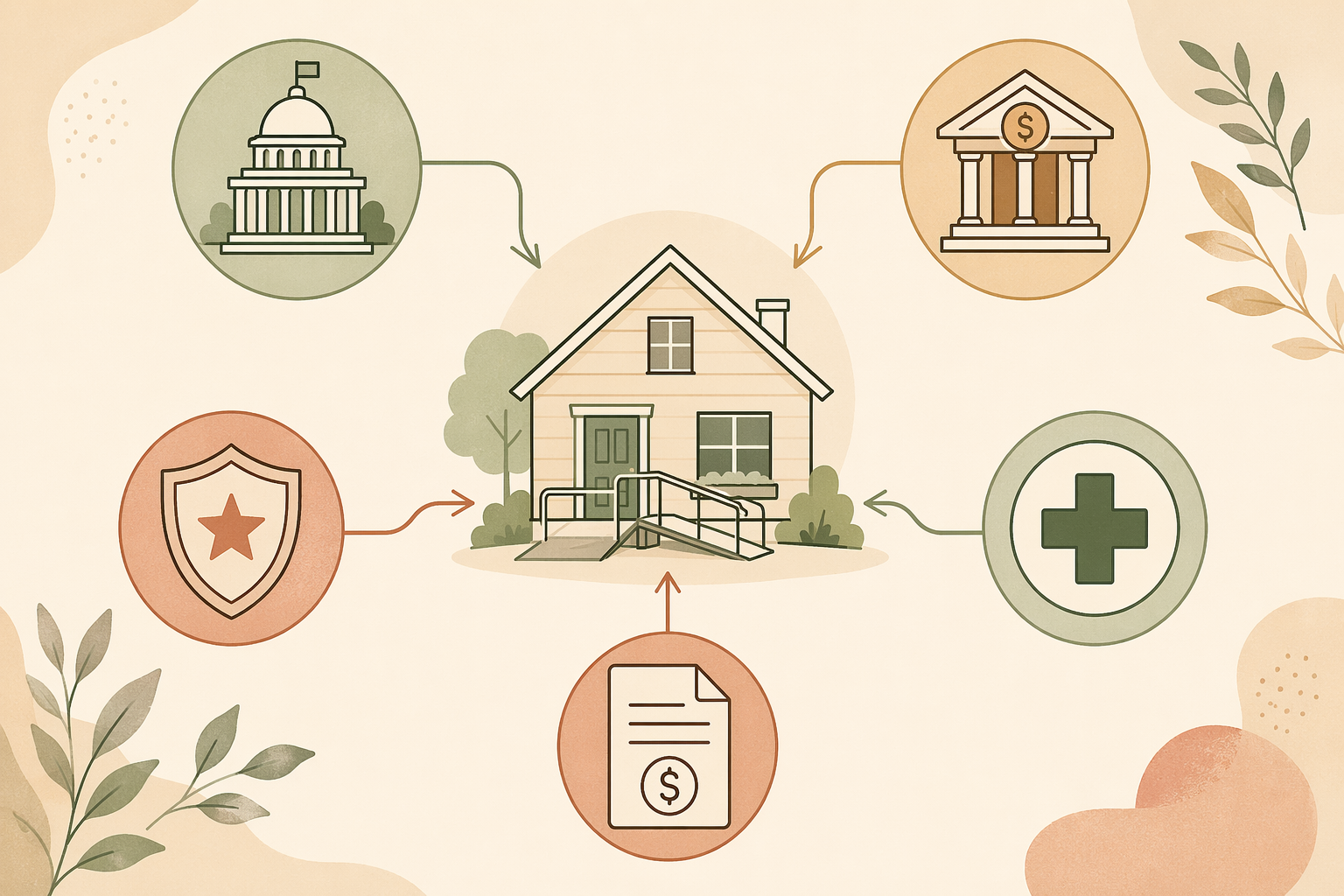
Bringing It All Together: A Strategic Approach to Funding
The most successful approach to funding aging-in-place modifications is rarely a single source. Instead, families often combine multiple strategies to cover the full cost.
Consider this example: a 70-year-old veteran living in a rural area needs a $15,000 bathroom modification. She could apply for a $6,800 HISA grant (service-connected), supplement it with a $7,500 USDA Section 504 loan at 1% interest, and deduct the remaining out-of-pocket costs as a medical expense on her taxes. The result: a $15,000 project with minimal out-of-pocket expense and a tax benefit at the end of the year.
The key is to start early. Grant applications can take months. Waiting lists for state programs can be long. Tax planning is most effective when done before the work begins. The families who succeed in funding their modifications are the ones who treat the funding process as a project in itself — with deadlines, documentation, and a clear strategy.
For a broader view of all the resources available — including services, technology, and additional funding pathways — see our complete guide to home helps for the elderly, which covers the full spectrum of support available to families navigating aging in place.
Related reading
- Where to Find Money for an Aging-in-Place Remodel: Grants, Loans, and Assistance Programs (2026)
- Does an Aging-in-Place Remodel Pay for Itself? The Financial Case for Modifying Your Home vs. Moving to Assisted Living
- How to Pay for an Elderly Parent's Bathroom Remodel: VA Grants, Medicaid Waivers, Tax Deductions, and More
Need a professional assessment?
Find a CAPS-credentialed professional or local aging services through our outbound resource list — we never name or rank individual contractors.
Find Local HelpNoticed something outdated or inaccurate on this page? Flag a correction. We review every report against CDC, NIA, and AARP HomeFit guidance before updating a page.