
Room checklist
CAPS vs. General Contractor vs. OT: Who Should You Hire for Aging-in-Place Home Modifications?
Family caregivers often hire the wrong professional first — a general contractor for a job that needs an OT assessment, or an OT for work that needs a contractor. This guide compares CAPS-certified specialists, general contractors, occupational therapists, and other aging-in-place professionals so you can match the right expert to your parent's specific needs.
Why Most Families Call the Wrong Person First
A typical story: an adult child notices their mother is unsteady on her feet. They call a general contractor, who installs a grab bar next to the toilet. The bar is solidly mounted, but its placement is wrong — too far forward for her to reach from a seated position, and at a height that doesn't align with her natural push-off motion. Within a month, she falls anyway.
This isn't a bad contractor story. It's a mismatch problem. The general contractor did what they were trained to do: install a fixture securely and to code. What they lacked was the clinical understanding of how this particular person's body moves, where her strength deficits are, and what specific hand position she needs to transfer safely. That knowledge belongs to an occupational therapist (OT). The installation skill belongs to a contractor. The gap between them is where most families lose time and money.
The aging-in-place market now has several professional pathways, each with a distinct role. A general contractor without specialized training lacks the specific knowledge of universal design principles — zero-threshold showers, 32-inch doorways, 5-foot by 5-foot turning radii, lever handles, and task lighting placement. An OT without construction experience may recommend modifications that aren't structurally feasible or code-compliant. A CAPS-certified aging-in-place specialist bridges part of that gap, but even a CAPS professional benefits from an OT's clinical input when mobility is complex.
This guide compares the five types of professionals you might hire — CAPS specialist, general contractor, occupational therapist, Senior Home Safety Specialist (SHSS), and universal design certified professional — so you can match the right expert to your parent's specific needs.
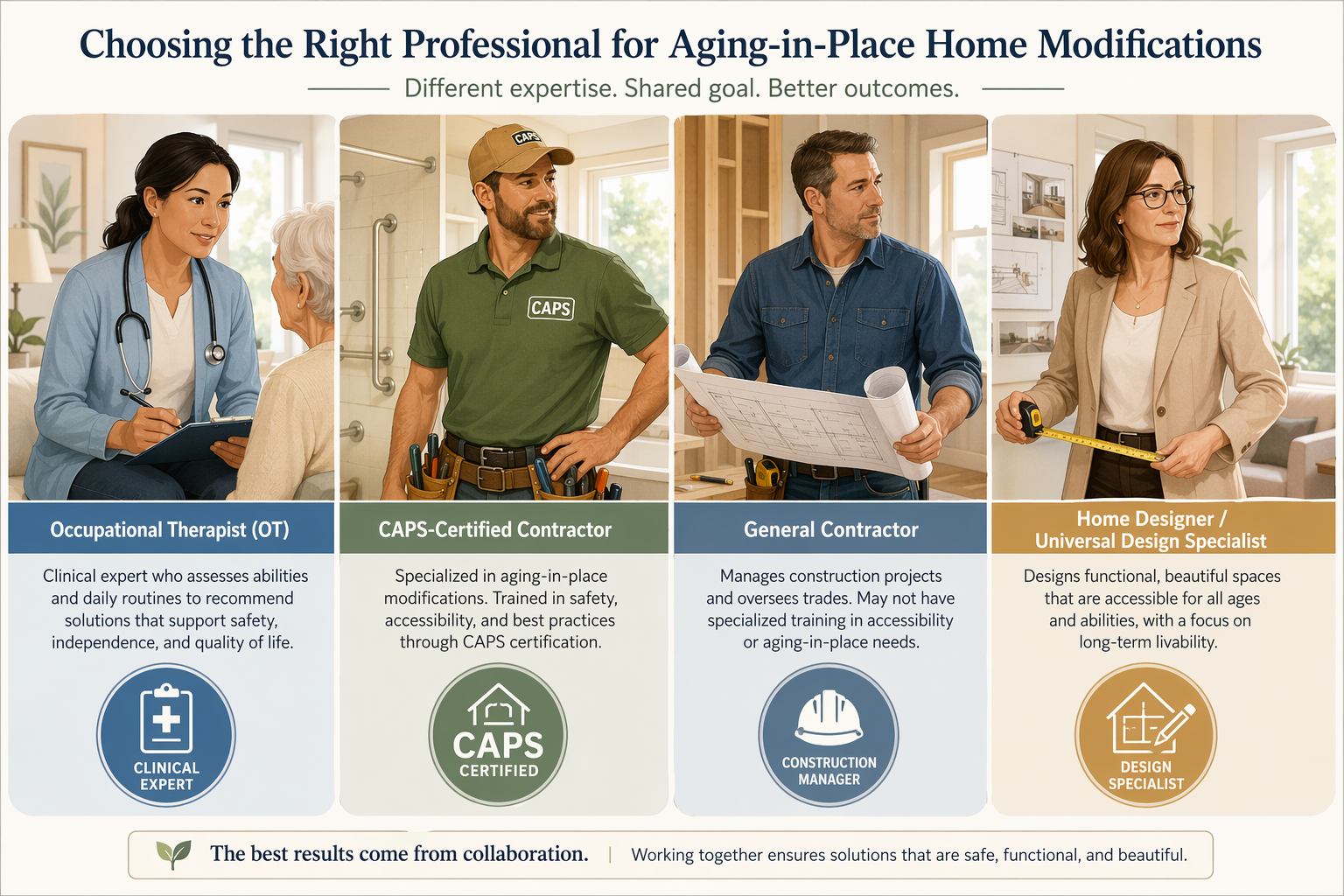
The Five Types of Professionals You Might Hire (and What Each Actually Does)
Before you can decide whom to call, you need a clear picture of what each professional is trained to do. The table below summarizes the five most relevant roles for aging-in-place home modifications.
| Professional | Training Focus | Typical Services | Cost Range | Best-Fit Scenario |
|---|---|---|---|---|
| CAPS-Certified Specialist | Construction-forward: structural modifications, universal design principles, remodeling project execution. Three-course program (Marketing, Design, Solutions) backed by NAHB and AARP since 2002. | Home assessment, modification recommendations, contractor quotes, project management, post-renovation follow-up. Handles ramps, roll-in showers, widened doorways, stair lifts, lighting upgrades. | Personalized home evaluation with report: ~$500. Full project costs: $10,000–$100,000+. | Structural modifications (bathroom remodel, doorway widening, stair lift installation) where design principles for aging are critical. |
| General Contractor (GC) | Broad construction: building codes, structural integrity, subcontractor management. May lack specific aging-in-place or universal design training. | General home renovation, structural work, code compliance. Can execute modification plans but may not identify aging-specific needs. | Varies by project; typically hourly or project-based. No specialized aging-in-place premium unless CAPS-trained. | Executing a modification plan created by an OT or CAPS specialist. Not ideal as the first call for aging-specific needs. |
| Occupational Therapist (OT) | Clinical: mobility assessment, strength evaluation, daily task analysis, rehabilitation. Medicare Part B may cover home evaluations. | Clinical home assessment, identification of mobility and safety needs, recommendations for modifications and adaptive equipment. Does not perform construction. | Home evaluation may be covered by Medicare Part B (deductible and coinsurance apply). Private pay: $150–$400 per evaluation. | First step after a fall, stroke, or diagnosis affecting mobility. Provides the clinical blueprint for modification work. |
| Senior Home Safety Specialist (SHSS) | Assessment-focused: fall risk identification, non-structural interventions, home safety checklists. Ideal for handymen, caregivers, and entrepreneurs. | Home safety assessments, fall risk reports, recommendations for non-invasive interventions (grab bars, non-slip mats, improved lighting, clutter removal). Recurring check-ins. | Assessment-based services: $150–$400 per evaluation. | Non-structural safety improvements and ongoing monitoring. Often combined with CAPS for a complete assessment-to-installation model. |
| Universal Design Certified Professional (UDCP/CEAC) | Universal design principles for all ages and abilities. CEAC focuses on environmental access and product evaluations. UDCP (NARI) centers on design principles. | Design consultation, product evaluation, accessibility planning. May overlap with CAPS but with a broader universal design lens. | Varies; typically design consultation fees. | Whole-home design for future-proofing, especially when multiple generations or varying abilities are involved. |
A key distinction: CAPS is construction-forward. It focuses on remodeling and structural modifications. The SHSS certification, by contrast, focuses on home safety assessments, fall risk identification, and non-invasive interventions. Many successful professionals pursue both certifications to offer a complete assessment-to-installation service model. For a deeper comparison of the credentials themselves, see our guide on CAPS vs. other aging-in-place certifications.
How to Match the Professional to the Project
The right professional depends on the scope of the project and the complexity of your parent's medical and mobility situation. Here are three common scenarios that illustrate the decision framework.
Scenario 1: Fall Risk After a Stroke or Diagnosis
Your parent has had a stroke or received a Parkinson's diagnosis. Their mobility is changing, and you're not sure what modifications will help. This is the clearest case for starting with an OT assessment. An occupational therapist evaluates their strength, balance, range of motion, and how they perform daily tasks like bathing, toileting, and cooking. The OT's recommendations become the blueprint. Then you hire a CAPS-certified contractor to execute the structural modifications — a roll-in shower, widened doorways, grab bars at clinically determined positions.
Scenario 2: Whole-Home Bathroom Remodel for Future Needs
Your parents are in their late 60s, relatively healthy, and planning a bathroom renovation to prepare for the future. They want a walk-in shower, better lighting, and easier access. In this case, a CAPS-certified contractor can handle the entire project. The CAPS training covers universal design principles — zero-threshold entry, 5-foot by 5-foot turning radius for wheelchair maneuverability, lever handles, and proper grab bar placement. If mobility is straightforward, the CAPS specialist's knowledge is sufficient without an OT assessment. However, if your parent has any existing mobility concerns, adding an OT consultation early is still wise.
Scenario 3: Simple Grab Bar and Lighting Installation
Your parent needs only a few grab bars, better lighting in the hallway, and a non-slip mat in the shower. This is a small job. A general contractor or handyman with CAPS awareness can handle it — provided they understand basic placement principles. The risk here is that a handyman without aging-in-place knowledge might install grab bars into drywall without blocking, or at heights that don't match your parent's needs. If you go this route, make sure the installer has at least some familiarity with aging-in-place best practices, or provide them with a placement plan from an OT or CAPS assessment.
- Complex mobility needs (post-stroke, Parkinson's, recent fall): Start with an OT assessment, then hire a CAPS contractor.
- Proactive whole-home remodel: A CAPS contractor can handle it directly. Add OT input if mobility is already a concern.
- Small, simple installations: A CAPS-aware handyman or general contractor may suffice, but verify their knowledge of placement principles.
When to Combine: The OT-Led Assessment + CAPS Contractor Model
For most families, the recommended approach is a two-step sequence: an occupational therapist conducts a clinical assessment, then a CAPS-certified contractor executes the structural modifications. This sequence works better than either professional working alone for several reasons.
The OT identifies needs the contractor might miss. A general contractor or even a CAPS specialist evaluates the home's physical structure — walls, floors, doorways. An OT evaluates the person's body — how they transfer from bed to chair, how they reach for a towel, where their balance fails. These clinical observations lead to specific placement recommendations that a construction-only assessment would not generate.
The CAPS contractor ensures the OT's recommendations are structurally feasible and code-compliant. An OT might recommend a ceiling lift in a bedroom, but the ceiling joists may not support it. They might suggest a roll-in shower, but the existing drain location makes it prohibitively expensive. The CAPS contractor brings construction reality to the clinical plan, creating a feasible, safe, and compliant outcome.
This combined model is especially important when the older adult has multiple chronic conditions, recent hospitalization, or progressive neurological conditions. In these cases, the clinical complexity demands an OT's expertise, and the structural complexity demands a CAPS contractor's expertise. Neither alone is sufficient.
Case Examples: Three Families, Three Different Hiring Decisions
Realistic examples help clarify how the decision framework works in practice.
Example A: Post-Stroke Bathroom Modification
Margaret, 78, had a mild stroke affecting her left side. Her daughter noticed she was struggling to step into the bathtub and had nearly fallen twice. They called an occupational therapist first. The OT assessed Margaret's balance, grip strength, and transfer patterns, then recommended a roll-in shower with a foldable seat, a handheld showerhead, grab bars at specific heights on both sides of the toilet and shower, and a raised toilet seat. The OT's report was covered by Medicare Part B. Then they hired a CAPS-certified contractor who executed the plan: removed the tub, installed a zero-threshold shower, widened the doorway to 32 inches, and placed grab bars at the OT-specified positions. Total project cost: approximately $12,000. Outcome: Margaret can shower independently with minimal assistance.
Example B: Proactive Whole-Home Remodel
Robert and Linda, both 65, are planning a major kitchen and bathroom renovation. They are healthy and active but want to stay in their home for the next 20 years. They hire a CAPS-certified contractor directly. The contractor designs a kitchen with pull-out shelves, lever-handle faucets, task lighting under cabinets, and a 5-foot turning radius. The bathroom gets a curbless shower, a comfort-height toilet, and grab bars pre-installed with blocking. No OT assessment was needed because their mobility is currently good. Total project cost: approximately $35,000. Outcome: a home that works now and will adapt as their needs change.
Example C: Simple Safety Upgrades
Frank, 82, lives alone and his son is worried about falls. The home needs grab bars in the shower and beside the toilet, better lighting on the stairs, and non-slip treads on the steps. The son hires a handyman who has completed the SHSS certification and is familiar with basic aging-in-place principles. The handyman installs grab bars into studs with proper blocking, adds motion-sensor night lights in the hallway and bathroom, and applies non-slip treads. Total cost: approximately $600. Outcome: reduced fall risk with minimal investment.
The Five-Legged Table: Why Home Design Is Only One Piece of the Puzzle
Even the best home modifications won't enable aging in place if other critical factors are neglected. Valerie Jurik-Henry, a CAPS-certified specialist with Right at Home, describes aging in place as a "five-legged table" with five essential supports: home design, financial ability, healthcare services, transportation, and social engagement.
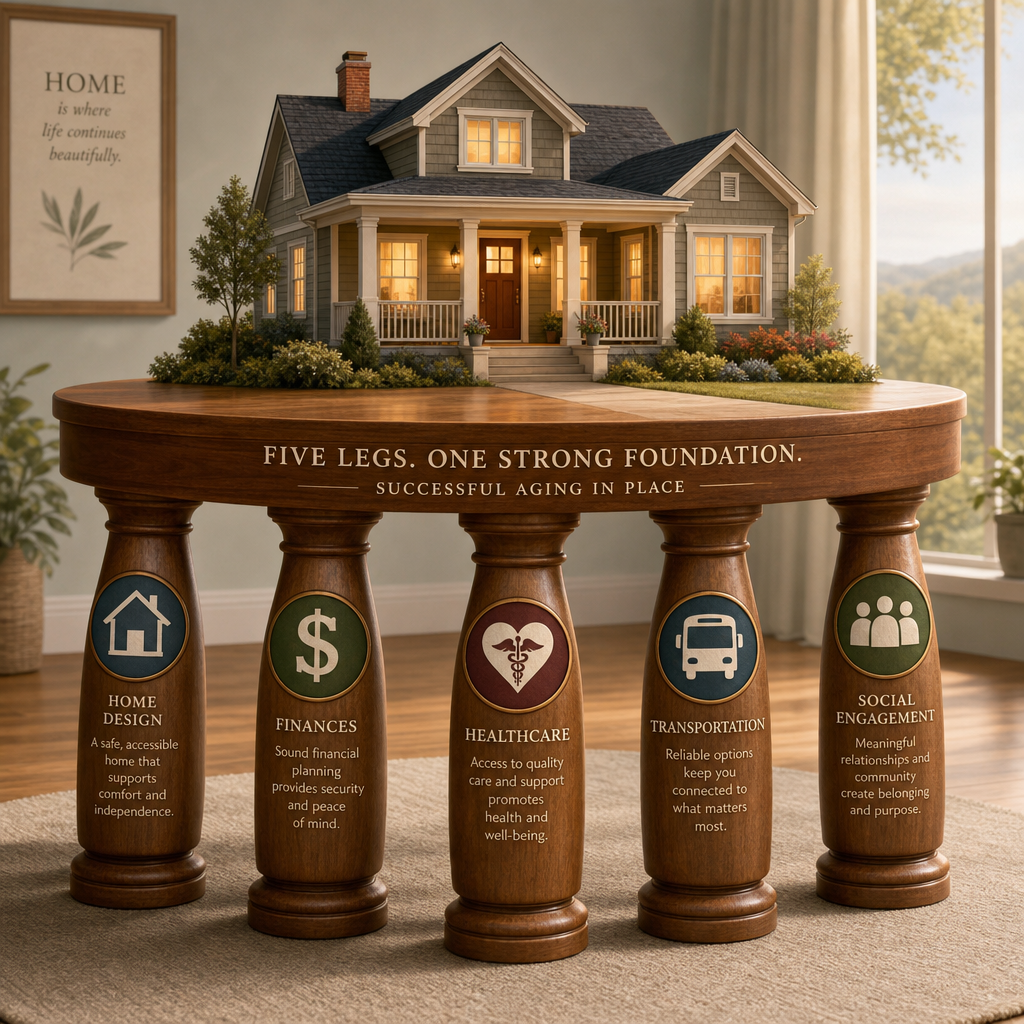
Consider the implications. You can install a beautiful roll-in shower and widen every doorway, but if your parent can't afford the modifications (financial ability), lacks access to home health aides (healthcare services), can't get to medical appointments (transportation), or is socially isolated (social engagement), the home modifications alone won't keep them safe and thriving at home.
This framework is especially important for family caregivers who tend to focus exclusively on the physical home. The statistics underscore the urgency: 88% of adults aged 50 and older prefer to remain in their homes as long as possible, according to the University of Michigan National Poll on Healthy Aging. Yet only about 4% of homes are aging-in-place-ready, per Amy Roberts, a senior real estate specialist and CAPS. That gap between desire and readiness won't be closed by construction alone.
When you're planning modifications, use the five-legged table as a checklist. Home design is the leg you're addressing by hiring a CAPS contractor or OT. But also ask: Can we afford this? Is there a plan for healthcare at home? How will they get to appointments? Are they connected to family, friends, or community? Strengthening all five legs is the difference between a modified house and a truly supportive home.
Making Your Decision: A Quick Reference Guide
When you're standing in your parent's home, unsure who to call, use this decision checklist:
- Start with an OT assessment if mobility, balance, or daily tasks are a concern — especially after a fall, stroke, or new diagnosis. Medicare Part B may cover it.
- Hire a CAPS-certified contractor for structural modifications — bathroom remodels, doorway widening, stair lifts, ramps. They bring universal design knowledge that a general contractor may lack.
- Use a general contractor only if they have CAPS training or are working from a detailed plan created by an OT or CAPS specialist.
- Consider an SHSS-certified professional for non-structural safety assessments and simple interventions — grab bars, lighting, clutter removal.
- Check the five-legged table: home design, financial ability, healthcare services, transportation, and social engagement. Don't stop at construction.
The wrong hire doesn't just waste money — it can create a false sense of security. A grab bar installed in the wrong position, a ramp with too steep a slope, a doorway that's still too narrow for a walker — these are not neutral mistakes. They are hazards that can lead to falls and injuries. Taking the time to match the right professional to the right job is one of the most important decisions you'll make as a family caregiver.
Related reading
- CAPS vs. Occupational Therapist vs. General Contractor: Who Should You Hire for Aging-in-Place Home Modifications?
- Aging in Place Specialist vs. Occupational Therapist: Who Should You Call for Home Modifications?
- CAPS vs General Contractor: Which Professional Should You Hire for Aging-in-Place Home Modifications?
Need a professional assessment?
Find a CAPS-credentialed professional or local aging services through our outbound resource list — we never name or rank individual contractors.
Find Local HelpNoticed something outdated or inaccurate on this page? Flag a correction. We review every report against CDC, NIA, and AARP HomeFit guidance before updating a page.