
Room checklist
The Evidence for Home Modifications: What Research Says About Preventing Falls, Reducing Caregiver Burden, and Keeping Older Adults Independent
This article presents the research-backed case for investing in home modifications, covering key studies on fall reduction, functional independence, cost-effectiveness, and caregiver burden — designed to help skeptical adult children make informed decisions about aging in place.
Why Evidence Matters When Deciding About a Parent’s Safety at Home
If you are reading this, you have likely crossed a threshold. Maybe your mother took a hard fall in the bathroom last month. Maybe your father’s recent diagnosis has you wondering whether their home of 40 years can still be a safe place to live. You are facing a decision that involves thousands of dollars, a reluctant parent, and a gnawing question: “Will this actually make a difference?”
That question is fair. Home modifications — grab bars, stair lifts, curbless showers, widened doorways — are not small purchases. They are also not merely convenience upgrades. A growing body of peer-reviewed research, including a 2025 systematic review of 20 studies published between 2010 and 2024, has examined whether these changes deliver measurable outcomes. The answer, supported by five randomized controlled trials rated “Excellent” on the PEDro scale, is that they do.
This article is written for the skeptical adult child who needs evidence, not anecdotes, to justify an investment. We will walk through what the research says about fall reduction, daily independence, cost-effectiveness, and caregiver burden — and where the evidence still has gaps. The goal is to give you a clear, research-backed framework for making decisions about your parent’s safety at home.
What the Research Says About Falls Prevention
The strongest evidence for home modifications lies in their ability to prevent falls. Multiple high-quality studies, including randomized controlled trials and large-scale population analyses, converge on the same conclusion: structural changes to the home reduce fall risk significantly.
The 2025 systematic review by Cha and colleagues, published in PMC, identified five randomized controlled trials (RCTs) on home modifications, all of which received an “Excellent” quality PEDro score of 9. Among the most cited is the Stark et al. (2017) RCT, which found that home modifications reduced falls by 39% in a sample of 300 older adults. Another study, the Hawkins et al. (2024) Safe at Home (SAH) program, reported that 79% of the 241 participants experienced no falls at all after receiving home modifications.
Population-level data reinforces these findings. Hollinghurst et al. (2022) conducted a national longitudinal study of 657,536 older adults and found that home adaptations reduced fall-related emergency admissions by 3% per quarter. While a 3% quarterly reduction may sound modest, across a population of this size it translates to thousands of avoided hospital visits each year. A separate RCT by Kamei and colleagues reported a 10.9% reduction in falls among participants who received home modifications.
| Study | Design | Key Finding |
|---|---|---|
| Stark et al. (2017) | RCT (n=300) | 39% reduction in falls |
| Hawkins et al. (2024) | SAH program (n=241) | 79% with no falls post-modification |
| Hollinghurst et al. (2022) | Longitudinal (n=657,536) | 3% quarterly reduction in fall-related ER admissions |
| Kamei et al. | RCT | 10.9% reduction in falls |
Functional Independence: More Than Just Safety
Falls prevention is the headline, but home modifications also improve how older adults function in their daily lives. The ability to bathe independently, cook a meal, or move from room to room without assistance is what makes aging in place meaningful — not just safe.
The Jeon et al. (2020) I-HARP trial demonstrated that home modifications improved both functional independence and quality of life among participants. This finding is consistent with the broader evidence: when the physical environment is adapted to a person’s changing abilities, they can perform activities of daily living (ADLs) more safely and with less assistance.
The impact on care hours is particularly striking. Carnemolla et al. (2019) studied 157 older adults and found that home modifications led to a 42% reduction in weekly care hours. This breaks down into a 46% reduction in informal care (provided by family members) and a 16% reduction in formal care (paid caregivers). For a family caregiver spending 20 hours per week helping a parent, a 46% reduction means roughly 9 fewer hours — time that can be redirected to work, rest, or other family responsibilities.
- Improved ability to perform ADLs (bathing, dressing, toileting) with less assistance
- Enhanced quality of life scores in the I-HARP trial (Jeon et al., 2020)
- 42% reduction in total weekly care hours (Carnemolla et al., 2019)
- 46% reduction in informal family caregiving time
- 16% reduction in formal paid care hours
The Riera Arias occupational therapy study further supports these findings, showing that targeted home modifications, when combined with OT assessment, improve functional outcomes and reduce the need for hands-on assistance.
The Cost-Effectiveness Argument: Do Modifications Pay for Themselves?
For many families, the central question is not whether modifications work, but whether they are worth the cost. The research on cost-effectiveness provides a compelling answer: home modifications are not just effective — they are economically rational.
The Wilson et al. (2017) modeling study, conducted in New Zealand, calculated the cost per quality-adjusted life year (QALY) for home modifications at NZD 5,480. To put that in perspective, interventions under NZD 50,000 per QALY are generally considered cost-effective in health economics. More importantly, the study found that home modifications were actually cost-saving for adults aged 75 and older who had experienced a prior fall — meaning the intervention saved more in healthcare costs than it cost to implement.
The Schiller embedded program study reported a cost of $528 per patient for a home modification intervention. When compared to the average cost of a single fall-related hospitalization — which can exceed $30,000 — the return on investment becomes clear. Even a modest reduction in fall risk can offset the cost of modifications many times over.
| Study | Metric | Finding |
|---|---|---|
| Wilson et al. (2017) | Cost per QALY | NZD 5,480 per QALY; cost-saving for 75+ with prior falls |
| Schiller et al. | Per-patient cost | $528 per patient for embedded modification program |
| HRS/ASPE (2008) | Out-of-pocket cost | ~33% paid less than $100; ~33% paid $100–$500 |
| ElderLife Financial (2026) | Grab bar cost | $100–$400 each installed |
For families concerned about upfront costs, it is worth noting that roughly one-third of older adults who added home features in the HRS study paid less than $100 out of pocket, and another third paid between $100 and $500. While major renovations like bathroom conversions or stair lifts cost more, many high-impact modifications — grab bars, lever handles, improved lighting — are relatively inexpensive.

The Bathroom: Highest-Risk Zone for Falls
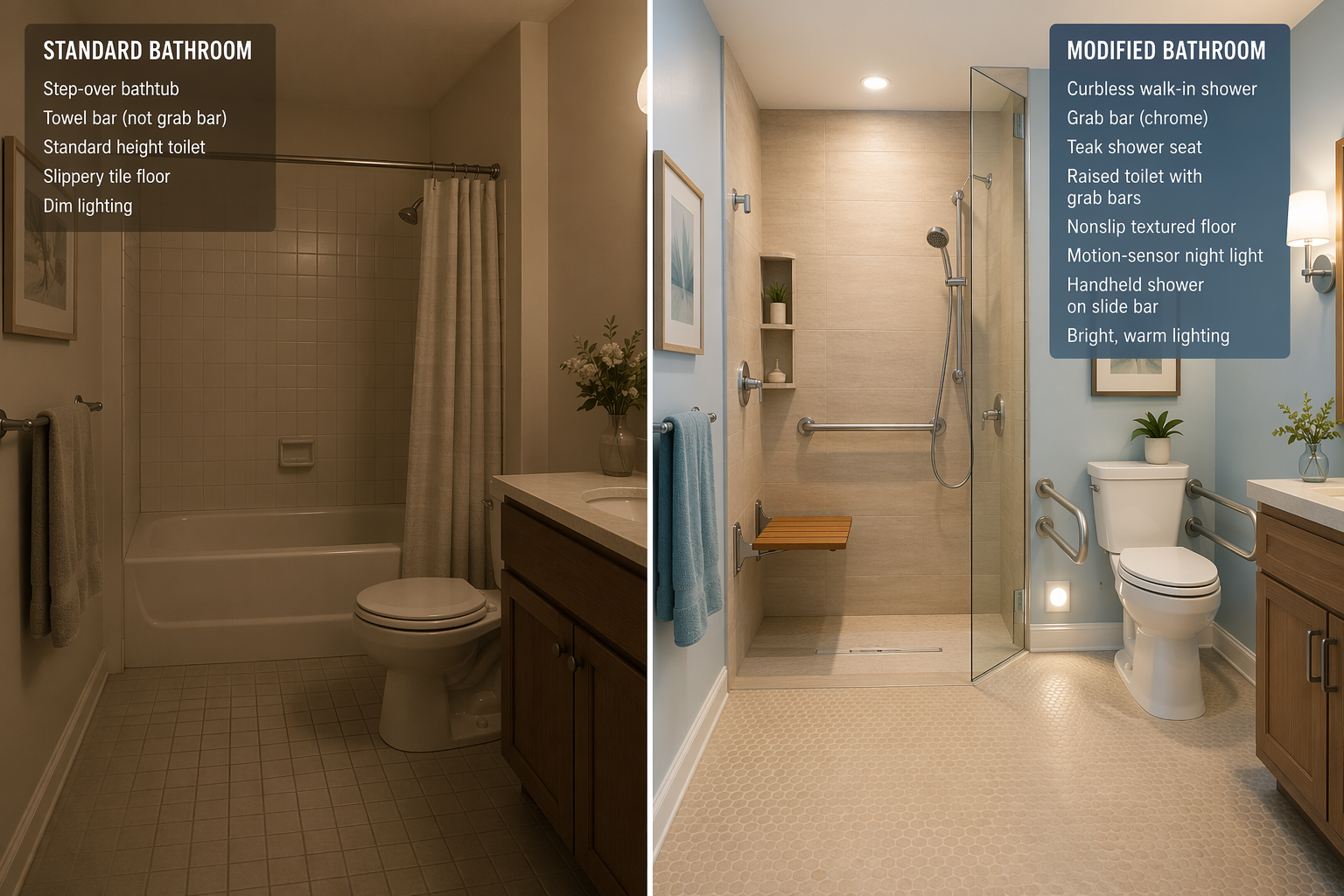
If you can only modify one room in your parent’s home, the research points clearly to the bathroom. The CDC reports that 28% of bathroom injuries in people aged 65 and older are toilet-related. The combination of wet surfaces, hard fixtures, and the need to transfer on and off the toilet or in and out of the tub creates a perfect storm for falls.
Grab bars are the single most studied bathroom modification. A lab-based biomechanical study by Levine et al. (2021) found that people using grab bars in their bathrooms were approximately 76% more likely to recover their balance than those without. This statistic comes from a controlled setting, but it aligns with the broader evidence that grab bars are a high-impact, low-cost intervention.
Beyond grab bars, the most impactful bathroom modifications include curbless (roll-in) showers, which eliminate the step-over threshold that causes many falls; raised toilet seats, which reduce the distance and effort required to sit and stand; and handheld showerheads on slide bars, which allow bathing from a seated position. For a complete guide on selecting and installing grab bars, see our Grab Bars for Bathroom Safety: A Complete Installation Guide for Family Caregivers.
Caregiver Burden: Reduction — and an Important Caveat
One of the most compelling arguments for home modifications is their impact on caregiver burden. The Carnemolla et al. (2019) study of 157 older adults found that home modifications reduced weekly care hours by 42%, with informal (family) care dropping by 46%. For adult children who are juggling careers, their own families, and caregiving responsibilities, this reduction can be transformative.
However, the evidence includes an important nuance that every family should understand before making decisions. The Jeon et al. (2020) I-HARP trial, while showing improved function and quality of life for older adults, also suggested a potential slight increase in caregiver burden for those caring for individuals with cognitive impairment. This counterintuitive finding may reflect the fact that when an older adult becomes more mobile and independent after modifications, caregivers may need to supervise more actively or manage new risks.
This nuance does not negate the value of home modifications for families affected by dementia. It does mean that modifications should be part of a broader care plan that includes caregiver education, respite planning, and realistic expectations about what changes will and will not accomplish. For a comprehensive orientation to the caregiving role, see our First 30 Days as a Family Caregiver: A Step-by-Step Onboarding Guide.
What the Research Still Doesn’t Know
A credible evidence review acknowledges its own limits. The 2025 systematic review by Cha and colleagues identifies several areas where the research base remains thin, and families should be aware of these gaps when making decisions.
- Personalized vs. standardized approaches: Most studies evaluate a fixed set of modifications (grab bars, railings, ramps). There is limited research on how to tailor modifications to an individual’s specific functional limitations, home layout, and preferences.
- Smart home technologies: While devices like motion sensors, automatic lighting, and voice-activated controls are increasingly common, their effectiveness in preventing falls or reducing caregiver burden has not been rigorously tested in large-scale RCTs.
- Long-term sustainability: Most studies follow participants for 6 to 12 months. We know less about whether the benefits of modifications persist over 5 or 10 years, or whether homes need to be re-assessed and re-modified as a person’s condition changes.
- U.S.-specific RCTs: Many of the highest-quality studies come from Australia, the UK, and New Zealand, where housing stock and healthcare systems differ from the U.S. More American randomized trials are needed to confirm the findings in a U.S. context.
- Cost-effectiveness across different populations: The Wilson study found modifications were cost-saving for adults 75+ with prior falls, but it is less clear whether they are cost-effective for younger, healthier older adults or for those with specific conditions like Parkinson’s or stroke.
These gaps do not mean the evidence is weak. They mean the research community is still catching up to the real-world complexity of aging in place. The existing evidence — particularly from the five high-quality RCTs — is strong enough to guide action, but families should approach modifications as part of an ongoing process, not a one-time fix.
The Bottom Line: Home Modifications Are a Tier 1 Intervention for Aging in Place
When you step back and look at the full body of evidence, the conclusion is clear. Of the 20 studies analyzed in the 2025 systematic review, 13 (65%) confirmed the effectiveness of home modifications across fall prevention, functional independence, and cost savings. All five randomized controlled trials received an “Excellent” quality rating. The interventions with the strongest evidence are bathroom modifications, grab bars, and stair railings — the same changes that occupational therapists have been recommending for decades.
Home modifications are not a luxury. They are not a convenience. They are a Tier 1 intervention for aging in place — supported by evidence that meets the same standards used in clinical medicine. For the skeptical adult child who needs to justify the investment to a reluctant parent or to themselves, the research provides a clear answer: this works.
- Start with a room-by-room home fall prevention assessment. Our Home Fall Prevention Checklist for Older Adults provides a printable guide to identify the highest-priority hazards.
- Prioritize the bathroom. Based on the evidence, this is the room where modifications have the greatest impact on safety and independence.
- Consult a CAPS-certified aging-in-place specialist who can assess your parent’s home and recommend modifications tailored to their specific needs. Learn more in our guide: What Does a CAPS Certified Aging-in-Place Contractor Do — and How to Find One.
The evidence is in. The question is no longer whether home modifications work. It is whether we are willing to invest in them before the next fall happens.
Related reading
Need a professional assessment?
Find a CAPS-credentialed professional or local aging services through our outbound resource list — we never name or rank individual contractors.
Find Local HelpNoticed something outdated or inaccurate on this page? Flag a correction. We review every report against CDC, NIA, and AARP HomeFit guidance before updating a page.