
Room checklist
Habitat for Humanity's CAPABLE Program: How Home Repairs Plus Health Services Improve Aging in Place Outcomes
For family caregivers and older adults exploring evidence-based aging in place solutions, this article explains Habitat for Humanity's CAPABLE model — an integrated health-housing intervention combining occupational therapy, nursing, and home repairs that demonstrably reduces falls, improves daily function, and saves thousands in healthcare costs.
What Is the CAPABLE Model? A Health-Housing Intervention, Not Just Home Repairs
When most families think about home modifications for an aging parent, they picture a contractor installing grab bars, widening a doorway, or building a ramp. The assumption is that a safer home is a finished product — a construction project with a start date and a punch list. The CAPABLE model, developed by researchers at Johns Hopkins University and adopted by Habitat for Humanity, turns that assumption on its head.
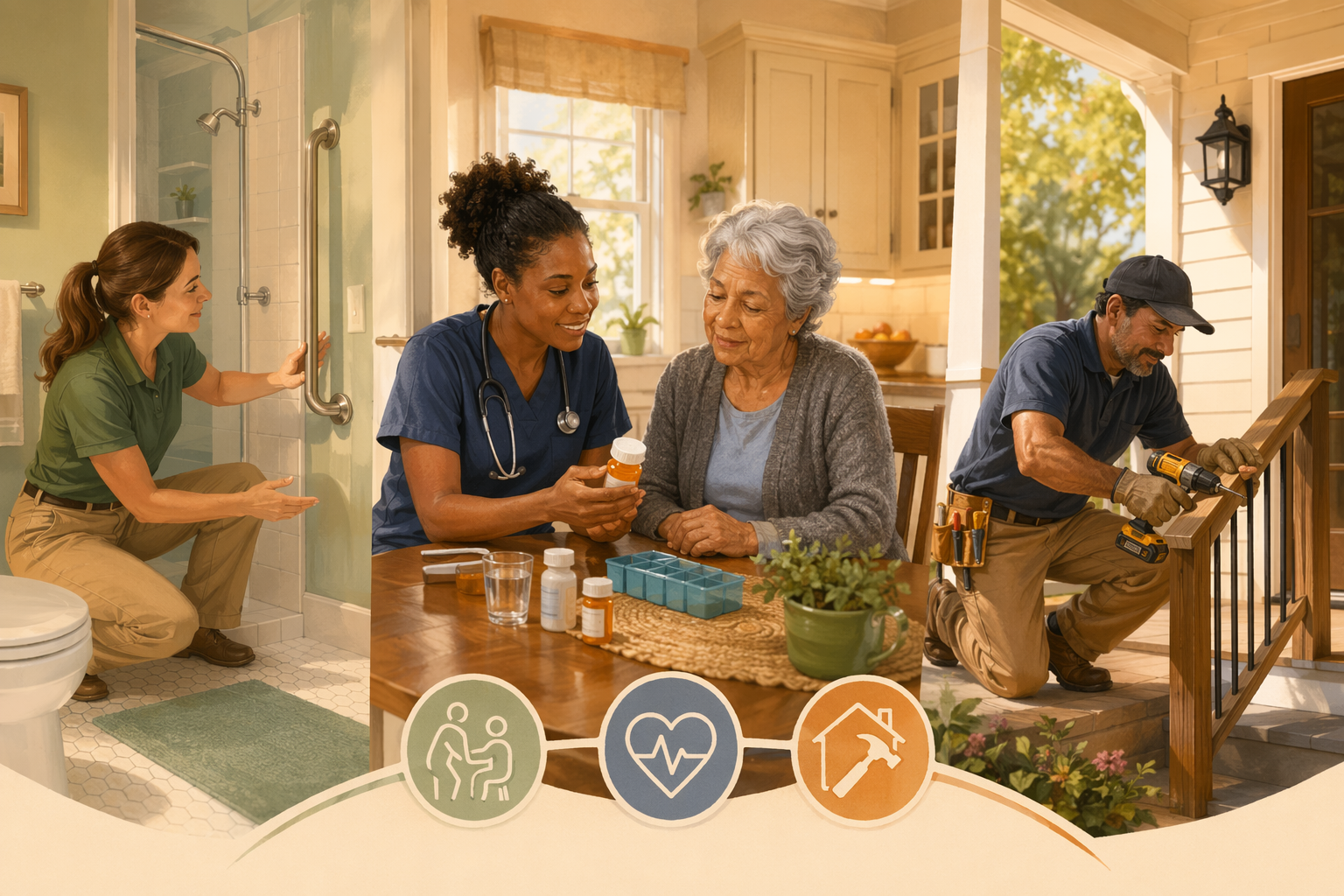
CAPABLE stands for Community Aging in Place — Advancing Better Living for Elders. It is a client-directed, home-based intervention that combines three distinct professionals into a single team: an occupational therapist, a registered nurse, and a construction specialist. Instead of a contractor deciding what needs to be fixed, the older adult sets their own functional goals — things like "I want to shower safely without help" or "I want to walk to the mailbox without fear of falling." The team then works together to address the medical, behavioral, and environmental barriers to those goals.
The occupational therapist assesses how the person moves through their home and identifies the specific tasks that have become difficult or dangerous. The registered nurse reviews medications, chronic conditions, pain levels, and other health factors that affect daily function. The construction specialist — in Habitat's case, often a crew leader or volunteer coordinator — handles the physical modifications that the OT and RN identify as necessary. The client decides which goals to pursue first, which means the intervention is tailored to what matters most to that individual, not what a checklist says is standard.
How Habitat for Humanity Adapted CAPABLE Across Five Pilot Affiliates
Habitat for Humanity is best known for building homes through volunteer labor and sweat equity. But its aging in place work, including the CAPABLE pilot, represents a different kind of intervention — one that relies on professional health expertise as much as construction skills. Habitat implemented the CAPABLE model across five affiliate organizations, each serving a distinct community with its own housing stock, demographic profile, and partnership network.
The five pilot affiliates operated under a shared framework but with local flexibility. Each site assembled a three-person core team:
- An occupational therapist to conduct functional assessments and develop activity-based goals with the client.
- A registered nurse to address medication management, pain, depression, and other health factors that affect independence.
- A construction specialist to execute the home repairs and modifications identified through the OT and RN assessments.
The process is intentionally client-directed. In a typical home repair program, a contractor walks through the house and produces a scope of work. In CAPABLE, the older adult identifies their own priorities — "I want to cook my own meals" or "I want to get in and out of the bathtub without help" — and the team works backward from those goals. The OT might recommend a raised toilet seat and grab bars. The RN might adjust the timing of a diuretic so the client is not rushing to the bathroom at night. The construction specialist installs the hardware. The result is a coordinated intervention, not a collection of disconnected fixes.
Beyond the five pilot sites, Habitat has extended the principles of CAPABLE through its Housing Plus model. Housing Plus pairs a home repair assessment with a functional assessment of activities of daily living conducted by a human or health services professional. While not every affiliate runs a full CAPABLE program, the Housing Plus framework allows more communities to adopt the integrated approach without requiring the full three-person clinical team on staff.
Key Outcomes: Reduced Depression, Improved Fall Confidence, and Better Daily Function
The results from Habitat's five-affiliate CAPABLE implementation are striking — not because the numbers are unprecedented in clinical research, but because they come from a real-world nonprofit setting rather than a controlled university study. The data, published by Habitat for Humanity, shows three primary areas of improvement:
- A 30% reduction in depressive symptoms among participants.
- A 15% increase in participants' confidence that they would not fall.
- Measurable improvement in the ability to complete daily tasks independently.
These outcomes are interconnected. Depression in older adults is often linked to a loss of autonomy — the feeling that you can no longer do the things that define your daily life. When a home modification makes it possible to shower without help, or when a medication adjustment eliminates the fear of a nighttime fall, the psychological effect is as real as the physical one. The 15% improvement in fall confidence is particularly important because fear of falling is itself a major risk factor for future falls — people who are afraid of falling tend to limit their activity, which leads to muscle weakness and balance decline, which makes falls more likely.
For family caregivers, these numbers translate into concrete, observable changes. A parent who was withdrawing from social activities because they were embarrassed about their mobility might start accepting invitations again. A spouse who was waking up multiple times per night to help their partner to the bathroom might find that the combination of a bedside commode and a medication review restores both of their sleep. The outcomes are not abstract statistics — they describe the difference between surviving at home and actually living there.
The $22,120 Healthcare Cost Savings: How CAPABLE Reduces Emergency Visits and Hospitalizations
Perhaps the most compelling data point for families and policymakers alike is the cost savings. When researchers followed up with CAPABLE participants 24 months after the intervention, they found an average savings of $22,120 per participant in healthcare costs. The savings came primarily from fewer emergency room visits and reduced hospitalizations — the expensive, high-acuity care that often results from an unaddressed fall or a cascade of preventable health events.
To put that figure in context, consider the alternatives. The average annual cost of assisted living in the United States is approximately $64,200, or about $5,350 per month. A single hip fracture from a fall can cost $40,000 or more in surgical and rehabilitative care. The $22,120 savings from CAPABLE is not a theoretical projection — it is the actual reduction in healthcare spending observed over two years for participants who received the intervention.
| Cost Comparison | Annual Cost | Notes |
|---|---|---|
| CAPABLE healthcare savings (per participant, 24 months) | $22,120 avg. savings | Reduced ER visits and hospitalizations |
| Assisted living (national median) | ~$64,200/year | $5,350/month; varies significantly by region |
| Home modification (typical range) | $10,000–$100,000 | One-time cost; varies by scope of work |
| Single hip fracture (surgery + rehab) | $40,000+ | Does not include long-term care costs |
The mechanism behind these savings is straightforward. When an older adult can move safely through their home, they are less likely to fall. When they have an occupational therapist and nurse helping them manage their daily routines, they are less likely to develop the complications — urinary tract infections from dehydration, pressure ulcers from immobility, medication errors from confusion — that send older adults to the emergency room. The home modification is not the only driver of savings; it is the integration of health services with the physical changes that produces the result.
For families weighing the cost of home modifications against the cost of a facility, the CAPABLE data provides a powerful counterargument. The question is not whether you can afford to modify the home. The question is whether you can afford not to — and whether the health system can afford to keep paying for preventable emergencies instead of preventive home interventions.
Real Stories: How a Ramp Became Physical Therapy for Anna Bowlby
Data tells one story. Anna Bowlby's story tells another. After Habitat for Humanity built a wheelchair ramp at her home in Portland, Oregon, Anna Bowlby broke her pelvis and five ribs in a fall. The ramp, originally installed to help her mother Evelyn — who lived to 92 — navigate the home's entrance, became something Anna never expected: a rehabilitation tool.
Anna walked that ramp 50 times a day during her recovery. Each pass was a small act of defiance against the injury — a refusal to let a broken body confine her to a bed or a nursing home. The ramp was not designed as physical therapy equipment. It was a home modification built for accessibility. But because it was there, because it was safe and sturdy and graded correctly for a wheelchair, it became the platform for Anna's recovery.
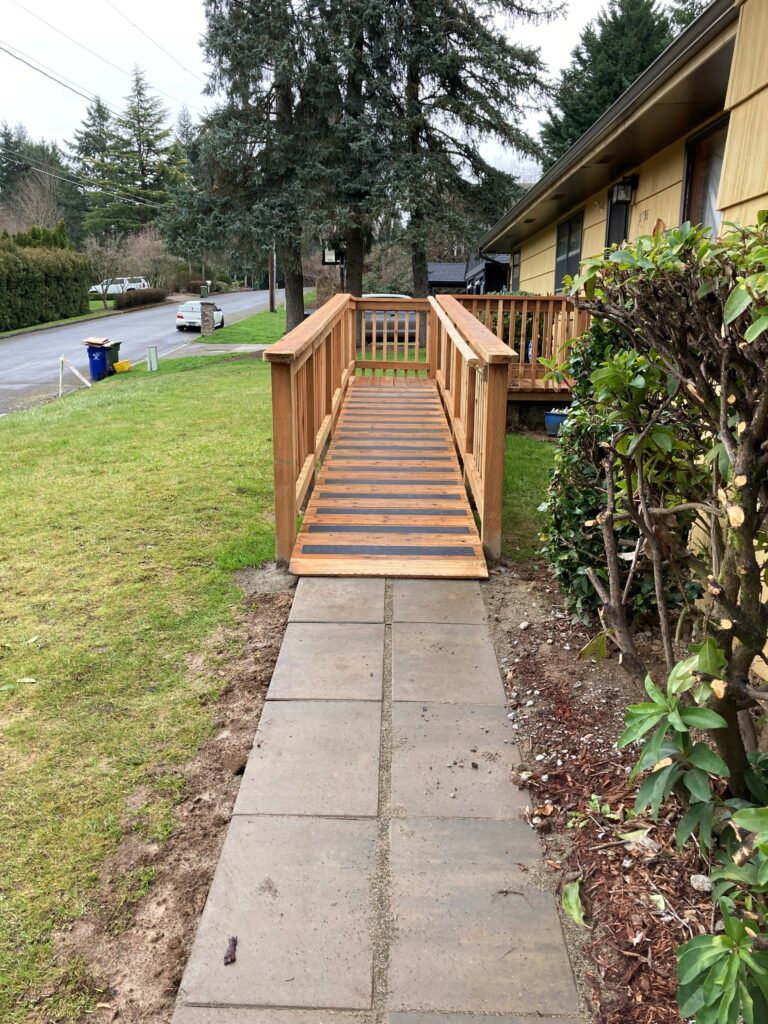
This is the kind of outcome that does not appear in a cost-savings spreadsheet. The ramp did not just prevent a fall — it enabled a recovery. It turned a passive safety feature into an active health intervention. Anna Bowlby did not need to go to a rehabilitation facility to rebuild her strength. She had everything she needed in her own home, because someone had thought about how she would move through it.
Her story illustrates why the CAPABLE model works. The ramp was not installed in isolation. It was part of a broader assessment of Anna's needs, her mother's needs, and the physical realities of their home. When the injury came — and it came despite the ramp — the infrastructure was already in place to support recovery. That is the difference between a home that is merely accessible and a home that is truly supportive of aging in place.
CAPABLE vs. Standard Home Repair Programs: What Makes the Health Integration Different
To understand why CAPABLE produces different outcomes than a standard home repair program, it helps to compare the two approaches directly. Most home modification programs — including Habitat's own non-CAPABLE aging in place services — follow a construction-first model: assess the home, identify hazards, install fixes. The assumption is that a safer environment automatically leads to a safer older adult.
| Dimension | Standard Home Repair Program | CAPABLE Model |
|---|---|---|
| Primary assessment | Home hazard inspection by contractor or volunteer | Functional assessment by OT + health assessment by RN |
| Goal setting | Determined by scope of work and budget | Client-directed: older adult chooses their own functional goals |
| Health integration | None or minimal (referral to outside provider) | Built-in: RN addresses medications, pain, depression, chronic conditions |
| Modification scope | Fixed list of eligible repairs (e.g., grab bars, ramps, railings) | Flexible: modifications are chosen to support the client's specific goals |
| Measured outcomes | Number of homes repaired, cost per project | Health outcomes: depression, fall confidence, ADL performance, healthcare costs |
| Typical duration | Single visit or short project | Multiple visits over several months (OT, RN, construction phased) |
The difference is not academic. A standard program might install grab bars in a bathroom, but if the older adult has uncontrolled pain that makes standing difficult, or a medication that causes dizziness at night, the grab bars alone will not prevent a fall. The CAPABLE model addresses all three layers — the physical environment, the medical condition, and the functional behavior — simultaneously.
This also distinguishes CAPABLE from the CAPS (Certified Aging-in-Place Specialist) contractor model. CAPS-certified contractors are trained in universal design and accessible home modifications, and they are an excellent resource for families planning renovations. But a CAPS contractor is not a health professional. They cannot adjust medications, assess for depression, or recommend changes to daily routines. CAPABLE does not replace the CAPS model — it complements it by adding the clinical expertise that makes home modifications more effective.
For families trying to decide which path to take, the choice depends on the older adult's health status. If the person is generally healthy and simply needs environmental fixes — a grab bar here, a ramp there — a standard program or a CAPS contractor may be sufficient. If the person has multiple chronic conditions, takes several medications, or is experiencing functional decline that is not purely physical, the integrated CAPABLE approach is likely to produce better outcomes.
Geographic Availability and How to Access CAPABLE Through Local Habitat Affiliates
CAPABLE is not yet available through every Habitat for Humanity affiliate. The model was piloted in five locations, and expansion depends on each affiliate's capacity to hire or contract with occupational therapists and registered nurses — roles that are not part of Habitat's traditional construction-focused staffing model. However, the Housing Plus model, which incorporates a human services or health assessment alongside the home repair assessment, is more widely available and extends the same principles to a larger number of communities.
For families interested in accessing CAPABLE or a similar integrated program, the first step is to contact their local Habitat affiliate and ask specifically about aging in place services. Not all affiliates advertise these programs prominently, and the staff member answering the phone may not immediately know what CAPABLE is. Asking the right questions can help:
- "Do you offer the CAPABLE program or any aging in place program that includes an occupational therapist or nurse?"
- "Do you use the Housing Plus model, where a health or social services assessment is done alongside the home repair assessment?"
- "What are the eligibility requirements? Do you serve homeowners age 62 and older with income at or below 80% of the area median income?"
- "Is there a waitlist? How long is the typical timeline from application to completion?"
Eligibility criteria vary by affiliate, but the general pattern across Habitat's aging in place programs includes: homeowner status, age 62 or older, and income at or below 80% of the area median income. Some affiliates have additional geographic restrictions — for example, Memphis Habitat's Aging in Place program requires residence inside Memphis city limits and uses a single call-in date each quarter for applications, with slots filling within minutes. Summit County Habitat's HUD-funded program serves seniors 62 and older with income below 80% AMI and includes a pre-assessment with an occupational therapist, home repair assessment, modifications, and a post-assessment.
For families who do not have a CAPABLE or Housing Plus program nearby, the existing Habitat Aging in Place program — which covers critical home repairs and modifications like grab bars, ramps, walk-in showers, and lever door handles — may still be an option. That program is more widely available and does not require the same clinical staffing infrastructure.
The Future of Housing-Health Integration: Scaling CAPABLE and the 'Bridging the Gap' Guide
The CAPABLE model represents a proof of concept that has implications far beyond Habitat for Humanity. If a nonprofit housing organization can produce a 30% reduction in depressive symptoms and $22,120 in healthcare savings per participant, the question is not whether this approach works — it is how to scale it.
Habitat has published a resource called the "Bridging the Gap" guide, designed to help other housing organizations implement CAPABLE and similar aging in place strategies. The guide covers the operational, financial, and partnership challenges that organizations face when they try to integrate health services into housing programs — how to contract with occupational therapists, how to bill for nursing services, how to measure outcomes, and how to build relationships with healthcare systems that may be skeptical of a construction nonprofit's ability to deliver health results.
The broader vision is one in which home modification is understood as a health intervention, not a construction project. When a doctor prescribes a grab bar the way they prescribe a medication, and when an insurance company pays for a ramp the way they pay for a rehabilitation session, the entire economics of aging in place shift. The $22,120 savings per CAPABLE participant is not an anomaly — it is a signal that the healthcare system has been spending money on the wrong end of the problem.
For family caregivers reading this, the takeaway is not that you need to find a CAPABLE program tomorrow. It is that the way we think about home modifications is changing. A ramp is not just a ramp. A grab bar is not just a piece of hardware. When they are installed as part of a coordinated, client-directed, health-integrated plan, they become tools for independence, recovery, and dignity. The CAPABLE model shows what is possible when we stop treating the home and the body as separate problems.
Related reading
- The Evidence for Aging-in-Place Home Modifications: What Research Says About Fall Prevention, Independence, and Cost Savings
- CAPS Contractor vs. Occupational Therapist vs. Universal Design Consultant: Which Professional Should Your Family Hire for Home Modifications?
- OT vs. CAPS First for Home Modifications: Why the Clinical Evaluation Should Come Before the Construction Plan
Need a professional assessment?
Find a CAPS-credentialed professional or local aging services through our outbound resource list — we never name or rank individual contractors.
Find Local HelpNoticed something outdated or inaccurate on this page? Flag a correction. We review every report against CDC, NIA, and AARP HomeFit guidance before updating a page.