
Room checklist
How Much Does a CAPS Home Modification Cost? Full Breakdown with Budget Planning
A comprehensive cost breakdown of aging-in-place modifications with a CAPS professional, including a comparison to assisted living, a detailed phasing strategy, and a roadmap for financial assistance through Medicaid waivers, VA grants, and tax deductions.
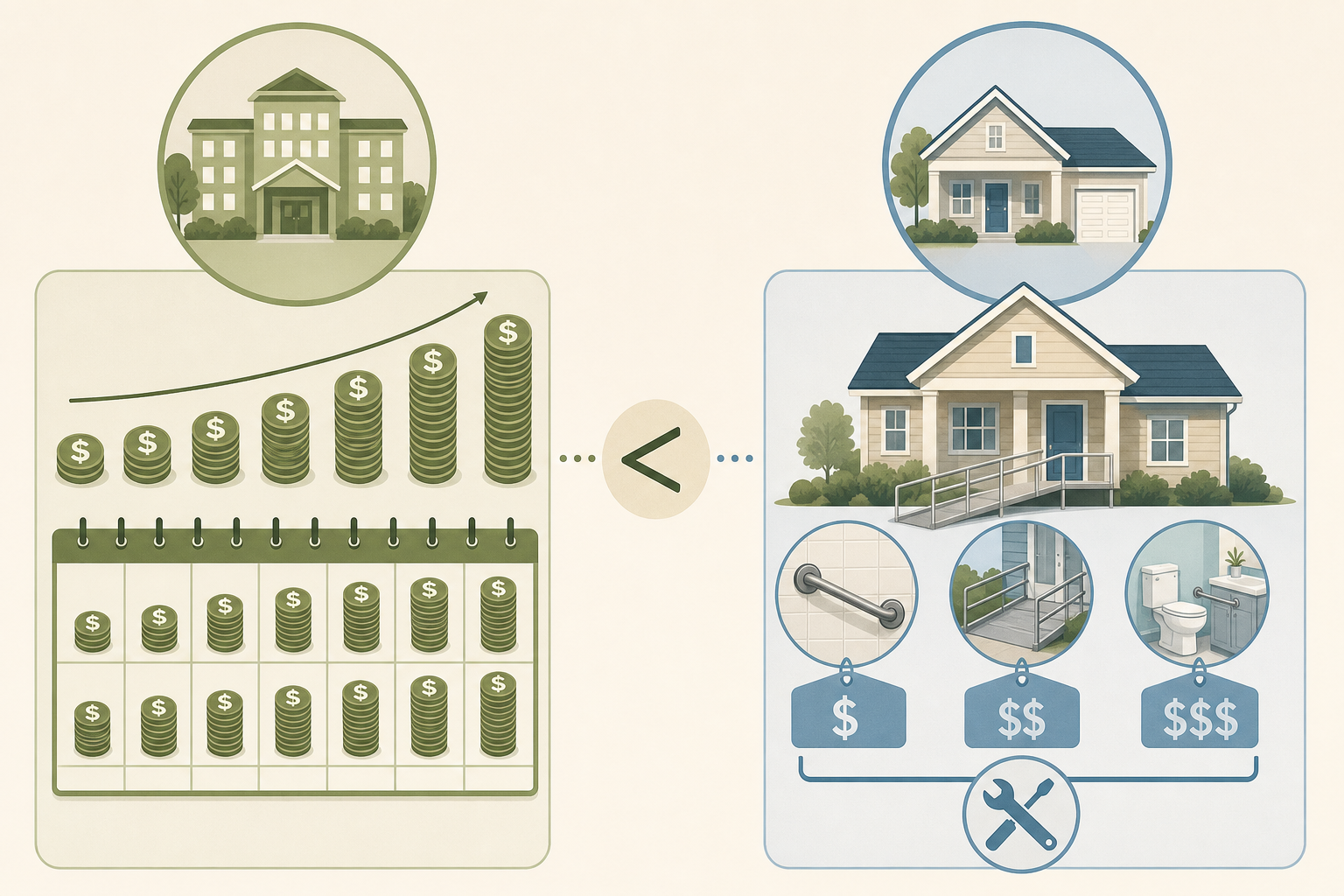
The Cost Reality: One Year of Assisted Living vs. a Lifetime of Home Modifications
When families first hear the price tag for a full bathroom remodel or a stairlift installation, the number can feel staggering. But that reaction changes when you place the figure next to the alternative. The average annual cost of assisted living in the United States is approximately $64,200 per year, or about $5,350 per month, according to data from the American Health Care Association and National Center for Assisted Living (AHCA/NCAL). A comprehensive set of home modifications — grab bars, a walk-in tub, widened doorways, non-slip flooring, and a stairlift — might run $10,000 to $50,000. Even at the high end, that is less than a single year in a facility.
This comparison matters because the vast majority of older adults want to stay put. A 2022 University of Michigan National Poll on Healthy Aging found that 88% of adults aged 50 and older consider it important to remain in their homes as they age. Yet the housing stock is not ready. According to a 2020 Census Bureau report, only about 10% of U.S. homes are fully equipped to accommodate an older adult's needs. That gap between desire and reality is exactly what a Certified Aging-in-Place Specialist (CAPS) is trained to close.
The financial argument is not just about comparing totals. It is about recognizing that modifications are a one-time capital investment, while assisted living is an ongoing operational expense that compounds every year. A $50,000 renovation that keeps someone safe at home for a decade costs $5,000 per year in amortized terms. That same decade in assisted living would cost roughly $642,000. The math shifts the conversation from "Can we afford the renovation?" to "Can we afford not to do it?"
For a deeper look at the hidden expenses families often overlook when comparing these two paths, see our article on the hidden costs of aging in place in 2026.
What You Pay for a CAPS Assessment (and Why It Saves Money)
Before any work begins, a CAPS professional conducts a comprehensive home safety assessment. This is not a quick walk-through. It is a systematic evaluation of every room, entryway, and potential hazard, resulting in a written report with prioritized recommendations.
The cost for this assessment typically ranges from $300 to $1,000, depending on the size of the home, the specialist's credentials, and your geographic location. Some CAPS professionals charge an hourly consultation rate of $75 to $200 per hour instead of a flat fee. While $1,000 may feel like a significant upfront expense, it is a fraction of what you might spend correcting mistakes from an unplanned renovation.
Think of the assessment as the blueprint for your entire project. Without it, families often make two expensive mistakes: they install the wrong type of modification for the actual mobility limitation, or they tackle low-priority upgrades first and run out of budget for the critical safety work. A CAPS assessment prevents both. For a detailed look at what the assessment includes and how to prepare, read our guide on how much it costs to hire a CAPS specialist.
If you are unsure whether your parent's home needs an assessment at all, our checklist of 10 signs your parent's home needs a CAPS assessment can help you decide before a fall forces the decision.
Complete Modification Cost Breakdown by Category
Once the assessment is complete, the CAPS professional will present a prioritized list of modifications with estimated costs. The table below shows typical price ranges for the most common aging-in-place upgrades. These are national averages; your actual costs will depend on local labor rates, material choices, and the specific layout of your home.
| Modification | Typical Cost Range | Notes |
|---|---|---|
| Grab bars (professionally installed) | $100 – $300 | Per bar; stainless steel or chrome finish |
| Wheelchair ramp | $1,500 – $5,000 | Depends on length, material (wood vs. aluminum), and site prep |
| Stairlift (straight rail) | $3,000 – $5,000 | Curved rail stairlifts cost significantly more |
| Walk-in tub | $5,000 – $15,000 | Includes installation; hydrotherapy models at the high end |
| Widened doorways (32" or wider) | $200 – $2,000 | Cost depends on whether the wall is load-bearing |
| Full bathroom accessibility remodel | $10,000 – $50,000+ | Most common and highest-impact area for seniors |
| Full kitchen accessibility remodel | $15,000 – $50,000+ | Includes pull-out shelves, lowered counters, touchless faucets |
| Non-slip flooring (per sq ft) | $7 – $12 | Material and installation; luxury vinyl plank is a popular choice |
| Smart thermostat | ~$170 | Includes installation; allows remote temperature control |
| Security cameras (3–4 units) | ~$1,000 | Includes installation and basic monitoring setup |
The bathroom deserves special attention. Research indicates that nearly 80% of older adults say they would need bathroom modifications to age in place safely. This is also the room where most falls occur. The CDC reports that more than 1 in 4 adults aged 65 and older falls each year, resulting in approximately 3 million emergency department visits. A well-designed bathroom remodel is not a luxury — it is a direct response to the most common injury risk for this population.
For a broader look at all types of aging-in-place remodeling costs, see our complete cost guide to aging-in-place remodeling. If you are specifically planning a bathroom renovation, our bathroom remodel crisis guide for elderly parents walks through the entire process from fall to finish.
Factors That Influence Your Final Cost
The ranges in the table above are wide for a reason. Several variables will push your final cost toward the lower or higher end of each range:
- Geographic location: Labor and material costs vary significantly by region. A bathroom remodel in San Francisco will cost substantially more than the same project in rural Ohio.
- Project scope: A single-room modification costs far less than a whole-house plan. Most families start with the bathroom and expand from there.
- Material choices: Basic grab bars start around $100 installed. Designer finishes, custom tile work, and premium fixtures can double or triple the cost of any modification.
- Contractor credentials: A CAPS-certified professional may charge a premium over a general handyman, but the specialized training in universal design and safety standards often prevents costly rework.
- Structural complexity: Widening a doorway in a load-bearing wall costs more than a simple partition wall. Adding a ramp may require grading and concrete work that a simple threshold ramp does not.
The best way to get an accurate estimate for your specific situation is to have a CAPS professional conduct an on-site assessment. The $300 to $1,000 you spend on that evaluation will give you a detailed scope of work that contractors can bid against accurately.
Your Financial Assistance Roadmap: Medicaid, VA Grants, and Tax Deductions
Many families assume they must pay for home modifications entirely out of pocket. While that is often the case, several financial assistance programs can significantly reduce the burden. The key is knowing which programs exist and whether you qualify.
| Funding Source | What It Covers | Key Eligibility Notes |
|---|---|---|
| Medicaid Home and Community-Based Services (HCBS) Waivers | Home modifications that enable an individual to remain at home rather than enter a nursing facility | State-specific; eligibility varies by income, assets, and level of care need. Waitlists are common in many states. |
| VA Specially Adapted Housing (SAH) Grant | Up to $117,014 (2026 figure) for modifications to accommodate a service-connected disability | For veterans with specific qualifying disabilities. Must use the home as primary residence. |
| VA Special Home Adaptation (SHA) Grant | Up to $23,444 (2026 figure) for modifications to improve accessibility | For veterans with different qualifying disabilities than SAH. Can be used in a home owned by a family member. |
| Tax Deduction (IRS Publication 502) | Medically necessary home modifications that accommodate a diagnosed condition | Modifications must be prescribed by a physician. Only the amount exceeding the increase in home value is deductible. |
| Medicare Advantage Plans (Part C) | Some plans include a home safety benefit covering grab bars, shower chairs, and fall prevention assessments | Not standard Medicare (Parts A & B). Check your specific plan's benefits; coverage varies widely. |
| Local Area Agencies on Aging (AAA) | May offer grants, low-interest loans, or sliding-scale services for home modifications | Programs vary by county. Contact your local AAA for a personalized list of available resources. |
The tax deduction route is worth particular attention. Under IRS Publication 502, medically necessary home modifications — such as grab bars, ramps, and widened doorways — may be deductible as medical expenses if they are prescribed by a physician to accommodate a diagnosed condition. The deduction applies to the cost of the modification minus any increase in the home's resale value. For example, if a $10,000 bathroom remodel adds $2,000 to the home's value, the deductible portion is $8,000. This is a complex area of tax law; consult a qualified tax professional before claiming the deduction.
For personalized guidance on available programs in your area, contact your local Area Agency on Aging. These organizations maintain up-to-date directories of state and local assistance programs that may not appear in national searches.
A Phased Strategy: Start with Safety, Then Expand
One of the most common misconceptions about home modifications is that you must do everything at once. That belief keeps many families from starting at all. In reality, a phased approach allows you to address the highest-risk areas first while spreading the cost over months or years.
Here is a practical three-phase strategy that many families use to stay within budget without compromising safety:
Phase 1: Immediate Safety (Budget: $3,000 – $15,000)
These are the highest-impact, lowest-cost modifications that address the most common fall risks. Most families can complete Phase 1 within a few weeks.
- Install grab bars in the shower, beside the toilet, and near the tub ($300 – $900 for three bars)
- Add non-slip flooring or mats in the bathroom and kitchen ($7 – $12 per sq ft)
- Improve lighting in hallways, stairways, and entryways ($200 – $500 for fixtures and installation)
- Install a raised toilet seat or comfort-height toilet ($150 – $500)
- Add a shower chair or transfer bench ($50 – $200)
- Set up a main-floor bedroom if stairs are a concern (cost varies; may be as simple as rearranging furniture)
Phase 2: Mobility and Access (Budget: $5,000 – $20,000)
Once the immediate fall risks are addressed, focus on modifications that improve daily mobility and independence.
- Install a stairlift ($3,000 – $5,000 for straight rail)
- Build a wheelchair ramp ($1,500 – $5,000)
- Widen doorways to 32 inches or wider ($200 – $2,000 per doorway)
- Replace doorknobs with lever handles ($50 – $150 per handle)
- Install a walk-in tub or curbless shower ($5,000 – $15,000)
Phase 3: Full Renovation (Budget: $15,000 – $50,000+)
Major structural renovations are typically reserved for families who have already addressed the immediate safety risks and are planning for long-term care needs.
- Full bathroom accessibility remodel ($10,000 – $50,000+)
- Full kitchen accessibility remodel ($15,000 – $50,000+)
- Whole-home smart technology integration (thermostat, lighting, security cameras: $1,500 – $5,000)
The ROI of Aging-in-Place Modifications: Resale Value and Market Demand
Home modifications are often viewed as an expense, but they can also be an investment. With only about 10% of U.S. homes equipped for aging in place, accessible homes are in short supply. As the population aged 65 and older continues to grow — reaching approximately 57.8 million in 2023, or 17.3% of the population — demand for accessible housing will only increase.
This creates a favorable market dynamic for homeowners who invest in modifications. Features like main-floor bedrooms, curbless showers, widened doorways, and no-step entries appeal not only to older adults but also to younger buyers who anticipate aging parents moving in or who simply value universal design. A home that is already modified saves the next buyer thousands of dollars in renovation costs, which can translate into a higher sale price and faster closing.
The emotional ROI is equally significant. Over 60% of seniors report having an emotional attachment to their home, and 40% say independence is the most important benefit of aging in place. Modifications that preserve that independence — allowing someone to bathe safely, navigate stairs, and prepare meals without assistance — have a value that no balance sheet can capture.
Next Steps: How to Find and Hire a CAPS Professional
If the cost breakdown and phasing strategy have convinced you that home modifications are the right path, the next step is finding the right professional to guide you. Here is how to start:
- Use the NAHB CAPS directory: The National Association of Home Builders maintains an official directory of CAPS-certified professionals. This is the most reliable starting point.
- Ask for recommendations: Senior care organizations, occupational therapists, and local Area Agencies on Aging often have lists of trusted contractors.
- Interview multiple candidates: Ask about their experience with aging-in-place projects, request references, and compare their assessment approaches.
- Verify credentials: Confirm that the contractor holds an active CAPS certification and carries liability insurance and workers' compensation coverage.
- Get a written assessment first: Before agreeing to any work, have the CAPS professional conduct a full home assessment and provide a written report with prioritized recommendations and cost estimates.
For a complete guide on what a CAPS contractor does and how to evaluate candidates, read our article on what a CAPS-certified aging-in-place contractor does and how to find one.
The upfront cost of a CAPS assessment — $300 to $1,000 — is a small price for a safe, cost-effective aging-in-place plan. When you compare that to the $64,200 annual cost of assisted living, the choice becomes clear. Start with an assessment, prioritize the safety-critical modifications, and build from there. Your home can be a safe place to age in place without requiring a six-figure budget or a single, overwhelming renovation.
Related reading
Need a professional assessment?
Find a CAPS-credentialed professional or local aging services through our outbound resource list — we never name or rank individual contractors.
Find Local HelpNoticed something outdated or inaccurate on this page? Flag a correction. We review every report against CDC, NIA, and AARP HomeFit guidance before updating a page.