
Room checklist
How Much Aging-in-Place Home Modifications Cost and How to Pay for Them
Understand the typical cost range for aging-in-place home modifications — from low-cost grab bars to full renovations — and learn about federal grants, VA benefits, Medicaid waivers, and other funding sources to help you afford them without paying out of pocket unnecessarily.
The first hard moment in an aging-in-place project is often not the fall, the doctor’s warning, or the family meeting. It is the quote: $7,800 for a safer shower, $4,000 for a ramp, or a stair lift estimate that suddenly makes everyone at the kitchen table quiet.
That number can feel outrageous until it is put next to the alternative. Typical aging in place home modifications often fall somewhere between about $3,000 and $15,000 for a practical safety package, while larger renovations can climb to $50,000 or more depending on the house and scope of work.[1][2] The national median cost of assisted living is often cited at more than $64,000 per year, which changes the math: a one-time modification is not automatically cheap, but it may be financially rational if it prevents or delays a move.[3]
The catch is that “home modification” is too broad to price honestly. A grab bar and better lighting are not the same project as a curbless shower, and neither is the same as widening doorways in an older house with narrow framing. Only about 10% of U.S. homes were described as aging-ready in AARP-related 2021 data, so many families are starting from a house that was never designed for walkers, wheelchairs, low vision, or post-hospital weakness.[3]
Start With the Cost Tier, Not the Wish List
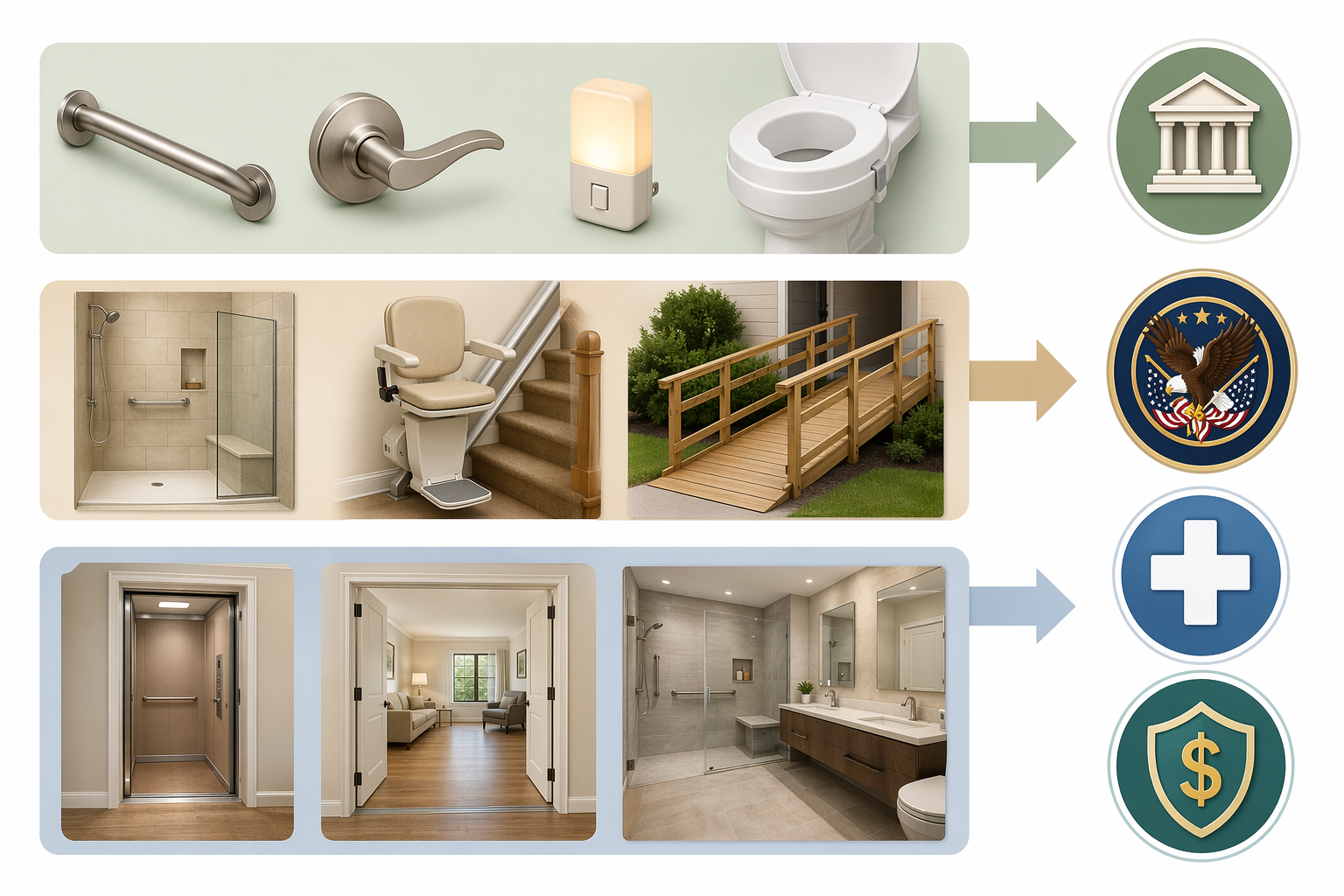
Before calling three contractors, sort the project into a cost tier. This keeps a family from treating a $75 lighting fix like a construction project, or a $12,000 bathroom change like something that can be solved with a weekend shopping trip.
| Cost tier | Typical projects | Usual first move | Funding paths to check early |
|---|---|---|---|
| $25–$500 | Grab bars, lever handles, night lights, brighter bulbs, toilet risers, handheld showerheads | Fix obvious hazards quickly; use a handyman only when installation needs anchoring or electrical work | Local aging agency, nonprofit programs, Medicaid waiver if already enrolled |
| $1,000–$10,000 | Walk-in shower, stair lift, ramp, exterior railings, doorway threshold changes | Get a safety assessment and written scope before accepting a contractor quote | Medicaid HCBS waiver, VA benefits, USDA Section 504, nonprofit repair programs, state or local grants |
| $10,000–$50,000+ | Full bathroom reconfiguration, home elevator, doorway widening, major kitchen or first-floor living changes | Separate medical necessity from preference, then price phases | VA SAH/SHA where applicable, Medicaid waiver where available, tax deduction review, renovation loan or grant programs |
The ranges are not promises. Region, labor market, home age, plumbing location, permits, and whether the work is preventive or urgent can move the number quickly. A ramp on a simple straight approach is a different job from a ramp that has to turn around landscaping, meet local slope requirements, and tie into a deteriorated porch.
Low-Cost Fixes: Do These Before the Big Debate
Low-cost aging-in-place changes are not glamorous, but they are the rare category where speed matters more than architectural taste. If an older parent is already grabbing a towel bar to step out of the tub, waiting for a full remodel plan is not responsible budgeting. It is a delay.
- Install properly anchored grab bars at the tub, shower, and toilet.
- Add night lights or motion lighting between the bed, bathroom, and kitchen.
- Replace round knobs with lever handles where grip strength is becoming a problem.
- Use a toilet riser or safety frame when standing up is the risky part of the routine.
- Remove loose rugs, curled mats, and extension cords from walking paths.
This is the tier where families should be careful not to over-professionalize the whole thing. Some items can be bought and installed quickly. Others, especially grab bars, need correct placement and anchoring. A bar screwed into drywall gives the appearance of safety while quietly becoming another hazard.
Mid-Range Projects Are Where Families Usually Get Stuck
The mid-range tier is where the practical argument usually starts. A daughter sees that the current shower is unsafe. A son thinks a shower chair is enough. The parent hates the idea of the bathroom looking like a facility. Someone asks whether insurance pays. Someone else says, incorrectly but confidently, that there is probably a grant for it.
Walk-in showers, stair lifts, ramps, and exterior railings are common because they address the places where daily life breaks down: bathing, entering the home, getting to the bedroom, and moving between levels. These projects are expensive enough to hurt but common enough that they should be priced with discipline rather than panic.
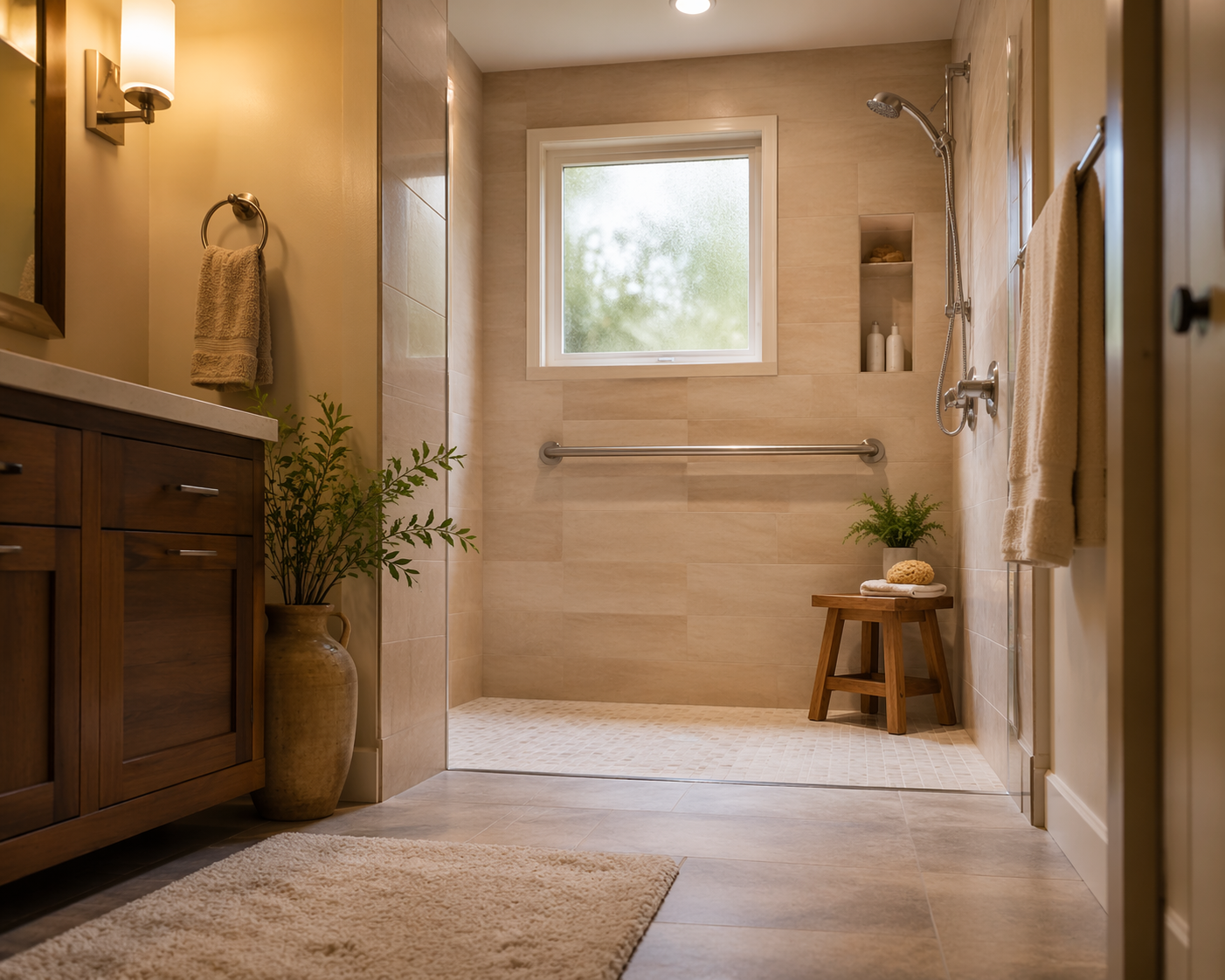
For a bathroom, ask what problem is actually being solved. If the danger is stepping over the tub wall, a low-curb shower may be enough. If the parent uses a wheelchair or needs hands-on help from a caregiver, the project may need a wider entry, more turning space, a handheld shower, blocking for future grab bars, and non-slip flooring. Those are not decorative upgrades; they change whether bathing remains possible at home.
For stairs, the first question is whether the parent truly needs to keep using both floors. Sometimes moving the bedroom downstairs is cheaper and safer than installing equipment. When that is not realistic, a stair lift may be the bridge between staying home and giving up a familiar house. For an exterior entrance, ramps should be quoted with slope, landing, drainage, railing, and winter conditions in mind, not just the distance from door to driveway.
This is also the tier where funding searches start to matter. Do not pay cash the same week a contractor hands over a quote unless the work is urgent and the family has already checked the obvious eligibility doors.
High-Cost Renovations Need Phasing, Not Fear
High-cost work includes home elevators, full bathroom reconfigurations, widening doorways, changing first-floor layouts, and major kitchen modifications. These projects can move beyond $50,000 when structural work, plumbing relocation, electrical upgrades, permits, or older-home surprises enter the job.[1][2]
The mistake is assuming that because the total project is large, it must be done all at once or not at all. In many houses, the smarter plan is phased: make the entry safe, make one bathroom usable, create a first-floor sleeping option, then decide whether larger accessibility work is still necessary. A full remodel may be justified, but the family should make that call after separating safety needs from resale dreams and contractor upsells.
For the deeper financial comparison between renovation cost and care-setting cost, see Does an Aging-in-Place Remodel Pay for Itself? The useful question is not whether every modification “pays for itself.” It is whether the right modification buys safety, time, and workable care at a lower total cost than the next housing option.
Match the Funding Search to the Project
Funding is fragmented, which is why families miss it. The useful way to search is not “find every aging-in-place program.” It is “which programs fit this person, this project, and this cost tier?”
If the parent is a veteran
Start with VA-related benefits before using savings. HISA, SAH, and SHA are not interchangeable, and eligibility depends on disability status, medical need, and the type of modification. The practical move is to gather the medical documentation and ask the VA which benefit category fits before signing a major contract.
If income is limited and the home is rural
USDA Section 504 is worth checking for eligible rural homeowners. The program is commonly described as offering loans up to $40,000 and grants up to $10,000 for qualifying very-low-income homeowners, with grants generally tied to older homeowners who need to remove health and safety hazards.[4] This is paperwork-heavy, but it belongs near the top of the list for the right household.
If Medicaid is already involved or likely
Ask about Medicaid Home and Community-Based Services waivers. Some state waiver programs may cover home modifications when they help a person remain safely at home instead of entering institutional care, but coverage varies sharply by state, waiver type, enrollment caps, and prior authorization rules. This is not a national yes-or-no benefit; the family has to check the state Medicaid office or waiver case manager.
If the project is small but urgent
Local Area Agencies on Aging, city housing departments, Rebuilding Together affiliates, Habitat for Humanity programs, and faith or community repair groups may be more useful than a federal search for small jobs. For a closer look at one nonprofit route, see Habitat for Humanity's Aging in Place Program. These programs often have waitlists, income rules, geographic limits, or volunteer-capacity limits, so they are best treated as possibilities to check early, not guaranteed funding.
If the home is in a community served by HUD aging-in-place grants
HUD’s Older Adults Home Modification Program funds nonprofit organizations, state and local governments, and public housing authorities to deliver low-cost home modifications and repairs for eligible older adults; families generally do not apply as individual homeowners through the federal notice itself.[5] That distinction matters. The route is to find whether a local agency in the parent’s area has received or administers this kind of funding.
If the family will still pay part of the bill
Keep records for a tax review. IRS Publication 502 describes when medical and dental expenses may be deductible, including certain home improvements made for medical care, subject to the rules on medical necessity, capital improvements, and the taxpayer’s deduction situation.[6] This is not instant cash, and it is not a reason to overbuild, but it can change the after-tax cost for some households.
For a fuller program-by-program funding walkthrough, use Paying for Aging in Place Home Modifications: A Guide to Grants, Loans, and Assistance Programs or How to Pay for an Aging-in-Place Remodel. The order still matters: veteran status, Medicaid status, income and rural eligibility, local nonprofit help, tax treatment, then loans or cash.
Is the Work Actually Worth Doing?
The skeptical family member is not wrong to ask. A modification is not automatically valuable because it sounds safe. The better question is whether the change addresses a real risk in the home and whether the cost is proportionate to the harm it may prevent.
One useful data point comes from a randomized controlled trial in the St. Louis area. The intervention averaged $765 per person, produced estimated medical savings of $1,613 per person, and reduced falls from 2.3 to 1.5 per person per year, a reduction of about 35%.[7] That is the kind of evidence families need because it connects a home change to both injury prevention and medical spending.
It also needs a boundary. The study ran from 2015 to 2017 in the St. Louis metro area, and the sample was predominantly women and included a large share of African American participants.[7] It supports the idea that targeted, evidence-informed home changes can reduce falls in a real community setting. It does not prove that every remodel, in every house, for every older adult, will produce the same return.
Grab bars have their own narrower evidence. A Human Factors study found that grab bars improved balance recovery by 76% during bathtub exit tasks.[8] That does not mean a grab bar solves every bathroom hazard. It does mean that dismissing a properly placed bar as “just a little thing” misses how falls actually happen: in a few unstable seconds during ordinary routines.
Who Should Verify the Plan?
For low-cost changes, the right helper may be a careful handyman, a local aging-services program, or an occupational therapist who can spot the highest-risk routines. For mid-range and high-cost projects, bring in someone who can translate function into construction scope before the family gets emotionally attached to a quote.
A Certified Aging-in-Place Specialist, or CAPS, is a practical credential to look for because it signals training in home modifications for older adults through the National Association of Home Builders.[9] It is not magic, and it does not replace licensing, insurance, references, or good project management. It is one useful screen when choosing who gets to tell your family what a safe bathroom or entrance should cost.
If you are weighing professional help, compare the roles before hiring: a CAPS contractor thinks in buildable scope, a general contractor thinks in construction execution, and an occupational therapist thinks in daily function and safety. The distinction is covered in CAPS vs. General Contractor vs. Occupational Therapist. For fee expectations, see How Much Does a CAPS Cost?.
A Practical Route From Quote to Decision
- Identify the unsafe routine first: bathing, toileting, stairs, entry, nighttime walking, cooking, or transfers.
- Classify the project as low-cost, mid-range, or high-cost before gathering estimates.
- Do the low-cost safety fixes immediately when the risk is obvious and installation can be done correctly.
- For mid-range or high-cost work, get input from an occupational therapist, CAPS professional, or experienced accessibility contractor.
- Check the most likely funding sources before paying cash: VA, Medicaid waiver, USDA, HUD-supported local programs, nonprofit repair help, and tax treatment.
- Only then decide what must be paid out of pocket, financed, postponed, or phased.
Aging-in-place home modifications can be expensive, but the family’s job is not to approve every safety-branded upgrade or reject every quote that hurts. The job is to price the right scope, look for help in the right order, and spend cash only after the obvious funding doors have been checked.
References
- How Much Do Home Modifications Cost for Aging in Place? — ElderLife Financial — https://www.elderlifefinancial.com/resources/how-much-do-home-modifications-cost-for-aging-in-place/
- Aging In Place Remodeling: A Guide To Modifying Your Home — Forbes Health — https://www.forbes.com/health/healthy-aging/aging-in-place-remodeling/
- Aging In Place Statistics — Choice Mutual — https://choicemutual.com/original-research/aging-in-place-statistics/
- Single Family Housing Repair Loans & Grants — USDA Rural Development — https://www.rd.usda.gov/programs-services/single-family-housing-programs/single-family-housing-repair-loans-grants
- Older Adults Home Modification Grant Program — Grants.gov — https://simpler.grants.gov/opportunity/7c069780-eefc-4889-9036-248615be6f4d
- Publication 502, Medical and Dental Expenses — Internal Revenue Service — https://www.irs.gov/publications/p502
- Fall prevention program can help reduce dangerous in-home tumbles by nearly 40% — WashU Medicine — https://medicine.washu.edu/news/fall-prevention-program-can-help-reduce-dangerous-in-home-tumbles-by-nearly-40/
- Bathtub Grab Bar Placement Affects the Safety of Older Adult Users — PubMed — https://pubmed.ncbi.nlm.nih.gov/34963373/
- Certified Aging-in-Place Specialist (CAPS) — National Association of Home Builders — https://www.nahb.org/education-and-events/credentials/certified-aging-in-place-specialist-caps
Related reading
Need a professional assessment?
Find a CAPS-credentialed professional or local aging services through our outbound resource list — we never name or rank individual contractors.
Find Local HelpNoticed something outdated or inaccurate on this page? Flag a correction. We review every report against CDC, NIA, and AARP HomeFit guidance before updating a page.