
Room checklist
What Home Modifications Does Habitat for Humanity Provide for Aging in Place? A Room-by-Room Guide
A detailed, room-by-room breakdown of the specific home modifications Habitat for Humanity's Aging in Place program typically provides — from bathroom grab bars and walk-in showers to wheelchair ramps and lever door handles — so adult children caregivers can quickly assess whether their parent's needs are covered before applying.
The Philosophy Behind Habitat's Modifications: Safety, Accessibility, and Person-Centered Design
Habitat for Humanity's Aging in Place program is not a home renovation service in the conventional sense. It is a targeted, evidence-based intervention designed to address a specific crisis: more than 19 million older adults in the U.S. currently live in homes that are in disrepair or ill-equipped to safely meet their needs, and by 2030, 20% of the U.S. population will be 65 or older. The program's core philosophy is that a person's home should not be a source of injury or isolation, and that the right modifications can keep families together.
What distinguishes Habitat's approach from a standard contractor's is the Housing Plus model. This pairs a human services assessment — which evaluates an older adult's ability to perform activities of daily living — with a home repair evaluation conducted by a Habitat construction specialist. The result is a set of modifications specific to each homeowner's lifestyle and functional needs, not a one-size-fits-all checklist. This dual-assessment process ensures that the work done is both medically appropriate and structurally sound.
Bathroom Modifications: The Most Common and Most Impactful Changes
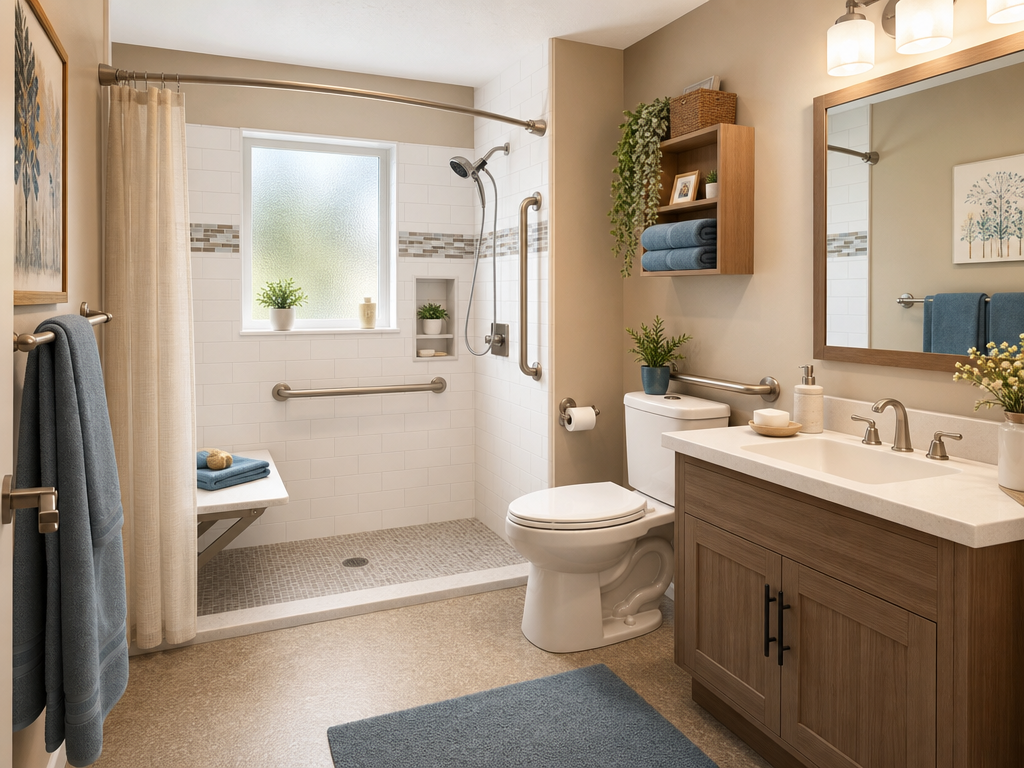
The bathroom is the most hazardous room in any home for an older adult, and it is where Habitat's program concentrates its most consistent and impactful work. A 2025 systematic review of home modification studies found that bathroom safety enhancements and mobility/accessibility improvements were implemented in 100% of the high-quality studies reviewed. This aligns directly with the modifications Habitat affiliates most commonly provide.
Based on documentation from the Summit County, Memphis, and Twin Cities affiliates, as well as the national FAQ, the following bathroom modifications are typical:
- Grab bars: Installed in the shower, near the toilet, and at the bathroom entrance. These are the single most frequently requested modification across all affiliates.
- Walk-in shower conversion (tub cut): Many affiliates will cut out an existing bathtub and install a low-threshold or zero-threshold walk-in shower stall. This eliminates the need to step over a tub wall, which is a primary fall risk.
- ADA-compliant comfort-height toilet: Standard toilets are often too low for older adults with limited hip or knee mobility. Habitat replaces them with taller models that make sitting and standing safer.
- Non-slip flooring: Slippery bathroom floors are a major hazard. Affiliates install slip-resistant flooring or apply anti-slip treatments to existing surfaces.
- Curved shower rod: A curved rod provides more elbow room inside the shower, reducing the chance of bumping into the curtain or door.
- Handheld showerhead: Allows for seated bathing and makes it easier for a caregiver to assist with showering.
- Lowered mirror: Adjusting the bathroom mirror to a height accessible from a seated position or for a person using a walker.
- Shower seat: A built-in or transfer bench seat allows the older adult to bathe safely while seated.
For caregivers who need a deeper dive into the bathroom remodel process itself, our Bathroom Remodel for Elderly Parents crisis guide covers the full timeline, contractor selection, and cost considerations.
Entry and Exit Modifications: Ramps, Handrails, and Zero-Step Access
Getting into and out of the home safely is a prerequisite for independence. Yet according to a U.S. Census Bureau report cited by Habitat Portland Region, only 40% of U.S. homes have a step-free entryway. For an older adult using a walker or wheelchair, a single step can become an insurmountable barrier.
Habitat affiliates address this with a focused set of exterior modifications:
- Wheelchair ramps: The most common exterior modification. The Portland Region affiliate reports that ramps and roof replacements make up the majority of their projects. Ramps are built to code with handrails on both sides.
- Handrails on both sides of steps: Installing or replacing handrails at all exterior entry points, including front steps, back steps, and porch stairs.
- Zero-step entry improvements: Where possible, affiliates modify the entryway to eliminate the step-up from ground level to the door threshold.
- Porch repairs: Fixing rotting or unstable porch floors, steps, and railings to prevent falls before the older adult even enters the home.
- New door locks and secure slide latches: Replacing faulty locks and adding slide latches for security, particularly important for older adults living alone.
- Address number improvements: Adding or replacing house numbers so emergency responders can find the home quickly.
If your parent's home requires a ramp or extensive exterior work, you may also want to read our guide on what a CAPS certified aging-in-place contractor does and how to find one, especially if you are considering hiring a specialized contractor for work outside Habitat's scope.
Kitchen Modifications: Cabinet Hardware, Counter Adjustments, and Accessibility

Kitchen modifications are less standardized across affiliates than bathroom or entry work, but several common interventions appear consistently in affiliate documentation. The goal is to reduce the physical effort required to prepare meals and access storage, not to perform a full kitchen remodel.
- Cabinet hardware replacement: Replacing small, hard-to-grip knobs with easy-grip lever-style handles or D-pulls. This is a low-cost, high-impact change for older adults with arthritis or reduced hand strength.
- Removing or replacing interior kitchen cabinetry: The Summit County affiliate lists this as an eligible modification. It may involve removing lower cabinets to create knee space for a seated user or replacing upper cabinets with pull-down shelving.
- Heightened platforms for appliances: The Twin Cities Habitat affiliate notes that they have installed heightened platforms for ovens, dishwashers, washers, and dryers to reduce bending and reaching.
- Counter or storage height adjustments: Some affiliates may adjust counter heights or install pull-out shelves, though this varies significantly by affiliate and is typically assessed on a case-by-case basis.
Bedroom and Living Space Modifications: Lighting, Flooring, and Fall Prevention
Falls happen everywhere in the home, not just in the bathroom. Habitat's program includes several modifications for bedrooms and living areas that address the most common environmental fall hazards. These are not cosmetic changes — they are targeted fall prevention interventions.
- Improved lighting: Installing motion-activated nightlights in hallways and bedrooms, and replacing dim or outdated fixtures with brighter bulbs. Poor lighting is a leading contributor to nighttime falls.
- Securing loose rugs: Applying anti-slip tape or removing loose rugs entirely. The Summit County affiliate specifically lists placing temporary anti-slip tape or securing rugs as an eligible modification.
- Fixing loose carpet: Repairing or replacing carpet that has become bunched, torn, or lifted at the edges, creating a tripping hazard.
- Installing slip-resistant flooring: In high-traffic areas, replacing slippery surfaces with slip-resistant materials. The Portland Region affiliate includes this in its project list.
- Bed height adjustments: Raising or lowering the bed to a height that makes it easier for the older adult to get in and out safely.
These modifications align with the CAPABLE model data, which Habitat implemented across five affiliates. Participants in the CAPABLE program saw their confidence in not falling increase by 15%, and their risk of falls markedly dropped. When followed up 24 months later, the average savings for a CAPABLE participant was $22,120 — largely driven by reduced healthcare costs from fall-related injuries.
Throughout the Home: Lever Handles, Detectors, and Universal Design Touches
Some of the most valuable modifications are the ones that apply to every room. These small, low-cost changes reduce daily friction and improve safety for older adults with limited hand strength, reduced vision, or mobility challenges.
| Modification | Purpose | Rooms Affected |
|---|---|---|
| Lever-style door handles | Replace round doorknobs that require gripping and twisting with lever handles that can be operated with a fist or elbow | All interior and exterior doors |
| Smoke and CO detectors | Install or replace detectors to ensure the home meets basic fire and carbon monoxide safety standards | Hallways, bedrooms, kitchen |
| ABC-rated fire extinguisher | Provide a multi-purpose extinguisher in an easily accessible location | Kitchen, garage |
| Peephole adjustment | Add or adjust the height of the door peephole so it is accessible from a seated or wheelchair height | Front door |
| Mailbox height adjustment | Lower or raise the mailbox to a height reachable without bending or stretching | Exterior |
| Address number improvement | Add or replace house numbers for visibility by emergency responders | Exterior |
The Summit County affiliate's detailed list of eligible modifications includes all of the above, and the HousingWire article on the Oswego County program confirms that lever door handles and raised toilets are standard offerings. These modifications are particularly valuable for older adults with arthritis, Parkinson's disease, or post-stroke weakness, where fine motor control is compromised.
What Is NOT Typically Covered: Setting Realistic Expectations
Understanding what Habitat's Aging in Place program does not cover is just as important as knowing what it does. The program is designed for safety and accessibility, not for cosmetic improvement or general home maintenance. Setting realistic expectations upfront can save families from disappointment after the assessment process begins.
- Cosmetic work: Painting, new cabinets, new appliances, window treatments, and decorative upgrades are generally not covered. The Memphis affiliate explicitly states that cosmetic work does not qualify.
- Rental properties: The homeowner must own and live in the home. Renters are not eligible, and some affiliates also exclude townhomes, condos, and mobile homes.
- Work exceeding the local budget cap: Each affiliate operates with a limited budget per project. If the total cost of needed modifications exceeds that cap, the homeowner may need to seek additional funding sources or prioritize the most critical items.
- Structural additions: Adding new rooms, building additions, or major structural changes are not part of the program. The focus is on modifying existing spaces.
- Work outside the service area: Each affiliate serves a specific geographic area. If the homeowner lives outside that area, they must apply to their local affiliate.
For families evaluating the full financial picture of aging in place, our article on the hidden costs of aging in place in 2026 provides a broader look at expenses that families often underestimate, including ongoing maintenance, utility upgrades, and potential assisted living trade-offs.
How Evidence Supports These Specific Modifications
The modifications Habitat provides are not arbitrary — they are grounded in a growing body of research on home modification effectiveness. Two key sources of evidence support the program's approach.
The CAPABLE Model: Measurable Outcomes from Habitat's Own Implementation
Habitat for Humanity implemented the CAPABLE (Community Aging in Place, Advancing Better Living for Elders) model across five affiliates. The results, published on Habitat's own site, show significant improvements:
- Confidence in not falling increased by 15%.
- Depressive symptoms reduced by 30%.
- Average savings of $22,120 per participant over 24 months, driven largely by reduced healthcare utilization from fall-related injuries.
- Participants' risk of falls markedly dropped, and they could more easily complete daily tasks.
The 2025 Systematic Review: Broader Evidence for Home Modifications
A 2025 systematic review by Cha (PMC11988477) analyzed 20 studies on home modifications for aging in place. The review found that 13 of 20 studies (65%) confirmed the effectiveness of home modifications in fall prevention, functional independence, and cost savings. Critically, bathroom modifications, grab bars, and stair railings were identified as the most impactful interventions — exactly the modifications that Habitat's program prioritizes.
The review also highlighted a sobering statistic: only 10% of U.S. homes are adequately designed for aging populations, according to U.S. Census Bureau data cited in the review. This underscores the scale of the problem that programs like Habitat's Aging in Place are trying to address.
For readers who want to explore the broader research landscape on home modification effectiveness, our article on the evidence for home modifications covers fall prevention, caregiver burden reduction, and cost-effectiveness in greater depth.
If you are a caregiver who needs to act quickly after a fall or diagnosis, our 30-day timeline for setting up aging in place services provides a structured plan for moving from crisis to coordinated care.
Related reading
Need a professional assessment?
Find a CAPS-credentialed professional or local aging services through our outbound resource list — we never name or rank individual contractors.
Find Local HelpNoticed something outdated or inaccurate on this page? Flag a correction. We review every report against CDC, NIA, and AARP HomeFit guidance before updating a page.